
Lactate, Pyruvate, CK, Carnitine


$299.00
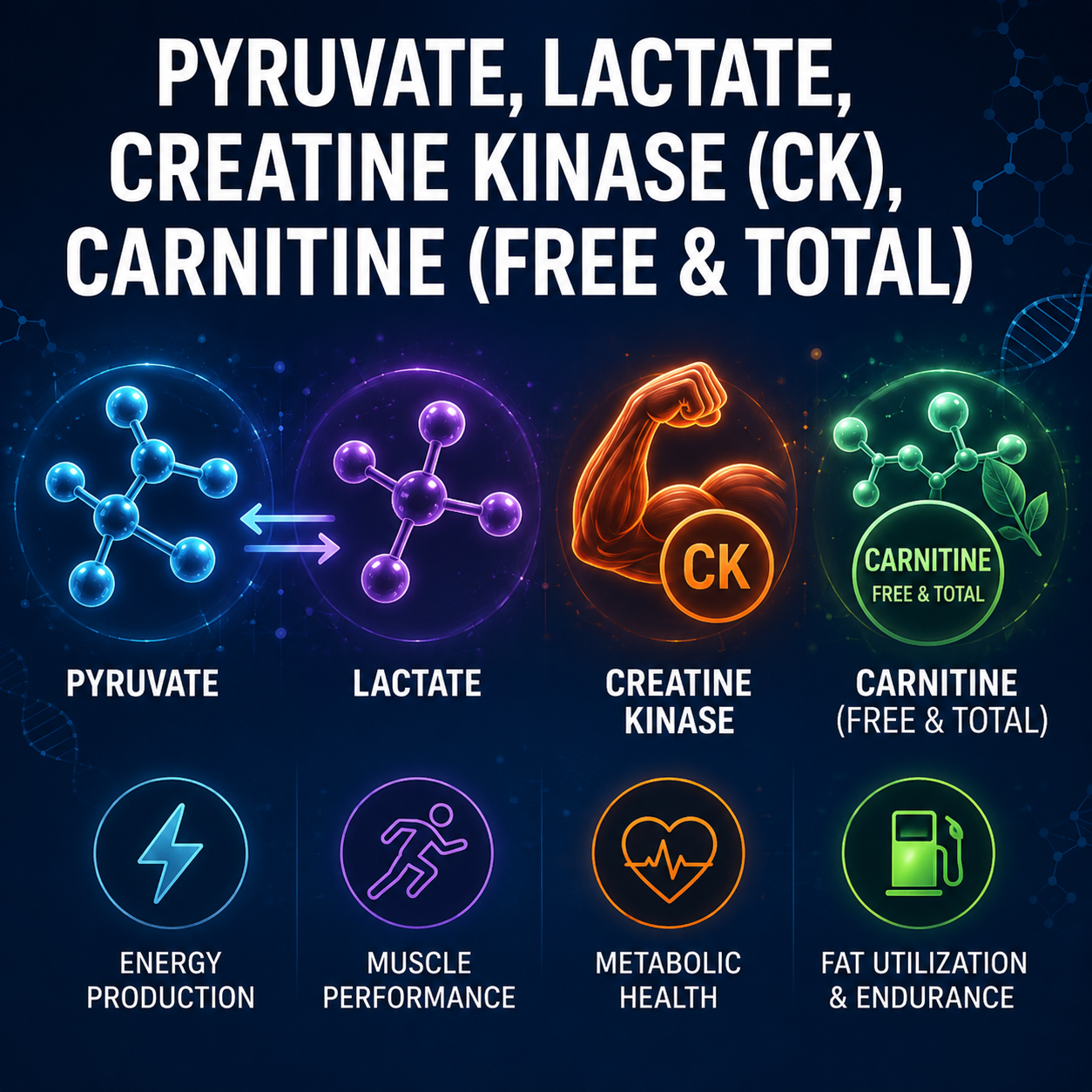
A focused first-line blood panel evaluating three complementary aspects of mitochondrial and cellular energy metabolism: lactate + pyruvate for oxidative/redox metabolism, CK for muscle involvement, and free + total carnitine for carnitine status and fatty-acid transport.
Useful for investigating unexplained fatigue, exercise intolerance, muscle weakness, prolonged recovery, brain fog and other symptoms that may involve impaired cellular energy production. Abnormal findings can help identify correctable contributors, guide additional testing and provide objective baseline markers for follow-up.
Description
Mitochondrial dysfunction cannot be adequately evaluated with one blood marker. This focused panel examines three complementary aspects of cellular energy metabolism: oxidative/redox metabolism, muscle involvement, and carnitine availability for mitochondrial fatty-acid metabolism.
The goal is not simply to label a patient as having “mitochondrial dysfunction.” Testing can help identify objective abnormalities, potentially correctable contributors, appropriate next-step testing, and useful baseline markers that can be followed when initially abnormal.
Lactate + Pyruvate
Evaluates glucose-derived energy metabolism and provides information about oxidative metabolism and cellular redox balance.
Creatine Kinase (CK)
Looks for evidence of muscle-cell injury or muscle involvement that may accompany mitochondrial or other metabolic problems.
Free + Total Carnitine
Evaluates carnitine availability, an important component of mitochondrial fatty-acid transport and energy metabolism.
Why Combine These Three Mitochondrial Tests?
Mitochondria do much more than produce ATP. They interact with glucose metabolism, fatty-acid utilization, muscle physiology and cellular stress responses. A useful first-line evaluation therefore looks at more than one pathway.
This panel was designed as a focused starting point rather than an exhaustive mitochondrial disease workup. Each component asks a different clinical question.
Is glucose-derived energy metabolism showing an abnormal pattern?
Is there evidence that muscle is being affected?
Is carnitine status potentially limiting fatty-acid energy metabolism?
Lactate + Pyruvate: Oxidative & Redox Metabolism
Glucose is broken down through glycolysis to produce pyruvate. Pyruvate can then enter mitochondrial pathways supporting oxidative ATP production or be converted to lactate.
↓
PYRUVATE
↙ ↘
LACTATE MITOCHONDRIA → ATP
Elevated lactate can provide evidence of altered oxidative metabolism, but mitochondrial disease is only one possible cause. Pyruvate adds additional information about glucose metabolism and helps provide context for an elevated lactate.
Creatine Kinase (CK): Is Muscle Involved?
CK is not a direct measurement of mitochondrial function. It is included because skeletal muscle is highly dependent upon energy production and can be affected in mitochondrial and other metabolic disorders.
An elevated CK can indicate muscle-cell injury and may redirect the evaluation toward exercise-related injury, medication effects, endocrine or inflammatory disorders, myopathy, or other causes.
Free & Total Carnitine: A Potentially Correctable Finding
Carnitine plays an important role in transporting long-chain fatty acids into mitochondria so they can be used for energy.
The test measures free carnitine, total carnitine and the relationship between free and esterified carnitine.
Who Might Consider a Cellular Energy Blood Panel?
This panel may be useful when symptoms or clinical history raise concern about impaired cellular energy metabolism but an extensive inherited mitochondrial-disease evaluation is not necessarily the appropriate starting point.
Persistent or unexplained low energy, particularly when conventional evaluation has not fully explained symptoms.
Poor stamina, disproportionate fatigue with activity or unusually prolonged recovery.
Weakness, muscle fatigue, aching or other symptoms suggesting possible muscle involvement.
Cognitive fatigue or neurological symptoms occurring as part of a broader cellular-energy pattern.
Clinical patterns suggesting altered fuel utilization or metabolic stress.
Objective baseline testing before addressing suspected mitochondrial or cellular-energy contributors.
What Happens if a Result Is Abnormal?
The purpose of testing is not simply to produce a diagnosis—it is to determine what the abnormality changes.
Determine whether the abnormality is reliable, particularly for collection-sensitive lactate and pyruvate.
Look for nutritional, metabolic, medication, muscle, systemic or mitochondrial contributors that could explain the finding.
Address correctable contributors and use an initially abnormal marker for follow-up when repeating it will answer a useful clinical question.
Testing Should Lead Somewhere
IDENTIFY THE ABNORMALITY
LOOK FOR THE DRIVER
CORRECT TREATABLE CONTRIBUTORS
SUPPORT MITOCHONDRIAL / CELLULAR ENERGY FUNCTION
REASSESS SYMPTOMS + RETEST ABNORMAL MARKERS WHEN USEFUL
Does an Abnormal Panel Determine Mitochondrial Treatment?
No single result tells a patient to take one particular mitochondrial supplement, medication or peptide. The results are used to make the treatment strategy more specific.
Depending upon the findings and clinical history, the next step may involve correcting nutrient deficiencies, addressing metabolic dysfunction, reviewing medications or other contributors to muscle or mitochondrial stress, improving sleep and exercise tolerance, correcting carnitine deficiency, or considering more specialized mitochondrial evaluation.
When Should the Panel Be Repeated?
The value of retesting depends upon what was abnormal initially. There is little benefit in repeatedly measuring a normal marker simply to monitor “mitochondrial health.”
Repeat when an initial abnormality needs confirmation or after addressing a suspected contributor if the result could document metabolic improvement.
An elevated CK can be followed after addressing the suspected muscle, medication, metabolic or other cause.
Low carnitine can be reassessed after replacement or correction of the underlying cause to document normalization.
When Is More Extensive Mitochondrial Testing Appropriate?
The Core Blood Panel is intentionally focused. Abnormal findings, persistent symptoms or a clinical pattern suggesting a more significant mitochondrial disorder may justify expanding the investigation.
GDF-15
Adds a different view of mitochondrial-associated cellular stress.
Learn about GDF-15 →Acylcarnitine Profile
Provides more detailed evaluation of fatty-acid oxidation and related metabolic pathways.
Acylcarnitine Testing →Organic Acids
Provides a broader view of metabolic intermediates associated with cellular energy and other biochemical pathways.
View Organic Acids Panel →Important: Lactate and Pyruvate Require Proper Collection
Lactate and particularly pyruvate are sensitive to collection and handling. Exercise, prolonged tourniquet use, difficulty during blood collection and improper specimen processing can produce misleading results.
What This Panel Does—and Does Not—Tell You
What It Can Do
- Identify selected abnormalities in cellular energy metabolism
- Detect evidence of muscle injury
- Identify abnormal carnitine status
- Help determine whether additional testing is appropriate
- Provide baseline markers when initially abnormal
- Help make treatment investigation more targeted
What It Cannot Do
- Diagnose every mitochondrial disorder
- Exclude mitochondrial dysfunction when results are normal
- Identify a genetic mitochondrial disorder by itself
- Determine that one supplement or peptide will work
- Replace appropriate medical evaluation of significant symptoms
Frequently Asked Questions
Is this a test for mitochondrial disease?
This is a focused blood assessment of several aspects of cellular energy metabolism. Abnormal findings can support further investigation, but the panel alone does not diagnose or exclude primary mitochondrial disease.
Why are lactate and pyruvate tested together?
They provide complementary information about glucose-derived energy metabolism and cellular redox relationships. The lactate-to-pyruvate relationship is particularly useful when lactate is elevated.
Why is CK included?
CK looks for evidence of muscle-cell injury. Muscle is highly dependent upon energy metabolism, although CK itself is not a direct mitochondrial-function marker.
Why test free and total carnitine?
Carnitine is important for mitochondrial fatty-acid transport. Identifying low carnitine is particularly useful because deficiency may be directly addressable and the level can be followed after treatment.
Can all three tests be normal despite mitochondrial dysfunction?
Yes. Normal results do not exclude mitochondrial dysfunction or primary mitochondrial disease. Further evaluation depends upon the symptoms, history and degree of clinical suspicion.
Should I repeat the panel after treatment?
Retesting is most useful when one or more markers were abnormal initially and repeating them can determine whether the biochemical abnormality has improved. Routine repetition of normal markers is generally less informative.
Do abnormal results mean I should use mitochondrial peptides?
No. These laboratory results do not establish that a patient will benefit from a particular mitochondrial peptide or other therapy. They can help characterize the metabolic pattern and determine appropriate next steps.