
Sauna Therapy for Detoxification, Inflammation & Mitochondria, Longevity
Sauna therapy is much more than sweating. Controlled heat changes circulation, heart rate, vascular function, cellular stress signaling, heat-shock proteins, inflammatory pathways, fluid balance, and the body's response to metabolic stress.
For patients with toxic burden, oxidative stress, mitochondrial dysfunction, chronic inflammation, or acquired undermethylation, regular sauna use may be especially interesting because these abnormalities frequently occur together. The most useful approach is to establish what is abnormal first, use sauna as part of a broader treatment strategy, and then objectively measure whether those abnormalities improve.
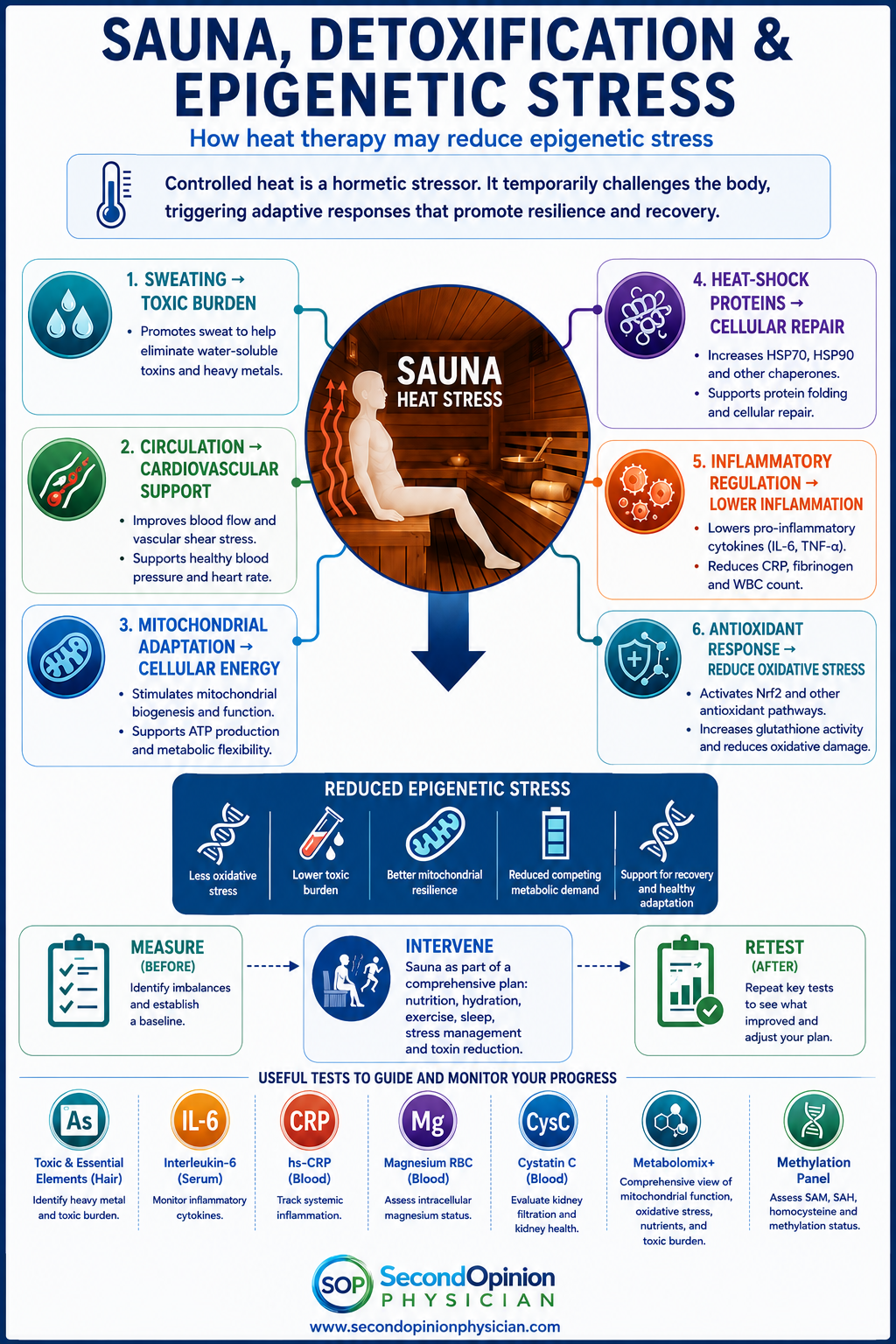
Sauna is best understood as a hormetic therapy. A tolerable dose of heat temporarily stresses the cardiovascular and metabolic systems, prompting adaptive responses involving circulation, heat-shock proteins, inflammatory signaling, antioxidant defenses, mitochondrial function, and cellular repair.
Why Sauna May Be Useful Beyond Relaxation
Heat bathing has been used for centuries in Finnish saunas, Russian banyas, Japanese hot springs, steam baths, and other traditional practices. Modern research now helps explain why repeated heat exposure may affect far more than comfort or sweating.
Cardiovascular Support
Heat causes peripheral vasodilation, increases skin blood flow, and raises heart rate. Repeated sauna use has been associated with favorable cardiovascular outcomes in long-term Finnish studies.
Heat-Shock Proteins
Heat activates proteins that help stabilize and repair damaged cellular proteins and improve tolerance to future physiologic stress.
Metabolic Adaptation
Repeated heat exposure may support vascular and mitochondrial adaptation and may complement exercise, sleep, nutrition, and broader metabolic therapy.
A Brief History of Therapeutic Heat
Therapeutic heat developed independently across many cultures. The Finnish sauna became a central part of social and health culture in Northern Europe. Russian banyas combined heat, steam, and cooling. Japanese hot-spring bathing evolved into a long-standing restorative tradition, and modern Japanese researchers later developed standardized far-infrared protocols such as Waon therapy.
Modern infrared systems are simply another way of delivering thermal energy to the body. They operate at lower room temperatures than traditional Finnish saunas, but can still produce significant heating, sweating, and cardiovascular stress.
Traditional Sauna vs Infrared Sauna vs Steam vs Hot Water
| Heat Method | Typical Environment | Main Advantage | Evidence |
|---|---|---|---|
| Finnish dry sauna | Often about 70–100°C / 158–212°F with relatively low humidity | Strong cardiovascular and thermal stimulus | Strongest long-term sauna outcome data |
| Far-infrared sauna | Often about 45–65°C / 113–149°F | Radiant heating at lower ambient temperature | Smaller clinical trials and short-term studies |
| Waon therapy | Typically about 60°C far infrared followed by warm covered rest | Standardized medical heat protocol | Studied particularly in cardiovascular disease |
| Steam / banya | Lower temperature with high humidity | Strong thermal load because evaporative cooling is reduced | Less long-term clinical research |
| Hot-water immersion | Typically around 39–40°C water | Very efficient whole-body heat transfer | Useful experimental passive-heat data |
| Exercise + sauna | Active exercise followed by passive heat | Combines muscular metabolism with heat adaptation | Potentially complementary benefits |
What Happens Physiologically During a Sauna Session?
Vasodilation
Blood vessels supplying the skin dilate so more heat can be transferred from the body's core toward the surface.
Heart Rate Rises
Cardiac output increases as circulation shifts toward the skin and the cardiovascular system works to maintain temperature regulation.
Fluid & Electrolyte Loss
Sweat removes water, sodium, chloride, magnesium, and smaller amounts of other minerals and compounds.
Heat-Shock Proteins
Heat activates molecular chaperones involved in protein repair, cellular protection, and adaptation to stress.
Energy Demand Increases
Thermoregulation requires energy. Repeated exposure may then stimulate adaptive vascular and metabolic responses.
Cytokines Change
Heat temporarily changes inflammatory signaling. The acute response immediately after sauna is not necessarily the same as the longer-term adapted response.
Sauna as Hormesis
Many beneficial physiologic adaptations occur because the body responds to manageable stress. Exercise is a familiar example. Heat appears to work in a similar way.
Repeated controlled heat exposure may influence:
- Heat-shock proteins
- Protein repair and folding
- Endothelial function
- Blood-volume adaptation
- Antioxidant defenses
- Cellular stress signaling
- Mitochondrial adaptation
The important principle is dose. More heat is not automatically better. The useful stimulus is one that can be tolerated consistently without excessive dehydration or cardiovascular stress.
Can Sauna Help Remove Heavy Metals and Toxic Elements?
Sweat is a genuine excretory fluid. Human research has identified toxic elements in sweat including arsenic, cadmium, lead, mercury, and nickel.
This supports the idea that sweating may provide an additional route of elimination, particularly when body burden is elevated.
Sauna is not a substitute for finding and removing the source of exposure. Ongoing exposure to mercury, lead, arsenic, mold-related compounds, solvents, smoke, or other environmental toxicants should still be addressed directly.
When toxic burden is suspected, establishing a measurable baseline makes a sauna strategy more clinically useful.
Why Toxic Burden May Matter in Undermethylation
Within an epigenetic model of undermethylation, environmental burden can increase the metabolic resources required for detoxification and cellular repair.
Toxic exposure may increase:
- Glutathione demand
- Oxidative stress
- Mitochondrial workload
- Inflammatory signaling
- DNA repair requirements
- Membrane repair
- Liver and kidney clearance demands
Sauna does not directly correct undermethylation. Its potential value is upstream: reducing toxic, inflammatory, oxidative, and metabolic pressures that may make an existing methylation problem more difficult to correct.
Sauna, Elevated SAH and Methylation
There is not strong human evidence showing that sauna directly lowers S-adenosylhomocysteine, or SAH.
The relationship is more likely to be indirect.
Patients with elevated SAH may also have:
- Mitochondrial stress
- Inflammation
- Oxidative damage
- Environmental toxic burden
- Impaired metabolic clearance
- Kidney dysfunction
If one or more of those factors improves, the overall biochemical environment may become more favorable for methylation.
Track the Biochemistry
If SAM, SAH, methionine, homocysteine, mitochondrial metabolites, oxidative stress, or inflammatory markers are abnormal initially, repeat those same markers after a sustained intervention.
Sauna, Glutathione and Oxidative Stress
Glutathione is one of the body's major intracellular antioxidant and detoxification systems. It helps control reactive oxygen species, supports detoxification reactions, protects proteins and membranes, and maintains cellular redox balance.
Heat exposure activates cellular stress-response pathways that interact with antioxidant systems, but sauna should not be described as a guaranteed glutathione-raising treatment.
A more useful model is that repeated controlled heat exposure may improve the body's ability to adapt to oxidative and metabolic stress while simultaneously providing another route of excretion through sweat.
Genova Metabolomix+ Before and After Sauna Therapy
For patients with a more complex biochemical picture, the Genova Metabolomix+ assessment can be useful before and after a sustained sauna program.
Organic Acids
Provides information about metabolic pathways and nutrient demands relevant to cellular energy production.
8-OHdG & Lipid Peroxides
Provides objective markers related to oxidative DNA damage and lipid membrane oxidation.
Broader Metabolic Context
Helps evaluate toxic elements, nutritional needs, amino acids, antioxidant pathways, and other metabolic stressors.
The most useful strategy is usually to repeat whatever was abnormal initially rather than changing the test after the intervention.
Clinical Evidence: Sauna and Chronic Inflammation
Inflammation is one of the areas where sauna can be followed objectively.
More Frequent Sauna Use Was Associated With Lower CRP
In large Finnish cohorts, more frequent sauna bathing has been associated with lower CRP and other inflammatory markers over time.
These studies cannot prove that sauna alone caused the difference, but they provide a useful rationale for monitoring a pre-existing inflammatory abnormality before and after a consistent intervention.
hs-CRP is often the more practical marker for serial monitoring because it reflects systemic inflammatory burden.
What About Interleukin-6?
IL-6 demonstrates why timing matters when testing around sauna use.
Acute heat can temporarily increase IL-6 as part of a normal stress response. Exercise can do the same thing. This does not necessarily indicate worsening chronic inflammation.
If IL-6 is being monitored, compare resting measurements obtained under similar conditions rather than testing immediately after a sauna session.
IL-6 can be useful when chronic cytokine activation is already part of the patient's baseline picture.
Sauna and Cardiovascular Health
The strongest long-term sauna data come from traditional Finnish sauna use.
Frequent sauna bathing has been associated with lower rates of sudden cardiac death, fatal cardiovascular disease, and all-cause mortality in long-term observational studies.
Possible mechanisms include:
- Peripheral vasodilation
- Increased cardiac output during heat exposure
- Improved vascular responsiveness
- Blood-pressure regulation
- Heat adaptation
- Potential reduction in chronic inflammatory burden
These associations do not mean sauna replaces exercise. Exercise provides muscular, skeletal, metabolic, and neurologic benefits that passive heat cannot reproduce.
Sauna, Dementia and Brain Health
Frequent traditional sauna use has also been associated with lower rates of dementia and Alzheimer's disease in Finnish observational research.
Potential mechanisms include improved vascular health, lower cardiovascular risk, heat-shock protein activation, reduced inflammatory burden, and better cellular stress adaptation.
These findings are promising but do not establish sauna as a proven treatment or prevention strategy for neurodegenerative disease.
Heat-Shock Proteins and Cellular Repair
Heat-shock proteins are molecular chaperones that help protect other proteins during physiologic stress.
They can help:
- Stabilize damaged proteins
- Refold proteins into appropriate structures
- Reduce abnormal protein aggregation
- Maintain protein quality control
- Improve cellular stress tolerance
These mechanisms are one reason thermal therapy is being studied in healthy aging, exercise recovery, mitochondrial biology, and neurodegenerative disease.
Heat Therapy and Mood
Controlled whole-body hyperthermia has also been studied in depression. Clinical research suggests that thermal exposure may influence biologic systems involved in mood regulation, although these protocols are not identical to ordinary home sauna use.
Smaller studies of Japanese Waon therapy have also reported improvements in fatigue, relaxation, appetite, and some mood-related symptoms.
Sauna, Mitochondria and ATP
Heat initially increases energy demand rather than simply creating more ATP.
The cardiovascular system works harder, sweat glands become active, circulation shifts toward the skin, and the body must maintain core temperature.
The potential mitochondrial benefit comes from the adaptive response to repeated controlled stress.
This may be particularly relevant to methylation because ATP is required for the conversion of methionine to SAM. Mitochondrial impairment can therefore interact with methylation even though sauna itself does not directly create SAM.
Kidney Function Matters During Sauna and Detoxification
The kidneys remain central to fluid balance, electrolyte regulation, acid-base physiology, and metabolic waste elimination regardless of how much someone sweats.
Kidney function becomes especially important when:
- Sauna use is frequent
- Fluid loss is substantial
- Creatine supplementation is used
- Potassium or magnesium supplementation is used
- A detoxification program is more intensive
Cystatin C can provide an additional kidney-filtration marker when creatinine may be difficult to interpret because of muscle mass, age, or creatine supplementation.
Sauna Hydration, Electrolytes and Alkalinity
Heavy sweating does not remove only water. Sodium, chloride, potassium, magnesium, and other electrolytes are also lost.
Replacing fluid and electrolytes may improve heat tolerance and recovery, while bicarbonate can provide an additional alkali source that participates in normal acid-base buffering.
The kidneys regulate acid-base balance partly by reclaiming bicarbonate and excreting hydrogen ions and other metabolic acids. Adequate hydration supports renal blood flow and urine production, while bicarbonate contributes to the body's buffering capacity.
Hydration and buffering support different aspects of renal physiology. Water helps maintain circulation and urine production, while bicarbonate contributes to acid-base buffering. Together they may support the physiologic environment in which the kidneys eliminate water-soluble metabolic waste.
Dr. Dave's Schvitz Splash
Dr. Dave's Schvitz Splash is a simple sauna hydration drink designed to provide fluid, electrolytes, bicarbonate buffering, antioxidant support, and a small amount of creatine.
- ½ teaspoon potassium bicarbonate
- ⅛ teaspoon Celtic sea salt
- ½ teaspoon vitamin C powder
- 1 teaspoon blueberry extract powder
- ¼ teaspoon creatine monohydrate
- Dash of stevia to taste
- Mix thoroughly in 20-30 oz distilled water
Why Potassium Bicarbonate?
Potassium is an important intracellular electrolyte involved in nerve conduction, muscle contraction, cardiovascular function, and fluid balance.
Bicarbonate is one of the body's major physiologic buffering systems. Providing bicarbonate can contribute to the available alkali load while the kidneys continue to regulate acid-base balance.
Why Sea Salt?
Sodium and chloride are among the primary electrolytes lost in sweat. Replacing some sodium may help maintain fluid balance and reduce post-sauna lightheadedness, weakness, or headache in people who sweat heavily.
Why Vitamin C and Blueberry Extract?
Vitamin C and blueberry-derived polyphenols provide antioxidant support during a broader nutritional and detoxification program.
Why Creatine?
Creatine supports the phosphocreatine energy-buffering system used heavily by muscle and brain tissue.
Creatine also has a methylation connection. Endogenous creatine synthesis consumes substantial methyl groups, so supplemental creatine may reduce one source of methylation demand.
Potassium caution: potassium bicarbonate may not be appropriate with significant kidney disease, elevated potassium, adrenal insufficiency, or medications that increase potassium, including some ACE inhibitors, ARBs, and potassium-sparing diuretics.
Magnesium Support for Frequent Sauna Users
Magnesium is important for ATP-dependent metabolism, muscle function, nervous-system regulation, sleep, and cardiovascular physiology.
Frequent sweating may increase magnesium losses, particularly in someone with marginal magnesium status.
Magnesium Glycinate — Approximately 240 mg
Approximately 240 mg of magnesium glycinate by mouth may be used separately when additional magnesium support is appropriate.
Patients with significant kidney impairment should use supplemental magnesium cautiously because reduced renal clearance can allow magnesium to accumulate.
Dr. Dave's Schvitz Soak
For people who find sauna heat difficult to tolerate, another practical strategy is localized cooling of the feet.
Cool Water + Ice Cubes During Sauna
Place the feet in a basin of water with several ice cubes during an approximately 15-minute sauna session.
The goal is noticeable cooling without creating painful cold exposure.
The feet contain a substantial vascular network and can exchange heat with the surrounding water. Local cooling may reduce the sensation of excessive heat while the remainder of the body continues to experience a thermal stimulus.
This is best considered a comfort and heat-tolerance strategy rather than a proven method for increasing detoxification.
A Simple 15-Minute Sauna Routine
Prepare
Begin reasonably hydrated. Prepare the Schvitz Splash and a basin of cool water with several ice cubes if foot cooling is desired.
Heat Gradually
Use a tolerable heat level, sip fluid as needed, and allow the body to warm and sweat without trying to maximize heat exposure.
Recover
Continue hydration, replace electrolytes as appropriate, cool gradually, and allow heart rate and circulation to return toward baseline.
How Often Should Sauna Be Used?
Many people begin with two or three sessions per week and gradually increase frequency according to tolerance.
More frequent use may be appropriate when hydration, electrolyte status, blood pressure, and overall health remain stable.
The strongest long-term Finnish observational associations involved frequent use, including four to seven sauna sessions per week.
How Long Should a Sauna Session Last?
A common starting point is approximately 10–15 minutes.
Many adapted users tolerate approximately 15–30 minutes, but temperature, humidity, sauna type, cardiovascular health, medications, hydration, and individual heat tolerance all matter.
The objective is a controlled heat stimulus, not heat exhaustion.
The Best Monitoring Strategy: Follow What Was Abnormal
You do not need every available test before and after sauna therapy.
If hs-CRP was high, repeat hs-CRP. If IL-6 was elevated, repeat IL-6 under comparable resting conditions. If toxic elements were elevated, repeat the same methodology. If methylation testing showed elevated SAH or an abnormal SAM:SAH relationship, repeat that pattern.
If several metabolic systems are abnormal together, Metabolomix+ can provide a broader before-and-after assessment.
Who Should Be More Cautious With Sauna?
Extra caution is appropriate with unstable cardiovascular disease, symptomatic low blood pressure, significant dehydration, advanced kidney disease, acute illness, pregnancy, impaired heat sensation, or medications that substantially alter blood pressure, fluid balance, potassium, or kidney function.
Alcohol should generally be avoided around sauna use because it can worsen dehydration and impair cardiovascular responses.
Further Viewing: Sauna and Heat Therapy
Dr. Rhonda Patrick has helped bring public attention to research involving sauna, cardiovascular health, heat-shock proteins, exercise recovery, and healthy aging.
Her discussions are useful additional background, although the broader evidence now includes long-term Finnish studies, controlled passive-heat experiments, infrared and Waon therapy studies, and newer clinical research.
Frequently Asked Questions About Sauna Therapy
Does sauna really detox the body?
Sweat can contain toxic elements and other compounds, so sweating is a genuine route of elimination. Sauna works best as an adjunct to exposure reduction, liver and kidney function, nutrition, hydration, and appropriate testing.
Can sauna remove heavy metals?
Lead, mercury, arsenic, cadmium, and other elements have been identified in sweat. Sauna may contribute to elimination, but significant exposure should still be addressed by identifying the source and using appropriate medical evaluation.
Can sauna help undermethylation?
Not directly. Sauna may help reduce toxic, inflammatory, oxidative, and mitochondrial pressures that can contribute to a less favorable metabolic environment in someone with undermethylation.
Can sauna lower SAH?
There is not strong evidence that sauna directly lowers SAH. If SAH is elevated, repeat methylation testing is the appropriate way to determine whether a broader intervention changed it.
Does sauna increase glutathione?
Heat exposure interacts with antioxidant and cellular stress-response systems, including pathways related to glutathione. It is more accurate to describe sauna as supporting adaptive stress responses than as a predictable glutathione-raising treatment.
Does sauna lower inflammation?
Frequent sauna use has been associated with more favorable inflammatory markers over time. Acute heat can temporarily increase some cytokines, so immediate post-sauna measurements should not be confused with resting chronic inflammation.
Should I monitor IL-6 or hs-CRP?
hs-CRP is a practical marker for systemic inflammatory burden. IL-6 may also be useful when cytokine-related inflammation is already suspected or documented. The best approach is usually to repeat whichever marker was abnormal initially.
What is the best before-and-after sauna test?
The best test is usually the one that was abnormal before treatment. Genova Metabolomix+ is particularly useful when mitochondria, oxidative stress, nutrient needs, and toxic burden all need to be evaluated together.
Why use potassium bicarbonate during sauna?
Potassium helps replace an important intracellular electrolyte, while bicarbonate provides an alkali source that participates in normal acid-base buffering. It should be used cautiously in patients at risk for elevated potassium.
Why use magnesium with sauna?
Frequent sweating can increase electrolyte losses. Magnesium is important for ATP metabolism, muscle function, sleep, and cardiovascular physiology and may be monitored with RBC magnesium when clinically relevant.
Why cool the feet during sauna?
Localized cooling may make a sauna session easier to tolerate by providing a small peripheral heat sink while the rest of the body remains exposed to heat. It should be viewed as a comfort strategy rather than a proven way to increase detoxification.
Is infrared sauna better than traditional sauna?
Not necessarily. Infrared sauna may be easier to tolerate because it operates at a lower ambient temperature. Traditional Finnish sauna has the strongest long-term cardiovascular and mortality data.
How often should I sauna?
Many people begin two or three times per week and increase gradually according to tolerance. More frequent use may be appropriate for some individuals when hydration and electrolyte status remain adequate.
How long should a sauna session last?
A common starting point is about 10–15 minutes. Many adapted users tolerate approximately 15–30 minutes, but temperature, humidity, sauna type, medications, cardiovascular status, hydration, and heat tolerance all matter.