
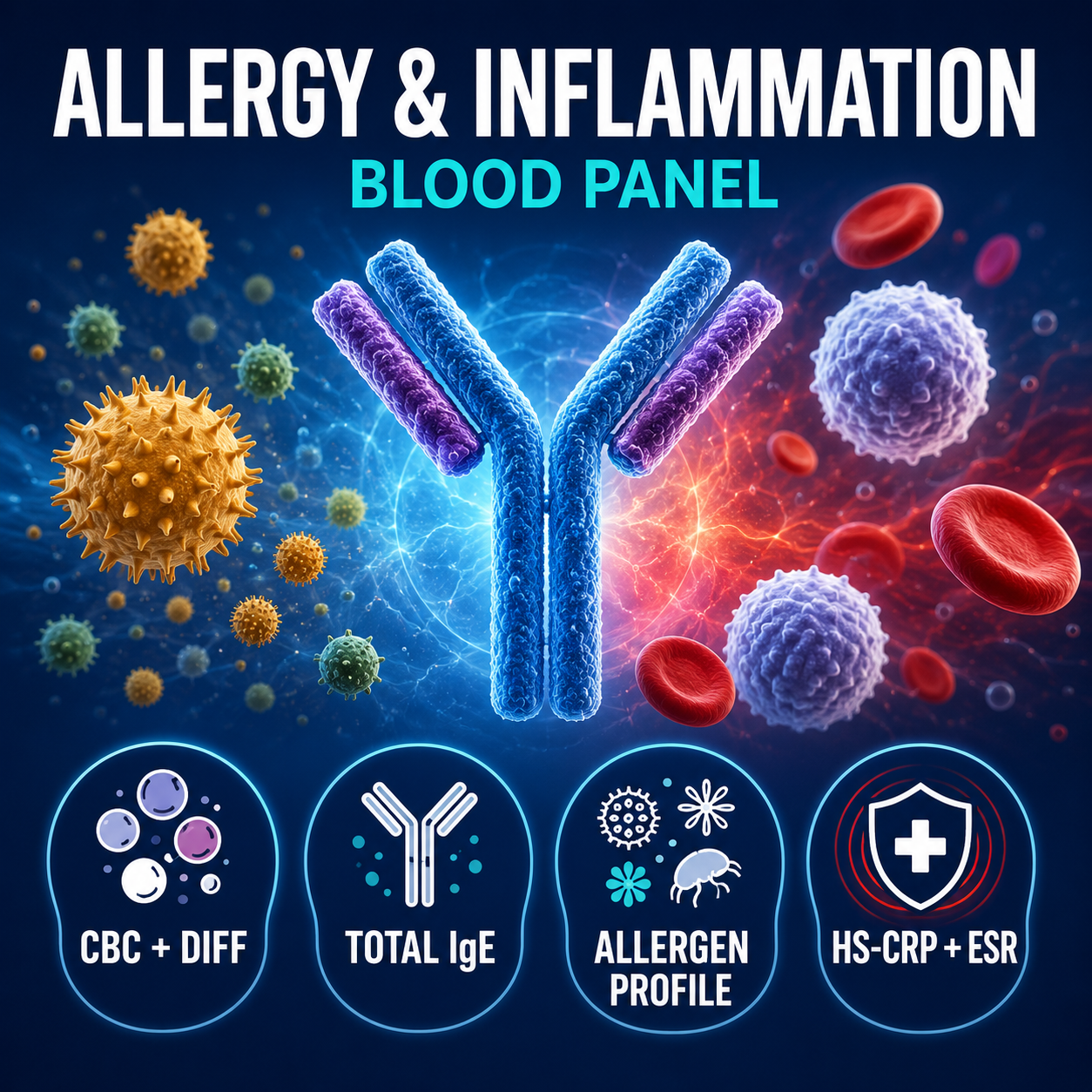
Allergy & Inflammation

$319.00
The Allergy & Inflammation Blood Panel combines a regional environmental allergy profile with total IgE, a CBC with differential, and high-sensitivity CRP to evaluate environmental allergy burden, eosinophilic inflammation, allergic sensitization, and broader systemic inflammation.
This Labcorp blood panel is particularly useful for patients with seasonal or persistent allergies, congestion, sneezing, itchy or watery eyes, eczema, asthma-type symptoms, elevated eosinophils, suspected mold or environmental sensitivity, sleep disruption, fatigue, brain fog, irritability, attention concerns, or unexplained inflammatory symptoms.
The regional respiratory allergy profile is selected according to where you live and tests common local trees, grasses, weeds, molds, dust mites, pets, cockroach and other inhaled allergens.
Description
The Allergy & Inflammation Blood Panel evaluates environmental allergic sensitization, eosinophilic activity, and broader systemic inflammation in one practical Labcorp blood panel.
It is designed for patients whose symptoms may be influenced by allergies or environmental triggers but who also need to know whether those reactions are contributing to a larger inflammatory burden.
The panel combines a regional respiratory allergen profile with total IgE, a CBC with differential, and high-sensitivity CRP.
The specific respiratory allergy profile is selected according to geographic region so testing reflects the trees, grasses, weeds, molds, dust mites, animals, and other inhaled allergens most relevant to where you live.
What Does the Allergy & Inflammation Blood Panel Include?
Regional Respiratory Allergen Profile + Total IgE
Measures allergen-specific IgE antibodies to common environmental triggers in your geographic region and also includes total IgE.
CBC With Differential — #005009
Measures white blood cells including eosinophils, which can become elevated with allergic disease, asthma, eczema, parasitic infection and other immune conditions.
High-Sensitivity CRP — #120766
Provides information about low-grade systemic inflammatory activity that may accompany metabolic, immune, environmental or other inflammatory stress.
Regional Environmental Allergy Testing
A major advantage of this panel is that the environmental allergy blood test is matched to geographic region.
Labcorp divides the United States into regional respiratory profiles because pollen and environmental exposures vary substantially by location.
Depending on the region, testing commonly includes allergens such as:
- Dust mites
- Cat dander
- Dog dander
- Cockroach
- Mouse
- Oak
- Cedar
- Elm
- Maple
- Birch
- Ragweed
- Grasses
- Alternaria mold
- Aspergillus
- Cladosporium
- Penicillium
The exact allergens and Labcorp test number depend on your geographic location.
Total IgE is already included in the regional respiratory profile. A separate Total IgE #002170 generally does not need to be added to this panel.
Why the Allergy & Inflammation Blood Panel Includes Eosinophils
The CBC with differential — Labcorp #005009 provides both the percentage and absolute number of eosinophils.
Eosinophils are particularly useful in an allergy-oriented assessment because they may increase with:
- Environmental allergies
- Allergic asthma
- Eczema and atopic disease
- Certain medication reactions
- Parasitic infection
- Eosinophilic gastrointestinal disorders
- Other immune conditions
An elevated eosinophil count does not identify the specific allergen, but when eosinophilia occurs together with positive allergen-specific IgE results, the findings can provide a clearer picture of active allergic burden.
Total IgE vs Specific IgE Allergy Testing
Total IgE and allergen-specific IgE provide different information.
Total IgE estimates the overall amount of IgE antibody circulating in the blood. It can be elevated in atopic disease, but a normal result does not rule out an allergy.
Allergen-specific IgE determines whether the immune system has produced IgE antibodies directed against individual substances such as dust mites, cats, dogs, grasses, weeds, trees or molds.
For that reason, the regional respiratory profile is considerably more useful than total IgE alone when the practical question is:
“What environmental exposures might actually be triggering symptoms?”
Why hs-CRP Is Included in the Allergy & Inflammation Blood Panel
Allergy testing identifies IgE-mediated sensitization, but patients with chronic symptoms often have more than one source of inflammation.
High-sensitivity CRP — Labcorp #120766 provides a broader measure of low-grade systemic inflammatory activity.
This can help determine whether the clinical picture involves primarily allergic sensitization or whether a larger inflammatory burden may also be present.
This distinction can be useful in patients with:
- Fatigue
- Brain fog
- Metabolic dysfunction
- Persistent inflammatory symptoms
- Poor recovery
- Sleep disturbance
- Environmental or toxic burden
- Chronic immune activation
hs-CRP does not identify the source of inflammation, but it can help determine whether further investigation is appropriate.
Allergy, Inflammation and Brain Function
Allergic symptoms are not limited to sneezing and congestion.
Persistent allergic and inflammatory signaling can interfere with sleep, increase physiologic stress, and contribute to fatigue and reduced cognitive performance.
In children, significant allergy burden may occur alongside:
- Sleep disruption
- Irritability
- Poor attention
- Sensory reactivity
- Behavioral changes
- Fatigue
- Developmental stress
In adults, common associated concerns can include:
- Brain fog
- Fatigue
- Insomnia
- Anxiety or increased irritability
- Headaches
- Poor recovery
The Allergy & Inflammation Blood Panel does not establish that allergy is the cause of these symptoms. Its purpose is to determine whether allergic sensitization and inflammatory activity are present and deserve attention within the larger treatment plan.
Allergy, Oxidative Stress and Methylation
Persistent immune activation can increase oxidative stress and metabolic demand.
Repeated allergic inflammation may increase requirements for:
- Antioxidant defense
- Glutathione production
- Tissue repair
- Mitochondrial energy
- Immune regulation
Within a Walsh-oriented or epigenetic assessment, this can be relevant when inflammation is acting as an additional stress on a patient with:
- Undermethylation
- Elevated SAH
- Low SAM-to-SAH ratio
- Mitochondrial stress
- Low antioxidant reserve
- Copper/zinc imbalance
The panel does not measure methylation directly. Instead, it helps identify an inflammatory or allergic burden that may be interfering with recovery or increasing biochemical demand.
Allergy & Inflammation Blood Panel for Mold Concerns
The regional respiratory profile commonly includes several molds, such as Alternaria, Aspergillus, Cladosporium and Penicillium.
This can help determine whether there is an IgE-mediated allergic sensitization to common environmental molds.
A positive mold IgE result is not the same as proof of toxic mold or mycotoxin exposure.
IgE testing evaluates allergic sensitization. Investigation of building exposure, mycotoxins or other environmental toxicants may require different testing when clinically indicated.
When Should Food Allergy Testing Be Added?
Food-specific IgE testing is best used selectively rather than automatically adding a broad food panel to every allergy evaluation.
Targeted food IgE testing may be useful when there is a reproducible history of symptoms following a particular food, including:
- Hives
- Swelling
- Wheezing
- Immediate gastrointestinal symptoms
- Consistent eczema flares
- Other rapid allergic reactions
Testing foods without a supportive clinical history can identify sensitization that is not clinically meaningful and may lead to unnecessary dietary restriction.
For this reason, selected food-specific IgE testing is better offered as an add-on based on symptoms and history.
When Is ESR Useful?
ESR, or sedimentation rate, is a broad and nonspecific inflammatory marker.
It may be useful when symptoms raise concern for:
- Autoimmune disease
- Chronic inflammatory disease
- Persistent systemic inflammation
- Certain infections
- Other inflammatory conditions
For a straightforward allergy evaluation, ESR often adds less useful information than the regional allergen profile, eosinophils and hs-CRP.
For that reason, ESR #005215 is better used as an optional add-on when the history suggests broader inflammatory or autoimmune disease.
Who May Benefit From the Allergy & Inflammation Blood Panel?
This panel may be particularly useful for patients with:
- Seasonal allergies
- Chronic nasal congestion
- Sneezing
- Itchy or watery eyes
- Asthma-type symptoms
- Eczema
- Elevated eosinophils
- Environmental sensitivity
- Possible mold allergy
- Pet-related symptoms
- Sleep disruption associated with congestion or allergy
- Fatigue or brain fog
- Irritability or attention concerns
- Unexplained low-grade inflammatory burden
What Information Will the Allergy & Inflammation Blood Panel Provide?
The panel can help answer:
- Is there evidence of environmental IgE sensitization?
- Which regional allergens are most relevant?
- Is total IgE elevated?
- Are eosinophils elevated?
- Does the pattern support an allergic or atopic process?
- Is low-grade systemic inflammation also present?
- Could environmental triggers be contributing to sleep, fatigue or inflammatory symptoms?
- Would targeted food allergy, mold, gastrointestinal or additional inflammatory testing be appropriate?
How Results May Help Guide an Individualized Plan
When clinically relevant allergens are identified, results can help guide practical interventions such as:
- Reducing exposure to important environmental triggers
- Dust-mite control
- Pet exposure strategies
- Pollen avoidance during peak seasons
- Evaluation of mold or damp environments
- Appropriate allergy treatment
- Consideration of allergy specialist referral or immunotherapy
- Review of inflammation and antioxidant support
- Additional gut or immune evaluation when indicated
The purpose of testing is not to eliminate every substance that produces a detectable antibody. Results should be matched with symptoms and exposure history to identify which findings are clinically important.
Before Your Allergy & Inflammation Blood Test
- This panel is performed through Labcorp.
- The CBC with differential is Labcorp #005009.
- The hs-CRP is Labcorp #120766.
- The regional respiratory allergen test number varies according to geographic location.
- Total IgE is included within the regional respiratory allergy profile.
- Unlike skin testing, blood-specific IgE testing can generally be performed while taking antihistamines.
- Tell your clinician about corticosteroids, biologic allergy medications and other immune-modifying treatments.
- Recent infection or other acute inflammation can influence hs-CRP and CBC findings.
- Fasting is generally not required solely for these allergy tests.
How the Allergy & Inflammation Blood Panel Works
1. Order the Panel
After purchase, your geographic location is used to select the appropriate Labcorp regional respiratory allergen profile.
2. Receive Your Labcorp Requisition
The requisition includes the regional environmental allergy profile, CBC with differential, and hs-CRP.
3. Have Your Blood Drawn
Visit an appropriate Labcorp patient service center for specimen collection.
4. Review Allergy and Inflammation Together
Results can identify specific environmental sensitization, total IgE, eosinophil activity and broader systemic inflammation.
5. Determine Whether More Focused Testing Is Needed
Depending on the pattern, further evaluation may include targeted food IgE, additional mold testing, ESR, gastrointestinal testing, oxidative-stress testing or other immune and inflammatory studies.
Frequently Asked Questions About the Allergy & Inflammation Blood Panel
Does the regional allergy panel include total IgE?
Yes. Labcorp's regional respiratory allergen profiles include total IgE together with allergen-specific IgE measurements, so a separate total IgE test generally does not need to be added.
Why is the allergy panel different depending on where I live?
Plants, pollens and environmental exposures vary across the United States. Labcorp uses regional respiratory profiles so the tested trees, grasses, weeds and other allergens better match common exposures in your geographic area.
Why is a CBC with differential included?
The CBC provides eosinophil measurements. Eosinophils may become elevated with environmental allergy, asthma, eczema, certain gastrointestinal immune disorders, parasites and other conditions and therefore provide useful additional context.
Does a normal total IgE rule out allergy?
No. A patient can have clinically important allergen-specific IgE despite a normal total IgE. Specific allergen results and clinical history are more informative when identifying individual triggers.
Does this panel test for mold?
Regional respiratory profiles generally include common environmental molds such as Alternaria, Aspergillus, Cladosporium and Penicillium. These results measure IgE allergic sensitization and do not prove toxic mold or mycotoxin exposure.
Does this panel test for food allergies?
Food IgE is not included routinely. Targeted food-specific IgE testing can be added when symptoms suggest an immediate or reproducible reaction to a particular food.
Why isn't ESR automatically included?
ESR is a nonspecific systemic inflammatory marker and is not particularly specific for allergy. It is more useful as an add-on when symptoms suggest broader inflammatory, autoimmune or infectious disease.
Can I take antihistamines before the blood test?
Blood-specific IgE testing is generally not affected in the same way as allergy skin testing by antihistamines, which is one practical advantage of a blood-based environmental allergy profile.