SECOND OPINION SERIES
Glutamate and OCD: Why Intrusive Thoughts Become “Stuck”
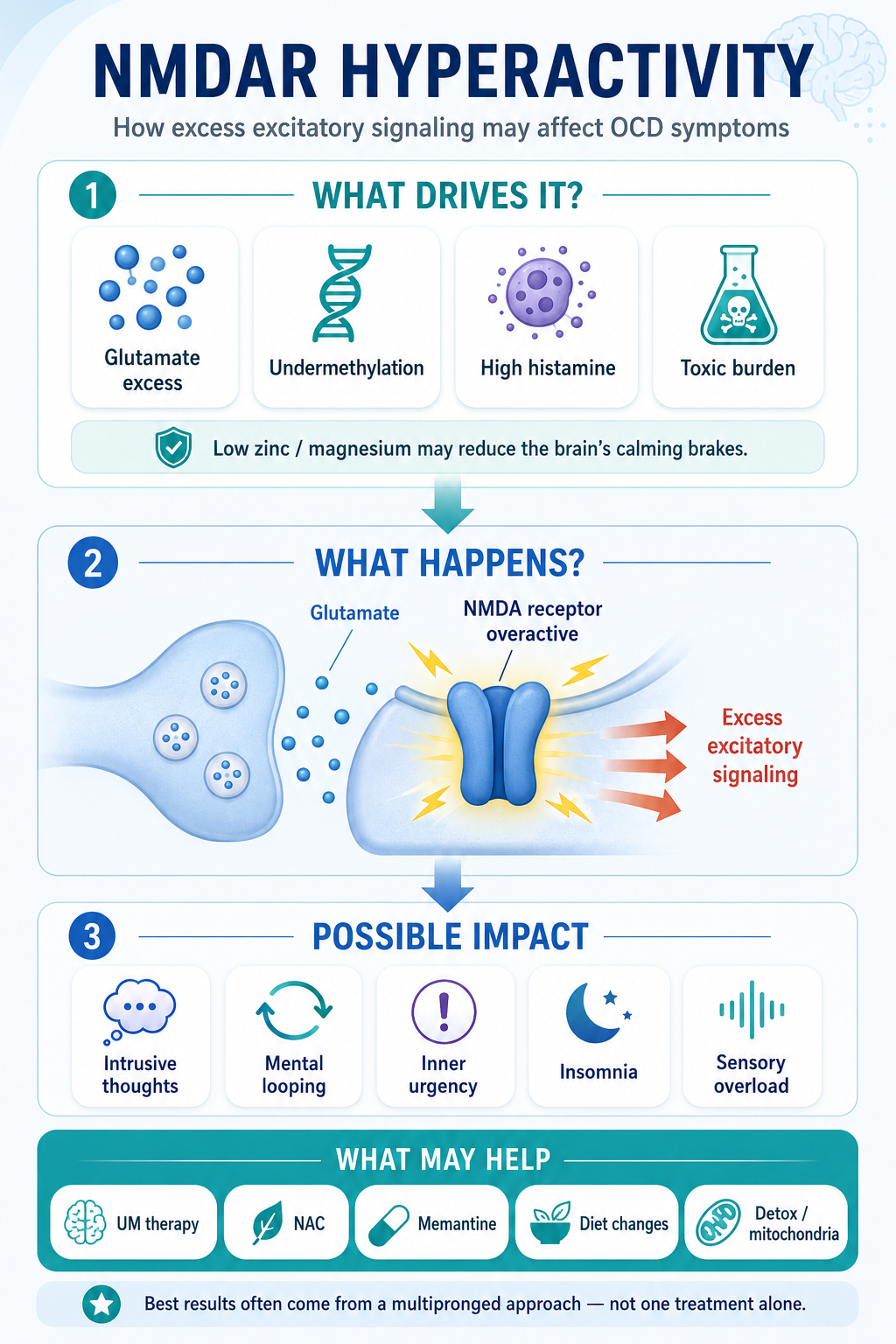
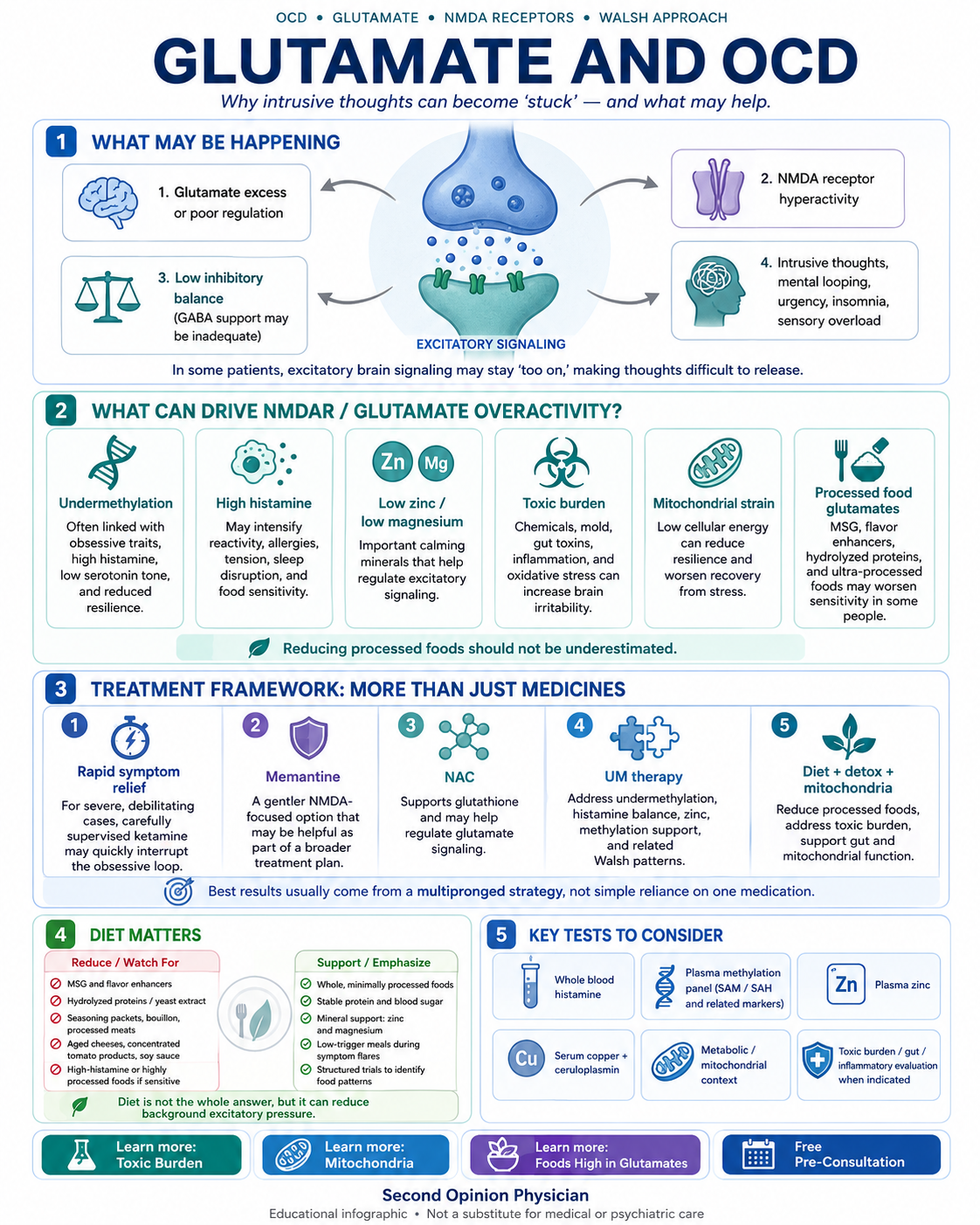
OCD is usually discussed as a serotonin disorder, but in many patients the pattern appears broader. Excessive or poorly regulated glutamate signaling, NMDA receptor overactivity, undermethylation, high histamine, low zinc or magnesium, oxidative stress, toxic burden, mitochondrial strain, and repeated exposure to processed-food glutamates may all contribute to a brain that stays “too on.” The result can be intrusive thoughts, mental looping, sensory overload, insomnia, inner urgency, and difficulty disengaging from fears even when they are recognized as irrational. Effective care therefore often requires a multipronged approach that combines symptom relief with undermethylation management, NAC, mineral support, diet modification, detoxification, mitochondrial support, and targeted biochemical testing.
What does glutamate have to do with OCD?
Glutamate is the brain’s main excitatory neurotransmitter. It is essential for learning, memory and attention, but poorly regulated glutamate signaling can make brain circuits too persistent. In OCD, the error signal may stay “on” after the rational mind already knows that the feared outcome is unlikely.
Research has found abnormalities involving cortical excitation and inhibition, NMDA receptor-mediated activity and glutamate-related genes in subsets of patients with OCD. One family-based study linked OCD susceptibility to variants in GRIN2B, which encodes an NMDA receptor subunit. Other work has implicated glutamate transport and cortico-striato-thalamo-cortical circuitry. These findings do not prove that every patient has “high glutamate,” but they support glutamatergic treatment as a rational option in selected cases.
“I know the thought is irrational, but my brain will not release it.”
“The obsession feels more urgent than everything else.”
“For a brief moment after treatment, I can finally see the thought instead of being trapped inside it.”
What can increase NMDA receptor activity and glutamate pressure?
Excessive excitatory signaling is rarely explained by one cause. In susceptible patients, several factors can converge: inherited glutamate-receptor differences, undermethylation, high histamine, low zinc or magnesium, oxidative stress, inflammation, mitochondrial strain, poor sleep, gut-derived toxins and repeated exposure to concentrated free glutamate in processed foods.
This is why the most durable plan is broader than medication. Rapid treatment can interrupt suffering, while diet, undermethylation therapy, NAC, mineral correction, histamine management and detoxification address the terrain that may keep the obsessive loop active.
Ketamine for severe OCD: interrupting the obsessive loop
Ketamine is different from conventional daily psychiatric medication. Some patients experience a rapid reduction in the urgency and emotional grip of obsessive thoughts. That break can restore perspective, improve hope and make exposure therapy, sleep restoration, dietary change and biochemical treatment easier to carry out.
Best suited to crisis-level care
- Clinic-based treatment with close monitoring
- Predictable systemic delivery
- Most established for severe or suicidal depression
- Useful when immediate stabilization is the priority
For OCD, the early research is encouraging but still based on relatively small studies.
More practical for repeated outpatient use
- Avoids IV placement and infusion visits
- Can be easier to integrate with ongoing care
- May help reduce rigidity, fear and obsessive intensity
- Allows deeper treatment to proceed while symptoms are quieter
Compounded racemic nasal ketamine is distinct from FDA-approved esketamine. Concentration, device and delivered dose must be prescribed and monitored individually.
Why rapid relief matters
In debilitating OCD—particularly when PTSD, autism, severe anxiety or major depression is also present—reducing symptom intensity can be a survival intervention. The purpose is not to replace longer-term therapy, but to create enough mental space for the patient to participate in it.
Elon Musk on prescribed ketamine
Elon Musk has publicly described prescribed ketamine as helpful for episodic depressive or negative brain states, including situations that cannot simply be “thought” away. His experience is not proof of effectiveness for OCD, but it is a visible example of physician-supervised use being compatible with sustained high-level work and functioning.
Clinical caution: Ketamine can cause dissociation, sedation, nausea, blood-pressure elevation and perceptual changes. Careful screening, dosing and follow-up remain important. In severe, disabling and treatment-resistant illness, potential benefit may outweigh these risks when treatment is prescribed and followed by an experienced clinician.
Memantine can provide useful day-to-day glutamate control
Memantine is a low-affinity NMDA receptor antagonist that may reduce excessive receptor activation without broadly shutting down normal glutamate function. It is generally slower and less dramatic than ketamine, but that does not make it unimportant.
For some patients, even a moderate reduction in obsessive intensity, reactivity or mental “stickiness” can improve daily function and make behavioral therapy easier. Memantine is therefore best viewed as a potentially valuable stabilizing tool—not a stand-alone cure and not merely an afterthought.
NAC for OCD: glutamate regulation and antioxidant support
N-acetylcysteine, or NAC, supports glutathione and influences the cystine-glutamate exchanger. This makes it relevant when OCD occurs with oxidative stress, inflammation, toxic exposure, poor detoxification or suspected glutamate dysregulation.
NAC is not a rapid rescue treatment and controlled trials have produced mixed results. Its greatest value may be as a low-cost part of a multiprong plan rather than as a stand-alone substitute for medication, exposure therapy or biochemical correction.
Undermethylation therapy may be central to lasting improvement
Within the Walsh Approach, obsessive thinking, perfectionism, ritualized behavior, seasonal allergies, high achievement, strong internal tension and elevated whole-blood histamine frequently cluster in an undermethylated pattern. This is not the same as saying that all OCD is caused by undermethylation.
Research outside the Walsh model also supports connections between OCD and methylation-related biology. Studies have examined one-carbon metabolism, COMT activity and expression, DNA methylation profiles and epigenetic differences in OCD. These findings do not validate a single universal “undermethylation test,” but they support the broader concept that methylation and epigenetic regulation can be relevant to OCD susceptibility, severity and treatment response.
In clinical practice, the undermethylated patient may have more than one driver of NMDA receptor stress: high histamine, low zinc, impaired antioxidant protection, low glutathione reserve, inflammatory burden, excessive methyl demand or an unfavorable SAM-to-SAH pattern. Treatment therefore needs to be individualized rather than reduced to one supplement. When this pattern is confirmed, correcting it can reduce the biochemical pressure that makes glutamate and NMDA receptor activity harder to control.
Methylation support
Support is selected from symptoms and laboratory findings. Depending on the pattern, this may include zinc, vitamin B6/P5P, magnesium, antioxidants, creatine, methionine or SAMe. Folate is not automatically appropriate in a Walsh-style undermethylated depression/OCD pattern.
Histamine management
Elevated histamine may amplify insomnia, allergies, food reactivity and neural excitability. Whole-blood histamine, diet history and symptom patterns help determine whether histamine reduction should accompany glutamate treatment.
Zinc and inhibitory balance
Zinc participates in antioxidant defenses, copper regulation, GABA-related function and modulation of NMDA receptor activity. Low zinc can remove an important inhibitory influence.
Toxic burden, inflammation and mitochondrial strain
OCD symptoms may worsen when the nervous system is under additional metabolic pressure. Mold exposure, heavy metals, gut-derived toxins, infections, poor sleep, inflammatory activation, low glutathione and mitochondrial dysfunction can all reduce the brain’s ability to regulate excitation.
Detoxification does not mean an aggressive cleanse. It means identifying and reducing exposures, supporting bowel and kidney elimination, correcting mineral and antioxidant deficiencies, treating dysbiosis when present and improving the metabolic conditions needed to clear inflammatory and methylation byproducts.
Dietary modification can meaningfully reduce excitatory pressure
Reducing processed foods should not be underrated. A diet dominated by packaged savory foods can repeatedly expose a sensitive patient to MSG, yeast extract, hydrolyzed proteins, “natural flavors,” flavor enhancers, aged ingredients and concentrated free glutamate. These exposures may not cause OCD by themselves, but they can add to an already overactive system.
Remove concentrated triggers
Begin with MSG, yeast extract, hydrolyzed protein, bouillon, seasoning packets, processed meats, flavored chips and heavily processed frozen meals.
Consider histamine overlap
Aged cheeses, fermented sauces, leftovers, cured meats and slow-cooked broths may create problems through both glutamate and histamine pathways.
Build a cleaner baseline
Use fresh proteins, vegetables, minimally processed carbohydrates, adequate minerals and stable meal timing so symptom changes are easier to recognize.
A structured food trial offers useful clinical information: do intrusive thoughts, agitation, sleep or sensory overload improve when processed foods and concentrated free glutamate are removed? For some patients, the improvement is substantial enough to become a cornerstone of the broader treatment plan.
Recommended testing for OCD with suspected glutamate overactivity
- Whole-blood histamine: evaluates the Walsh high-histamine/undermethylation pattern.
- Plasma methylation panel: measures SAM, SAH, methionine, homocysteine and related markers of methylation efficiency.
- Plasma zinc, serum copper and ceruloplasmin: evaluates zinc deficiency, copper imbalance and calculated non-ceruloplasmin-bound copper.
- Vitamin D, CBC, CMP and homocysteine: provides metabolic, nutritional, kidney, liver and methylation context.
- Toxic burden, mold, gut or organic-acid testing: considered when history suggests inflammatory, environmental or mitochondrial contributors.
- Blood beta-hydroxybutyrate: useful when evaluating nutritional ketosis or ketone therapy; it does not diagnose OCD or directly measure brain glutamate.
A multiprong treatment plan is essential
Severe OCD rarely improves because of one medicine, one supplement or one dietary restriction. The most useful approach separates immediate survival and symptom control from the longer work of changing the biological terrain.
Reduce immediate suffering
Use established psychiatric care, exposure-based therapy and, when clinically justified, rapid glutamate-directed interventions such as ketamine. Memantine may provide useful ongoing NMDA-receptor support.
Correct the sustaining pattern
Treat undermethylation when present; reduce processed foods and histamine triggers; evaluate zinc, copper and SAM/SAH balance; support glutathione with NAC when appropriate; and address toxic burden, gut inflammation and mitochondrial function.
The goal is not lifelong dependence on a rescue treatment. It is to reduce symptom intensity enough for the patient to survive, function and participate in the deeper work that may produce more durable improvement.
Frequently asked questions
Is glutamate high in everyone with OCD?
No. OCD is biologically diverse. Research supports altered glutamate and NMDA-receptor signaling in some patients, but a routine blood test cannot directly determine glutamate activity inside the brain.
What are signs that glutamate may be contributing to OCD?
Possible clues include unusually “sticky” intrusive thoughts, sensory overload, internal agitation, insomnia, exaggerated reactions to MSG or concentrated free-glutamate foods, and worsening during inflammation, poor sleep, toxic exposure or severe stress. These clues are not diagnostic by themselves.
Does ketamine work faster than memantine for OCD?
Ketamine may reduce obsessive intensity within hours in some patients. Memantine generally acts more gradually and may provide useful ongoing reduction in obsessive intensity or mental stickiness. Neither treatment works for everyone, and both require individualized prescribing.
Is nasal ketamine the same as IV ketamine?
No. IV ketamine provides controlled systemic dosing in a monitored clinic and is used most often for severe or suicidal depression. Nasal treatment is less invasive and may be more practical for repeated use, but absorption, formulation and delivered dose vary. Compounded racemic ketamine is also different from FDA-approved intranasal esketamine.
Can undermethylation cause OCD?
Undermethylation is not the sole cause of OCD. In the Walsh Approach, however, obsessive thinking, perfectionism, high whole-blood histamine and related traits may identify a biochemical pattern that intensifies symptoms and helps guide nutrient and laboratory evaluation.
How are undermethylation and glutamate connected?
The proposed connection is indirect and multipronged. Methylation status can affect histamine clearance, antioxidant capacity, neurotransmitter regulation and the ability to manage inflammatory or metabolic stress. When low zinc, high histamine, oxidative stress or toxic burden are also present, glutamate-related excitability may become harder to regulate.
What is the role of NAC in OCD?
NAC supports glutathione and influences extracellular glutamate regulation through the cystine-glutamate exchanger. It may be most useful when oxidative stress, inflammation or toxic burden accompanies OCD, but studies are mixed and it should not be the only treatment for severe symptoms.
Can a low-glutamate diet reduce OCD symptoms?
Some sensitive patients report improvement when concentrated free glutamate, MSG, yeast extract, hydrolyzed proteins, aged foods and high-histamine triggers are reduced. Diet is supportive rather than a replacement for psychiatric, behavioral or biochemical treatment.
What laboratory tests are useful for OCD and glutamate sensitivity?
Useful tests may include whole-blood histamine, a plasma methylation panel with SAM and SAH, plasma zinc, serum copper, ceruloplasmin, homocysteine, vitamin D, CBC and CMP. Toxic-burden, mold, gut or organic-acid testing may be added when the history supports those concerns.
How can toxic burden and mitochondrial dysfunction worsen OCD?
Toxins, inflammation, low glutathione and impaired mitochondrial energy production can reduce neuronal resilience and increase oxidative and excitatory stress. They may also interfere with methylation, detoxification and the brain’s ability to recover after stimulation.
This page is educational and does not replace psychiatric care. Medication should not be started, stopped or changed without the prescribing clinician. Suicidal thoughts, inability to remain safe, psychosis or rapidly worsening symptoms require urgent professional evaluation.
Identify the biochemical pattern behind severe OCD
A focused review can help determine whether glutamate/NMDA receptor activity, undermethylation, high histamine, zinc-copper imbalance, oxidative stress, toxic burden or mitochondrial strain may be contributing to the patient’s symptoms.