
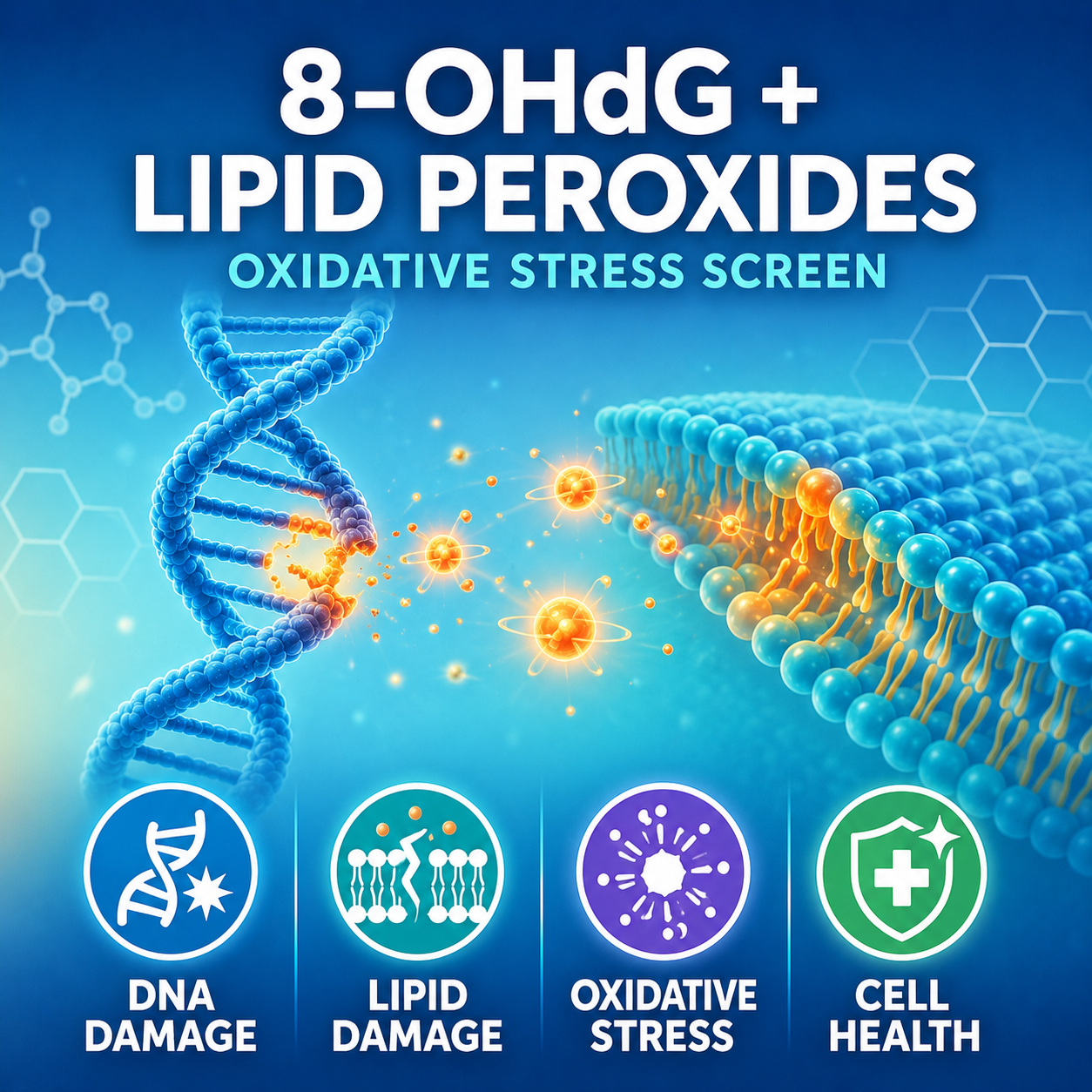
8-OHdG, Lipid Peroxides


$279.00
The Genova Oxidative Stress 2.0 Test is a focused at-home urine test that measures oxidative DNA damage (8-OHdG) and lipid peroxidation, providing objective evidence of whether free-radical activity is producing measurable cellular injury.
This test is particularly useful when oxidative stress is suspected in association with copper overload, low zinc, inflammation, toxic or environmental exposure, mitochondrial stress, immune activation, fatigue, brain fog, mood or behavioral concerns, poor recovery, or impaired methylation. Within the Walsh Approach and the Five Epigenetic Drivers of Undermethylation, it can help determine whether oxidative stress should become a stronger treatment priority.
Description
The Genova Oxidative Stress 2.0 Test is a focused urine test that measures whether oxidative stress is producing measurable damage to DNA and cell-membrane lipids.
Oxidative stress develops when production of reactive oxygen species exceeds the body's ability to neutralize them through antioxidant defenses. The result may be damage to DNA, cellular membranes, mitochondria, proteins, and other structures necessary for normal cellular function.
The Genova Oxidative Stress 2.0 urine test measures two important markers—8-OHdG and lipid peroxides—to help determine whether oxidative damage is actually present rather than assuming that antioxidant support is needed based on symptoms alone.
This test is available through Genova Diagnostics as Oxidative Stress 2.0 — Test #3601.
What Does the Genova Oxidative Stress 2.0 Test Measure?
The Genova Oxidative Stress 2.0 Test focuses on two different forms of cellular oxidative injury:
8-OHdG – Oxidative DNA Damage
8-hydroxy-2'-deoxyguanosine (8-OHdG) is produced when reactive oxygen species damage DNA. Urinary 8-OHdG provides a marker of oxidative injury to genetic material and can help determine whether free-radical stress is producing measurable DNA damage.
Lipid Peroxides – Cell Membrane Damage
Lipid peroxides reflect oxidative damage to fats. This is important because cell membranes, mitochondrial membranes, nervous-system tissue, and circulating lipoproteins contain lipids that are vulnerable to oxidation.
Genova's current sample report measures urinary 8-OHdG and lipid peroxides normalized to creatinine, allowing the two types of oxidative injury to be assessed together.
Why Order an Oxidative Stress Urine Test?
Symptoms alone cannot reliably determine whether oxidative damage is occurring.
Fatigue, brain fog, poor recovery, inflammatory symptoms, mood changes, environmental sensitivity, or poor supplement response can have many different causes.
The value of an oxidative stress urine test is that it helps answer a more specific question:
Is oxidative stress producing measurable cellular damage, and should antioxidant and cellular-protection strategies become a greater priority?
This can help avoid both undertreatment of substantial oxidative stress and unnecessary escalation of antioxidant supplements when oxidative injury is not clearly demonstrated.
Genova Oxidative Stress 2.0 and the Walsh Approach
Oxidative stress is particularly relevant within the Walsh Approach because several common biochemical patterns can reduce antioxidant protection or increase free-radical production.
These may include:
- Copper overload
- Elevated free copper
- Low zinc
- Pyroluria with antioxidant depletion
- Inflammation
- Immune activation
- Toxic-metal or environmental exposure
- Low antioxidant reserve
- Mitochondrial stress
The Genova Oxidative Stress 2.0 Test adds useful information by determining whether those biochemical risks are associated with measurable oxidative injury.
Oxidative Stress Testing After Copper and Zinc Screening
Copper and zinc balance can have an important influence on oxidative defense.
Zinc contributes to antioxidant enzymes, cellular repair, immune regulation, and metallothionein function. Copper is also an essential mineral, but excessive unbound or poorly regulated copper may participate in oxidative reactions.
When testing shows:
- Elevated serum copper
- Elevated free copper
- Low plasma zinc
- Low ceruloplasmin relative to copper
- A persistent copper-overload clinical pattern
the Genova Oxidative Stress 2.0 urine test may help determine whether oxidative damage has become an important part of that biochemical picture.
An abnormal copper or zinc result does not automatically prove oxidative injury. Measuring 8-OHdG and lipid peroxides provides additional evidence about whether cellular damage is actually occurring.
Oxidative Stress, Mitochondria and Energy Production
Mitochondria produce the energy required for cellular function and are also an important source and target of reactive oxygen species.
When mitochondrial function becomes impaired, increased oxidative stress may develop. At the same time, oxidative damage to mitochondrial membranes and DNA can further impair energy production, creating a cycle of cellular stress.
This relationship may be relevant when there is:
- Persistent fatigue
- Poor exercise tolerance
- Slow recovery
- Brain fog
- Neurologic symptoms
- Metabolic dysfunction
- Evidence of mitochondrial stress on other testing
Lipid peroxidation is particularly relevant because mitochondrial membranes depend on intact lipids for normal energy production.
Genova Oxidative Stress 2.0, Brain Health and Neurodevelopment
The brain has high energy requirements and contains abundant lipid-rich cellular membranes, making nervous-system tissue particularly vulnerable to oxidative injury.
Oxidative stress may therefore be worth investigating when neurologic, cognitive, behavioral, or developmental symptoms occur alongside evidence of inflammation, nutrient imbalance, environmental exposure, mitochondrial dysfunction, or impaired antioxidant defense.
Testing may provide useful context in patients with concerns involving:
- Brain fog
- Cognitive changes
- Attention difficulties
- Sensory reactivity
- Sleep disturbance
- Mood instability
- Irritability
- Developmental concerns
- Poor stress recovery
The test does not diagnose a neurologic, psychiatric, or developmental disorder. Its purpose is to determine whether oxidative damage is one potentially modifiable biochemical factor within the larger clinical picture.
Oxidative Stress, Inflammation and Immune Activation
Inflammation and oxidative stress can reinforce one another.
Immune activation can increase production of reactive oxygen species, while oxidative cellular damage can generate additional inflammatory signaling.
This relationship may be relevant in patients with:
- Chronic inflammation
- Allergic or immune reactivity
- Elevated eosinophils
- Environmental sensitivities
- Chronic infection or post-infectious symptoms
- Gut dysbiosis
- Metabolic inflammation
When systemic inflammation also needs to be assessed, the urine oxidative-stress markers can be paired with blood markers such as Labcorp high-sensitivity CRP (hs-CRP), Test #120766. hs-CRP measures systemic inflammatory activity, while 8-OHdG and lipid peroxides provide information about oxidative cellular damage.
Oxidative Stress, Toxic Burden and Environmental Exposure
Environmental exposures may increase oxidative demand through several mechanisms, including direct free-radical production, depletion of antioxidant reserves, mitochondrial stress, and increased detoxification requirements.
The Genova Oxidative Stress 2.0 Test may be especially useful when there is concern about:
- Toxic-metal exposure
- Mold or mycotoxin exposure
- Air pollution or smoke exposure
- Occupational chemical exposure
- Pesticides or solvents
- Other environmental toxicants
The test does not identify which toxin or exposure is responsible. Instead, it helps determine whether oxidative cellular damage is present and whether more targeted exposure testing may be appropriate.
Oxidative Stress and the Five Epigenetic Drivers of Undermethylation
Oxidative stress can also be important when evaluating the Five Epigenetic Drivers of Undermethylation.
Toxic burden, mitochondrial stress, increased methylation demand, creatine-related methyl demand, and impaired metabolic clearance can interact with inflammatory and oxidative pathways.
When oxidative stress is substantial, additional biochemical resources may be required for:
- Glutathione production and recycling
- DNA repair
- Cell-membrane repair
- Detoxification
- Immune regulation
- Mitochondrial maintenance
These processes can increase metabolic and methylation demand and may help explain why some patients remain symptomatic despite basic methylation support.
The Genova Oxidative Stress 2.0 Test does not measure methylation directly. Its value is in identifying oxidative stress as a possible contributor to an acquired or epigenetically driven methylation problem.
8-OHdG and Oxidative DNA Damage
8-OHdG is one of the most widely used biomarkers of oxidative DNA damage.
DNA is continually exposed to oxidative stress, but healthy cells also possess repair systems that correct much of this damage. Urinary 8-OHdG reflects oxidized DNA products that have been removed and excreted.
An elevated result may therefore indicate increased oxidative pressure on DNA and can be useful when evaluating whether antioxidant and upstream risk-factor management deserves greater emphasis.
Genova currently measures urinary 8-OHdG using LC-MS/MS.
Lipid Peroxides and Cell Membrane Damage
Lipid peroxidation occurs when reactive oxygen species attack polyunsaturated fats within cellular membranes and other lipid-containing structures.
This may affect:
- Cell membrane integrity
- Mitochondrial membranes
- Brain and nervous-system tissue
- Cellular signaling
- Lipoproteins
Measuring lipid peroxides alongside 8-OHdG helps distinguish oxidative damage affecting membrane lipids from oxidative damage affecting DNA.
Who May Benefit From the Genova Oxidative Stress 2.0 Test?
This focused oxidative-stress panel may be particularly useful in patients with:
- Copper overload or elevated free copper
- Low zinc
- Pyroluria
- Chronic inflammation
- Immune or allergic reactivity
- Environmental sensitivities
- Suspected toxic-metal or mold exposure
- Fatigue or poor recovery
- Brain fog or cognitive concerns
- Neurologic or developmental concerns
- Sleep disturbance
- Mood instability or irritability
- Suspected mitochondrial dysfunction
- Impaired methylation with possible oxidative or toxic drivers
- Poor or incomplete response to a nutrient protocol
How the Genova Oxidative Stress 2.0 Test Helps Guide Treatment
The purpose of testing is not simply to label someone as having oxidative stress. The result can help determine how strongly antioxidant and upstream corrective strategies should be emphasized.
Depending on the complete clinical picture, findings may support closer attention to:
- Zinc repletion when deficient
- Copper regulation when indicated
- Glutathione production and recycling
- Antioxidant nutrient status
- Mitochondrial support
- Inflammation management
- Blood sugar regulation
- Gut and immune health
- Environmental exposure reduction
- Identification and removal of ongoing oxidative triggers
Which interventions are appropriate depends on the underlying cause. An elevated oxidative-stress marker does not tell us that every antioxidant supplement is needed.
Genova Oxidative Stress 2.0 vs Organic Acids Testing
The Genova Oxidative Stress 2.0 Test is intentionally focused.
Its primary purpose is to answer whether measurable oxidative damage to DNA and lipids is present.
An Organic Acids Test provides a much broader metabolic assessment and may include information relevant to:
- Mitochondrial energy production
- Vitamin cofactors
- Neurotransmitter metabolism
- Gut microbial metabolites
- Detoxification
- Other metabolic pathways
If the main clinical question is simply whether oxidative damage is occurring, the focused Oxidative Stress 2.0 panel may be the more direct choice. If the goal is to investigate why energy metabolism or broader biochemical pathways are abnormal, expanded metabolic testing may provide more information.
What Information Will the Genova Oxidative Stress 2.0 Test Provide?
The test can help answer:
- Is measurable oxidative DNA damage present?
- Is measurable lipid peroxidation present?
- Could copper/zinc imbalance be associated with oxidative injury?
- Could inflammation or immune activation be contributing?
- Could environmental or toxic burden be increasing cellular stress?
- Could mitochondrial stress be part of the picture?
- Should antioxidant support receive greater emphasis?
- Should more detailed testing be performed to identify the underlying source?
Genova Oxidative Stress 2.0 Test: Commonly Ordered With
- Serum Copper, Plasma Zinc and Ceruloplasmin – particularly useful when copper overload or zinc deficiency is suspected.
- hs-CRP – Labcorp #120766 – evaluates systemic low-grade inflammatory activity.
- Interleukin-6 (IL-6) – provides information about inflammatory cytokine signaling.
- Vitamin D – useful in immune, inflammatory and Walsh-oriented assessment.
- Hair Toxic & Essential Elements Analysis – useful when environmental or toxic-metal exposure is suspected.
- Organic Acids Testing – provides broader information about mitochondrial and metabolic function.
- Methylation Testing – useful when oxidative stress may be increasing methylation demand or contributing to an epigenetic undermethylation pattern.
Before Your Genova Oxidative Stress 2.0 Urine Collection
- This is an at-home urine collection; no blood draw is required for the Genova Oxidative Stress 2.0 panel.
- The test is Genova Diagnostics Oxidative Stress 2.0 #3601.
- Follow the collection instructions included with the Genova kit carefully.
- Review medications and supplements with your clinician when interpreting results.
- Do not stop prescription medications simply for testing unless directed by the prescribing clinician.
- Recent illness, intense exercise, major inflammatory events, smoking, or unusual environmental exposure may influence oxidative-stress markers and should be considered when results are reviewed.
How the Genova Oxidative Stress 2.0 Test Works
1. Receive the Genova Collection Kit
The urine collection kit and instructions are sent to you.
2. Collect the Urine Sample at Home
Collect the specimen according to the instructions supplied with the Genova kit.
3. Return the Sample to Genova Diagnostics
The specimen is shipped to the laboratory using the collection and shipping materials provided.
4. Review 8-OHdG and Lipid Peroxides
Results show whether there is evidence of oxidative injury to DNA, membrane lipids, or both.
5. Identify the Likely Drivers
If oxidative stress is elevated, the next step is to determine what may be driving it—such as copper/zinc imbalance, inflammation, toxic exposure, mitochondrial dysfunction, metabolic stress, or inadequate antioxidant reserve—and address those factors as part of an individualized plan.
Frequently Asked Questions About the Genova Oxidative Stress 2.0 Test
What does the Genova Oxidative Stress 2.0 Test measure?
It measures urinary 8-OHdG, a marker of oxidative DNA damage, and lipid peroxides, which reflect oxidative damage to fats and cellular membranes.
Is this the same as an antioxidant vitamin test?
No. The panel measures oxidative damage rather than directly measuring antioxidant nutrient levels. A broader nutritional panel may be appropriate when the goal is to determine which nutrient deficiencies are contributing to inadequate antioxidant defense.
Why is this test useful with copper overload?
Excess poorly regulated copper and inadequate zinc may contribute to increased oxidative stress. The urine test helps determine whether measurable oxidative damage is present rather than assuming that copper imbalance has already produced cellular injury.
What does elevated 8-OHdG mean?
An elevated 8-OHdG result suggests increased oxidative damage to DNA. It does not identify the specific cause, so inflammation, toxic exposure, metabolic dysfunction, mitochondrial stress, smoking, diet, and other contributors may require evaluation.
What do elevated lipid peroxides mean?
Elevated lipid peroxides suggest increased oxidative damage to fats and cell membranes. This may be relevant to mitochondrial membranes, nervous-system tissue, metabolic health, and other lipid-rich cellular structures.
Does this test diagnose mitochondrial dysfunction?
No. Oxidative stress and mitochondrial dysfunction frequently interact, but the test does not directly measure mitochondrial energy production. Organic acids or other mitochondrial testing may be appropriate when mitochondrial dysfunction is a primary concern.
Does this test measure methylation?
No. It does not measure SAM, SAH, methionine, homocysteine, or methylation directly. It can identify oxidative stress as one factor that may increase methylation demand or contribute to an acquired epigenetic undermethylation pattern.
Can the Genova Oxidative Stress 2.0 Test be repeated?
Yes. When oxidative damage is initially elevated, repeat testing may be useful for determining whether the marker pattern changes after underlying inflammatory, nutritional, metabolic, environmental, or mitochondrial contributors are addressed.
Cellular Stress & Resilience Panel 3: Oxidative Stress Screen
Panel 3 uses the Genova Oxidative Stress 2.0 Urine test.
This is a focused urine test designed to measure oxidative damage at the cellular level. It is useful when symptoms, history, or prior labs suggest that oxidative stress may be contributing to neurologic, immune, developmental, behavioral, sleep, mood, or fatigue-related concerns.
What this panel measures
- 8-OHdG is a urine marker of oxidative DNA stress. It helps assess whether free radical activity is causing measurable oxidative injury to DNA.
- Lipid peroxides reflect oxidative damage to fats and cell membranes. This is important because cell membranes, mitochondrial membranes, and brain tissue are highly dependent on healthy fats and are vulnerable to oxidative injury.
Why oxidative stress matters
Oxidative stress occurs when the body produces more free radicals than it can neutralize. This can happen with copper overload, low zinc, low antioxidant reserve, inflammation, allergies, infections, gut dysbiosis, environmental exposure, toxic metal burden, blood sugar instability, mitochondrial stress, or poor diet.
The brain and nervous system are especially sensitive to oxidative stress because they require high energy and contain lipid-rich tissue. In children, oxidative stress may contribute to attention problems, sensory reactivity, speech/language stress, emotional dysregulation, sleep disruption, developmental concerns, and poor stress recovery. In adults, it may contribute to fatigue, brain fog, insomnia, mood instability, inflammation, and slower recovery.
Why this panel is useful after copper/zinc screening
Copper overload and low zinc can increase oxidative stress. Zinc helps regulate copper, supports metallothionein activity, and contributes to antioxidant defense. When copper is elevated or zinc is low, the body may have less protection against oxidative injury.
This panel helps determine whether oxidative damage is currently measurable and whether antioxidant therapy should be emphasized more strongly.
Best for
Patients with copper overload, low zinc, elevated free copper, low vitamin D, elevated eosinophils, allergies, immune reactivity, environmental sensitivity, suspected mold or toxic exposure, fatigue, brain fog, developmental concerns, attention problems, sleep disruption, anxiety, irritability, sensory symptoms, or poor response to supplements.
Clinical purpose
The goal of Panel 3 is to determine whether oxidative damage is acting as a meaningful obstacle to recovery. Results can help guide antioxidant therapy, glutathione support, zinc repletion, copper regulation, mitochondrial support, immune/allergy treatment, and reduction of environmental or inflammatory triggers.
Collection
At-home urine collection through Genova.
Clinical note
Panel 3 is a focused oxidative stress screen. It does not replace core bloodwork, allergy testing, hair mineral analysis, methylation testing, stool testing, or an Organic Acids Test. It is most useful when the main question is whether oxidative damage is present and whether antioxidant support should become a stronger part of the treatment plan.