
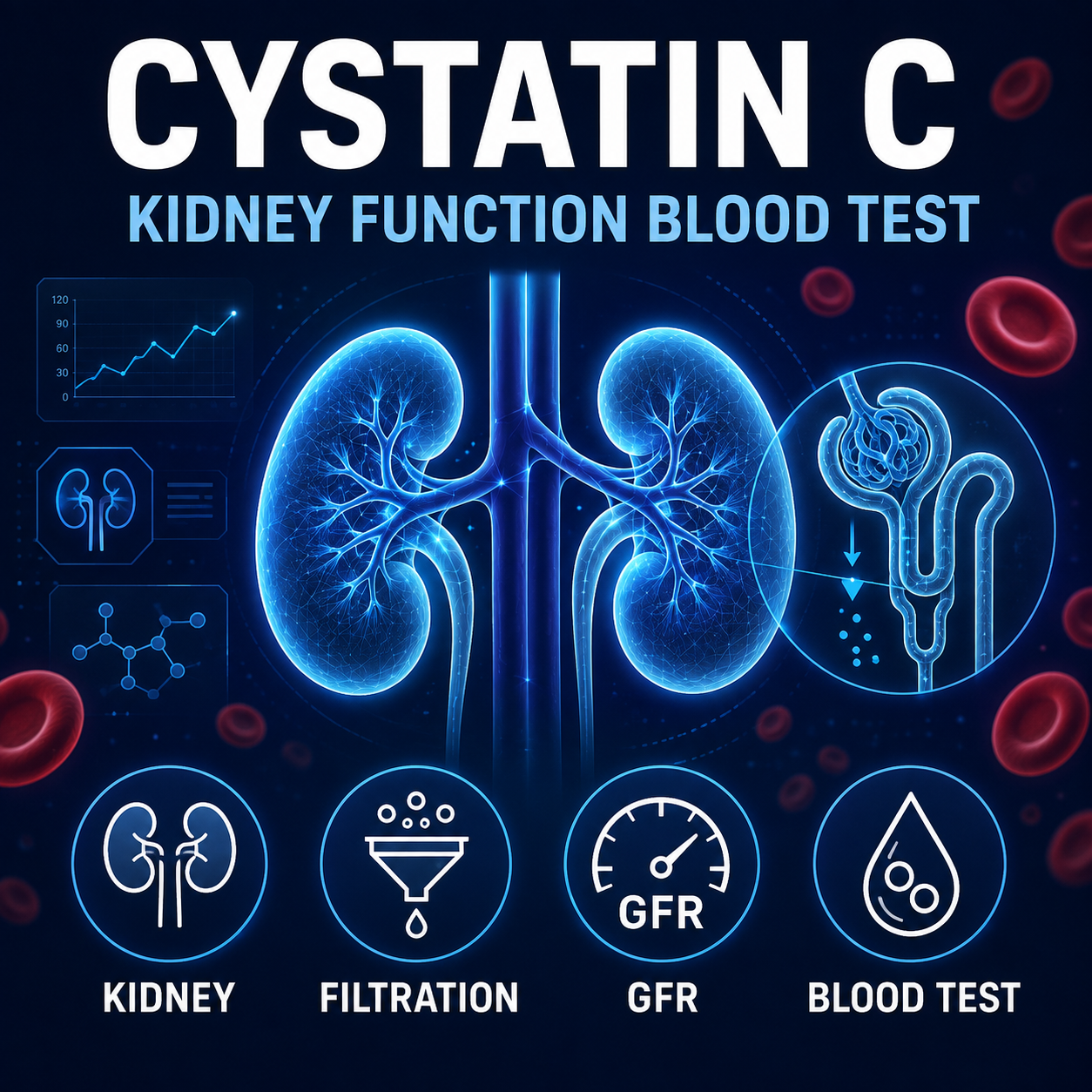
Cystatin-C


$89.00
The Cystatin C Blood Test provides an alternative way to assess kidney filtration that is less dependent on muscle mass than serum creatinine.
This can be especially useful when creatinine may be misleading because of creatine supplementation, high or low muscle mass, aging, weight loss, chronic illness, or intensive exercise.
For patients with undermethylation, elevated SAH, high homocysteine, mitochondrial stress, or an acidic metabolic pattern, kidney function is also important because the kidneys help regulate acid-base balance, bicarbonate, electrolyte handling, and metabolic clearance.
Description
The Cystatin C Blood Test provides an alternative marker of kidney filtration when serum creatinine may not accurately reflect renal function.
Cystatin C is a small protein produced by nearly all nucleated cells at a relatively steady rate. Healthy kidneys filter it from the bloodstream, so blood levels generally rise when kidney filtration declines.
Unlike creatinine, cystatin C is much less influenced by skeletal muscle mass. This can make it particularly useful for patients taking creatine supplements, highly muscular patients, patients with reduced muscle mass, older adults, or anyone whose creatinine-based kidney assessment seems inconsistent with the broader clinical picture.
Within an epigenetic and undermethylation assessment, kidney function is also relevant because the kidneys help regulate acid-base balance, bicarbonate, electrolytes, homocysteine-related metabolism, and metabolic waste clearance.
Labcorp Cystatin C — Test #121251
Alternative to Creatinine
Cystatin C provides information about kidney filtration without relying as heavily on muscle-derived creatinine production.
Less Confounded by Creatine
Creatine supplementation can increase creatinine and make routine kidney results harder to interpret. Cystatin C provides another perspective.
Clearance & pH Matter
Kidney function affects acid-base regulation, bicarbonate, homocysteine-related metabolism, and overall metabolic clearance.
What Is a Cystatin C Blood Test?
Cystatin C is a small protein produced continuously by most nucleated cells.
It enters the bloodstream and is freely filtered through the kidney glomeruli. When kidney filtration decreases, the concentration of cystatin C in the blood generally increases.
This makes cystatin C a useful alternative marker of renal filtration.
Labcorp #121251 reports Cystatin C only. It does not include an estimated GFR calculation. If a calculated cystatin C-based or combined creatinine-cystatin C eGFR is specifically needed, a different Labcorp test should be ordered.
Cystatin C vs Creatinine for Kidney Function
Creatinine remains an important routine kidney marker, but it has an important limitation: creatinine is produced from muscle metabolism.
Muscle-Dependent Marker
Serum creatinine can vary with muscle mass, exercise, meat intake, creatine supplementation, age, and other factors in addition to kidney filtration.
Less Muscle Dependent
Cystatin C is produced by nucleated cells rather than primarily by skeletal muscle and can therefore provide useful additional information when creatinine may be misleading.
This does not make cystatin C universally “better” than creatinine. The two markers provide complementary information, and in selected patients comparing them can provide a clearer picture of kidney function.
Cystatin C for Patients Taking Creatine
This is one of the most practical uses for a Cystatin C Blood Test in the epigenetic section.
Creatine supplementation can increase serum creatinine because some creatine is naturally converted to creatinine.
As a result, a patient taking creatine may develop:
- A higher serum creatinine
- A lower calculated creatinine-based eGFR
- An apparent decline in kidney function that may not represent a true change in filtration
Cystatin C can help separate “more creatinine production” from a true decline in kidney filtration.
This can be particularly important when creatine is being used as part of a mitochondrial or methylation-support strategy.
Why Creatine Is Relevant to Undermethylation
Creatine is not only a muscle supplement. Endogenous creatine synthesis is one of the body's significant consumers of methyl groups.
The body uses SAM to methylate guanidinoacetate during creatine synthesis.
Providing creatine from the diet or supplementation can reduce the amount the body needs to synthesize internally and may therefore reduce methylation demand in selected patients.
Creatine Synthesis Uses SAM
Endogenous creatine synthesis consumes SAM-dependent methyl groups and can become an important component of overall methylation demand.
Cystatin C Clarifies Kidney Status
If creatine is added therapeutically and serum creatinine subsequently rises, cystatin C can provide a less muscle-dependent kidney marker.
Why Kidney Function Matters in Undermethylation
Undermethylation is not simply a question of adding more methyl donors.
Normal methylation also depends on:
- Efficient cellular energy production
- Normal methionine and SAM metabolism
- Prevention of excessive SAH accumulation
- Homocysteine metabolism
- Adenosine metabolism
- Normal acid-base physiology
- Efficient metabolic clearance
The kidneys influence several of these systems, particularly acid-base regulation, electrolyte balance, homocysteine levels, and removal of metabolic waste.
Cystatin C, Homocysteine and Kidney Function
Kidney function is an important consideration when interpreting an elevated homocysteine result.
Reduced kidney filtration is commonly associated with increasing homocysteine concentrations.
An elevated homocysteine level should therefore not automatically be assumed to reflect folate, B12, or methylation deficiency. Kidney function should also be considered.
This becomes particularly important in patients with an undermethylation pattern where homocysteine is being used to guide methionine, SAMe, B-vitamin, or other methylation-related strategies.
Cystatin C, SAH and Metabolic Clearance
After SAM donates a methyl group, it ultimately forms S-adenosylhomocysteine, or SAH.
SAH is an important methylation inhibitor.
SAH hydrolase converts SAH reversibly toward:
- Homocysteine
- Adenosine
Efficient downstream metabolism of these products helps favor continued SAH breakdown.
Methylation Inhibition
Excess SAH can inhibit many SAM-dependent methyltransferase reactions.
Renal Function Matters
Reduced kidney function is strongly associated with higher circulating homocysteine.
Metabolic Environment
Renal dysfunction can add to the broader metabolic environment in which elevated SAH and impaired methylation occur.
Cystatin C does not directly measure SAH clearance. Its role is to help determine whether kidney filtration may be an additional factor contributing to a difficult-to-correct metabolic pattern.
Cystatin C, Kidney Function and pH Balance
The kidneys are one of the primary regulators of long-term acid-base balance.
They help maintain normal blood pH by:
- Reabsorbing bicarbonate
- Generating new bicarbonate
- Excreting hydrogen ions
- Excreting ammonium
- Regulating potassium, sodium, and other electrolytes
When kidney function becomes impaired, the body's ability to eliminate its daily acid load may also decline.
Over time, this can contribute to lower bicarbonate and metabolic acidosis.
Cystatin C and an Acidic Epigenetic Pattern
In an undermethylated patient with low CO2/bicarbonate, an acidic metabolic pattern, elevated SAH, or poor response to alkalinity support, kidney function deserves closer attention.
Cystatin C
Provides information about renal filtration that is less dependent on muscle-derived creatinine.
CO2 / Bicarbonate
Provides routine laboratory information about systemic bicarbonate and acid-base status.
Urine Albumin / Creatinine
Can detect abnormal albumin leakage even when blood filtration markers remain relatively preserved.
Cystatin C therefore complements rather than replaces a CMP, creatinine, bicarbonate, urinalysis, and urine albumin/creatinine assessment when kidney or pH regulation is a significant concern.
Cystatin C and the Five Epigenetic Drivers of Undermethylation
Monitor Creatine Use
Cystatin C is especially useful when therapeutic creatine makes serum creatinine more difficult to interpret.
Kidney Regulation
Kidneys help regulate bicarbonate, acid excretion, electrolytes, and metabolic waste handling.
Homocysteine & SAH Context
Kidney dysfunction can elevate homocysteine and may add another metabolic burden when SAH is already elevated.
Who May Benefit From a Cystatin C Blood Test?
The Cystatin C Blood Test may be particularly useful for patients with:
- Creatine supplementation
- High skeletal muscle mass
- Low muscle mass or muscle wasting
- Older age
- Significant weight loss
- Borderline or unexpected creatinine
- Concern about kidney function despite a normal creatinine
- Elevated homocysteine
- Elevated SAH
- Low SAM:SAH ratio
- Undermethylation with impaired clearance concerns
- Low bicarbonate or an acidic metabolic pattern
- Multiple medications or higher-dose supplement protocols
What Can a Cystatin C Blood Test Help Answer?
- Is cystatin C elevated?
- Could creatinine be misleading because of muscle mass?
- Could creatine supplementation be making creatinine appear higher?
- Is kidney filtration a concern despite an apparently acceptable serum creatinine?
- Could reduced kidney function be contributing to elevated homocysteine?
- Could renal impairment be adding to an elevated-SAH metabolic pattern?
- Does kidney function deserve closer evaluation before increasing creatine, minerals, or other metabolic support?
- Should a calculated creatinine-cystatin C eGFR or urine kidney evaluation be added?
Cystatin C Blood Test: Commonly Ordered With
CMP + Creatinine
Provides conventional creatinine-based kidney information plus electrolytes and CO2/bicarbonate.
Albumin / Creatinine Ratio
Evaluates albumin leakage and can identify renal damage that may not yet significantly affect filtration.
Homocysteine + SAM / SAH
Provides direct context when kidney function, homocysteine metabolism, and an elevated-SAH undermethylation pattern may overlap.
Before Your Cystatin C Blood Test
Labcorp Cystatin C — Test #121251
- This is a serum or plasma blood test performed through Labcorp.
- This test measures Cystatin C only; it does not include an eGFR calculation.
- Tell your clinician if you take creatine or have unusually high or low muscle mass.
- Steroid use, thyroid dysfunction, inflammation, and several other nonrenal factors may influence cystatin C and should be considered when interpreting the result.
- Do not discontinue prescription medications solely for this test unless instructed by the treating clinician.
How the Cystatin C Blood Test Works
Order the Test
After purchase, a Labcorp requisition and collection instructions are provided.
Have Your Blood Drawn
A serum or plasma specimen is collected at an appropriate Labcorp patient service center.
Compare With Creatinine
Cystatin C can be interpreted alongside serum creatinine, muscle mass, creatine use, and previous kidney-function results.
Determine Whether More Testing Is Needed
If results raise concern, additional testing may include a calculated cystatin C/creatinine eGFR, CMP, urinalysis, urine albumin/creatinine ratio, or other renal studies.
Frequently Asked Questions About Cystatin C
Does Labcorp #121251 include eGFR?
No. Labcorp #121251 measures cystatin C only. Other Labcorp tests are available when a cystatin C-based or combined creatinine-cystatin C eGFR calculation is desired.
Why test cystatin C instead of just creatinine?
Cystatin C is less dependent on muscle mass and creatinine production. It can provide useful additional information when creatinine may be unusually high or low for reasons unrelated to kidney filtration.
Why is cystatin C useful if I take creatine?
Creatine supplementation can increase serum creatinine without necessarily reducing true kidney filtration. Cystatin C is less influenced by this effect and may provide useful clarification.
How does cystatin C relate to undermethylation?
Kidney function affects homocysteine, acid-base physiology, electrolyte balance, and metabolic clearance. These can become important when an undermethylation pattern includes elevated SAH, high homocysteine, creatine therapy, or impaired pH regulation.
Can kidney dysfunction raise homocysteine?
Yes. Reduced renal function is commonly associated with increased homocysteine levels. Kidney status should therefore be considered when interpreting elevated homocysteine.
Does cystatin C measure pH?
No. It is a kidney-filtration marker. Kidney function matters to pH because the kidneys reabsorb bicarbonate and excrete acid. CMP CO2/bicarbonate provides more direct routine information about systemic acid-base status.
Does cystatin C directly measure SAH clearance?
No. It does not measure SAM, SAH, homocysteine clearance, or adenosine directly. It can help determine whether kidney dysfunction may be adding to the metabolic environment in which an elevated-SAH pattern is occurring.
Cystatin C with eGFR — Kidney Function Marker
What is Cystatin C?
Cystatin C is a small protein produced by nearly all nucleated cells at a relatively constant rate. It is filtered by the kidneys and is used as a marker of glomerular filtration rate, or GFR. When kidney filtration decreases, cystatin C levels tend to rise.
Unlike creatinine, cystatin C is less affected by muscle mass, body size, diet, protein intake, and some of the factors that can make creatinine-based kidney estimates misleading. For this reason, cystatin C can provide a more sensitive or more accurate estimate of kidney function in selected patients.
Why Test Cystatin C?
Cystatin C is useful when a more refined kidney-function assessment is needed beyond routine creatinine and eGFR. It may be especially helpful when creatinine may underestimate or overestimate kidney function, such as in older adults, people with low muscle mass, highly muscular individuals, malnourished patients, chronic illness, weight loss, or unusual protein intake.
Testing may be considered for:
- Confirming kidney function when creatinine-based eGFR is borderline or questionable
- Earlier detection of reduced kidney filtration
- Monitoring kidney status in patients using multiple medications or supplements
- Evaluating kidney reserve before more intensive detoxification, metabolic, or supplement protocols
- Assessing cardiorenal and metabolic risk more accurately
- Clarifying kidney function when creatinine appears normal but clinical concern remains
Functional Medicine Relevance
Cystatin C can be a valuable addition to a functional medicine assessment because kidney filtration affects detoxification capacity, mineral handling, blood pressure regulation, metabolic health, cardiovascular risk, medication clearance, and tolerance of higher-dose nutritional protocols.
In patients using higher-dose minerals, amino acids, detoxification support, methylation support, or oxidative therapies, cystatin C may help confirm that kidney filtration is adequate and that creatinine alone is not giving a falsely reassuring impression.
Related Testing to Consider
Cystatin C is often most useful when interpreted alongside:
- CMP with creatinine and eGFR
- Urinalysis
- Urine albumin/creatinine ratio
- BUN/creatinine ratio
- Electrolytes and CO2/bicarbonate
- Blood pressure and metabolic markers
- Fasting glucose, insulin, A1c, lipids, hs-CRP, and uric acid when assessing metabolic/cardiorenal risk
Summary
Cystatin C with eGFR is a practical kidney-function test that may provide a more reliable estimate of filtration than creatinine alone in selected patients. It is especially useful when kidney function needs to be confirmed, when creatinine may be misleading, or when a patient is undergoing a functional medicine program involving detoxification, methylation support, mineral therapy, metabolic correction, or higher-dose supplementation.