
The Five Epigenetic Biotypes of Undermethylation
Dr. William Walsh identified five major biochemical biotypes associated with mood and behavior disorders: undermethylation, overmethylation, copper overload, pyroluria and toxic overload. Toxic overload—the fifth Walsh biotype—can inhibit methylation through elevated SAH and impaired SAH-hydrolase pathway function, ultimately contributing to an undermethylated state. The Five Epigenetic Biotypes of Undermethylation build on this model by identifying five common pathways that may cause or sustain impaired methylation: toxin exposure, mitochondrial stress, creatine demand, methylation demand, and acidic pH with impaired clearance.
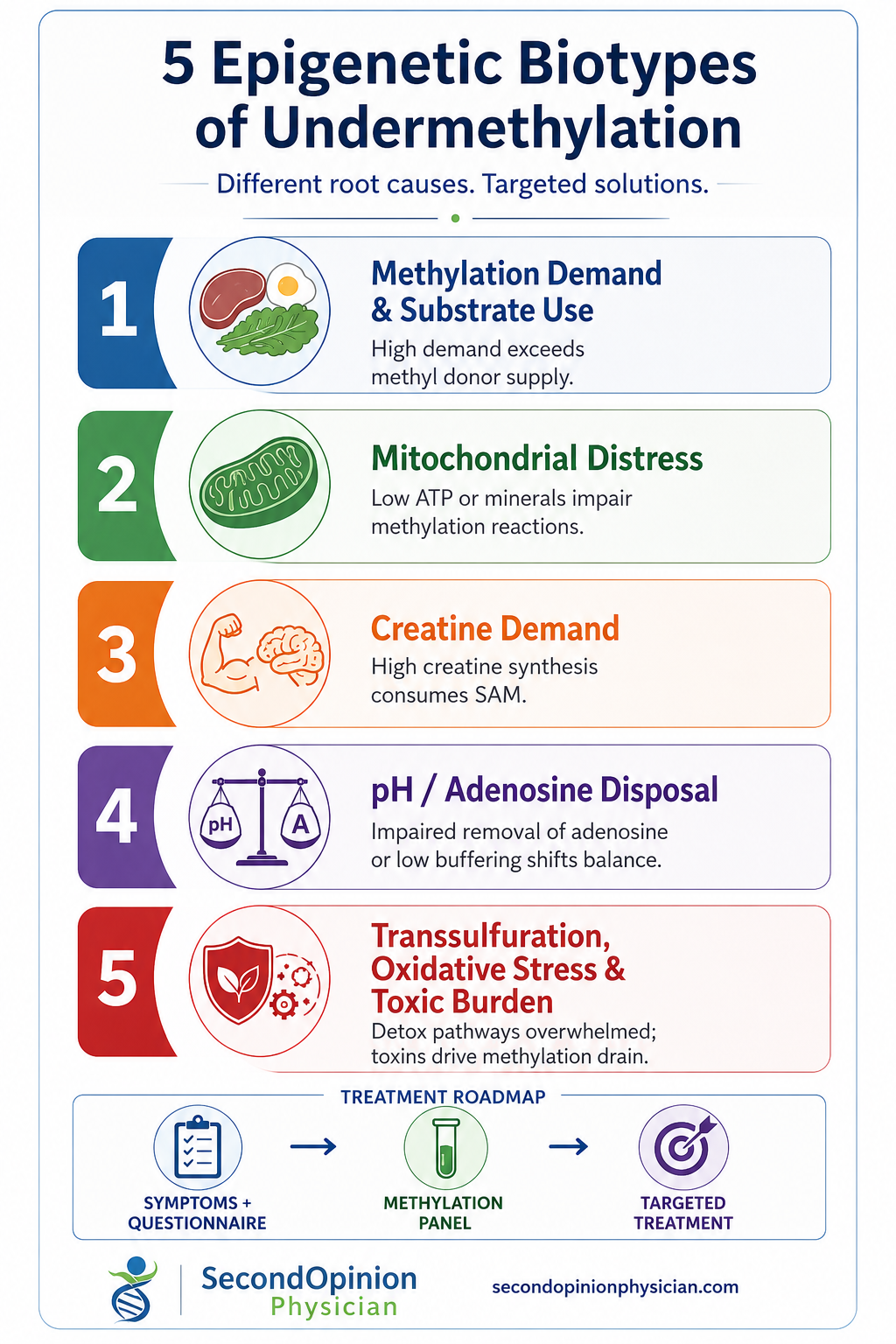
The Five Epigenetic Biotypes of Undermethylation
Undermethylation describes a biochemical pattern. The next question is often more important: why is methylation impaired?
Traditional Walsh biochemistry provides an important framework for identifying undermethylation. Functional methylation testing can add another layer by directly examining metabolites such as SAM, SAH, methionine and homocysteine.
But even when undermethylation is established, the laboratory pattern does not necessarily reveal what is causing or perpetuating it.
The Five Epigenetic Biotypes of Undermethylation organize several recurring biochemical patterns that may help explain why methylation remains impaired—and why simply adding methionine, SAMe or other methyl donors may not always produce the expected response.
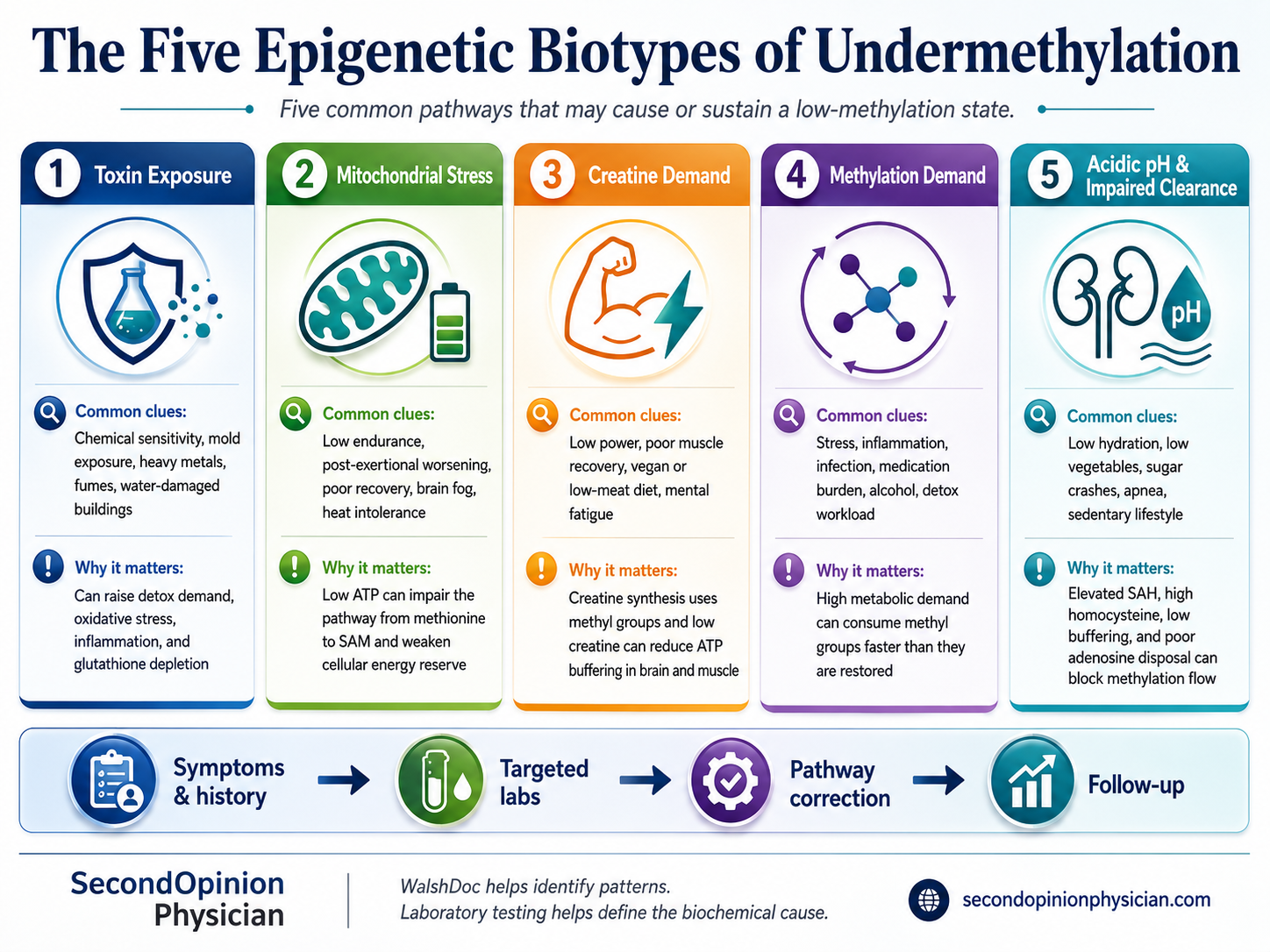
Five recurring biochemical patterns may contribute to or perpetuate undermethylation. More than one can occur in the same patient.
Why the Five Epigenetic Biotypes Matter
Low SAM, elevated SAH, an abnormal SAM:SAH ratio or elevated homocysteine may demonstrate that methylation metabolism is abnormal. Those findings are important—but they still may not explain the mechanism behind the abnormality.
For example:
- Is the patient failing to generate enough ATP to efficiently produce SAM?
- Is endogenous creatine production consuming excessive methyl-group capacity?
- Is chronic biochemical stress increasing methylation demand?
- Is toxic burden contributing to oxidative and mitochondrial stress?
- Is elevated SAH being perpetuated by impaired homocysteine or adenosine clearance?
The purpose of the Five Epigenetic Biotypes is to move from “this patient appears undermethylated” toward “what biochemical pathway may be causing or sustaining the undermethylation?”
The Five Epigenetic Patterns
Toxin Exposure
Environmental, occupational, mold, chemical, medication or gut-derived burdens that may increase oxidative stress, detoxification demand or metabolic workload.
Mitochondrial Stress
Impaired cellular-energy production or mitochondrial stress that may reduce ATP availability, increase oxidative stress and interfere with energy-dependent methylation metabolism.
Creatine Demand
High endogenous creatine production, inadequate creatine availability or high brain/muscle energy demand that may increase methyl-group consumption while reducing ATP buffering.
Methylation Demand
Conditions that increase methyl-group use for repair, stress adaptation, metabolism and other biochemical functions faster than methylation resources can be restored.
Acidic pH & Impaired SAH–Adenosine Clearance
Patterns involving buffering, kidney function, homocysteine removal, adenosine disposal or other factors that may prevent the reversible SAH hydrolase pathway from moving efficiently toward clearance.
Toxin Exposure, Oxidative Stress & Undermethylation
The Toxin Exposure pattern identifies exposures and sensitivity symptoms that may increase oxidative stress, metabolic workload or detoxification demand.
Toxic burden should not be treated as synonymous with mitochondrial dysfunction. Instead, it can function as an upstream or intermediary stressor that affects several systems simultaneously.
- Chemical or perfume sensitivity
- Symptoms triggered by cleaning products or fumes
- Building-specific symptoms
- Known or suspected mold exposure
- Water-damaged buildings
- Smoke or pollutant sensitivity
- Heavy-metal exposure
- Pesticide or industrial exposure
- Occupational chemical exposure
- Untested well water or other environmental concerns
- Exposure history
- Toxic elements when indicated
- Oxidative stress
- Glutathione and antioxidant reserve
- Kidney and liver clearance
- Gut dysbiosis and inflammatory burden
- Copper and zinc status
- Potential mitochondrial consequences
How Toxic Burden Can Intersect With Mitochondria
Environmental or metabolic stress may increase reactive oxygen species, consume antioxidant resources and interfere with normal cellular metabolism. In susceptible patients, mitochondrial function may become one of the downstream systems affected.
Toxic burden → oxidative/metabolic stress → mitochondrial stress → increased cellular demand
Mitochondrial Stress: When Cellular Energy May Limit Methylation
Mitochondria generate much of the ATP required for cellular work. Methylation is among the many biochemical systems that depend upon adequate cellular energy.
This creates an important connection with undermethylation:
The ATP → SAM Connection
MITOCHONDRIAL ENERGY PRODUCTION
ATP AVAILABILITY
METHIONINE → SAM
METHYLATION REACTIONS
Conversion of methionine to S-adenosylmethionine (SAM) requires ATP. Therefore, a patient with adequate methionine but unexpectedly low SAM raises a different question than a patient who simply lacks methylation substrate.
Could impaired cellular-energy metabolism be contributing?
- Low endurance despite adequate nutrition and sleep
- Need to rest during ordinary daily activities
- Poor exercise tolerance
- Prolonged recovery after exertion
- Muscle fatigue or weakness
- Brain fog after sustained mental work
- Reduced cognitive stamina
- Unrefreshing sleep
- Inconsistent energy or afternoon fatigue
- Heat or temperature intolerance
- Low SAM despite adequate methionine
- Low SAM:SAH ratio
- Persistent undermethylation despite methyl-donor support
- Evidence of increased oxidative stress
- Energy symptoms occurring with undermethylation
- Other ATP-dependent pathways appearing impaired
Mitochondrial Stress Is Broader Than Magnesium Deficiency
Magnesium is important for ATP-dependent reactions, but mitochondrial dysfunction can involve much more: impaired fuel metabolism, carnitine deficiency, oxidative stress, poor oxygen delivery, sleep apnea, nutrient deficiency, metabolic dysfunction, medications, inflammation, toxic exposures and primary mitochondrial disease.
Testing the Cellular-Energy Hypothesis
Symptoms can suggest mitochondrial stress, but they cannot establish the mechanism. Testing is most useful when it identifies an abnormality that changes treatment or provides a baseline for follow-up.
Lactate + Pyruvate
Provides information about oxidative metabolism and the relationship between pyruvate utilization and lactate production.
Creatine Kinase — CK
Provides a marker of muscle-cell injury or involvement when muscle symptoms are part of the clinical picture.
Free + Total Carnitine
Assesses carnitine availability for fatty-acid transport and can identify a potentially correctable abnormality.
When Deeper Mitochondrial Testing Is Needed
Acylcarnitines
Provides a more detailed view of fatty-acid oxidation and mitochondrial fuel metabolism.
GDF-15
An additional biomarker that may be useful when more significant mitochondrial or cellular stress is suspected.
Organic Acids & Expanded Testing
May provide additional information about metabolic intermediates, nutrient cofactors and cellular-energy pathways.
Testing Is Not the Treatment
An abnormal mitochondrial marker is most useful when it changes the treatment plan. A carnitine abnormality may support carnitine replacement. Other patterns may direct attention toward metabolic dysfunction, oxidative stress, nutrition, oxygenation or deeper investigation.
When an abnormal marker is used as a baseline, repeating it after treatment can help determine whether the underlying pathway changed.
Treating the Mitochondrial Pattern
The goal is not simply to “stimulate mitochondria.” Treatment should identify and correct the factors interfering with cellular energy.
Depending upon the patient, that may involve correcting deficiencies, improving metabolic health, addressing sleep and oxygenation, restoring physical conditioning gradually, reducing oxidative stress, supporting mitochondrial cofactors or investigating an underlying disease.
Nutrients such as CoQ10, carnitine, creatine, thiamine, riboflavin, magnesium and antioxidant support affect different parts of the system and should not automatically be treated as one universal mitochondrial cocktail.
Mitochondrial Stress and Creatine Demand Are Not the Same Thing
The two patterns frequently overlap, but they ask different biochemical questions.
Can the Cell Produce Enough Energy?
Mitochondrial Stress focuses primarily on ATP production and cellular-energy metabolism.
Core question: Is mitochondrial energy production impaired?
Can the Cell Buffer Energy Efficiently?
Creatine Demand focuses on ATP buffering, creatine availability and the methyl groups consumed when the body manufactures creatine.
Core question: Is creatine demand increasing methylation demand or limiting rapid ATP recycling?
A patient can have either pattern—or both.
Creatine Demand: Brain Energy, Muscle Energy & Methyl-Group Consumption
Creatine is not simply a sports supplement. The creatine-phosphocreatine system acts as a rapidly available energy buffer in the brain, skeletal muscle and other tissues with changing energy requirements.
Creatine also creates one of the clearest biochemical connections between cellular energy and methylation because endogenous creatine synthesis consumes SAM-derived methyl groups.
SAM
ENDOGENOUS CREATINE SYNTHESIS
SAH PRODUCTION + METHYL-GROUP USE
LESS METHYLATION CAPACITY AVAILABLE ELSEWHERE
- Difficulty maintaining muscle mass
- Reduced strength or power
- Rapid fatigue during short intense activity
- Poor recovery between physical efforts
- Prolonged muscle soreness
- High resistance-training workload
- Progressive decline in exercise capacity
- Mental exhaustion after sustained concentration
- Brain fog with cognitive workload
- Reduced cognitive stamina
- Difficulty maintaining prolonged focus
- Slow recovery after intense mental stress
- Neurologic or neurodevelopmental conditions with high energy demand
- Vegan or long-term vegetarian diet
- Low meat or fish intake
- Older age
- Loss of lean muscle mass
- Rapid growth
- Rehabilitation or tissue rebuilding
- Chronic illness or inflammatory stress
- Low SAM despite adequate methionine
- Poor SAM:SAH ratio
- Limited response to SAM or methionine
- Low dietary creatine
- High physical or cognitive demand
- Mitochondrial symptoms accompanying undermethylation
- Improvement after creatine supplementation
Why Creatine Can Affect Energy and Methylation at the Same Time
Supplemental creatine can reduce the amount of creatine the body must synthesize internally, potentially sparing methyl groups. At the same time, phosphocreatine helps rapidly regenerate ATP in tissues with high or fluctuating energy demands.
Methylation Demand: When Biochemical Workload Exceeds Capacity
Methylation Demand describes circumstances in which methyl groups may be consumed faster than they can be replenished.
A patient may have adequate methionine intake and still demonstrate impaired methylation if biochemical demand remains persistently high.
- Chronic psychological or emotional stress
- Chronic inflammation
- Persistent infection
- Frequent illness or slow recovery
- Tissue repair
- Long-term medication use
- Multiple simultaneous medications
- Alcohol or stimulant exposure
- Environmental exposure
- High endogenous creatine synthesis
- Is methyl-group demand exceeding supply?
- Is methionine adequate?
- Is remethylation functioning efficiently?
- Are choline and betaine pathways adequately supported?
- Is inflammation increasing repair demand?
- Is creatine synthesis consuming methyl groups?
- Are medications increasing metabolic workload?
Why Expanded Methylation Testing Can Matter
SAM and SAH provide important information, but a broader methylation panel can help evaluate methionine, homocysteine, choline, betaine, DMG and related metabolites that may reveal substrate, remethylation or pathway abnormalities.
Acidic pH & Impaired SAH–Adenosine Clearance
This pattern focuses less on methyl-group supply and more on whether methylation byproducts are being cleared efficiently.
The SAH hydrolase reaction is reversible. Forward movement away from SAH depends upon removal of its downstream products—homocysteine and particularly adenosine.
SAH
HOMOCYSTEINE + ADENOSINE
DOWNSTREAM CLEARANCE
LESS SAH INHIBITION OF METHYLATION
- Inconsistent energy
- Low fluid intake
- Inadequate electrolyte intake
- High refined-carbohydrate intake
- Low vegetable/mineral intake
- Blood-sugar instability
- Gut fermentation or dysbiosis
- Sedentary lifestyle
- Sleep apnea or impaired oxygenation
- Alcohol, diuretics or stimulants
- Elevated SAH
- Low SAM:SAH ratio
- Elevated homocysteine
- Low bicarbonate / CO2
- Kidney filtration concerns
- Liver or metabolic clearance concerns
- Hydration/electrolyte abnormalities
- Conditions potentially impairing adenosine disposal
Why Simply Adding More Methyl Donors May Not Work
If elevated SAH is acting as a methylation inhibitor, increasing methyl-group supply does not necessarily correct the underlying bottleneck. The biochemical question becomes whether homocysteine and especially adenosine are being removed efficiently enough to allow the SAH reaction to move forward.
Walsh Biotypes and Epigenetic Biotypes Answer Different Questions
What Biochemical Pattern Does the Patient Have?
Traditional Walsh assessment evaluates patterns such as:
- Undermethylation
- Overmethylation
- Copper overload
- Pyroluria
- Other biochemical imbalances
Whole-blood histamine, copper, ceruloplasmin, zinc and other laboratory markers help establish the biochemical phenotype.
Why Might Undermethylation Be Occurring?
Once undermethylation is suspected or established, the expanded model asks whether the pattern may involve:
- Toxin exposure
- Mitochondrial stress
- Creatine demand
- Excess methylation demand
- Impaired SAH/adenosine clearance
The two frameworks are complementary rather than competing.
How WalshDoc Identifies the Dominant Pattern
The Biotype + Undermethylation Assessment combines traditional Walsh symptom-pattern recognition with a more detailed evaluation of potential epigenetic drivers.
The questionnaire examines symptoms, history, diet, medication use, exposures, physical and cognitive energy, recovery, stress, hydration and other factors that may help distinguish one biochemical pattern from another.
1. Walsh Biotype
Does the clinical pattern suggest undermethylation, copper imbalance, pyroluria or another Walsh biochemical pattern?
2. Epigenetic Driver
If undermethylation appears important, which of the five expanded patterns is strongest—and which secondary patterns may also be contributing?
3. Testing Direction
Which laboratory pathway is most likely to clarify the mechanism and change treatment?
Symptoms Guide Testing—They Do Not Replace It
Fatigue, brain fog, anxiety, poor exercise recovery or chemical sensitivity can occur in multiple biochemical patterns. The purpose of the questionnaire is to improve pattern recognition and help choose the most informative laboratory tests.
Testing the Five Epigenetic Biotypes
The objective is not to order every available laboratory test. Testing should follow the suspected biochemical pattern.
Walsh Biochemistry
- Whole-blood histamine
- Plasma zinc
- Serum copper
- Ceruloplasmin
- Homocysteine
- Urinary pyrroles when indicated
- Vitamin D
- CBC / CMP
Functional Methylation
- SAM
- SAH
- SAM:SAH ratio
- Methionine
- Homocysteine
- Choline / betaine pathways
- Related methylation metabolites
Mitochondrial Testing
- Lactate / Pyruvate
- CK
- Free + Total Carnitine
- Acylcarnitines when indicated
- GDF-15 when indicated
- Organic acids / expanded metabolic testing
Cellular Stress
- 8-OHdG
- Lipid peroxides
- Toxic elements when indicated
- Mineral status
- Environmental exposure assessment
SAH / Metabolic Clearance
- SAH
- Homocysteine
- Bicarbonate / CO2
- Kidney filtration markers
- Liver markers
- Hydration/electrolyte status
When Clinically Indicated
- Gut testing
- Inflammatory evaluation
- Hormonal assessment
- Sleep / oxygenation evaluation
- Additional metabolic testing
- Specialist genetic evaluation
From Undermethylation to a Treatment Strategy
The central principle is simple: confirm the biochemical pattern, identify the likely driver, and treat the bottleneck rather than repeatedly adding methyl donors.
SYMPTOMS + WALSH PATTERN
CONFIRM UNDERMETHYLATION / METHYLATION ABNORMALITY
IDENTIFY DOMINANT EPIGENETIC DRIVER
SELECT TARGETED LABORATORY TESTING
CORRECT THE BIOCHEMICAL BOTTLENECK
RETEST ABNORMAL PATHWAYS + REASSESS SYMPTOMS
Test → Treat → Retest
The Five Epigenetic Biotypes are intended to produce a treatment strategy that can be evaluated over time.
Test
Establish the abnormalities that are relevant to the suspected mechanism.
Treat
Correct deficiencies and address the dominant biochemical driver rather than treating every possible pathway simultaneously.
Retest
Repeat the markers that were meaningfully abnormal and compare them with symptoms, function and treatment response.
This is especially useful with mitochondrial abnormalities, methylation markers, copper/zinc imbalance, homocysteine and other measurable findings where objective change can help determine whether the intervention is addressing the suspected mechanism.
Start With the Undermethylation Pattern—Then Ask Why
The purpose of the Five Epigenetic Biotypes is not to create five more diagnoses. It is to identify why a patient may remain undermethylated and which biochemical pathway deserves the greatest attention.
A patient may require traditional Walsh testing, expanded methylation testing, mitochondrial evaluation—or a combination. The clinical pattern helps determine where to begin.
Questionnaire findings are screening results and do not replace laboratory confirmation, clinical assessment or ongoing medical care.
Frequently Asked Questions
Are the Five Epigenetic Biotypes the same as the Walsh Five Biotypes?
No. Traditional Walsh biotypes identify broad biochemical patterns such as undermethylation, overmethylation, copper overload and pyroluria. The Five Epigenetic Biotypes go deeper within undermethylation by asking which metabolic factors may be causing or perpetuating the pattern.
Can a patient have more than one Epigenetic Biotype?
Yes. The patterns can overlap. Toxic burden may contribute to mitochondrial stress, while mitochondrial stress and high creatine demand can occur simultaneously. The goal is to identify the dominant pattern and important secondary contributors.
How can mitochondrial dysfunction contribute to undermethylation?
Conversion of methionine into SAM requires ATP. If cellular-energy production is impaired, mitochondrial dysfunction is one possible contributor to inadequate SAM production or a broader methylation abnormality. Mitochondrial dysfunction does not automatically mean a person is undermethylated, however, so symptoms and laboratory findings need to be interpreted together.
What is the difference between Mitochondrial Stress and Creatine Demand?
Mitochondrial Stress asks whether cellular ATP production is impaired. Creatine Demand asks whether ATP buffering and creatine availability are inadequate or whether endogenous creatine synthesis is consuming excessive methyl-group capacity. A patient may have either pattern or both.
What mitochondrial tests may be useful in undermethylation?
When the clinical pattern suggests impaired cellular energy, a focused baseline may include lactate/pyruvate, CK and free/total carnitine. Acylcarnitines, GDF-15, organic acids or more specialized evaluation may be appropriate when deeper investigation is needed.
Why can SAM or methionine fail to correct undermethylation?
Providing more methylation substrate does not necessarily correct impaired ATP production, excessive methyl-group demand, elevated SAH, impaired clearance, toxic burden or other pathway bottlenecks. This is one reason identifying the underlying biochemical pattern can matter.
Does the WalshDoc questionnaire replace laboratory testing?
No. The questionnaire is designed to identify patterns and help select the most informative testing. Laboratory findings are then used to confirm relevant biochemical abnormalities and distinguish between overlapping mechanisms.
Why use expanded methylation testing?
SAM and SAH are important markers, but expanded testing can provide additional information about methionine, homocysteine, choline, betaine and related methylation pathways. This can help distinguish inadequate substrate from excessive demand, impaired recycling or other metabolic bottlenecks.
Should abnormal mitochondrial tests be repeated?
When an abnormal test influenced treatment, repeating that marker can help determine whether the underlying pathway changed. Normal tests generally do not need to be repeatedly measured simply as a nonspecific mitochondrial wellness score.