
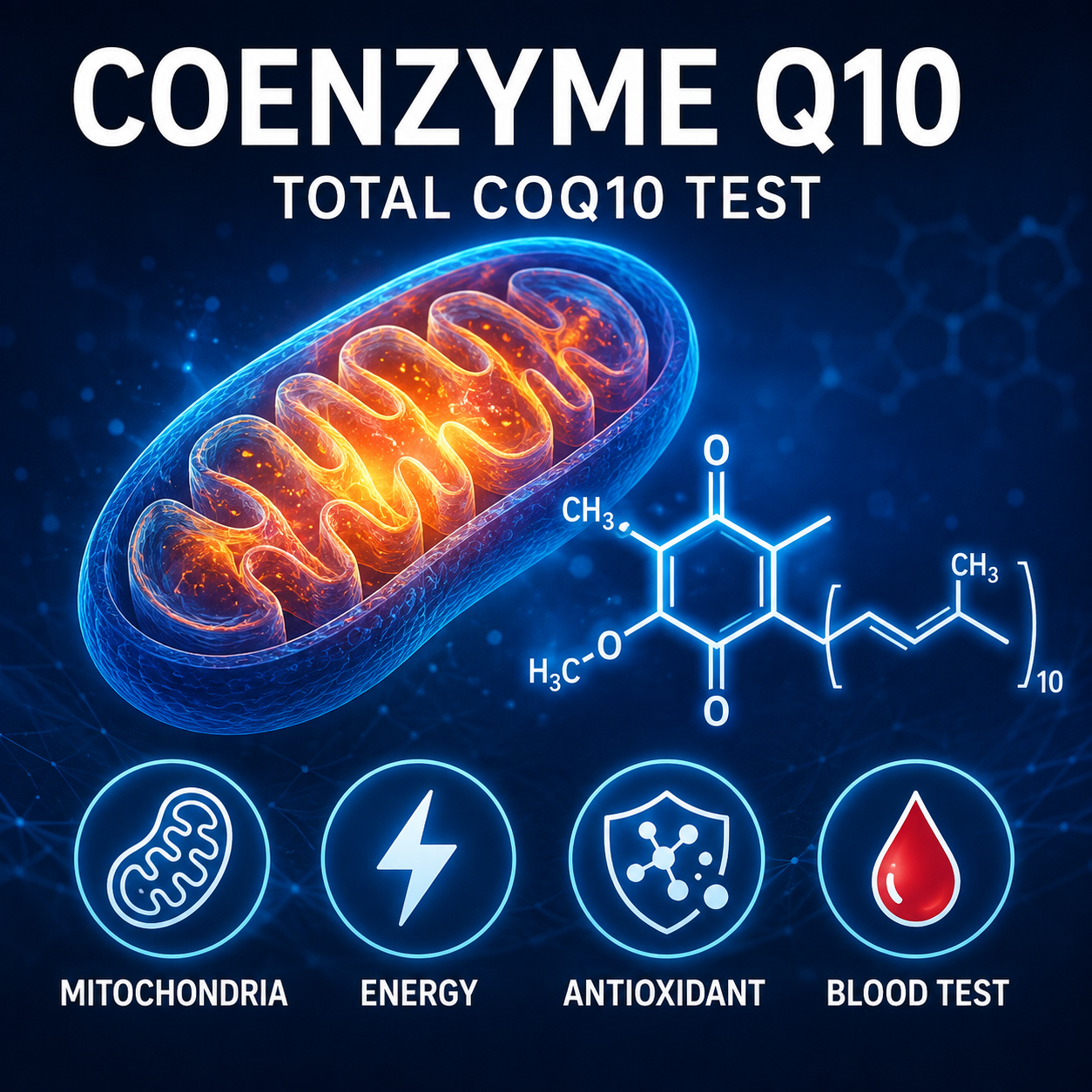
Coenzyme Q10, Total
$98.00
The CoQ10 Blood Test measures total circulating coenzyme Q10, a key mitochondrial cofactor required for ATP production and antioxidant protection. It is especially useful for evaluating statin-associated muscle symptoms, fatigue, poor exercise recovery, cardiovascular energy demands, mitochondrial dysfunction, oxidative stress, and undermethylation patterns where low cellular energy may impair SAM production.
Description
The CoQ10 Blood Test measures circulating coenzyme Q10, an essential component of mitochondrial energy production and an important lipid-soluble antioxidant.
CoQ10 sits within the inner mitochondrial membrane, where it transfers electrons through the respiratory chain and helps cells generate ATP. This is especially important in tissues with high energy requirements such as the heart, skeletal muscle, brain, and kidneys.
CoQ10 also has particular relevance to undermethylation. ATP is required for the conversion of methionine into S-adenosylmethionine (SAM), the body's principal methyl donor. When mitochondrial energy production is impaired, low ATP availability may become one additional metabolic stress affecting methylation.
This test is especially useful when evaluating fatigue, poor exercise recovery, calf or thigh muscle pain, statin-associated symptoms, cardiovascular concerns, oxidative stress, mitochondrial dysfunction, or low-SAM/elevated-SAH patterns.
Labcorp Coenzyme Q10, Total — Test #120251
ATP Production
CoQ10 transfers electrons within the mitochondrial respiratory chain and is essential for efficient oxidative phosphorylation and ATP production.
Methionine → SAM
The enzyme methionine adenosyltransferase requires ATP to convert methionine into SAM, directly linking cellular energy availability with methylation capacity.
High-Energy Tissues
Heart and skeletal muscle contain large numbers of mitochondria and may be especially affected when CoQ10 or mitochondrial energy production is inadequate.
What Does the CoQ10 Blood Test Measure?
The CoQ10 Blood Test measures total circulating coenzyme Q10 in serum.
CoQ10 exists in two principal forms:
- Ubiquinone — the oxidized form
- Ubiquinol — the reduced antioxidant form
Labcorp's Coenzyme Q10, Total #120251 reports total CoQ10 rather than separately measuring the reduced and oxidized fractions.
Because CoQ10 is fat soluble, it circulates largely in lipoproteins. This means serum CoQ10 can partly correlate with total and LDL cholesterol, which should be considered when interpreting the result.
Why CoQ10 Is Critical for Mitochondrial ATP Production
Mitochondria produce much of the ATP needed to power cellular activity.
During oxidative phosphorylation, electrons generated from carbohydrates, fats, and amino acids move through the mitochondrial electron transport chain.
CoQ10 acts as a mobile electron carrier, transferring electrons from Complex I and Complex II toward Complex III.
CoQ10 is therefore not simply an antioxidant supplement. It is part of the machinery cells use to make ATP.
When CoQ10 availability or mitochondrial function is impaired, the consequences may include:
- Reduced energy production
- Fatigue
- Poor exercise tolerance
- Muscle fatigue
- Poor recovery
- Increased oxidative stress
- Greater cellular repair demand
CoQ10, ATP and Undermethylation
Methylation is often discussed mainly in terms of folate, B12, methionine, and homocysteine. However, cellular energy is also required for methylation to function normally.
The first step in producing SAM illustrates this directly.
Methionine + ATP → SAM
Methionine adenosyltransferase combines methionine with ATP to produce S-adenosylmethionine, or SAM.
SAM is the principal methyl donor used in hundreds of methylation reactions.
Mitochondria Supply ATP
Because ATP is required to synthesize SAM, mitochondrial dysfunction may become one factor limiting efficient methylation in susceptible patients.
This becomes especially important when laboratory testing shows:
- Low SAM
- Low SAM:SAH ratio
- Elevated SAH
- Low methionine
- Persistent fatigue
- Evidence of mitochondrial stress
- Poor response to a methylation protocol
A low CoQ10 result does not diagnose undermethylation. Rather, it may identify mitochondrial energy insufficiency as one potentially correctable factor contributing to a more complex acquired or epigenetic undermethylation pattern.
CoQ10, SAH and Adenosine Clearance
After SAM donates its methyl group, it ultimately becomes S-adenosylhomocysteine (SAH).
SAH is important because it inhibits many methyltransferase enzymes. Excess SAH can therefore suppress methylation even when SAM itself is not severely depleted.
SAH hydrolase converts SAH toward:
- Homocysteine
- Adenosine
The reaction is reversible. Efficient removal and metabolism of homocysteine and adenosine helps favor continued SAH breakdown.
Methylation Inhibition
When SAH accumulates, it can inhibit SAM-dependent methyltransferase reactions.
Clearance Matters
Adenosine must be efficiently metabolized and cleared so it does not oppose forward movement of the reversible SAH-hydrolase reaction.
ATP-Dependent Metabolism
Adequate ATP supports multiple cellular pathways involved in adenosine metabolism, membrane transport, renal function, and broader metabolic clearance.
CoQ10 does not directly clear adenosine, and adenosine is not simply transported unchanged to the kidneys for excretion. Its relevance is upstream: CoQ10 supports mitochondrial ATP production, and adequate cellular energy is needed for many of the metabolic processes involved in maintaining normal adenosine handling and cellular clearance.
This provides another reason to evaluate mitochondrial health when a patient has an elevated-SAH form of undermethylation.
CoQ10 and the Five Epigenetic Drivers of Undermethylation
Within the Five Epigenetic Drivers framework, the strongest connection between CoQ10 and undermethylation is mitochondrial stress.
Reduced ATP Production
Impaired oxidative phosphorylation may reduce cellular energy available for ATP-dependent biochemical reactions, including SAM synthesis.
Higher Repair Demand
Mitochondrial dysfunction can increase reactive oxygen species, creating additional antioxidant and cellular-repair demands.
Competing Biochemical Needs
When mitochondrial, antioxidant, and repair demands increase, the overall metabolic burden on an already impaired methylation system may become greater.
Why CoQ10 Is Especially Important for the Heart
The heart contracts continuously and requires an enormous, uninterrupted supply of ATP.
Cardiac muscle therefore contains a particularly high concentration of mitochondria.
CoQ10 supports heart function through two major mechanisms:
Cardiac ATP Production
CoQ10 participates directly in mitochondrial electron transport and helps generate the ATP required for continuous cardiac contraction.
Membrane Protection
CoQ10 helps protect mitochondrial membranes and circulating lipoproteins from oxidative damage.
Because cardiovascular disease, aging, inflammation, oxidative stress, and statin treatment can all intersect with mitochondrial biology, CoQ10 can be a useful marker in a broader cardiovascular and metabolic assessment.
CoQ10 Blood Test for Statin Use
Statin therapy is one of the most practical reasons to consider measuring CoQ10.
Statins lower cholesterol by inhibiting HMG-CoA reductase, an enzyme within the mevalonate pathway.
That same pathway is also required for endogenous CoQ10 synthesis.
Statins can therefore lower circulating CoQ10 levels while lowering cholesterol.
Labcorp specifically notes that plasma CoQ10 concentrations are reduced during statin therapy and that the decline can be dose related.
This does not mean every patient taking a statin develops CoQ10 deficiency or needs supplementation. It does make CoQ10 status particularly relevant when muscle or energy symptoms develop after starting or increasing a statin.
Statin Muscle Side Effects: Calves, Thighs and Muscle Fatigue
Statin-associated muscle symptoms can occur even when creatine kinase remains normal.
Typical symptoms may include:
- Muscle aching
- Muscle heaviness
- Cramping
- Stiffness
- Tenderness
- Weakness
- Poor exercise tolerance
- New or unexplained muscle fatigue
The symptoms are often relatively symmetrical and commonly involve larger muscle groups.
Calf Muscles
Patients may notice aching, tightness, cramping, heaviness, or unusual fatigue in both calves, particularly with walking or exercise.
Thighs & Proximal Muscles
Thigh soreness, leg weakness, difficulty climbing stairs, or reduced exercise tolerance can also occur with statin-associated muscle symptoms.
Symptoms often begin within weeks after starting a statin or increasing the dose, although they can also appear after longer periods of treatment.
Physically active patients may notice symptoms particularly clearly because impaired muscle energy production or muscle discomfort becomes evident during exercise and recovery.
Why Statins, CoQ10 and Muscle Energy Are Connected
Skeletal muscle requires large amounts of ATP, particularly during physical activity.
One proposed explanation for statin-associated muscle symptoms is that reduced CoQ10 availability may impair mitochondrial energy production in susceptible muscle tissue.
Mevalonate Inhibition
The medication inhibits a pathway involved in both cholesterol and endogenous CoQ10 synthesis.
Mitochondrial Electron Transport
CoQ10 is required for efficient electron flow and oxidative phosphorylation within skeletal-muscle mitochondria.
Muscle Energy & Recovery
When muscle energy metabolism is impaired, fatigue, soreness, weakness, or reduced exercise tolerance may become more apparent.
This mechanism remains biologically plausible, but CoQ10 depletion is not the only proposed cause of statin-associated muscle symptoms.
CoQ10 Blood Test + Creatine Kinase for Statin Muscle Symptoms
CoQ10 and creatine kinase answer different questions and can be particularly useful together.
CoQ10
Helps determine whether circulating CoQ10 is reduced in a patient whose medication directly affects the pathway responsible for CoQ10 synthesis.
Creatine Kinase (CK)
Helps determine whether muscle-cell stress or injury is sufficient to cause measurable release of CK into the bloodstream.
A normal CK does not exclude statin-associated muscle symptoms. Many patients with statin-related myalgia have muscle aching, weakness, or cramps without a substantial CK elevation.
Statins, CoQ10 and Undermethylation
This interaction may become particularly relevant in a patient who already has evidence of undermethylation or mitochondrial stress.
Consider the combined pattern:
- Statin use
- Low CoQ10
- Calf or thigh muscle symptoms
- Fatigue or poor exercise recovery
- Low SAM
- Elevated SAH
- Low SAM:SAH ratio
- Oxidative stress
In this setting, the clinical issue may be broader than a medication side effect alone.
Mitochondrial energy impairment can potentially add to methylation burden because:
- ATP is required to make SAM from methionine.
- Muscle stress can increase repair and energy demands.
- Oxidative stress can increase antioxidant requirements.
- Poor mitochondrial function can add another acquired driver to an existing undermethylation pattern.
This is why CoQ10 may deserve attention when a patient with undermethylation develops fatigue, muscle symptoms, or poor recovery while taking a statin.
CoQ10, Creatine and Cellular Energy
CoQ10 and creatine support cellular energy in different but complementary ways.
CoQ10
Supports production of ATP by transferring electrons through the mitochondrial respiratory chain.
Creatine
Helps rapidly regenerate ATP through the phosphocreatine system in muscle, brain, and other high-energy tissues.
Creatine has an additional methylation connection because producing creatine internally consumes SAM-dependent methyl groups.
In a patient with high muscle demand or undermethylation, evaluating CoQ10, CK, mitochondrial function, and creatine demand together may provide more useful information than looking at any one marker by itself.
CoQ10 and Oxidative Stress
CoQ10 also functions as an important fat-soluble antioxidant.
In its reduced form, ubiquinol, it helps protect:
- Mitochondrial membranes
- Cell membranes
- Circulating lipoproteins
- Other lipid-rich tissues
This antioxidant function is particularly relevant because mitochondria themselves can become a major source of reactive oxygen species when electron transport is inefficient.
CoQ10 may therefore deserve closer attention when testing shows:
- Elevated 8-OHdG
- Elevated lipid peroxides
- Chronic inflammatory burden
- Evidence of mitochondrial stress
- Poor muscle recovery
CoQ10 Blood Test for Fatigue and Poor Recovery
Persistent Fatigue
Low cellular energy may become clinically relevant when fatigue persists despite otherwise routine laboratory findings.
Poor Recovery
Muscle fatigue, loss of endurance, or prolonged recovery may justify closer evaluation of mitochondrial cofactors.
Cognitive Fatigue
The brain has very high energy requirements, making mitochondrial support relevant in selected patients with brain fog or reduced cognitive endurance.
Who May Benefit From a CoQ10 Blood Test?
The CoQ10 Blood Test may be particularly useful for patients with:
- Statin use
- Calf muscle pain or tightness
- Thigh pain or weakness
- Muscle cramps
- Poor exercise tolerance
- Persistent fatigue
- Slow exercise recovery
- Suspected mitochondrial dysfunction
- Low SAM or elevated SAH
- Undermethylation with mitochondrial stress
- Elevated oxidative-stress markers
- Cardiovascular concerns
- Questions about the need for CoQ10 supplementation
What Can the CoQ10 Blood Test Help Answer?
- Is circulating CoQ10 low?
- Could statin therapy be contributing to reduced CoQ10 status?
- Could low CoQ10 be one factor affecting mitochondrial ATP production?
- Could mitochondrial energy impairment be relevant to fatigue or poor recovery?
- Could muscle symptoms warrant CK testing as well?
- Could mitochondrial stress be adding to an undermethylation pattern?
- Should a broader mitochondrial or oxidative-stress evaluation be considered?
- Does CoQ10 supplementation need to be reviewed rather than assumed?
CoQ10 Blood Test: Commonly Ordered With
Creatine Kinase (CK)
Helps identify muscle-cell stress or injury, particularly with statin-associated muscle symptoms.
Free + Total Carnitine
Evaluates carnitine availability for transport of long-chain fatty acids into mitochondria for energy production.
Lactate + Pyruvate
Provides complementary information about glucose-derived energy metabolism and cellular redox balance.
8-OHdG + Lipid Peroxides
Evaluates whether oxidative stress is producing measurable DNA and membrane damage.
SAM / SAH Testing
Provides direct information about methylation capacity, including low SAM or elevated SAH patterns.
Metabolomix+
Provides broader organic-acid, mitochondrial, nutritional, amino-acid, toxic-element, and oxidative-stress information.
Before Your CoQ10 Blood Test
Labcorp Coenzyme Q10, Total — Test #120251
- This is a serum blood test performed through Labcorp.
- Labcorp measures total CoQ10 using LC/MS-MS.
- The specimen is protected from light during processing.
- Tell your clinician if you are currently taking CoQ10, ubiquinone, or ubiquinol.
- Provide a complete medication list, especially statins.
- Because circulating CoQ10 is transported in lipoproteins, total and LDL cholesterol may provide useful context.
- Do not stop a statin or other prescription medication solely for testing unless instructed by the prescribing clinician.
How the CoQ10 Blood Test Works
Order the Test
After purchase, a Labcorp requisition and collection instructions are provided.
Have Your Blood Drawn
The serum specimen is collected at an appropriate Labcorp patient service center.
Review CoQ10 Status
The result is interpreted with supplement use, statin therapy, muscle symptoms, cholesterol levels, fatigue, and other mitochondrial findings.
Determine Next Steps
If CoQ10 is low or symptoms suggest broader mitochondrial dysfunction, additional muscle, methylation, or oxidative-stress testing may be considered.
Frequently Asked Questions About the CoQ10 Blood Test
Why is CoQ10 important for ATP production?
CoQ10 transfers electrons within the mitochondrial respiratory chain. This electron flow helps create the proton gradient used to produce ATP through oxidative phosphorylation.
How does CoQ10 relate to undermethylation?
CoQ10 supports mitochondrial ATP production. ATP is directly required for methionine adenosyltransferase to convert methionine into SAM, the body's principal methyl donor. Low CoQ10 does not diagnose undermethylation, but mitochondrial energy impairment may contribute to an acquired undermethylation pattern.
Does ATP help convert methionine to SAM?
Yes. ATP is a direct substrate in the methionine-to-SAM reaction. Methionine adenosyltransferase uses methionine and ATP to synthesize SAM.
Does CoQ10 directly clear SAH or adenosine?
No. CoQ10 does not directly break down SAH or clear adenosine. It supports mitochondrial ATP generation, which contributes to the broader cellular energy required for many metabolic and clearance processes. SAH clearance depends on efficient metabolism of both homocysteine and adenosine.
Can statins lower CoQ10?
Yes. Statins inhibit HMG-CoA reductase within the mevalonate pathway, which is involved in both cholesterol and endogenous CoQ10 synthesis. Labcorp notes that circulating CoQ10 can decline during statin therapy.
Can statins cause calf muscle pain?
Statin-associated muscle symptoms can involve the calves, thighs, buttocks, back, and other large muscle groups. Symptoms may include aching, stiffness, cramps, weakness, heaviness, or reduced exercise tolerance and are often bilateral or symmetrical.
Can statin muscle symptoms occur with a normal CK?
Yes. Many patients with statin-associated muscle aching or weakness do not have a major CK elevation. CK is more useful for determining whether significant muscle-cell injury is present.
Should CoQ10 and CK be tested together?
They provide complementary information. CoQ10 evaluates an important mitochondrial energy cofactor, while CK evaluates muscle-cell injury or stress. The combination may be particularly useful in a patient taking a statin who develops muscle symptoms or poor exercise recovery.
Why is CoQ10 particularly important for the heart?
The heart has continuous energy requirements and contains a high concentration of mitochondria. CoQ10 supports the mitochondrial ATP production required for cardiac contraction and also contributes to antioxidant protection.
Does a low CoQ10 result mean I should automatically take CoQ10?
Not necessarily. The result should be interpreted with supplement use, medications, cholesterol levels, symptoms, and the broader mitochondrial picture. Testing can help determine whether CoQ10 deserves greater attention rather than assuming supplementation is necessary for everyone.