
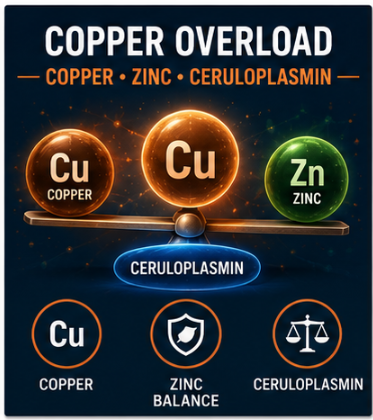
Copper Overload


$199.00
The Copper Overload Panel measures serum copper, ceruloplasmin, and plasma zinc—the three core laboratory markers used together to evaluate copper metabolism and copper/zinc balance.
This focused panel is useful when symptoms such as anxiety, irritability, insomnia, hormonal sensitivity, mood instability, or behavioral changes raise concern for abnormal copper regulation. Copper should not be interpreted alone; the relationship between copper, ceruloplasmin, and zinc provides a more meaningful picture and may help identify the copper-overload pattern emphasized in the Walsh Approach.
Description
The Copper Overload Panel measures serum copper, ceruloplasmin, and plasma zinc — the three core laboratory markers used together to evaluate copper metabolism and copper/zinc balance.
Copper is an essential nutrient, but abnormal copper metabolism can affect neurotransmitter regulation, oxidative balance, mood, behavior, hormonal sensitivity, and neurological function. The relationship between copper, ceruloplasmin, and zinc is therefore more informative than looking at serum copper alone.
Copper must be interpreted together with ceruloplasmin and zinc. A person may have a clinically important copper imbalance even when the total copper result by itself does not appear dramatically elevated.
The Three Markers That Matter
Serum Copper
CopperMeasures total circulating copper and provides the starting point for evaluating copper status.
Copper is essential for normal physiology, but excessive or poorly regulated copper may contribute to oxidative and neurotransmitter imbalance.
Ceruloplasmin
Copper TransportCeruloplasmin is a copper-binding protein produced primarily by the liver. Much of the copper circulating in blood is normally carried by ceruloplasmin.
Comparing copper with ceruloplasmin helps provide a more complete picture of copper transport and regulation.
Plasma Zinc
ZincZinc is an essential mineral with important roles in neurotransmitter function, antioxidant defense, immune regulation, enzyme activity, and copper balance.
Low zinc frequently accompanies the copper-overload pattern identified in Walsh-oriented assessment.
Copper Should Never Be Interpreted Alone
Ceruloplasmin and Non-Ceruloplasmin-Bound Copper
Ceruloplasmin binds and transports much of the copper circulating in the bloodstream. When copper is disproportionately high relative to ceruloplasmin, a larger fraction may exist outside normal ceruloplasmin binding.
This is often referred to clinically as non-ceruloplasmin-bound copper or, less precisely, “free copper.”
Poorly regulated copper can participate in oxidation-reduction reactions and may contribute to oxidative stress and cellular injury. This is different from saying that copper itself is a “free radical.”
The relationship between total copper and ceruloplasmin can therefore provide information that is not apparent from the serum copper value alone.
Copper, Dopamine & Norepinephrine
Copper has an important relationship with catecholamine neurotransmitter metabolism.
The enzyme dopamine beta-hydroxylase requires copper and participates in the conversion of dopamine to norepinephrine.
This biochemical relationship is one reason copper metabolism receives particular attention in the Walsh Approach when evaluating patients with anxiety, agitation, emotional reactivity, insomnia, and other mood or behavioral symptoms.
When Is Copper Overload Worth Investigating?
Copper imbalance may be worth considering when the clinical history includes characteristic combinations of mood, hormonal, behavioral, or physical symptoms.
Mood & Anxiety
Anxiety, panic, inner tension, emotional volatility, irritability, agitation, depression, or difficulty calming the nervous system.
Sleep & Activation
Insomnia, racing thoughts, increased arousal, restlessness, or feeling persistently “wired.”
Hormonal Patterns
Symptoms associated with puberty, pregnancy, postpartum changes, menstrual cycles, menopause, estrogen exposure, or other periods of hormonal change.
Attention & Behavior
Attention problems, impulsivity, agitation, emotional dysregulation, or behavioral symptoms may sometimes occur alongside abnormal copper/zinc balance.
Copper, Estrogen & Postpartum Mood Changes
Copper metabolism has an important relationship with estrogen. Copper and ceruloplasmin normally rise substantially during pregnancy and then change following delivery.
Within the Walsh model, difficulty restoring normal copper balance after pregnancy is considered particularly relevant in some women with postpartum depression, anxiety, agitation, or other postpartum mood symptoms.
Why Zinc Is Just as Important as Copper
A copper panel without zinc provides an incomplete picture.
Zinc is involved in hundreds of biological processes and is particularly important to antioxidant defense, immune regulation, neurological function, enzyme activity, intestinal health, and neurotransmitter regulation.
Within the Walsh Approach, copper overload frequently occurs together with inadequate zinc status. Correcting the pattern therefore involves understanding both sides of the copper/zinc relationship rather than simply attempting to lower copper.
Copper, Zinc & Methylation
Copper overload may also intersect with methylation indirectly, particularly when high copper occurs together with low zinc.
One important area is the metabolism of SAH (S-adenosylhomocysteine). SAH is produced after SAM donates a methyl group and is a potent inhibitor of methyltransferase reactions when it accumulates.
Zinc participates in enzymes involved in downstream adenosine metabolism. In the Walsh-oriented interpretation of elevated SAH, inadequate downstream clearance — including impaired adenosine handling — may interfere with efficient movement through the reversible SAH hydrolase pathway.
For this reason, significant zinc deficiency may have consequences extending beyond copper balance and should be considered when interpreting broader methylation abnormalities.
Copper Overload in the Walsh Approach
Copper overload is one of the major biochemical patterns emphasized by Dr. William Walsh and the Walsh Research Institute.
The Walsh Approach does not diagnose copper overload from symptoms alone. Laboratory findings are interpreted together with clinical history, symptoms, hormonal patterns, zinc status, medication responses, and other biochemical findings.
Learn More About Copper Overload
Explore the educational sections below for a deeper explanation of copper, zinc, ceruloplasmin, symptoms, and the Walsh biochemical approach.
Copper Overload Articles Copper & Ceruloplasmin Copper Overload EducationCopper Panel or Comprehensive Biotype Panel?
Copper Overload Panel
Copper Zinc CeruloplasminBest when the primary question is whether copper/zinc imbalance may be contributing to symptoms.
Comprehensive Biotype Panel
Methylation Copper Zinc Vitamin D CBC / CMPUsually the better starting point for someone seeking a complete Walsh biochemical assessment, because copper imbalance frequently overlaps with methylation and other nutrient patterns.
What Is Included?
| Laboratory Test | What It Helps Assess |
|---|---|
| Copper, Serum | Total circulating copper and overall copper status |
| Ceruloplasmin | Copper-binding and transport; interpretation of copper status |
| Zinc, Plasma | Zinc status and copper/zinc balance |
Why Interpretation Matters
Copper results should not be interpreted simply as “high” or “normal.” The relationship between copper, ceruloplasmin, zinc, symptoms, and clinical history provides the more useful picture.
Interpretation may include consideration of total copper, zinc status, the relationship between copper and ceruloplasmin, and whether the overall pattern fits the patient's clinical history.
Copper and zinc both perform essential biological functions. The objective is to restore appropriate balance rather than simply drive copper as low as possible.
Need Help Interpreting Your Results?
Laboratory values are most useful when considered alongside symptoms, hormonal history, medications, supplements, methylation status, and other biochemical findings.
A focused physician consultation can be used to review the Copper Overload Panel. Patients seeking a broader Walsh evaluation may instead choose the Comprehensive Biotype Panel with Consultation and Biotype Report.
20-Minute Consultation Comprehensive Biotype ConsultationAdditional information
| Copper Overload Panel | Test Only, Test plus Phone Consult |
|---|