


Follow-Up Biotype + Methylation Assessment
$299.00
Physician-reviewed assessment for established patients repeating both Walsh Biotype labs and methylation testing.
Compares updated symptoms and treatment response with prior Biotype and methylation findings, including SAM, SAH, methionine, homocysteine, copper/zinc balance, whole blood histamine, and related markers.
Includes AI-supported questionnaire scoring and trend organization, physician interpretation of the changes, an updated written assessment and nutrient/supplement plan, plus a courtesy phone call to review the report.
Description
This repeat methylation panel interpretation is for established patients who are repeating both Walsh Biotype testing and methylation-related laboratory testing after an initial assessment and nutrient plan.
The purpose is to compare current symptoms, questionnaire trends, treatment response, repeat Biotype labs, and methylation markers with prior findings to determine whether the biochemical pattern is improving, persisting, shifting, or suggesting that the nutrient strategy should be adjusted.
How Do I Know if Methylation Treatment Is Working?
The most useful way to evaluate methylation treatment response is to look at symptoms and laboratory trends together.
A patient may feel substantially better while SAM, SAH, copper/zinc balance, histamine, homocysteine, or other biochemical markers are still correcting. In other cases, laboratory findings may improve while important symptoms remain.
Symptoms Improve + Labs Improve
This usually provides the strongest evidence that the biochemical pattern and treatment response are moving in the intended direction.
Symptoms Improve + Labs Lag Behind
The current plan may still be working, but continued treatment and repeat monitoring may be appropriate before making large changes.
Labs Improve + Symptoms Persist
This may suggest that the original biochemical pattern is only part of the clinical picture and that another contributor deserves attention.
Symptoms or Labs Worsen
The nutrient plan, supplement tolerance, dosing, methylation strategy, or broader biochemical interpretation may need to be reconsidered.
What Does Repeat Methylation Panel Interpretation Show?
A repeat methylation panel interpretation is not simply a second reading of the same laboratory test. The purpose is to determine how methylation chemistry has changed after treatment and whether those changes match the patient's clinical response.
Depending on the panel used, the physician review may include changes in:
SAM
Whether methyl-donor availability has improved, remained low, or shifted in relation to treatment.
SAH
Whether methylation inhibition appears to be improving, persisting, or becoming more prominent.
Methionine & Homocysteine
Whether methionine-cycle patterns are changing in a way that supports or challenges the current methylation strategy.
Adenosine
May provide additional context when SAH clearance remains impaired or the methylation pattern does not normalize as expected.
Transsulfuration Markers
Cysteine, cystathionine, glutathione, taurine, and related findings can show whether sulfur and antioxidant pathways are shifting with treatment.
Methyl Donor Pathways
Betaine and related metabolites can provide additional information about remethylation and methyl-donor availability.
What Does SAM/SAH Trend Interpretation Show?
SAM/SAH trend interpretation evaluates whether effective methylation capacity appears to be changing in response to treatment.
SAM supplies methyl groups for many biochemical reactions. SAH is produced after those methyl groups are transferred and can inhibit methyltransferase activity when it accumulates.
A follow-up methylation assessment asks whether SAM is becoming more adequate, whether SAH is clearing more effectively, and whether the relationship between the two is moving in a clinically favorable direction.
What if SAM Improves but SAH Stays High?
An improvement in SAM does not necessarily mean that methylation efficiency has normalized if SAH remains elevated.
Persistent high SAH can continue to inhibit methyltransferase activity. This is why a high SAH follow-up should consider the entire pathway rather than focusing only on increasing methyl donors.
The review may consider homocysteine, adenosine, zinc status, gut and metabolic stress, cellular energy, treatment response, and other factors that may influence SAH clearance.
For more background, see What Causes Undermethylation? Low SAM vs. High SAH.
What if SAM Remains Low?
A low SAM follow-up asks why methyl-donor availability remains inadequate despite treatment.
Potential contributors may include insufficient methionine availability, impaired methionine-to-SAM conversion, inadequate ATP or magnesium support, increased methylation demand, high endogenous creatine demand, medication effects, or other metabolic pressures.
The appropriate change in treatment depends on the broader pattern rather than the SAM value alone.
Why Repeat Walsh Biotype Labs With Methylation Testing?
The Walsh Biotype and methylation panels answer complementary questions.
The methylation panel shows what is happening within the methylation and related pathways. The Biotype labs show whether other core Walsh patterns—such as copper/zinc imbalance, histamine-related methylation tendency, pyroluria, or nutrient deficiencies—are improving at the same time.
Copper, Zinc & Ceruloplasmin
Help determine whether copper overload or zinc deficiency is resolving and whether calculated free copper is changing appropriately.
Whole Blood Histamine
Provides a repeat traditional Walsh marker that can be compared with direct methylation findings and symptom response.
Homocysteine
Helps connect the Biotype assessment with direct methylation and transsulfuration findings.
Vitamin D, CBC & CMP
Provide additional nutrient, hematologic, liver, kidney, electrolyte, and metabolic context relevant to ongoing treatment.
Urinary Pyrroles When Indicated
May be repeated when pyroluria remains clinically relevant or prior findings need reassessment.
View the Comprehensive Biotype Panel.
How Does the WalshDoc Trend Report Work?
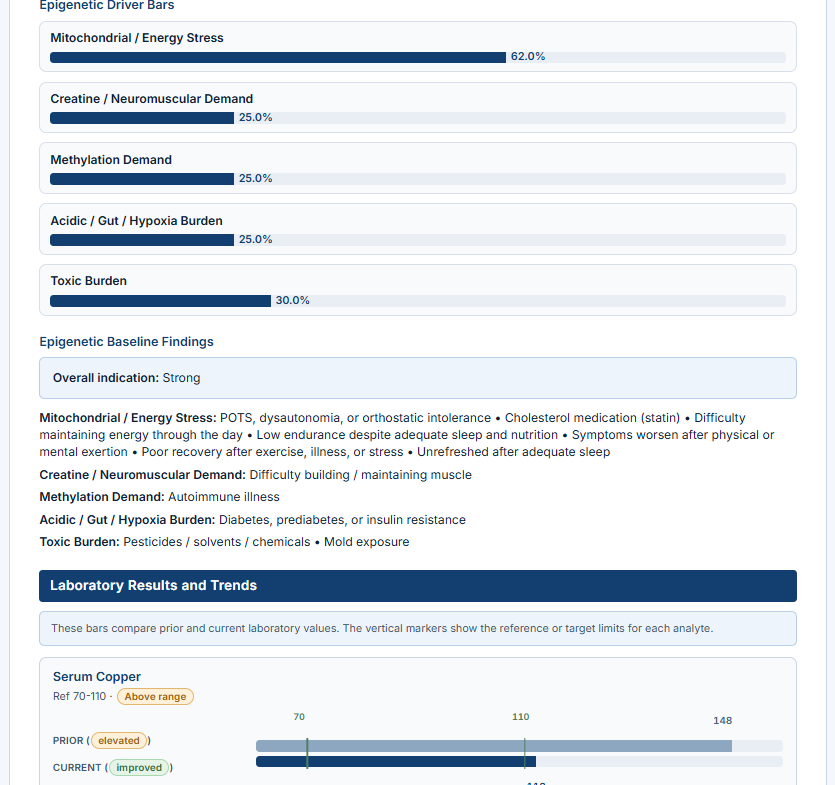
The follow-up WalshDoc report is designed to show change over time, rather than simply produce another stand-alone assessment.
The patient completes an updated questionnaire describing current symptoms, treatment response, supplement tolerance, side effects, setbacks, and other changes since the prior assessment.
The actual report organizes the patient's submitted responses into structured trends such as improved, worsened, unchanged, or no longer relevant. These symptom changes are then reviewed alongside updated Biotype and methylation laboratory findings.
How Does AI-Supported Analysis and Scoring Help?
WalshDoc uses AI-supported analysis and structured scoring to help organize questionnaire findings, symptom trends, Walsh Biotype patterns, and methylation-related indicators into a format that can be reviewed efficiently.
Structured Symptom Scoring
Questionnaire findings are organized by Biotype and Epigenetic Biotype rather than presented as an unstructured symptom list.
Trend Comparison
Current responses are compared with the prior clinical pattern to highlight areas that improved, worsened, or remained unchanged.
Pattern Organization
The system groups relevant findings into biochemical categories that can then be compared with laboratory data.
Physician Interpretation
The scoring and AI-supported organization do not determine treatment independently. Dr. Epstein reviews the clinical history, questionnaire trends, laboratory results, and treatment response before preparing the updated assessment.
WalshDoc scoring is intended to make complex longitudinal information easier to compare. It is not an automated diagnosis or stand-alone treatment recommendation.
Learn more about the WalshDoc follow-up questionnaire and trend assessment.
What Is Included in the Updated Written Assessment?
Current Biotype and methylation-related symptoms are compared with the prior clinical pattern.
Updated copper, zinc, ceruloplasmin, histamine, homocysteine, vitamin D, CBC/CMP, and other relevant findings are reviewed.
SAM, SAH, methionine, homocysteine, adenosine, glutathione, cysteine, cystathionine, betaine, taurine, and related pathway findings are reviewed when available.
Laboratory and symptom changes are compared with the original assessment to identify meaningful biochemical trends.
Dr. Epstein evaluates whether the original biochemical interpretation remains appropriate or should be modified.
Recommendations may be continued, adjusted, simplified, sequenced differently, or expanded according to the new findings.
When Should a Methylation Supplement Plan Be Changed?
A methylation supplement monitoring strategy should not assume that the same doses or nutrients remain appropriate indefinitely.
The plan may need adjustment when:
- SAM remains low despite treatment;
- SAH remains elevated;
- SAM/SAH balance improves but symptoms do not;
- homocysteine moves outside the desired range;
- copper/zinc balance is changing significantly;
- new supplement sensitivity develops;
- symptoms improve enough that prior doses may no longer be necessary;
- new metabolic or gastrointestinal factors become apparent.
What if Symptoms Improve but Methylation Labs Do Not?
Clinical improvement is important, but persistent biochemical abnormalities may indicate that treatment is incomplete.
For example, a patient may feel better while SAH remains elevated, SAM remains low, or copper/zinc balance is still correcting. In that situation, continued treatment or a modified strategy may still be appropriate.
This is one reason biochemical treatment response should be evaluated using both clinical and laboratory trends.
What if Methylation Labs Improve but Symptoms Do Not?
Improved methylation markers do not guarantee that every symptom will resolve if other biochemical or clinical factors remain active.
Persistent symptoms may suggest that the patient also has unresolved copper overload, pyroluria, mitochondrial stress, gastrointestinal dysfunction, hormonal factors, medication effects, inflammation, environmental exposures, or another contributor that deserves attention.
When Is Biotype + Methylation Retesting Better Than Biotype Labs Alone?
The combined assessment is most appropriate when both the traditional Walsh Biotype pattern and the direct methylation chemistry need to be followed together.
Choose Biotype + Methylation Retesting When:
SAM/SAH, methionine, homocysteine, glutathione, or related methylation findings were important in the original assessment and need repeat interpretation.
Choose Biotype-Only Follow-Up When:
The main goal is to reassess copper/zinc balance, histamine, homocysteine, vitamin D, CBC/CMP, pyrroles, and traditional Walsh Biotype response without repeating a methylation panel.
If only Biotype labs are being repeated, use the Follow-Up Walsh Protocol Biotype Assessment.
Which Lab Review Option Should I Choose?
Standard Follow-Up — $299
Choose this option when the repeat Biotype and methylation testing was ordered through Second Opinion Physician or is already provided in the expected format.
Outside Laboratory Review — $399
Choose this option when results come from another physician, clinic, or laboratory and require additional organization, reconciliation, or comparison across different dates, formats, methods, reference ranges, or incomplete panels.
What Does the Courtesy Phone Call Include?
The primary service being purchased is the physician review, laboratory interpretation, trend analysis, updated written assessment, and revised nutrient plan.
A courtesy phone call is included after the report is prepared to review the principal findings, clarify recommendations, and answer reasonable questions about the written assessment.
Complex review of repeat Biotype and methylation testing requires substantially more physician time than the call itself. The written report is the primary clinical product.
Complete the Follow-Up Questionnaire Before Your Review
Established patients should complete the appropriate WalshDoc follow-up questionnaire before the physician assessment so that current symptoms and treatment response can be compared with the prior pattern.
Complete the WalshDoc follow-up assessment before submitting repeat Biotype and methylation laboratory results.
View the Follow-Up Questionnaire Understanding the Methylation TestWhat Does This Follow-Up Assessment Not Include?
- a new-patient comprehensive assessment;
- emergency or psychiatric crisis care;
- medication management;
- unlimited messaging or ongoing case management;
- comprehensive review of unrelated medical conditions or extensive unrelated lab panels unless separately arranged.
If the clinical picture has substantially expanded beyond the original Walsh Biotype and methylation assessment, a broader functional medicine review may be more appropriate.
Repeat Methylation Panel & SAM/SAH Trend FAQs
How do I know if methylation treatment is working?
Treatment response is evaluated by comparing current symptoms, supplement tolerance, repeat Biotype findings, methylation laboratory trends, and prior results. Improvement in both clinical symptoms and relevant biochemical markers generally provides the strongest evidence of progress.
What does repeat methylation panel interpretation show?
It evaluates how markers such as SAM, SAH, methionine, homocysteine, adenosine, glutathione, cysteine, cystathionine, betaine, taurine, and related pathway findings have changed since the prior assessment.
What does SAM/SAH trend interpretation show?
It helps determine whether methyl-donor availability and methylation inhibition appear to be moving in a favorable direction and whether the relationship between SAM and SAH is improving with treatment.
What if SAM improves but SAH remains high?
Persistent high SAH may continue to inhibit methylation even when SAM improves. The follow-up review considers the broader pathway, including homocysteine, adenosine, clinical response, and other metabolic factors.
Why repeat Biotype labs at the same time?
Biotype labs help determine whether copper/zinc balance, histamine-related patterns, homocysteine, vitamin D, pyroluria, and other Walsh findings are improving alongside the methylation chemistry.
How does the WalshDoc trend report work?
The follow-up report organizes current questionnaire responses into symptom trends such as improved, worsened, unchanged, or no longer relevant and compares those trends with prior findings and updated laboratory results.
Does AI make the diagnosis or treatment plan?
No. WalshDoc uses AI-supported organization and structured scoring to help summarize questionnaire findings and trends. Physician review determines the clinical interpretation and recommendations.
What if I am only repeating Biotype labs?
Use the focused Follow-Up Walsh Protocol Biotype Assessment when direct methylation-panel interpretation is not needed.
Additional information
| Consultation | Consultation, Consultation with Labs Provided by Patient |
|---|