
Homocysteine: Cardiovascular Risk, Methylation, MTHFR & the Walsh Approach
Homocysteine is much more than a vitamin marker. It is an important cardiovascular risk marker and a central intermediate in the methylation cycle, connecting methionine and SAM to SAH, glutathione production, oxidative stress and one-carbon metabolism.
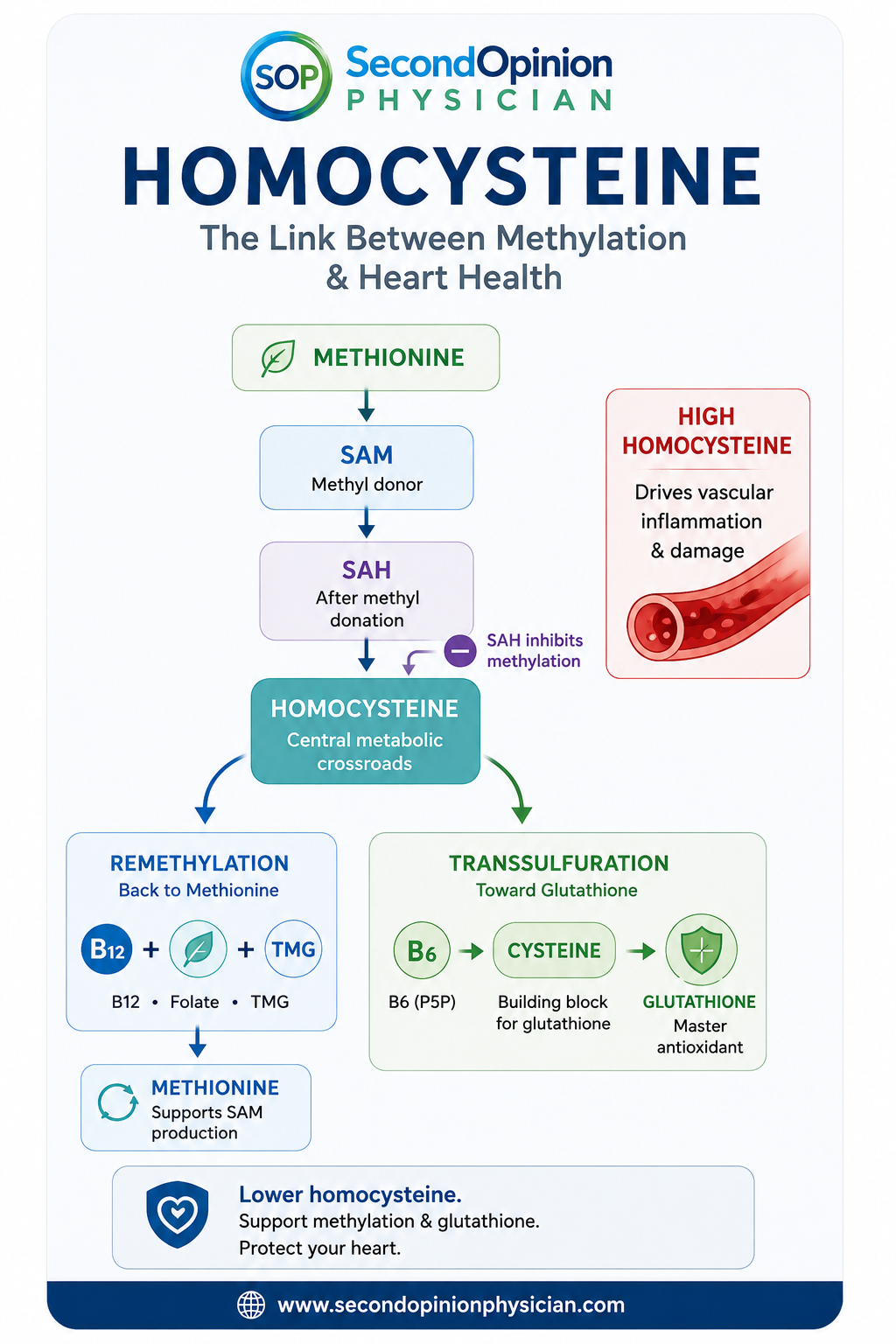
An elevated homocysteine level can provide evidence that these pathways are not functioning efficiently. A normal level can be equally informative—particularly when interpreting MTHFR genetic variants. Finding an MTHFR SNP does not establish impaired methylation by itself. When homocysteine is normal and other functional markers are favorable, the genetic variant may have relatively little biochemical expression.
The Walsh Approach and Dr Epstein's Five-Epigenetic-Driver assessment therefore look beyond an isolated MTHFR result. Homocysteine is interpreted alongside symptoms, methylation phenotype, nutrient status and, when appropriate, direct measurements of SAM, SAH, methionine and related methylation metabolites.
Why Homocysteine Is an Important Blood Test
Homocysteine is unusual because it provides information about both cardiovascular risk and methylation metabolism. Elevated levels can signal impaired one-carbon metabolism while also being associated with vascular dysfunction, oxidative stress and cardiovascular and cerebrovascular risk.
Cardiovascular Risk
Homocysteine provides information about vascular and metabolic risk that is different from cholesterol alone.
Methylation
It sits at the intersection of methionine recycling, SAM/SAH metabolism and glutathione production.
MTHFR Context
Homocysteine helps determine whether an MTHFR variant appears to be producing a functional bottleneck in remethylation.
Homocysteine and Cardiovascular Disease Risk
Homocysteine is not another cholesterol measurement. It is a sulfur-containing amino acid whose concentration reflects several nutrient-dependent and metabolic pathways. Persistently elevated homocysteine has been associated with coronary artery disease, stroke and other vascular disorders.
A lipid panel evaluates lipid-related risk. Homocysteine provides a different window into vascular stress, methylation and nutrient-dependent metabolism. A person can have acceptable cholesterol values while still having elevated homocysteine.
Why Can High Homocysteine Contribute to Vascular Inflammation?
Endothelial Dysfunction
Elevated homocysteine can interfere with normal function of the endothelium—the inner lining of blood vessels.
Oxidative Stress
Abnormal homocysteine metabolism is associated with increased oxidative stress and impaired vascular antioxidant defenses.
Nitric Oxide
Homocysteine can adversely affect nitric-oxide signaling, potentially influencing normal vascular relaxation and blood flow.
Inflammatory Signaling
Persistent elevation can contribute to an unfavorable vascular environment involving inflammation and vascular remodeling.
Blood pressure, glucose, ApoB, LDL, triglycerides, smoking history, inflammation and other established risk factors remain important.
Homocysteine and the Methylation Pathway
Homocysteine occupies a central position in one-carbon metabolism. Methionine is converted to S-adenosylmethionine (SAM), the body's major methyl donor.
SAM donates methyl groups to reactions involving DNA regulation, neurotransmitters, hormones, phospholipids, creatine and many other compounds. After donating its methyl group, SAM becomes S-adenosylhomocysteine (SAH).
SAH inhibits methyltransferase reactions. A person can therefore have normal homocysteine while still having elevated SAH and impaired methylation.
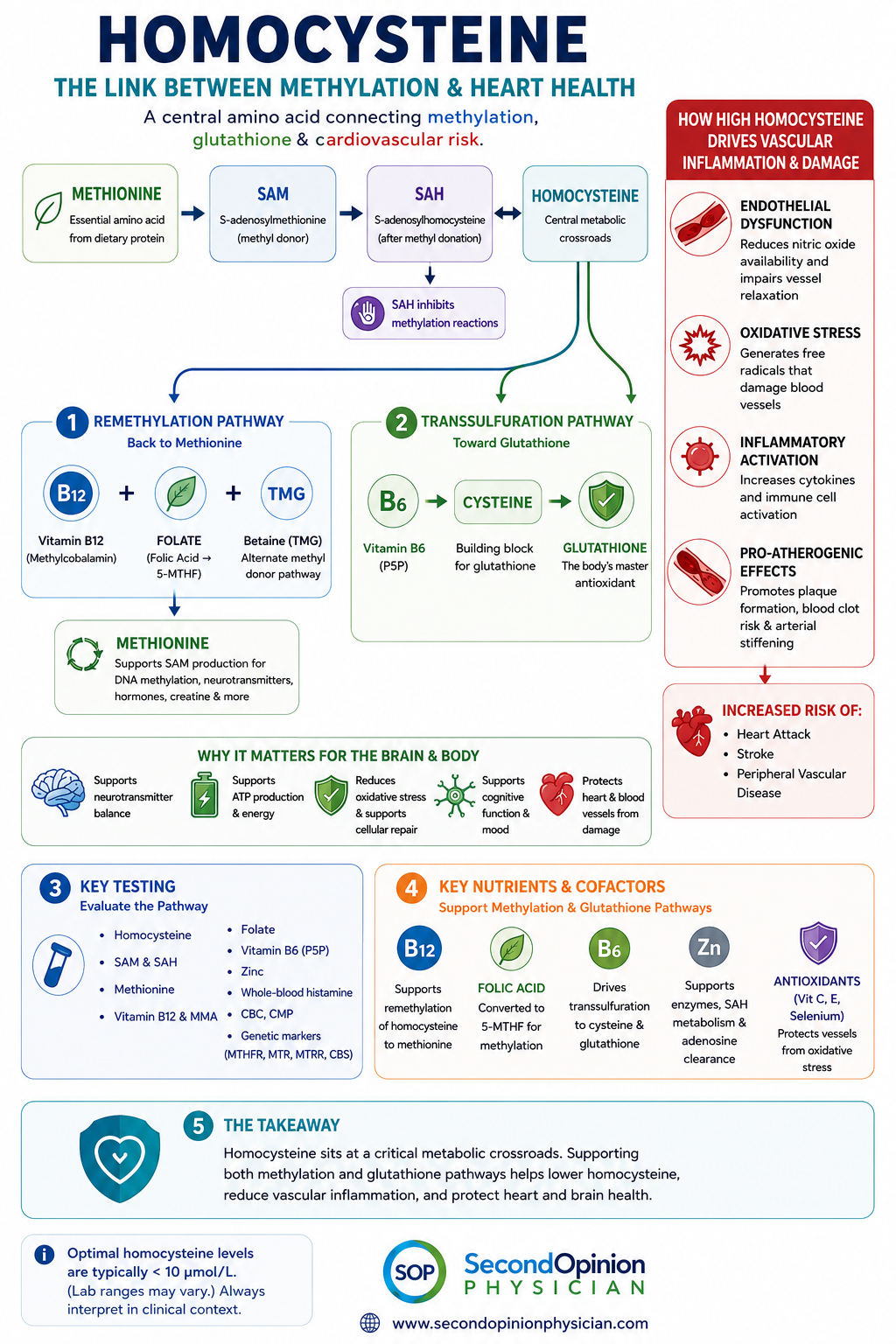
How the Body Processes Homocysteine
Remethylation → Methionine & SAM
Homocysteine can receive a methyl group and return to methionine, supporting continued SAM production.
- Vitamin B12
- Folate-dependent metabolism
- TMG / betaine
- Methionine availability
- Overall methylation demand
Transsulfuration → Glutathione
Homocysteine can move through cystathionine toward cysteine, an important precursor for glutathione.
- Vitamin B6 / P5P
- Cystathionine metabolism
- Cysteine availability
- Glutathione synthesis
- Oxidative-stress demand
Homocysteine and MTHFR: Why the SNP Does Not Tell the Whole Story
MTHFR participates in folate metabolism and helps generate 5-methyltetrahydrofolate, which participates in the B12-dependent remethylation of homocysteine to methionine.
Certain MTHFR variants can reduce enzyme activity. However, identifying an MTHFR SNP does not automatically establish impaired methylation, elevated homocysteine or a need for methylfolate.
MTHFR Genetic Test
Identifies inherited MTHFR variants.
Genetics show what could influence the pathway.Homocysteine Blood Test
Shows whether homocysteine is actually accumulating at the time of testing.
Biochemistry helps show what is happening now.Can Normal Homocysteine Suggest MTHFR Is Not the Main Problem?
Yes—with an important qualification. Normal homocysteine does not rule out an MTHFR variant. It does indicate that homocysteine metabolism is currently being maintained well enough to prevent significant accumulation.
A person may carry one or even two common MTHFR variants while maintaining normal homocysteine because folate status, B12 status, riboflavin, diet, alternate remethylation pathways and other compensatory mechanisms are adequate.
When homocysteine and other functional markers are favorable, an MTHFR variant may not be the primary biochemical problem requiring treatment.
B12 deficiency, folate deficiency, B6 deficiency, kidney dysfunction, thyroid dysfunction, medications and other metabolic factors can also elevate homocysteine.
Homocysteine, SAM and SAH: Direct Methylation Testing
SAM — Methyl Donor
S-adenosylmethionine supplies methyl groups throughout the body. Low SAM availability can limit methyl-donor capacity.
SAH — Methylation Inhibitor
SAH is produced after SAM donates its methyl group. Elevated SAH can directly inhibit methyltransferase reactions.
This reaction is reversible. Effective handling of homocysteine and adenosine influences movement away from SAH.
This is why an expanded methylation assessment may consider homocysteine together with SAM, SAH, methionine, adenosine handling, zinc status, metabolic health and clearance pathways.
Homocysteine in the Walsh Approach to Undermethylation
The Walsh Approach does not determine undermethylation from an MTHFR SNP alone. Symptoms, biochemical phenotype and laboratory findings are considered together.
Walsh Biotype Assessment
Whole-blood histamine, symptoms, physical traits, family history, medication response and nutrient patterns help identify a biochemical phenotype.
Expanded Methylation Assessment
Homocysteine, SAM, SAH and methionine add information about how the methylation cycle is functioning and where a metabolic bottleneck may be occurring.
Homocysteine and the Five Epigenetic Drivers of Undermethylation
The Epstein Five-Epigenetic-Driver approach expands the traditional Walsh framework by asking why methylation is impaired. Homocysteine can help identify where the cycle may be encountering difficulty.
Two people can both have an undermethylation phenotype while showing very different SAM, SAH, methionine and homocysteine patterns. Their nutritional strategies may therefore need to be different.
How Elevated Homocysteine Is Managed in the Walsh Approach
The goal is not simply to force the laboratory number downward. The more useful question is why homocysteine is elevated and which metabolic pathway needs support.
Vitamin B6 / P5P
Supports enzymes that move homocysteine through transsulfuration toward cysteine and glutathione.
Vitamin B12
Supports methionine synthase and remethylation of homocysteine back toward methionine.
TMG / Betaine
Provides an alternate route for remethylating homocysteine through the BHMT pathway without directly depending on MTHFR.
Folate — When Appropriate
Folate supports remethylation, but the Walsh Approach considers the methylation phenotype and broader biochemical pattern rather than automatically recommending folate based on an MTHFR result.
Zinc
Zinc supports numerous metabolic processes. In the elevated-SAH interpretation, zinc status is also considered in relation to adenosine metabolism and the biochemical conditions affecting SAH clearance.
Creatine & Methylation Demand
Endogenous creatine synthesis consumes methyl groups. Providing creatine can reduce the body's need to synthesize all of its creatine internally and may reduce methylation demand.
Lab Tests for Homocysteine, MTHFR and Methylation
Homocysteine is most useful when interpreted in context. Testing can be organized around the methylation cycle itself, nutrient cofactors and medical factors that can influence the result.
Functional marker connecting methylation and cardiovascular risk.
View Test →Provides a more direct view of methylation chemistry.
View Panel →Identifies common MTHFR genetic variants.
View Test →Traditional Walsh marker used in assessing methylation phenotype.
View Test →Important to the transsulfuration pathway.
View Test →Key nutrients involved in homocysteine remethylation.
View Test →Measures folate status relevant to one-carbon metabolism.
View Test →Important mineral in the broader methylation and antioxidant system.
View Test →Assesses a major antioxidant connected to transsulfuration.
View Test →Useful functional marker when evaluating vitamin B12 status.
View Test →Supports mitochondrial antioxidant defense through manganese-dependent SOD.
View Test →Provides hematologic context including red-cell indices.
View Test →Adds kidney, liver, glucose, protein and electrolyte information.
View Test →Provides additional information about kidney filtration and clearance.
View Test →Thyroid dysfunction can be relevant when investigating elevated homocysteine.
View Panel →Homocysteine Testing: Where Cardiovascular Risk Meets Methylation
One Marker Can Answer Several Different Questions
Homocysteine provides information relevant to vascular risk, remethylation, transsulfuration and methylation metabolism.
An elevated result deserves investigation rather than an automatic prescription for methylfolate. A normal result can also be informative, particularly when determining whether an MTHFR variant appears to be producing a significant functional problem.
When the clinical picture suggests deeper methylation dysfunction, homocysteine can be interpreted alongside SAM, SAH, methionine, whole-blood histamine and the broader biochemical phenotype.
Frequently Asked Questions About Homocysteine, MTHFR and Methylation
What does a high homocysteine level mean?
Elevated homocysteine can reflect impaired remethylation or transsulfuration and may occur with deficiencies of folate, vitamin B12 or vitamin B6, kidney dysfunction, thyroid disorders, medications and other metabolic factors. It is also associated with cardiovascular and cerebrovascular risk.
Does high homocysteine mean I have an MTHFR mutation?
No. MTHFR variants are only one possible contributor. Elevated homocysteine has multiple nutritional, metabolic and medical causes and should not automatically be attributed to MTHFR.
Can you have an MTHFR mutation with normal homocysteine?
Yes. Many people with common MTHFR variants maintain normal homocysteine. This suggests that homocysteine metabolism is currently being maintained adequately, although it does not prove that every aspect of cellular methylation is normal.
Can normal homocysteine suggest MTHFR is not the main problem?
Yes. Normal homocysteine does not rule out an MTHFR variant, but it suggests that the variant is not currently impairing homocysteine metabolism enough to cause significant accumulation. Other methylation markers may still be abnormal.
Does normal homocysteine mean methylation is normal?
Not necessarily. Homocysteine is only one part of the methylation cycle. SAM, SAH, methionine and other metabolic factors can reveal abnormalities that are not apparent from homocysteine alone.
Why is homocysteine associated with cardiovascular disease?
Persistently elevated homocysteine is associated with endothelial dysfunction, oxidative stress, impaired nitric-oxide signaling, inflammatory activity and other unfavorable vascular changes. It provides information that is different from cholesterol and other lipid markers.
Should everyone with high homocysteine take methylfolate?
No. Folate can support homocysteine remethylation, but elevated homocysteine can have several causes. Vitamin B12, vitamin B6, kidney and thyroid function, methylation phenotype and the broader biochemical pattern should also be considered.
What is the relationship between homocysteine, SAM and SAH?
Methionine is converted to SAM, the body's major methyl donor. After SAM donates a methyl group it becomes SAH. SAH can then be converted toward homocysteine and adenosine. Because elevated SAH inhibits methylation reactions, SAM and SAH can reveal problems that homocysteine alone may miss.
How does vitamin B12 affect homocysteine?
Vitamin B12 is required for the folate-dependent remethylation of homocysteine back to methionine. Inadequate B12 availability can therefore contribute to elevated homocysteine.
How does vitamin B6 affect homocysteine?
Vitamin B6 supports the transsulfuration pathway that moves homocysteine toward cystathionine, cysteine and ultimately glutathione production.
What is the best test for understanding methylation?
No single test answers every methylation question. Homocysteine is a useful starting marker, while direct measurement of SAM, SAH and methionine can provide a more detailed picture of methylation chemistry.
How does the Walsh Approach evaluate homocysteine?
Homocysteine is interpreted within the broader biochemical pattern rather than as an isolated number. Whole-blood histamine, zinc, vitamin B6, vitamin B12, folate, symptoms and other laboratory findings may all contribute to interpretation. SAM, SAH and methionine testing can provide additional information when needed.
Start With Homocysteine — Go Deeper When Needed
Homocysteine is an excellent starting marker for evaluating methylation and cardiovascular risk. When symptoms or laboratory findings suggest a more complex methylation problem, SAM, SAH, methionine and the broader Walsh biochemical pattern can provide considerably more information.