
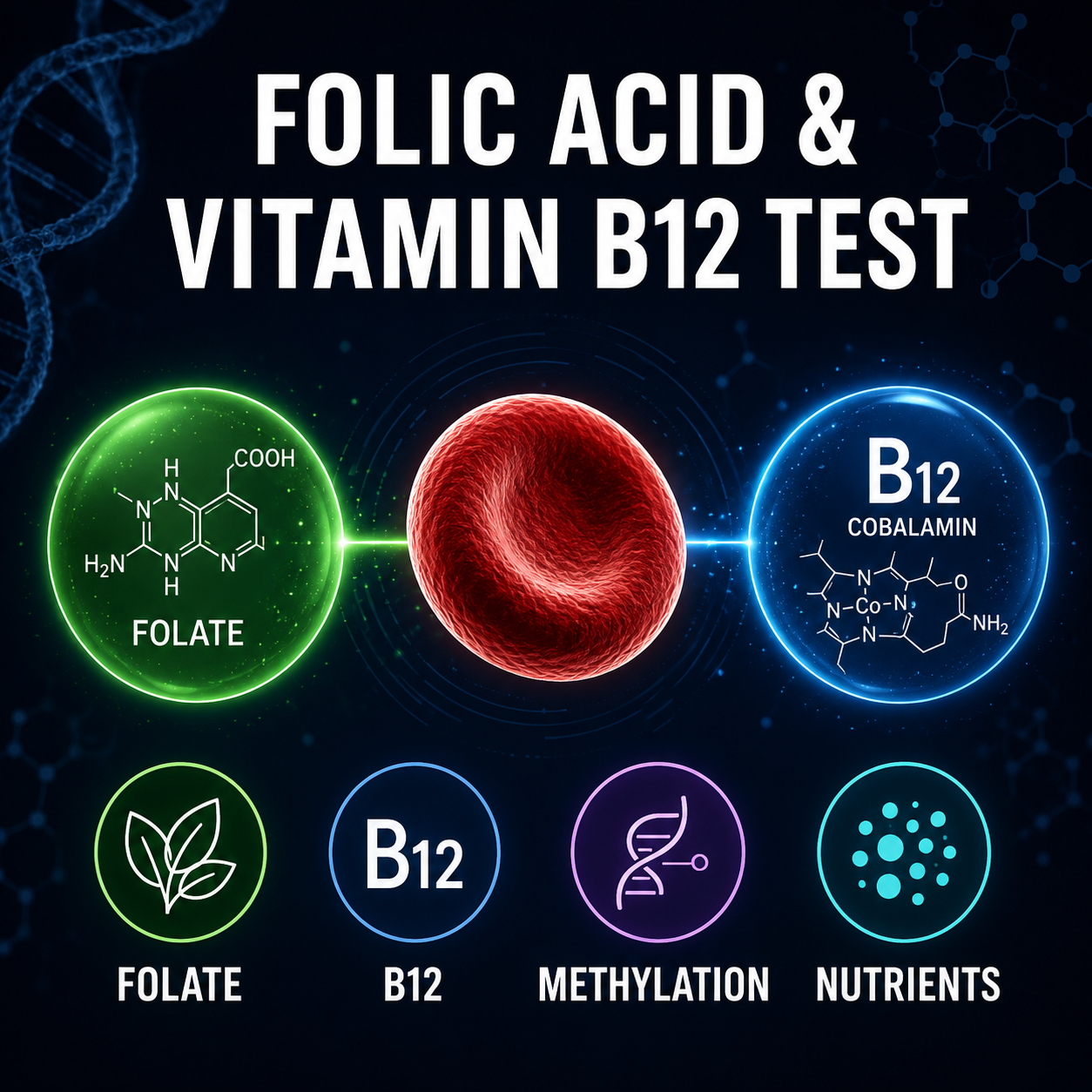
Folate & Vitamin B12


$54.00
The Vitamin B12 and Folate Test measures serum vitamin B12 and folate to help identify deficiencies that may contribute to macrocytosis, elevated homocysteine, anemia, fatigue, neuropathy, cognitive symptoms, and impaired methylation.
It is particularly useful when there are MTHFR or COMT genetic variants, suspected celiac disease or other malabsorption, alcohol use, low methionine, elevated MCV, or questions about whether folic acid or methylated folate supplementation is actually needed. Within a Walsh-oriented assessment, serum folate is especially helpful before automatically adding folate to an undermethylation protocol.
Description
The Vitamin B12 and Folate Blood Test measures two nutrients essential for red blood cell production, neurologic function, DNA synthesis, homocysteine metabolism, and methylation.
One of the most practical reasons to test is to determine whether folate is actually deficient before adding folic acid, methylfolate, or high-dose B-vitamin supplementation.
This is particularly important when evaluating undermethylation, depression, elevated homocysteine, low methionine, macrocytosis, MTHFR or COMT variants, malabsorption, celiac disease, alcohol-related nutritional problems, or unexplained neurologic symptoms.
Within the Walsh Approach, folate is not automatically considered beneficial simply because methylation is impaired. In some patients with a classic undermethylated, low-serotonin depression pattern, unnecessary folate supplementation may be counterproductive. Testing helps distinguish a true nutritional need from supplementation based primarily on genetics or assumption.
Labcorp Vitamin B12 and Folates — Test #000810
Neurologic & Methylation Support
B12 is required for normal nerve function, red blood cell formation, DNA synthesis, and recycling homocysteine toward methionine.
Measure Before Supplementing
Folate is essential when deficient, but a normal or high level may argue against automatically adding folic acid or methylfolate simply because an MTHFR variant or methylation concern is present.
Homocysteine → Methionine
B12 and folate participate in remethylation of homocysteine and can therefore help clarify nutritional causes of elevated homocysteine or low methionine.
What Does the Vitamin B12 and Folate Blood Test Measure?
This Labcorp blood test measures circulating levels of:
Vitamin B12
Vitamin B12 is required for normal neurologic function, red blood cell maturation, DNA synthesis, methionine metabolism, and methylation.
Serum Folate
Folate is required for nucleotide synthesis, cell division, red blood cell development, and one-carbon metabolism. Serum folate is particularly responsive to recent dietary and supplemental folate exposure.
B12 and folate work together in several metabolic pathways. Deficiency of either can contribute to macrocytosis, megaloblastic anemia, elevated homocysteine, fatigue, and other abnormalities.
Why Test Folate Before Taking More Folate?
Folate supplementation has become extremely common, particularly following genetic testing that identifies an MTHFR variant.
However, an MTHFR SNP does not establish that folate is deficient, nor does it prove that high-dose methylfolate is needed.
The practical question is not simply “Can I metabolize folate differently?” It is also “Do I actually need more folate?”
Measuring folate can help identify whether supplementation is correcting a deficiency or simply adding more folate to a patient whose level may already be adequate or high.
Testing may therefore help avoid unnecessary use of:
- Folic acid
- Methylfolate / 5-MTHF
- High-folate B-complex formulas
- Multiple overlapping methylation supplements
- Prenatal or multivitamin products containing additional folate
Folate, Serotonin Reuptake and Walsh Undermethylation
The Walsh Approach treats folate differently in patients with the classic undermethylated depression phenotype.
In this model, undermethylated depression is associated with excessive removal of serotonin from the synapse through increased serotonin-transporter activity. The practical treatment goal is therefore not simply to increase folate or provide every available methylated B vitamin.
Low Synaptic Serotonin Activity
The Walsh model describes a subgroup in which serotonin is cleared from the synapse too rapidly, producing relatively low serotonin activity despite normal neurotransmitter production.
More Is Not Always Better
Walsh has proposed that folates can increase expression of serotonin-reuptake transport mechanisms and may therefore worsen symptoms in some undermethylated patients with depression when folate is already sufficient.
This is why folic acid or methylfolate should not automatically be prescribed simply because a patient has depression, an MTHFR variant, or evidence of impaired methylation.
When folate is already adequate, unnecessary supplementation may provide little nutritional benefit while potentially being a poor biochemical fit for a Walsh-defined undermethylated depression pattern.
If a true folate deficiency exists, that deficiency still deserves attention. The result should be interpreted with the clinical phenotype, B12, homocysteine, methionine, SAM, SAH, medications, and broader methylation findings.
Folate Is Not the Same as Methylation
This distinction is particularly important in functional medicine.
Folate participates in one-carbon metabolism, but adding folate does not necessarily mean that overall methylation will improve.
Methylation can be impaired for many reasons, including:
- Low methionine
- Low SAM
- Elevated SAH
- Impaired SAH clearance
- Mitochondrial dysfunction and low cellular energy
- High creatine synthesis demand
- Oxidative stress
- Toxic burden
- Inflammation
- Mineral deficiencies
- Acid-base or metabolic-clearance problems
For this reason, treating every methylation abnormality with methylfolate may miss the actual biochemical bottleneck.
Folate Testing With MTHFR and COMT Variants
Genetic variants such as MTHFR and COMT identify potential differences in biochemical pathways, but genetics indicate potential rather than current biochemical function.
Potential Folate-Pathway Difference
An MTHFR variant can affect conversion within folate metabolism but does not establish whether serum or tissue folate is actually low.
Methyl-Donor Response
COMT variants may influence individual responses to changes in methyl-donor exposure, but they do not determine B12 or folate status.
Measure the Current State
B12, folate, homocysteine, methionine, SAM, and SAH provide information about what is happening biochemically now.
Do You Need Methylfolate Because You Have MTHFR?
Not necessarily.
Before adding methylfolate, it is useful to ask:
- Is folate actually deficient?
- Is vitamin B12 adequate?
- Is homocysteine elevated?
- Is methionine low?
- Is MCV elevated?
- Is there evidence of malabsorption?
- What folate-containing supplements are already being taken?
- Does the broader pattern suggest undermethylation, overmethylation, elevated SAH, or another methylation problem?
An isolated genetic variant should not substitute for biochemical assessment.
Pregnancy, Folic Acid and Neural Tube Defect Prevention
Folic acid has an important and well-established role in preventing neural tube defects such as spina bifida and anencephaly.
Public-health recommendations advise women capable of becoming pregnant to obtain adequate folic acid before conception and during early pregnancy because the neural tube develops very early, often before pregnancy is recognized.
This page is not recommending that women disregard established folic-acid recommendations for pregnancy.
Neural-tube-defect prevention and treatment of a Walsh-defined undermethylated depression pattern are different clinical questions and should not be confused.
The Walsh Hypothesis: Could Excess Folate Exposure Contribute to Undermethylation?
Dr. William Walsh has raised a broader concern that the dramatic increase in folic-acid exposure associated with supplementation and food fortification may have unintended epigenetic effects in susceptible individuals.
Within the Walsh model, excessive folate exposure—particularly during critical developmental periods such as preconception and pregnancy—has been proposed as one possible contributor to persistent or chronic undermethylation in some offspring.
Walsh has further argued that the increasing prevalence of undermethylated biochemical patterns may partly reflect changes in environmental and nutritional exposures across generations.
This is a Walsh hypothesis, not an established conclusion of mainstream prenatal or epidemiologic medicine. The protective effect of appropriate folic acid against neural tube defects is well established. The question Walsh raises is whether unnecessary or excessive exposure beyond physiologic need could have different epigenetic effects in genetically or biochemically susceptible individuals.
This distinction supports a practical principle outside of established pregnancy-prevention recommendations: when deciding whether to prescribe additional folate therapeutically, measure need rather than assuming that more is always beneficial.
Epstein Perspective: Folate Is Only One Potential Epigenetic Pressure
Dr. Epstein's clinical model expands the discussion beyond folate exposure alone.
Modern patients may be exposed to several acquired or epigenetic pressures simultaneously, including:
Environmental Exposure
Metals, chemicals, pollutants, mold-related exposures, medications, and other environmental stressors may increase detoxification and antioxidant demand.
Cellular Energy Stress
Mitochondrial dysfunction can reduce ATP availability while increasing oxidative stress and cellular repair requirements.
Chronic Immune Activation
Allergy, metabolic inflammation, infection, dysbiosis, and other immune stresses can increase biochemical and antioxidant demand.
SAM Consumption
Endogenous creatine synthesis consumes substantial SAM-dependent methylation capacity and can become more important when energy or muscle demands are high.
DNA & Membrane Repair
Oxidative injury increases antioxidant, glutathione, cellular-repair, and metabolic requirements.
SAH, pH & Metabolic Burden
Impaired metabolic clearance, elevated SAH, kidney function, mineral balance, and acid-base physiology may also influence methylation efficiency.
From this perspective, modern undermethylation may reflect the cumulative effect of multiple epigenetic drivers rather than one nutritional exposure alone.
This is why measuring folate is useful: it allows folate deficiency or excess supplementation to be considered as one part of the larger biochemical picture rather than automatically making folate the treatment for every methylation abnormality.
Vitamin B12, Folate and Elevated Homocysteine
B12 and folate are required for remethylation of homocysteine toward methionine.
Deficiency of either nutrient can therefore contribute to elevated homocysteine.
When homocysteine is elevated, test before assuming.
The important question is whether the elevation reflects an actual B12 or folate deficiency—or whether kidney function, low methionine, B6 status, elevated SAH, oxidative stress, mitochondrial dysfunction, or another metabolic problem is contributing.
Low Methionine, B12 and Folate
Methionine is used to produce SAM, the body's principal methyl donor.
B12 and folate help recycle homocysteine back toward methionine, so deficiency can contribute to impaired methionine regeneration.
However, low methionine does not automatically indicate that methylfolate should be given.
When low methionine is present, useful questions include:
- Is B12 deficient?
- Is folate actually low?
- Is homocysteine elevated or low?
- Is dietary protein adequate?
- Is SAM low?
- Is SAH elevated?
- Is mitochondrial energy production impaired?
- Is there significant toxic or oxidative burden?
Vitamin B12 and Folate Test for Macrocytosis and High MCV
An elevated MCV means that red blood cells are larger than expected.
B12 and folate deficiency are important nutritional causes of macrocytosis and should generally be excluded before assuming a more complicated hematologic cause.
Testing is particularly useful with:
- Elevated MCV
- Macrocytosis with or without anemia
- Low hemoglobin or hematocrit
- Abnormal red blood cell indices
- Hypersegmented neutrophils
Other causes include alcohol use, liver disease, hypothyroidism, medications, and bone-marrow disorders.
Vitamin B12 and Folate Testing for Malabsorption and Celiac Disease
Vitamin deficiencies may be an important clue that intestinal absorption is impaired.
Proximal Small Intestine
Folate is absorbed primarily in the proximal small intestine, making low folate particularly relevant when celiac disease or small-intestinal malabsorption is suspected.
More Complex Absorption
B12 absorption depends on gastric, pancreatic, intrinsic-factor, and terminal-ileal processes and may become impaired for several gastrointestinal reasons.
When malabsorption is suspected, B12 and folate may be interpreted with:
- Celiac antibody testing
- CBC
- Iron and ferritin
- Vitamin D
- Zinc
- Magnesium
- Comprehensive gastrointestinal testing when indicated
Alcohol, Folate and Macrocytosis
Regular or excessive alcohol use can affect both folate status and red blood cell size.
Alcohol may contribute to:
- Poor nutritional intake
- Reduced folate status
- Macrocytosis
- Liver dysfunction
- Altered methionine metabolism
- Elevated or abnormal homocysteine
Because alcohol itself can increase MCV, measuring B12 and folate helps determine whether a superimposed nutritional deficiency is also present.
Vitamin B12 Testing for Neurologic Symptoms
Vitamin B12 deficiency is especially important to identify because neurologic symptoms may occur even without obvious anemia.
Testing may be useful with:
- Numbness or tingling
- Peripheral neuropathy
- Balance problems
- Weakness
- Fatigue
- Brain fog
- Memory or cognitive changes
If serum B12 is borderline or inconsistent with the symptoms, methylmalonic acid (MMA) can provide additional information about functional B12 status.
Serum Folate vs RBC Folate
Serum Folate
Reflects circulating folate and is relatively sensitive to recent dietary intake and supplementation. It is useful when asking whether folate is currently deficient or whether supplements are producing high circulating levels.
RBC Folate
Reflects folate incorporated into red blood cells during their formation and provides a longer-term picture of folate status across the life of circulating erythrocytes.
When the primary question is long-term folate exposure, tissue stores, or whether sustained supplementation may already be providing adequate folate, RBC folate can provide useful additional information.
Who May Benefit From the Vitamin B12 and Folate Test?
Before Adding Folate
- MTHFR finding
- Undermethylation
- Elevated homocysteine
- Low methionine
Macrocytosis & Anemia
- High MCV
- Anemia
- Alcohol use
- Abnormal CBC
Deficiency Concerns
- Celiac disease
- Malabsorption
- Neuropathy
- Brain fog or fatigue
What Can the Vitamin B12 and Folate Test Help Answer?
- Is vitamin B12 deficient or unusually low?
- Is serum folate deficient?
- Is folate already adequate or high before supplementation is increased?
- Could B12 or folate deficiency explain macrocytosis?
- Could deficiency contribute to elevated homocysteine?
- Does an MTHFR result correspond with an actual folate deficiency?
- Could malabsorption or celiac disease be contributing?
- Could alcohol use be contributing to folate deficiency or high MCV?
- Is additional methylfolate actually indicated?
- Should RBC folate be measured for longer-term status?
- Is more comprehensive methylation testing appropriate?
Vitamin B12 and Folate Test: Commonly Ordered With
Homocysteine
Helps evaluate remethylation and provides additional information about B12, folate, methionine, kidney function, and methylation.
Methylmalonic Acid
Useful when serum B12 appears acceptable but functional B12 deficiency remains a concern.
RBC Folate
Provides a longer-term measure of folate status and can be useful when determining whether sustained supplementation is necessary.
CBC
Evaluates MCV, anemia, hemoglobin, hematocrit, and other blood-cell abnormalities associated with nutrient deficiency.
Celiac + Iron Studies
Useful when nutritional deficiency may result from impaired gastrointestinal absorption.
Methylation Panel
Measures SAM, SAH, methionine, homocysteine, and related pathways when the clinical question extends beyond B12 and folate status.
Before Your Vitamin B12 and Folate Blood Test
Labcorp Vitamin B12 and Folates — Test #000810
- This is a serum blood test performed through Labcorp.
- Tell your clinician about folic acid, methylfolate, B12, B-complex vitamins, prenatal vitamins, multivitamins, and energy supplements.
- Recent folate supplementation can substantially influence serum folate and should be considered when interpreting the result.
- Recent B12 supplementation or injections can also affect serum B12.
- Labcorp notes that high-dose biotin may interfere with this assay and recommends stopping high-dose biotin for at least 72 hours before collection.
- Do not discontinue medically necessary prenatal folic acid, prescription medication, or other treatment solely for laboratory testing unless instructed by the treating clinician.
How the Vitamin B12 and Folate Test Works
Order the Test
A Labcorp requisition and specimen-collection instructions are provided.
Have Your Blood Drawn
Visit an appropriate Labcorp patient service center for specimen collection.
Review Deficiency and Excess
B12 and folate are interpreted with current supplements, CBC, MCV, homocysteine, symptoms, diet, genetics, and clinical history.
Determine Whether More Testing Is Needed
Depending on the findings, additional testing may include MMA, RBC folate, celiac testing, iron studies, homocysteine, or a comprehensive methylation panel.
Frequently Asked Questions About Vitamin B12 and Folate Testing
If I have an MTHFR variant, do I automatically need methylfolate?
No. An MTHFR variant identifies a genetic tendency but does not establish folate deficiency or determine the appropriate supplement dose. Measuring folate, B12, homocysteine, and the broader methylation pattern provides more useful clinical context.
Why test folate before taking methylfolate?
Because folate may already be adequate. Testing can identify actual deficiency and can help avoid adding unnecessary folate solely because a genetic report or methylation concern suggests it might be useful.
Can folate be a poor choice for undermethylated depression?
Within the Walsh model, yes, in selected patients. Walsh describes a subtype of undermethylated depression characterized by low synaptic serotonin activity and proposes that folates may worsen that biochemical pattern by influencing serotonin-reuptake mechanisms. This does not mean folate should be withheld when a true deficiency or established medical indication is present.
Did prenatal folic acid cause undermethylation?
This has not been established. Dr. Walsh has proposed that excessive folate exposure during critical developmental periods could contribute to epigenetic undermethylation in susceptible individuals. This remains a hypothesis and should be distinguished from the well-established benefit of appropriate folic acid intake for prevention of neural tube defects.
Why might undermethylation be more common today?
The Walsh hypothesis considers changing folate exposure as one possibility. Dr. Epstein's broader epigenetic model also considers modern toxic burden, mitochondrial stress, chronic inflammation, oxidative stress, high creatine demand, and impaired metabolic clearance as interacting acquired pressures that may contribute to persistent undermethylation.
Can B12 or folate deficiency raise homocysteine?
Yes. Both nutrients participate in remethylation of homocysteine toward methionine. Kidney function, B6 status, methionine metabolism, and other factors can also affect homocysteine.
Can B12 or folate deficiency cause macrocytosis?
Yes. Either deficiency can interfere with normal red blood cell maturation. Alcohol use, liver disease, hypothyroidism, medications, and bone marrow disorders can also increase MCV.
What is the difference between serum folate and RBC folate?
Serum folate is more responsive to recent intake and supplementation. RBC folate reflects folate incorporated into red blood cells during their development and provides a longer-term measure of folate status.
Does a normal serum B12 completely rule out B12 deficiency?
No. When symptoms or other laboratory findings remain suspicious, methylmalonic acid may provide additional information about functional B12 status.
Does this test diagnose undermethylation?
No. B12 and folate are important components of one-carbon metabolism, but they do not directly determine overall methylation status. SAM, SAH, methionine, homocysteine, clinical biotype, and other metabolic findings provide a more complete assessment.