
Leucovorin for Autism: Dosage, FRAT Testing and Folinic Acid Treatment
Leucovorin, also called folinic acid, is being studied and used in selected patients with autism when folate transport into the brain may be impaired. The Folate Receptor Antibody Test (FRAT) measures blocking and binding antibodies that can interfere with the folate receptor-alpha pathway. This guide explains what FRAT results mean, how folinic acid may bypass impaired transport, the dosage ranges used in published autism studies, and why physician review is important before treatment is started.
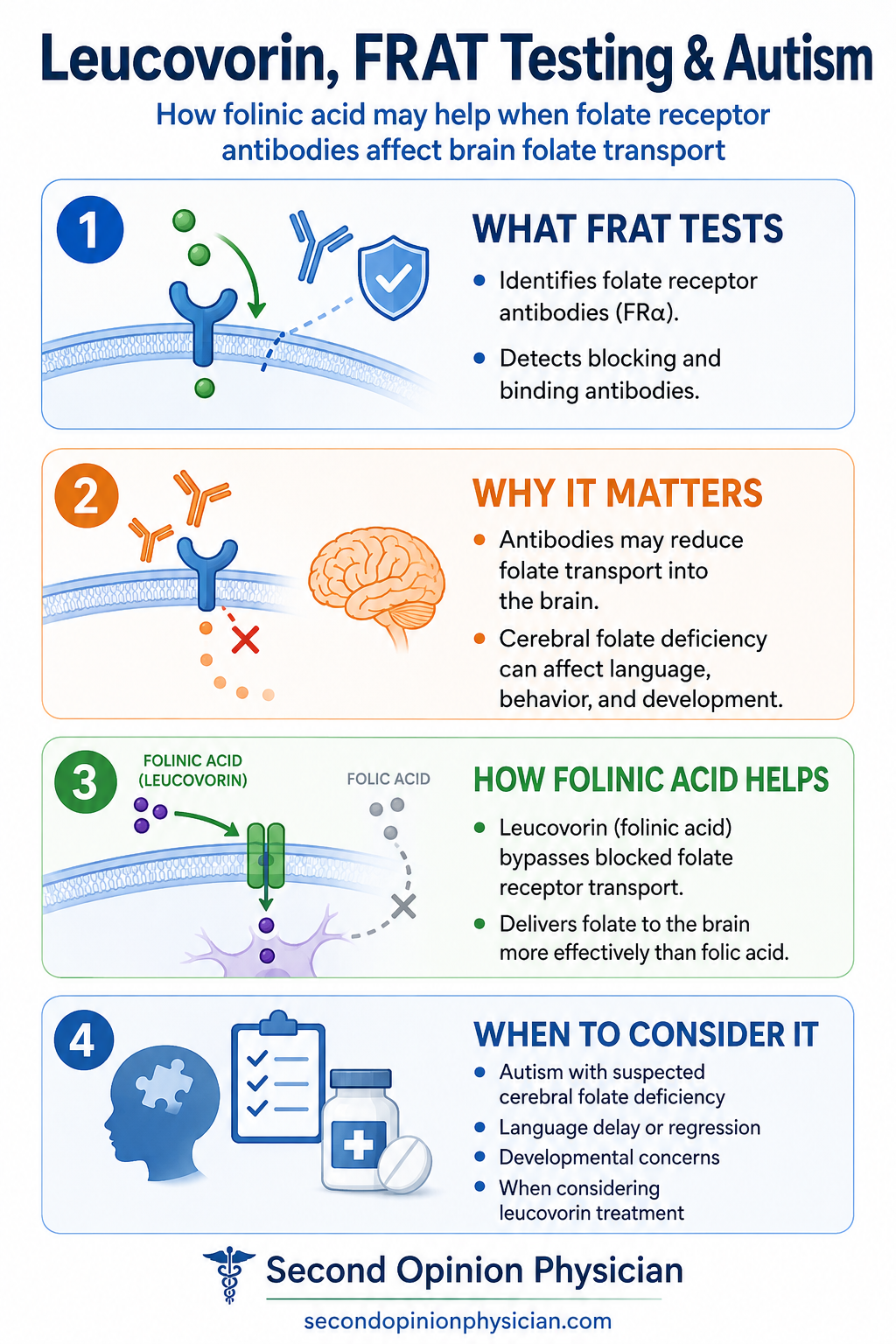
Test Folate Transport Before Choosing Treatment
A child can have normal blood folate while folate transport into the brain is impaired. FRAT testing looks for blocking and binding folate receptor alpha antibodies that may interfere with that transport. When results and the clinical history support treatment, physician-guided leucovorin may be considered.
What Is Leucovorin, and Why Is It Used in Autism?
Leucovorin calcium is a prescription form of folinic acid, a reduced folate. It is different from folic acid and methylfolate. In selected patients, folinic acid can use alternative folate-transport pathways and may help overcome impaired transport associated with folate receptor alpha antibodies.
Autism is biologically heterogeneous, so leucovorin is not a universal autism treatment. The strongest rationale is present when symptoms, developmental history and laboratory findings suggest impaired cerebral folate transport or another folate-pathway abnormality.
Key point
The clinical question is not simply whether a child has autism. It is whether folate transport or folate metabolism may be impaired and whether folinic acid is likely to be appropriate for that individual.
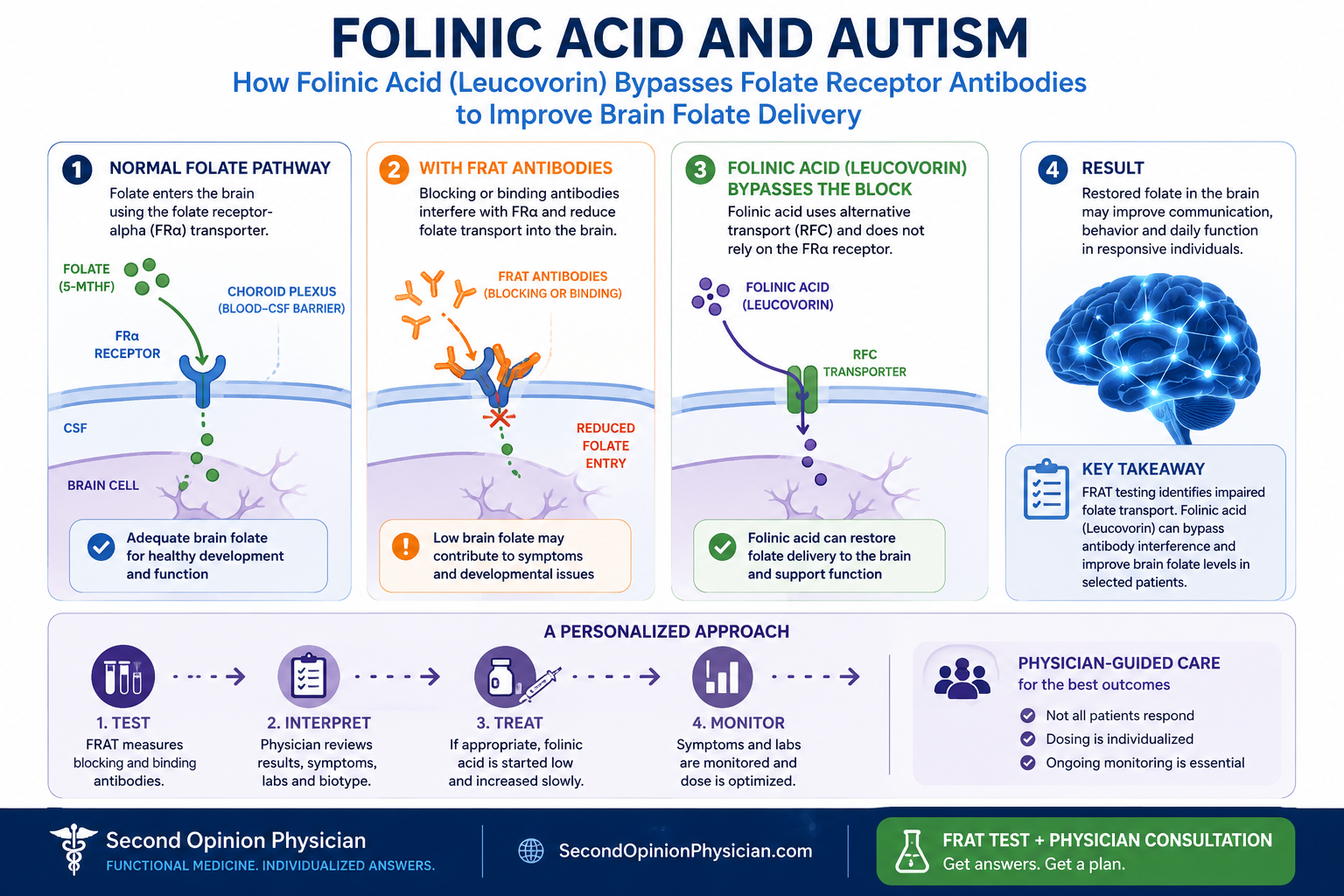
Suggested infographic: normal folate receptor transport, blocking or binding antibodies interfering with the receptor, and folinic acid using alternate transport pathways to support delivery into the brain.
How Folate Receptor Antibodies Can Reduce Brain Folate
FRα carries folate toward the brain
Folate receptor alpha helps move folate across the choroid plexus into cerebrospinal fluid.
Blocking or binding antibodies interfere
Autoantibodies may block receptor function or bind to the receptor and disrupt normal folate transport.
Folinic acid may improve delivery
At clinically supervised doses, folinic acid may use additional transport pathways and help raise folate availability within the central nervous system.
What Does the FRAT Test Measure?
The Folate Receptor Antibody Test measures two types of antibodies to folate receptor alpha. Both can be clinically relevant, and either result must be interpreted with the patient’s symptoms and developmental history.
Interferes with folate binding or transport
A blocking antibody may directly interfere with folate binding to the receptor and reduce receptor-mediated transport.
Binds to folate receptor alpha
A binding antibody attaches to the receptor. The clinical meaning may depend on the titer, symptom pattern and other findings.
Why test before treatment?
FRAT results can strengthen the rationale for leucovorin, help explain why blood folate may not reflect brain folate transport and provide a baseline for physician interpretation. A negative result can redirect attention toward other methylation, nutrient, immune or metabolic factors.
FRAT Test Results: What Positive Blocking or Binding Antibodies Mean
Positive blocking antibody
Supports interference with receptor-mediated folate transport. The degree of elevation, symptoms and treatment history still matter.
Positive binding antibody
Indicates immune binding to the folate receptor. Higher binding titers have been investigated as a possible marker of leucovorin response.
Negative FRAT result
Does not rule out every cause of cerebral folate deficiency or every reason for folate-pathway dysfunction. Further evaluation may still be appropriate.
Leucovorin Autism Dosage Chart: Ranges Used in Published Studies
Searchers often want a single leucovorin dose for autism, but published studies have used different ages, formulations, titration methods and outcome measures. The table below summarizes research protocols; it is not a prescribing chart for an individual child.
| Study approach | Published dose | Duration | Important context |
|---|---|---|---|
| High-dose randomized autism trial | 2 mg/kg/day, maximum 50 mg/day | 12 weeks | Studied children with autism and language impairment. Treatment was divided and medically supervised. |
| Lower-dose randomized trial | 5 mg twice daily | 12 weeks | Small placebo-controlled study using a fixed lower dose. |
| Clinical titration | Individualized; often introduced below the target dose | Varies | Dose selection may depend on age, weight, FRAT findings, sensitivity, sleep, behavior, medications and prior folate reactions. |
Why the published maximum is not a starting dose
A research target such as 2 mg/kg/day up to 50 mg/day does not mean that every child should begin at that amount. Some patients develop activation, irritability, insomnia, anxiety, hyperactivity, headaches, gastrointestinal symptoms or worsening behavior. Physician-guided titration allows response and tolerance to be assessed.
What Studies Suggest About Folinic Acid and Autism
Controlled trials and observational studies suggest that some children may improve in language, communication, irritability or broader autism measures during folinic acid treatment. Benefits have not been uniform, and biomarker-positive subgroups may be more likely to respond.
Language and communication
A randomized double-blind trial reported improved verbal communication after high-dose folinic acid in children with autism and language impairment.
FRAT-positive subgroups
Research has investigated blocking and binding antibodies as possible predictors of treatment response rather than treating autism as one uniform condition.
Evidence remains developing
Trial sizes have generally been modest, protocols differ and not every child responds. Larger independent studies remain important.
Important evidence update
A 2024 randomized trial that is sometimes cited in support of folinic acid was retracted in January 2026. It should not be used as supporting evidence. This page therefore emphasizes the remaining controlled and observational literature.
Is Leucovorin FDA-Approved for Autism?
No. Leucovorin is not FDA-approved as a general treatment for autism. In March 2026, the FDA approved expanded use of Wellcovorin tablets for adults and children with confirmed FOLR1-related cerebral folate transport deficiency, a rare genetic disorder. Some affected patients may have developmental delays with autistic features, but this approval is not the same as approval for autism or for a positive FRAT antibody test.
Use of leucovorin in autism without confirmed FOLR1-related cerebral folate transport deficiency remains off-label and should be based on physician judgment, evidence, symptoms, testing and informed discussion.
Why FRAT Testing Should Include Physician Interpretation
A laboratory result does not determine dose or treatment by itself. Physician review helps answer the practical questions that follow a positive, negative or borderline result.
Questions the consultation addresses
- Does the clinical history fit impaired cerebral folate transport?
- Is the result blocking positive, binding positive or both?
- Could folinic acid be appropriate?
- What starting approach and titration are reasonable?
- What symptoms or side effects should be monitored?
Other factors that may change the plan
- Prior reaction to folic acid, methylfolate or folinic acid
- Undermethylation, copper overload or elevated SAH
- Sleep disturbance, agitation, anxiety or seizure history
- Current prescriptions and supplements
- Diet, gut function, immune findings and nutritional status
What the Second Opinion Physician package includes
The FRAT package includes the test kit and laboratory processing, questionnaire review, physician consultation and a written report. When the result and clinical history support treatment, leucovorin may be prescribed when clinically appropriate.
How to Order the Folate Receptor Antibody Test
Order the package
Purchase the FRAT test with consultation and report review.
Receive the kit
The requisition is provided and the collection kit is shipped.
Complete the blood draw
Use a qualified local draw site and follow the kit instructions.
Review the results
Dr. Epstein reviews the result, questionnaire and treatment options.
Leucovorin, Folinic Acid and FRAT Test Questions
What is the usual leucovorin dose for a child with autism?
There is no single dose for every child. A frequently cited randomized trial used 2 mg/kg/day up to 50 mg/day, while another small trial used 5 mg twice daily. These were research protocols, not universal starting doses. Clinical treatment is usually individualized and may begin below the eventual target.
What does a positive FRAT test mean?
A positive result identifies blocking antibodies, binding antibodies or both against folate receptor alpha. It supports possible interference with folate transport into the brain but must be interpreted with the developmental history, neurological findings and treatment response.
What is the treatment for a positive FRAT test?
Folinic acid, also called leucovorin, may be considered when the result and clinical picture support impaired folate transport. Dose, titration and monitoring should be determined by a physician rather than from the antibody result alone.
What does FRAT binding positive mean?
It means the test detected antibodies that bind to folate receptor alpha. Binding titer may add information about immune interference and has been studied as a possible treatment-response biomarker.
What does FRAT blocking positive mean?
It means antibodies were detected that can interfere with folate binding or receptor-mediated transport. The degree of elevation and the clinical pattern help determine its significance.
Is folinic acid the same as leucovorin?
Leucovorin calcium is the prescription drug form of folinic acid. The terms are often used interchangeably in clinical discussions, although product formulation and dosing should be confirmed.
Is folinic acid the same as folic acid?
No. Folinic acid is a reduced folate that does not require the same activation steps as folic acid. It may also use additional transport pathways when folate receptor function is impaired.
Can FRAT testing diagnose cerebral folate deficiency?
FRAT testing identifies folate receptor alpha autoantibodies. It can support suspected autoimmune impairment of folate transport, but it is not identical to measuring cerebrospinal-fluid 5-MTHF or confirming a pathogenic FOLR1 gene variant.
Can a FRAT test be negative even when folate transport is impaired?
Yes. Folate transport and cerebral folate deficiency can be affected by genetic, metabolic, mitochondrial and other mechanisms. A negative antibody result does not exclude every cause.
Is leucovorin FDA-approved for autism?
No. The 2026 FDA approval applies to confirmed FOLR1-related cerebral folate transport deficiency, not autism generally and not FRAT autoantibody positivity by itself. Use in autism remains off-label.
Educational information only. Leucovorin is a prescription medication. Dosing and treatment decisions should be made by a licensed clinician after reviewing the patient’s history, medications, test results and treatment risks.
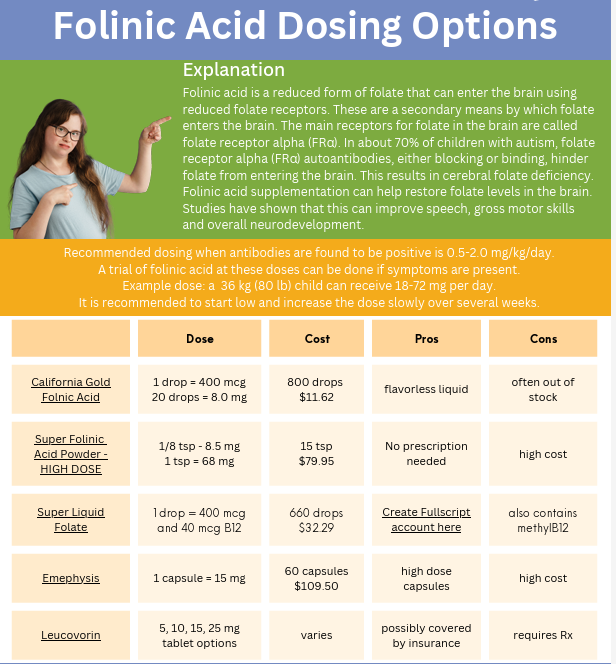
Leucovorin for Autism: What Parents and Clinicians Should Know
Families and clinicians are exploring whether folate receptor autoantibodies (FRα) contribute to low brain folate—and when folinic acid (leucovorin) may help. This article explains FRAT testing, what the evidence shows, and how we personalize decisions at Second Opinion Physician.
What Are Folate Receptor Antibodies?
FRα transports folate across the choroid plexus into cerebrospinal fluid. In some people, the immune system creates blocking or binding antibodies that interfere with this transport, leading to cerebral folate deficiency (CFD) even when blood folate looks normal.
Why the FRAT Test Matters
The Folate Receptor Antibody Test (FRAT) measures both blocking and binding FRα antibodies. A positive result supports the diagnosis of impaired transport and helps identify candidates who may benefit from folinic acid.
Leucovorin and Autism: What Studies Suggest
Small controlled studies report improvements in language and social communication for subsets of autistic children who are FRAT-positive and treated with folinic acid. Responses vary; leucovorin is not a blanket therapy for autism, and larger trials are still needed.
FDA / Regulatory Context
The FDA has engaged with the NDA holder (GSK/Wellcovorin) regarding labeling updates for cerebral folate deficiency. Media coverage underscores the need for more research and individualized care.
Clinical Considerations We Weigh
Folinic acid (leucovorin) differs from folic acid and can bypass FRα-related transport issues. We also consider methylation status—high folate can aggravate mood/anxiety in some undermethylated patients—so testing and dosing are personalized.
Key Takeaways
Test first. FRAT helps target who may benefit. Leucovorin shows promise in FRAT-positive CFD, but decisions are individualized after physician review of symptoms, labs, and biotype factors.
FAQ
Is leucovorin FDA-approved for autism?
It has taken steps to approve folinic acid (leucovorin calcium) for cerebral folate deficiency, common in Autism. Folinic acid in general has been successfully used, off label, for Autism.
Folinic acid vs. folic acid?
Folinic acid (leucovorin) is an active form that can bypass certain transport problems; folic acid is synthetic and may not help when FRα antibodies are present.
Who should consider FRAT testing?
Individuals with autism or neurological symptoms in whom CFD is suspected, especially when considering folinic acid therapy.
FDA Takes Action to Make a Treatment Available for Autism Symptoms
- For Immediate Release:
The U.S. Food and Drug Administration today initiated the approval of leucovorin calcium tablets for patients with cerebral folate deficiency (CFD), a neurological condition that affects folate (a vitamin essential for brain health) transport into the brain. Individuals with cerebral folate deficiency have been observed to have developmental delays with autistic features (e.g., challenges with social communication, sensory processing, and repetitive behaviors), seizures, and problems with movement and coordination.
Resource:
https://www.fda.gov/news-events/press-announcements/fda-takes-action-make-treatment-available-autism-symptoms