
AI supported medical assessment; calculating questionnaire scores, correlated labs and trend analysis to optimize supplement therapy.
The future of medicine is not less human — it is more structured, more data-informed and more accurate. An AI supported medical diagnosis helps calculate symptom scores, correlate laboratory findings and track treatment response over time, allowing more precise nutrient, methylation and biotype-based therapy. That's the approach we have adopted at WalshDoc, the questionnare and lab tracking report builder for Second Opinion Physician.
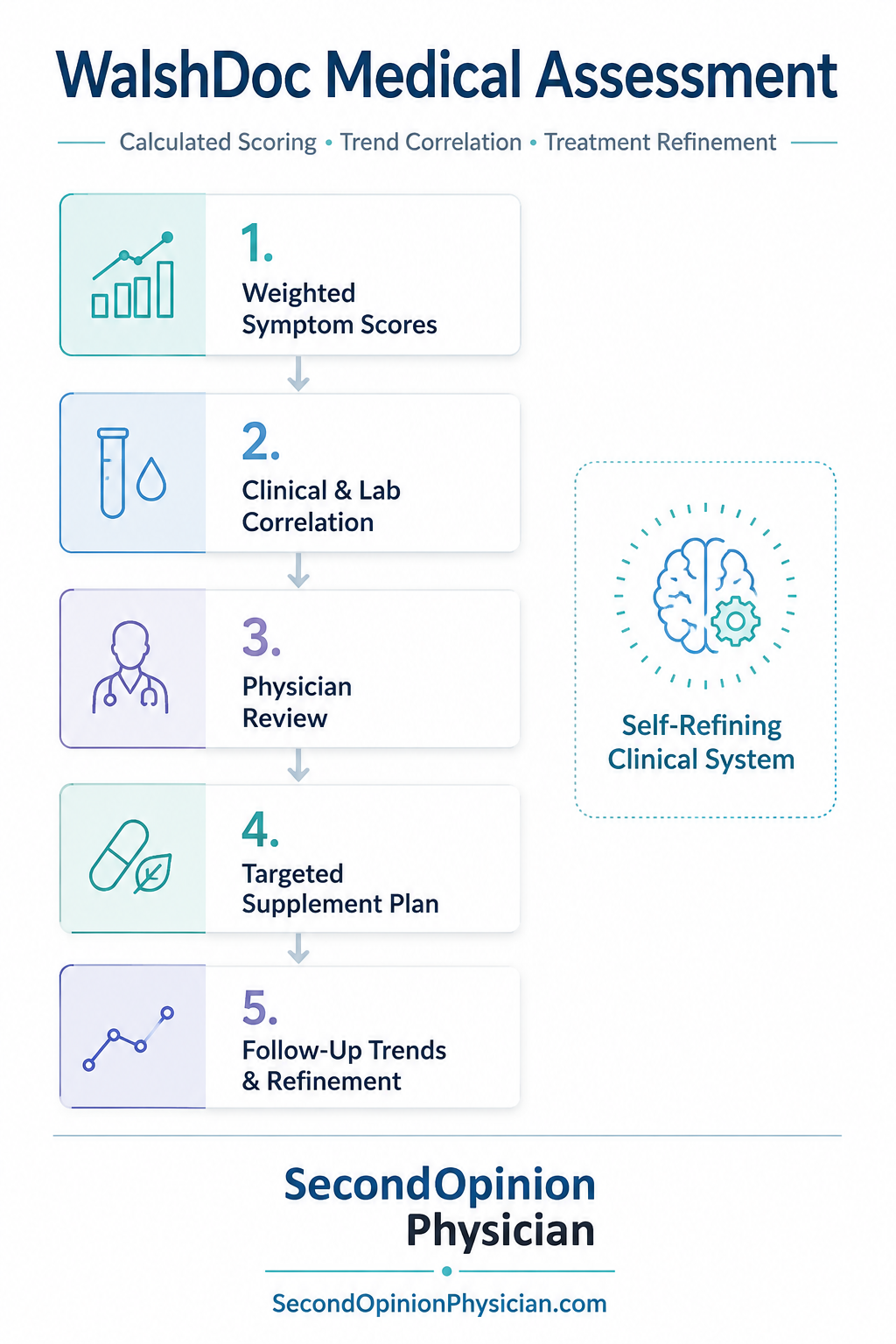
Precision assessment begins by looking at more of the patient—not simply one diagnosis or one laboratory result. WalshDoc brings structured symptom scoring, targeted laboratory data and longitudinal treatment trends into one analytical framework.
AI-assisted computation calculates weighted questionnaire scores, identifies dominant symptom and trait patterns, compares those patterns with laboratory findings, and tracks what changes after treatment. The physician defines the clinical model and interprets the findings; the computational layer provides consistency, organization and the ability to repeatedly compare far more data than can reasonably be processed during a brief office encounter.
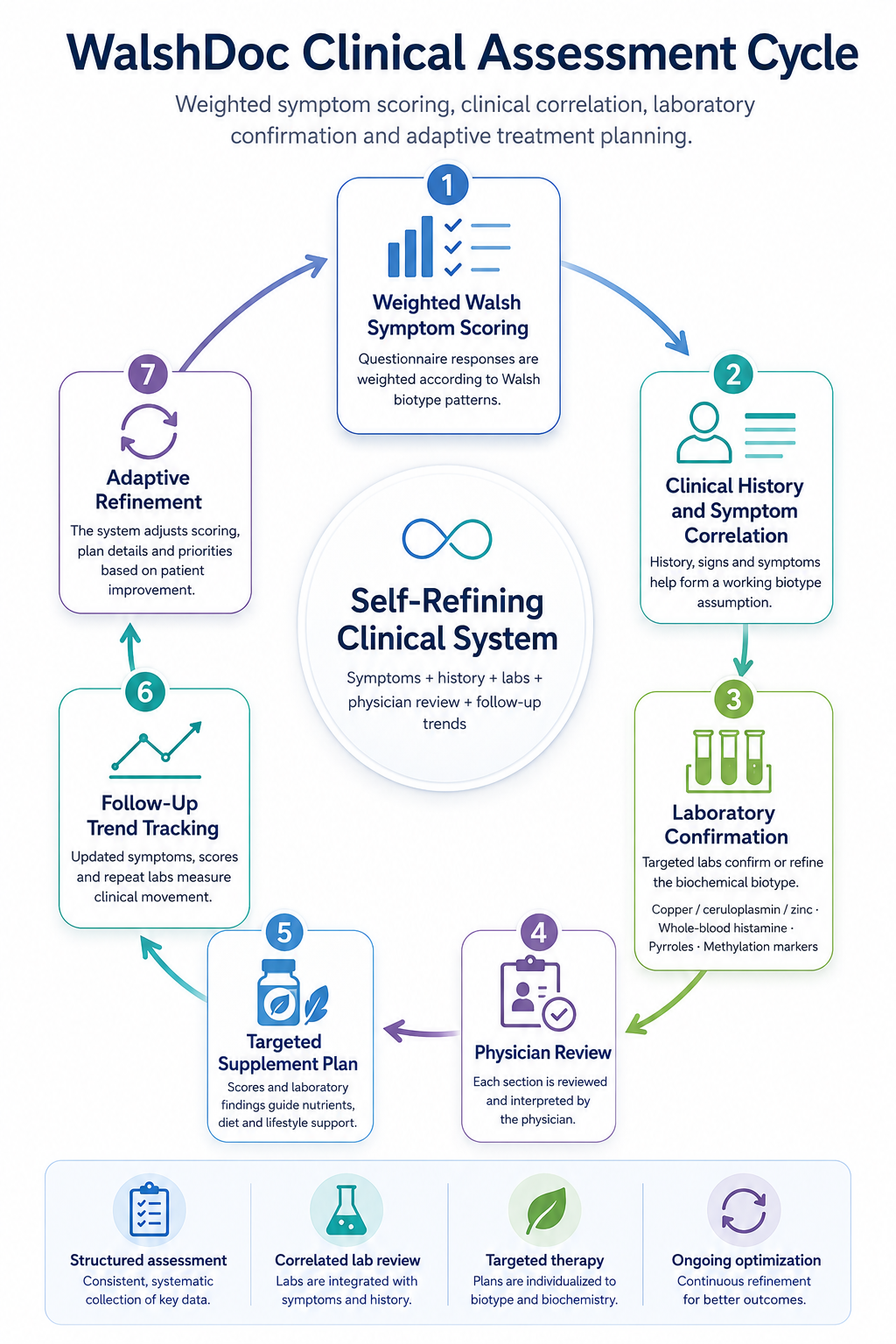
AI-Supported Medical Assessment: The Next Layer of Clinical Analysis
The future of medicine is likely to involve more—not less—physician judgment, supported by better-organized data. Structured questionnaires can capture details that may never surface during a short encounter. Calculated scores can weigh stronger findings differently from weak or nonspecific symptoms. Laboratory results can then be compared with the predicted pattern, and follow-up data can show whether the treatment actually moved the patient in the expected direction.
Calculated Questionnaire Scores for More Consistent Pattern Recognition
WalshDoc does not treat every “yes” answer equally. Primary indicators, supporting indicators and overlapping symptoms can receive different weights according to their relevance to the clinical pattern. The resulting bars provide a visual estimate of which patterns deserve the greatest attention.
Walsh biotype pattern scores
- Undermethylation
- Overmethylation
- Copper overload
- Pyroluria
What the scoring helps organize
- Physical and emotional symptom clusters
- Likely neurotransmitter-function tendencies
- Methylation-related patterns
- Mineral and nutrient abnormalities
- Medication and supplement sensitivity
- Laboratory priorities
The clinical value is reproducibility. The same scoring logic can be applied to every assessment and recalculated when new information is added rather than relying on memory or an impression formed during one visit.
Correlated Laboratory Data Improve Assessment Accuracy
A symptom score becomes more useful when it predicts something measurable. WalshDoc uses questionnaire results to identify which biochemical findings should be investigated, then compares the predicted pattern with laboratory data.
| Clinical pattern | Correlated laboratory findings | What the correlation adds |
|---|---|---|
| Methylation pattern | Whole-blood histamine, homocysteine, SAM, SAH | Helps distinguish a symptom-based methylation pattern from measurable functional methylation abnormalities. |
| Copper overload pattern | Copper, ceruloplasmin, plasma zinc | Shows whether a mineral imbalance supports the predicted pattern and should become a treatment priority. |
| Pyroluria pattern | Urinary pyrroles, zinc and related nutrient findings | Provides biochemical context for a zinc/B6-centered pattern. |
| Functional methylation stress | SAM, SAH, homocysteine and related pathway markers | Helps identify methyl-donor shortage, methylation inhibition, excess demand or impaired clearance. |
The Walsh Biotypes Provide the Clinical Pattern Framework
The Walsh Approach provides the initial pattern-recognition framework for mood, behavior and treatment response. Rather than starting with a single laboratory abnormality, it recognizes recurring combinations of physical traits, emotional symptoms, behavioral characteristics and medication responses that may correspond to distinct biochemical patterns.
WalshDoc translates those clinical observations into calculated scores so that the biotype model can be evaluated more consistently, compared with laboratory data and followed longitudinally.
Epigenetic Drivers Extend the Undermethylation Model
Identifying an undermethylation pattern is only the beginning. The next question is what may be impairing methylation or increasing methylation demand. Dr. Epstein’s model adds five functional drivers that can be scored separately from the traditional biotype pattern.
Toxin Exposure
Mold, metals, chemicals and other exposures may increase detoxification demand and oxidative burden.
Mitochondrial Stress
Reduced ATP availability may limit energy-dependent methylation, recycling, detoxification and recovery.
Creatine Demand
Endogenous creatine synthesis consumes methyl groups and may increase demand on available SAM.
Methylation Demand
Stress, inflammation, infection, tissue repair, alcohol, medications and detoxification can increase methyl-group requirements.
Acidic pH & Impaired Clearance
Poor buffering and impaired homocysteine or adenosine disposal may favor SAH accumulation and reduced methylation flow.
Methylation Assessment Beyond MTHFR
MTHFR genetics can identify predisposition, but they do not directly show the current functional state of methylation. WalshDoc places greater emphasis on the biochemical pathway itself and on factors that may impair methylation even when an MTHFR result does not explain the clinical picture.
Direct methylation markers
SAM, SAH and homocysteine provide information about methyl-donor availability, pathway inhibition and methylation flow.
Neurotransmitter regulation
Within the Walsh model, methylation status is relevant to serotonin and dopamine transporter expression and neurotransmitter reuptake.
Cellular function
Methylation participates in DNA regulation, enzyme activity, detoxification, creatine synthesis and numerous processes throughout the body.
ATP and Mitochondrial Function Add Another Layer to Methylation Analysis
Methionine must be activated to form SAM, and that reaction requires ATP. Cellular energy also supports repair, detoxification, recycling and other metabolic work required to maintain methylation flow. Mitochondrial stress therefore deserves consideration when fatigue, poor exercise tolerance, impaired recovery or oxidative stress accompany an undermethylation pattern.
AI-assisted research and analysis helped organize common factors that can impair mitochondrial function and translate them into weighted questionnaire items, allowing ATP-related stress to be considered alongside the other epigenetic drivers.
Trend Analysis Optimizes Supplement Selection and Dosage
The initial treatment plan should not be treated as permanent. Once nutrient, supplement, diet, lifestyle or medication-related changes are introduced, the response becomes new clinical data.
Clinical response
- Mood, anxiety, sleep, focus and behavior
- Energy, exercise tolerance and recovery
- Physical and inflammatory symptoms
- New symptoms and adverse reactions
- Changes in treatment tolerance
Treatment and laboratory response
- Repeat key laboratory markers
- Track supplement selection and dosage
- Record medication changes
- Compare diet and lifestyle changes
- Correlate interventions with symptom trends
Independent data progressively refine the working assessment
Greater Accuracy Through Consistent, Longitudinal Analysis
A physician who spends substantial time reviewing questionnaires, laboratory relationships and treatment history can evaluate a much broader clinical picture than is possible during a brief encounter. The limitation is that hundreds of variables become difficult to compare manually.
AI-assisted analysis supports that work by applying the same scoring rules repeatedly, retaining earlier findings, comparing multiple time points and correlating symptom changes with laboratory values, supplement doses, medications, diet and lifestyle. It does not become rushed or fatigued during the computational portion of the review.
The Future of Medicine: Better Decisions From Better-Organized Data
AI does not need to become the clinician to materially improve medicine. One of its most useful roles is helping physicians consistently analyze more information than can reasonably be processed during a conventional visit. Structured questionnaire scoring, laboratory correlation and longitudinal trend analysis make detailed assessment more scalable without reducing the role of clinical judgment.
WalshDoc applies that approach to the Walsh biotypes, methylation and the five epigenetic drivers of undermethylation. As symptom, laboratory and treatment data accumulate, the scoring model can be compared with real outcomes and progressively refined.
More complete assessment
More relevant symptom, history and treatment variables can be considered together.
More consistent analysis
The same computational rules can be applied repeatedly without practice fatigue.
More adaptive treatment
Supplement selection, dosage and treatment sequence can change as measured outcomes change.
Start With Structured Symptom Scoring and Targeted Laboratory Testing
The combined questionnaire evaluates Walsh biotype patterns together with the five epigenetic drivers of undermethylation. Targeted laboratory testing then provides objective biochemical context, followed by physician interpretation, individualized therapy and longitudinal follow-up.
AI-Supported Medical Assessment FAQs
What does AI do in the WalshDoc assessment?
AI-assisted computation calculates weighted questionnaire scores, organizes symptom patterns, compares those patterns with laboratory findings and analyzes changes over time. Clinical interpretation remains physician directed.
Does AI diagnose Walsh biotypes or methylation disorders?
No. Questionnaire scores generate a working biochemical hypothesis. Laboratory findings, treatment response and physician interpretation are used to support, weaken or revise that hypothesis.
How are questionnaire scores calculated?
Primary and supporting indicators receive different weights according to their relevance to Walsh biotypes and epigenetic drivers. The calculated scores show relative pattern strength and help prioritize laboratory testing.
Why correlate symptoms with laboratory results?
Correlation allows a symptom-based hypothesis to be checked against objective findings such as whole-blood histamine, copper, ceruloplasmin, zinc, urinary pyrroles, homocysteine, SAM and SAH.
How can trend analysis optimize supplement therapy?
Follow-up questionnaires and repeat laboratory testing can be compared with supplement selection and dosage changes. This helps determine whether treatment is moving symptoms and laboratory markers in the intended direction and whether the protocol should be continued or adjusted.
Why evaluate methylation beyond MTHFR?
MTHFR testing identifies genetic variation, while direct markers such as SAM, SAH and homocysteine provide information about current methylation chemistry and factors that may be impairing methylation function.
Educational information only. WalshDoc questionnaire scores and AI-assisted calculations do not establish a psychiatric or medical diagnosis. Laboratory and treatment recommendations require individualized physician review. Psychiatric medication should not be stopped or changed without appropriate medical supervision.