
Acylcarnitines


$449.00
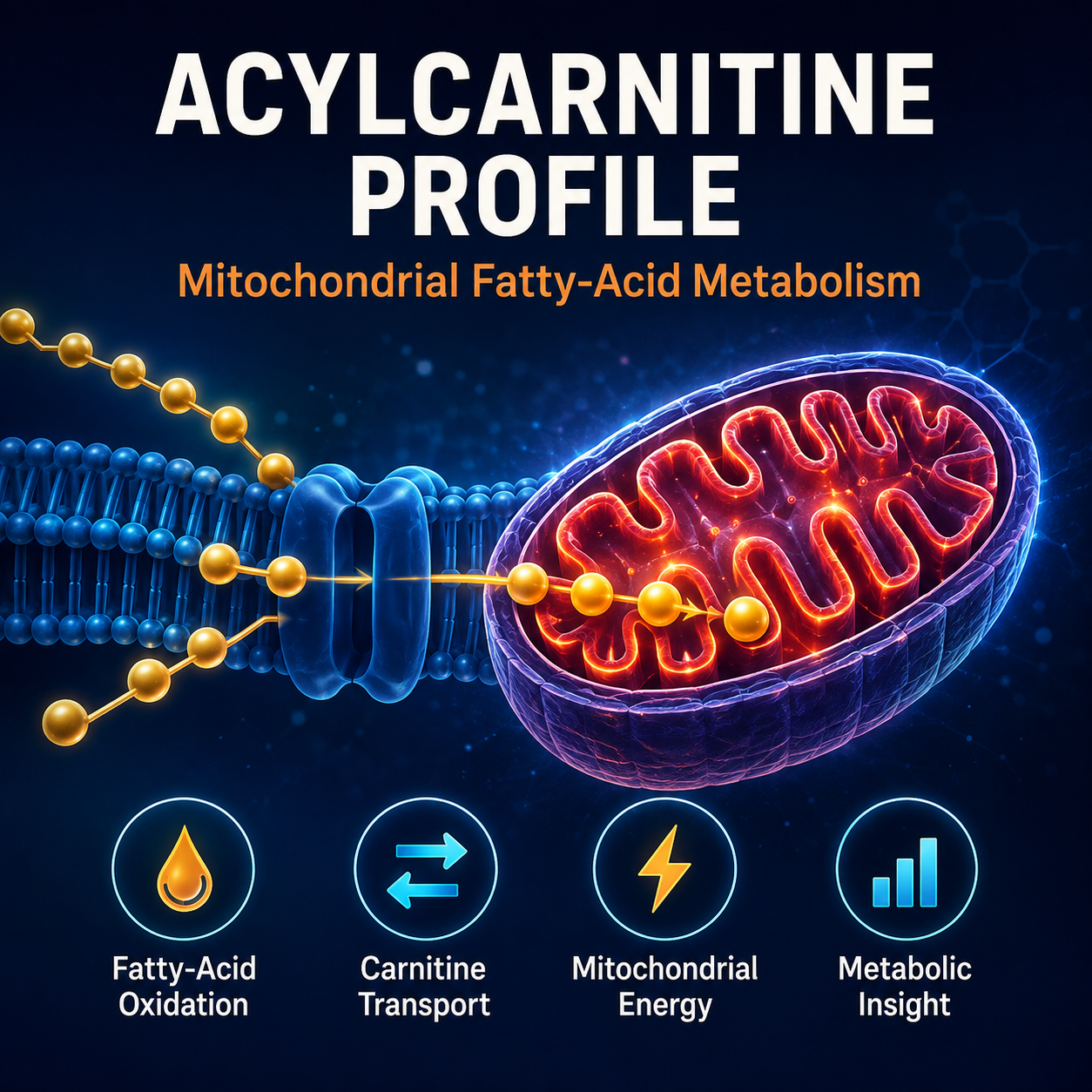
The Acylcarnitines Profile is an advanced blood test evaluating how fatty acids are transported and metabolized for mitochondrial energy production. Patterns of individual acylcarnitines can provide clues to abnormalities in fatty-acid oxidation, carnitine metabolism and certain inherited metabolic disorders.
This is generally a second-level mitochondrial test, rather than a routine screening test. It may be considered when symptoms, family history, an abnormal core mitochondrial panel or other metabolic findings justify deeper evaluation.
Description
Fatty acids are an important source of mitochondrial energy. To use long-chain fatty acids efficiently, cells depend upon carnitine transport and a series of mitochondrial reactions that progressively break fatty acids down for energy production.
The Acylcarnitines Profile measures multiple acylcarnitine species in blood. The resulting pattern can provide clues to abnormalities in fatty-acid oxidation, carnitine metabolism and certain inherited metabolic pathways that cannot be identified by measuring free and total carnitine alone.
What Does an Acylcarnitines Profile Test?
Acylcarnitines are compounds formed when fatty acids and other metabolic intermediates become attached to carnitine. Measuring a range of these compounds provides a biochemical snapshot of how mitochondrial fuel-processing pathways are functioning.
Rather than asking only “Is there enough carnitine?”, an acylcarnitine profile asks a more detailed question:
↓
CARNITINE TRANSPORT
↓
MITOCHONDRIAL β-OXIDATION
↓
ACETYL-CoA
↓
CELLULAR ENERGY
If one of these metabolic steps is impaired, particular acylcarnitines may accumulate or become deficient, creating a pattern that can help determine where additional investigation should be directed.
Free & Total Carnitine vs. Acylcarnitines
These tests are related, but they answer different questions.
Free + Total Carnitine
Evaluates overall carnitine status and can identify carnitine deficiency.
Primary question:
Is carnitine availability abnormal?
Acylcarnitines Profile
Measures individual acylcarnitine species to evaluate patterns of fatty-acid and organic-acid metabolism.
Primary question:
Is there a recognizable metabolic pattern suggesting impaired fuel utilization?
Why Test Acylcarnitines?
The principal clinical strength of acylcarnitine testing is its ability to identify patterns. Different chain lengths and molecular species can accumulate when particular steps in fatty-acid oxidation or organic-acid metabolism are impaired.
Helps evaluate abnormalities in mitochondrial pathways responsible for converting fatty acids into usable energy.
Provides information beyond the concentration of free and total carnitine alone.
Characteristic patterns may provide clues to specific fatty-acid oxidation and organic-acid disorders.
Who Might Need an Acylcarnitines Profile?
This is generally not the first test needed for nonspecific fatigue. It becomes more useful when the clinical picture raises greater suspicion for impaired fatty-acid utilization or a metabolic disorder.
Disproportionate fatigue or poor tolerance of sustained physical activity.
Unexplained muscle weakness, pain, cramping or episodes of muscle injury.
Symptoms that become pronounced during fasting, illness or other periods of increased energy demand.
Findings from lactate/pyruvate, CK or carnitine testing that justify a deeper metabolic investigation.
A combination of neurological, muscular, cardiac, metabolic or other findings suggesting a broader disorder.
Early-onset symptoms or family history raising suspicion for an inherited metabolic condition.
What Does an Abnormal Acylcarnitine Pattern Mean?
An abnormal acylcarnitine result should be interpreted as a metabolic pattern rather than a simple positive or negative result.
The particular compounds that are elevated or reduced, their chain lengths, the degree of abnormality and the patient's clinical history all matter.
Does an Abnormal Acylcarnitine Profile Change Treatment?
Potentially—but its greatest value is often determining what should be investigated next.
Unlike a simple nutrient measurement, an abnormal acylcarnitine pattern may indicate that a particular metabolic pathway deserves more focused evaluation. Treatment therefore depends upon the underlying abnormality rather than the acylcarnitine result alone.
Determine which acylcarnitines are abnormal and whether the pattern suggests a recognizable metabolic pathway.
Use complementary biochemical or genetic testing when the pattern warrants confirmation.
Treatment may involve correcting carnitine or nutrient abnormalities, avoiding metabolic stressors or treating an identified underlying disorder.
When a meaningful abnormal pattern is present, repeat testing may help determine whether the biochemical abnormality persists or changes with treatment.
A Stepwise Mitochondrial Testing Strategy
START FOCUSED
Lactate + Pyruvate • CK • Free & Total Carnitine
IDENTIFY AN ABNORMAL PATTERN OR HIGH CLINICAL SUSPICION
EXPAND WHEN INDICATED
Acylcarnitines • GDF-15 • Organic Acids
METABOLIC / GENETIC EVALUATION WHEN WARRANTED
Acylcarnitines and Organic Acids Are Complementary
The Acylcarnitines Profile and an organic acids test examine metabolism from different perspectives.
Acylcarnitines Profile
Particularly useful for evaluating patterns involving fatty-acid oxidation and carnitine-linked mitochondrial metabolism.
Organic Acids
Provides a broader view of metabolic intermediates involving energy metabolism and multiple related biochemical pathways.
What About GDF-15?
GDF-15 provides another complementary approach. Rather than evaluating fatty-acid intermediates, GDF-15 can act as a biomarker of cellular stress and may be elevated in mitochondrial disease and other conditions.
It should therefore be viewed as another piece of the mitochondrial assessment rather than a substitute for an acylcarnitine profile.
GDF-15 & Mitochondrial DysfunctionWhen Should Acylcarnitines Be Retested?
Routine serial testing is generally unnecessary when the initial profile is normal and clinical suspicion is low.
When a significant abnormal pattern is identified, however, repeating the profile may be useful after treatment, correction of a metabolic contributor, or as part of monitoring an established metabolic disorder.
What This Test Does—and Does Not—Tell You
What It Can Do
- Evaluate multiple acylcarnitine species
- Identify abnormal fatty-acid oxidation patterns
- Provide clues to specific metabolic pathways
- Help determine appropriate follow-up testing
- Complement carnitine and organic-acid testing
- Provide a baseline when significantly abnormal
What It Cannot Do
- Diagnose every mitochondrial disorder
- Exclude mitochondrial dysfunction when normal
- Replace genetic testing when genetic disease is suspected
- Determine one universal mitochondrial treatment
- Show that a particular supplement or peptide will work
- Replace clinical interpretation
Frequently Asked Questions About Acylcarnitines
What is an acylcarnitine?
An acylcarnitine is formed when carnitine carries an acyl group derived from fatty-acid or other intermediary metabolism. Measuring different acylcarnitines can reveal characteristic metabolic patterns.
Is an acylcarnitine profile the same as a carnitine blood test?
No. Free and total carnitine evaluates overall carnitine status. An acylcarnitine profile measures multiple individual species and provides a more detailed assessment of metabolic pathways.
Does an abnormal profile diagnose mitochondrial disease?
Not by itself. Particular patterns can raise suspicion for specific metabolic disorders, but results may require correlation with additional biochemical testing, clinical findings and genetic testing.
Should everyone with fatigue get this test?
No. A focused first-line assessment is usually more appropriate for nonspecific fatigue. Acylcarnitines become more useful when symptoms or other findings suggest a deeper metabolic or fatty-acid oxidation problem.
Can the test be normal in mitochondrial dysfunction?
Yes. A normal acylcarnitine profile does not exclude mitochondrial dysfunction or primary mitochondrial disease.
Does an abnormal result determine treatment?
The pattern can influence what is investigated and treated next, but it does not prescribe a single mitochondrial therapy. Treatment depends upon the underlying metabolic abnormality.
Start Focused. Expand Testing When the Pattern Calls for It.
For many patients, lactate/pyruvate, CK and free/total carnitine provide a more practical first-line assessment. The Acylcarnitines Profile adds a deeper evaluation of fatty-acid oxidation and mitochondrial fuel metabolism when clinically indicated.