
GDF-15 Mitochondrial Blood Test - What it Means
Growth Differentiation Factor 15 (GDF-15) is increasingly used as a blood biomarker when mitochondrial disease or significant cellular-energy dysfunction is being investigated. Unlike lactate, pyruvate or carnitine, GDF-15 does not directly measure an energy-producing pathway. Instead, it reflects a cellular stress response that can become activated when mitochondria are under substantial physiological strain.

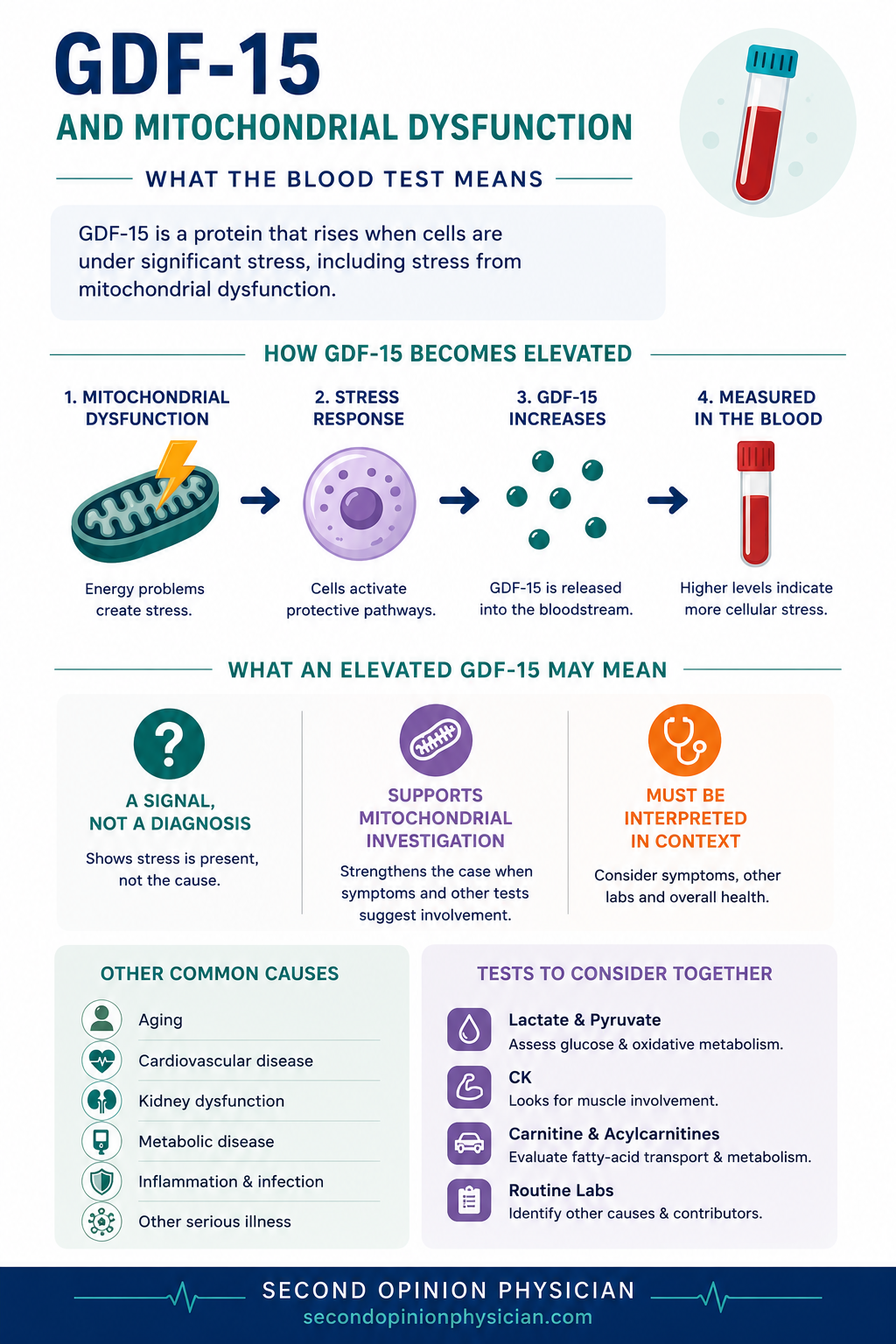
GDF-15 can be particularly useful because mitochondrial disorders do not always produce continuously abnormal lactate or other conventional metabolic markers. An elevated GDF-15 may therefore provide another clue that mitochondrial stress is present, especially when symptoms involve several high-energy tissues such as muscle, brain, heart, retina or other neurological systems.
However, GDF-15 is not specific for mitochondrial disease. It can rise with aging and numerous cardiovascular, renal, metabolic, inflammatory and other medical conditions. The value of the test is therefore not simply whether it is “high,” but whether the result makes sense alongside the patient's symptoms and other mitochondrial and metabolic findings.
GDF-15 is best viewed as a signal of cellular stress—not a stand-alone diagnosis of mitochondrial disease. Mitochondrial dysfunction can activate cellular stress pathways that increase circulating GDF-15, making the marker useful when mitochondrial disease is part of the clinical question.
The important distinction is specificity. An elevated result may support evidence of mitochondrial or metabolic stress, but it does not tell us by itself why that stress is occurring. GDF-15 becomes much more informative when interpreted with symptoms and complementary markers such as lactate, pyruvate, CK, carnitine and acylcarnitines.
In This Guide
What Is GDF-15?
GDF-15 stands for Growth Differentiation Factor 15. It is a circulating protein whose production can increase when cells encounter physiological stress.
GDF-15 is sometimes described as a mitochondrial biomarker, but that description requires an important qualification: GDF-15 is not produced exclusively because of mitochondrial dysfunction.
Rather, mitochondrial abnormalities are one important stimulus capable of activating stress-response pathways associated with increased GDF-15.
A circulating signal associated with cellular and physiological stress.
It can provide evidence supporting significant mitochondrial stress even when some traditional metabolic markers are normal.
It cannot independently establish the cause of the cellular stress or diagnose mitochondrial disease.
Why Can Mitochondrial Dysfunction Increase GDF-15?
Mitochondria must continuously coordinate energy production with the needs of the cell. When mitochondrial function becomes substantially disturbed, cells can activate adaptive stress-response pathways.
These responses attempt to preserve cellular function when energy production, protein handling, oxidative balance or other aspects of mitochondrial biology are under strain.
GDF-15 can rise as part of this broader cellular stress response.
What Does an Elevated GDF-15 Blood Test Mean?
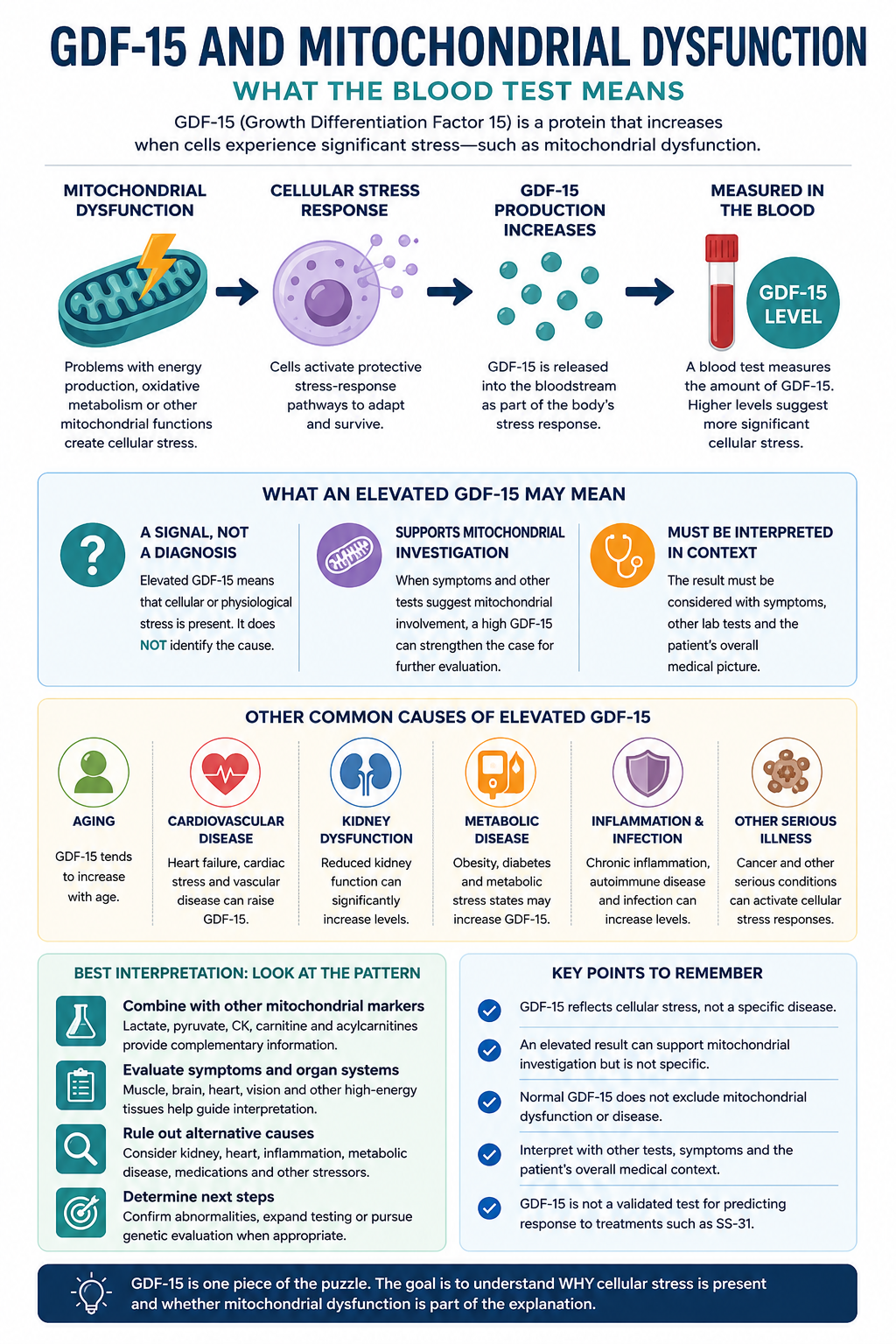
An elevated GDF-15 means that a biological process associated with increased cellular stress is occurring. The laboratory result does not establish which process is responsible.
When a patient also has symptoms or laboratory findings compatible with mitochondrial disease, an elevated GDF-15 can strengthen the rationale for further mitochondrial evaluation.
↓
Evidence of significant cellular stress
↓
Does the clinical pattern suggest mitochondrial involvement?
↓
Compare with symptoms + metabolic markers + other medical causes
What Else Can Cause High GDF-15?
This is one of the most important limitations of GDF-15 testing. Many conditions other than primary mitochondrial disease can increase GDF-15.
GDF-15 tends to increase with age, making age and overall health important parts of interpretation.
Cardiovascular disease and cardiac stress can increase circulating GDF-15.
Renal impairment can substantially influence GDF-15 and should be considered when evaluating an elevated result.
Obesity, diabetes and other metabolic stress states may be associated with increased levels.
Inflammatory and systemic illness can activate cellular stress responses that influence GDF-15.
GDF-15 can rise in malignancy and other conditions associated with substantial physiological stress.
When Might GDF-15 Testing Be Useful?
GDF-15 becomes more relevant when the clinical picture suggests that impaired cellular energy metabolism could be contributing to symptoms, particularly when several high-energy tissues are involved.
Unexplained fatigue, exercise intolerance, poor stamina or unusually prolonged recovery.
Weakness, muscle fatigue or other evidence suggesting possible mitochondrial muscle involvement.
Neurological symptoms, cognitive changes or multisystem findings that raise concern for impaired cellular energy metabolism.
Retinal, optic or other visual abnormalities can be relevant because ocular tissues have substantial energy requirements.
Selected cardiomyopathy or multisystem presentations may increase suspicion of mitochondrial disease.
The combination of neurological, muscular, cardiac, hearing, visual or metabolic abnormalities is particularly important.
What Tests Should Be Interpreted With GDF-15?
GDF-15 becomes much more useful when it is treated as one part of a mitochondrial testing pattern rather than as an isolated laboratory value.
Looks for evidence that oxidative metabolism is not adequately accommodating metabolic demand.
Adds information about glucose metabolism and cellular redox relationships.
Looks for evidence of muscle-cell injury when muscle involvement is suspected.
Evaluates availability of an important component of mitochondrial fatty-acid transport.
Can reveal characteristic abnormalities in fatty-acid oxidation and related metabolic pathways.
CBC, CMP, renal function, metabolic and other testing help identify alternative causes and interpret GDF-15 appropriately.
GDF-15 Is More Useful as Part of a Pattern
Combining GDF-15 with complementary markers can provide a broader view of cellular stress, oxidative metabolism, muscle involvement and mitochondrial fatty-acid metabolism.
Can GDF-15 Be Normal in Mitochondrial Disease?
Yes. A normal GDF-15 should not be treated as absolute proof that mitochondrial disease or mitochondrial dysfunction is absent.
Mitochondrial disorders vary considerably in their genetics, severity, affected tissues and biochemical expression. No single circulating biomarker captures every mitochondrial abnormality.
How Should a GDF-15 Result Be Interpreted?
The result should be interpreted by asking what other evidence is present and whether another condition provides a better explanation for the elevation.
Symptoms and complementary metabolic abnormalities may strengthen the rationale for further mitochondrial evaluation.
The elevation may reflect significant non-mitochondrial physiological stress and requires appropriate clinical interpretation.
Do not assume mitochondrial disease. Review age, kidney function, cardiovascular and metabolic health, inflammation and other potential causes.
A normal result does not end the investigation when the clinical pattern strongly suggests mitochondrial or metabolic disease.
Does GDF-15 Predict Response to SS-31 / Elamipretide?
GDF-15 should not currently be considered a general predictive test for response to SS-31 (elamipretide).
SS-31 acts on mitochondrial inner-membrane biology and cardiolipin. Although GDF-15 may provide evidence of cellular stress associated with mitochondrial disease, that does not mean an elevated result identifies a patient who will respond clinically to SS-31.
The distinction matters: a biomarker of disease or cellular stress is not automatically a biomarker of treatment response.
Related Mitochondrial and Cellular Energy Topics
Frequently Asked Questions About GDF-15
What is the GDF-15 blood test?
GDF-15 measures Growth Differentiation Factor 15, a circulating protein associated with cellular and physiological stress. It can be useful as one biomarker in the evaluation of mitochondrial disease.
Does high GDF-15 mean mitochondrial disease?
No. Mitochondrial disease is one possible explanation, but GDF-15 can also increase with aging, cardiovascular disease, kidney dysfunction, metabolic disease, inflammation and other serious illnesses.
Why does mitochondrial dysfunction raise GDF-15?
Significant mitochondrial dysfunction can activate cellular stress-response pathways associated with increased production of GDF-15.
Can GDF-15 be normal in mitochondrial disease?
Yes. No single circulating biomarker detects every mitochondrial disorder, so a normal result does not independently exclude mitochondrial disease.
What tests should be done with GDF-15?
Depending on the clinical situation, complementary testing can include lactate, pyruvate, CK, free and total carnitine, acylcarnitines, routine metabolic testing and more specialized metabolic or genetic studies.
Is GDF-15 better than lactate for mitochondrial disease?
They provide different information. GDF-15 reflects cellular stress, while lactate provides information related to oxidative metabolism. They can therefore be complementary rather than interchangeable.
Does GDF-15 show whether SS-31 will work?
No. GDF-15 is not established as a general biomarker for predicting clinical response to SS-31/elamipretide.
Put GDF-15 in the Larger Mitochondrial Picture
GDF-15 can provide an important clue, but mitochondrial evaluation is strongest when cellular stress is considered together with oxidative metabolism, muscle markers, fatty-acid metabolism, symptoms and the patient's broader medical picture.