
How to Test for Mitochondrial Dysfunction: Blood, Metabolic & Cellular Energy Testing
There is no single blood test that diagnoses or excludes every form of mitochondrial dysfunction. Mitochondria perform many different functions, and abnormalities may involve cellular energy production, oxidative metabolism, fatty-acid utilization, muscle function or mitochondrial stress responses.
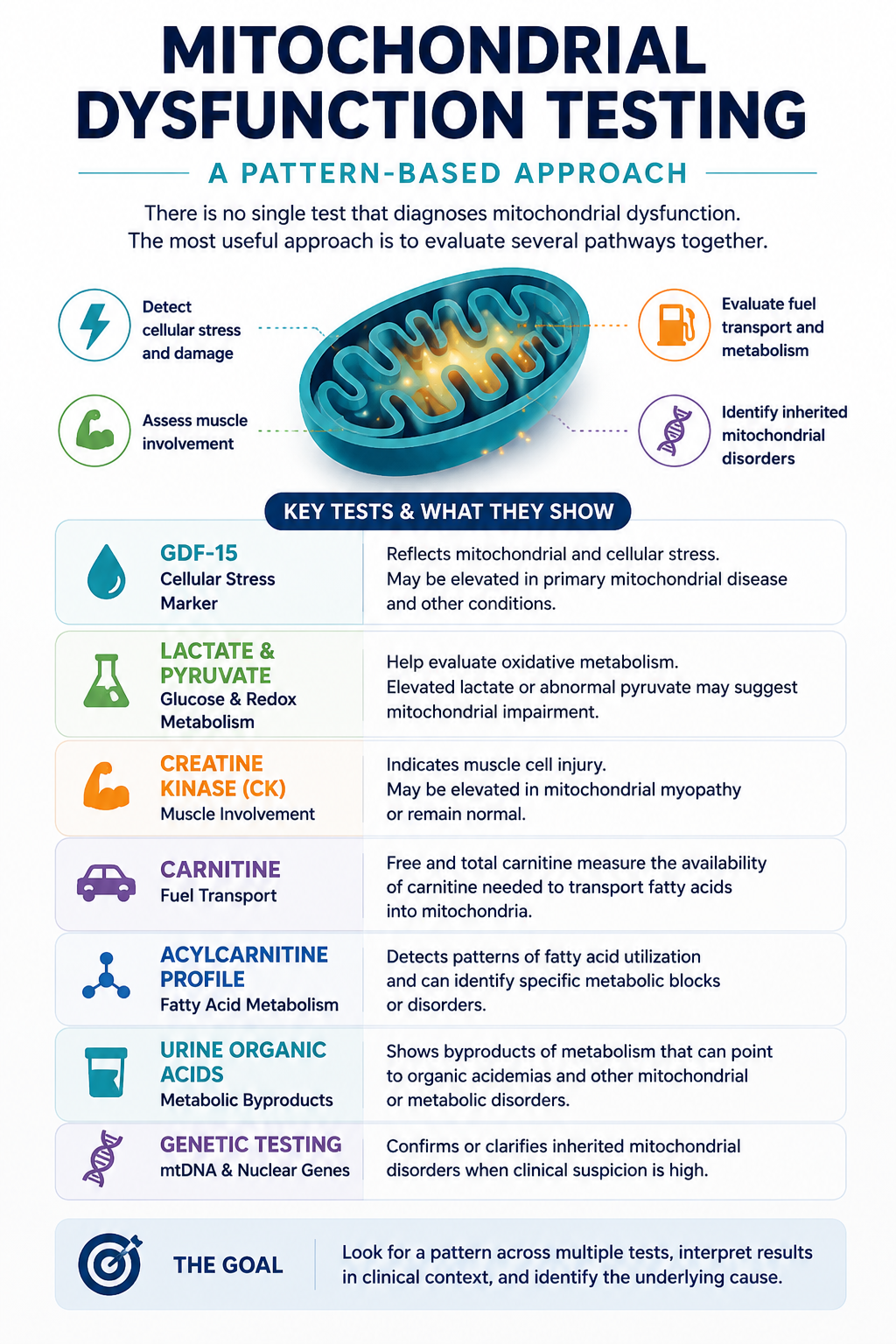
A useful mitochondrial evaluation therefore looks for a pattern. Tests such as GDF-15, lactate, pyruvate, creatine kinase (CK), free and total carnitine, and an acylcarnitine profile examine different aspects of cellular energy metabolism. Urine organic acids, plasma amino acids and genetic testing may be added when the history or initial results indicate a need for a more extensive evaluation.
The goal is not simply to label a patient with “mitochondrial dysfunction.” It is to determine whether measurable abnormalities of energy metabolism are present—and then ask why.
Mitochondrial dysfunction is not identified by one abnormal laboratory result. Because mitochondria participate in energy production, fatty-acid metabolism, muscle function and cellular stress responses, different tests examine different parts of the mitochondrial picture.
A focused evaluation can begin with markers such as GDF-15, lactate, pyruvate, creatine kinase (CK), carnitine and acylcarnitines, then expand to organic acids, amino acids or genetic testing when indicated. The goal is to identify a meaningful pattern and distinguish potentially acquired mitochondrial stress from evidence that warrants evaluation for a primary mitochondrial disorder.
In This Guide
Is There a Test for Mitochondrial Dysfunction?
Mitochondrial dysfunction can be investigated, but there is no universal test that directly measures the health of every mitochondrion in the body.
One reason is that mitochondrial abnormalities are heterogeneous. A patient with impaired oxidative phosphorylation may have a different biochemical pattern from someone with abnormal fatty-acid oxidation, mitochondrial myopathy or secondary mitochondrial stress from another illness.
Mitochondrial abnormalities can also be tissue-specific. Blood may not perfectly reflect what is occurring within skeletal muscle, brain, heart or retina.
Normal lactate or CK does not exclude mitochondrial disease or impaired mitochondrial metabolism.
Glucose metabolism, fatty-acid oxidation, cellular stress and muscle involvement require different laboratory markers.
Symptoms, onset, family history and the organs involved help determine how extensively testing should proceed.
What Blood Tests Can Help Evaluate Mitochondrial Function?
A focused initial evaluation can examine several complementary components of mitochondrial and cellular energy metabolism. Each marker answers a somewhat different question, which is why the overall pattern is generally more informative than any one result.
Looks at: cellular stress response
Can be elevated in primary mitochondrial disease but also rises in several non-mitochondrial conditions.
Looks at: oxidative metabolism
May rise when mitochondrial oxidative metabolism cannot adequately accommodate metabolic demand.
Looks at: glucose and redox metabolism
Provides additional context for interpreting lactate and certain metabolic abnormalities.
Looks at: muscle involvement
CK can identify muscle injury but may remain normal in mitochondrial myopathy.
Looks at: fatty-acid transport
Carnitine is required to transport long-chain fatty acids into mitochondria for energy metabolism.
Looks at: fatty-acid metabolism
Characteristic patterns can identify certain fatty-acid oxidation and organic-acid disorders.
Key clinical concept: No single marker measures overall mitochondrial function. GDF-15, lactate and pyruvate, CK, carnitine and acylcarnitines evaluate different parts of the cellular-energy picture and are most useful when interpreted together.
What Is GDF-15 and Why Test It?
Growth Differentiation Factor 15 (GDF-15) is a circulating stress-response protein that has emerged as a useful biomarker in the evaluation of primary mitochondrial disease.
Mitochondrial dysfunction can activate the integrated cellular stress response, which can increase production of GDF-15. This makes it different from a conventional nutrient or metabolic measurement: it provides information about how cells are responding to physiological stress.
GDF-15 can be particularly helpful because some patients with mitochondrial disease do not have chronically elevated lactate.
The result is therefore most useful when combined with symptoms and other mitochondrial or metabolic markers.
What Do Lactate and Pyruvate Tell Us?
Glucose is metabolized through glycolysis to produce pyruvate. Pyruvate can then enter mitochondrial pathways that support oxidative energy production, or it can be converted to lactate.
↓
PYRUVATE
↙ ↘
LACTATE MITOCHONDRIA → ATP
When oxidative metabolism cannot adequately process available pyruvate, lactate may rise. This is why lactate has historically been an important marker in suspected mitochondrial disease.
But elevated lactate is not specific to mitochondrial disease, and normal lactate does not exclude mitochondrial dysfunction.
Can reflect increased conversion of pyruvate to lactate when oxidative metabolism is impaired, but exercise, illness, hypoxia and collection conditions can also raise it.
Adds information about glucose metabolism and cellular redox state and helps provide context when lactate is elevated.
Explore Lactate & Pyruvate Testing →
What Does the Lactate-to-Pyruvate Ratio Mean?
The relationship between lactate and pyruvate can provide information about the cellular redox state and may help distinguish certain metabolic patterns.
However, the lactate-to-pyruvate ratio is generally most useful when lactate itself is elevated. A calculated ratio based upon two low or technically unreliable measurements can be misleading.
Why Include Creatine Kinase (CK)?
Creatine kinase is primarily a marker of muscle-cell injury rather than a direct measurement of mitochondrial function.
It is useful because skeletal muscle is one of the tissues commonly affected by mitochondrial disorders. An elevated CK can strengthen evidence that muscle is involved, while a normal CK does not exclude mitochondrial myopathy.
Suggests active muscle-cell injury and broadens the differential beyond mitochondrial disorders alone.
Does not eliminate mitochondrial muscle dysfunction because some mitochondrial myopathies produce little CK elevation.
Why Measure Carnitine and Acylcarnitines?
Fat is an important source of cellular energy, particularly during fasting and sustained activity. Long-chain fatty acids cannot simply diffuse into the mitochondrial matrix. They depend upon the carnitine shuttle for transport.
Free & Total Carnitine
Measures carnitine availability and can identify deficiency or abnormal carnitine metabolism.
Acylcarnitine Profile
Measures numerous fatty-acid intermediates attached to carnitine. Characteristic patterns can point toward particular blocks in fatty-acid oxidation or organic-acid metabolism.
What Can a Urine Organic Acid Test Add?
Organic acids are metabolic intermediates generated as carbohydrates, amino acids and fatty acids are processed.
Urine organic-acid analysis can reveal characteristic patterns associated with certain inherited metabolic disorders and may provide additional clues when mitochondrial or fatty-acid metabolism is abnormal.
Specific enzyme defects can produce recognizable accumulation patterns.
Selected organic-acid abnormalities may complement acylcarnitine findings.
Some patterns can support broader evidence of altered energy metabolism but are not diagnostic alone.
What About Plasma Amino Acids?
Quantitative plasma amino-acid testing can identify patterns associated with selected inherited metabolic disorders and may provide additional information about altered intermediary metabolism.
It is not necessary in every adult with fatigue or exercise intolerance. Its value increases when symptoms began early in life, neurological or developmental abnormalities are present, unexplained metabolic episodes occur, or the broader presentation suggests an inherited disorder.
Should Routine Laboratory Testing Be Done Too?
Yes. Common causes of fatigue, weakness and exercise intolerance should not be overlooked simply because mitochondrial dysfunction is being considered.
A patient can have profound cellular-energy symptoms from anemia, iron deficiency, thyroid dysfunction, metabolic disease or nutritional deficiencies without having primary mitochondrial disease.
CBC and iron studies can identify anemia or inadequate iron availability that may impair exercise capacity and energy.
CMP, glucose-related markers and thyroid testing can identify common metabolic contributors to fatigue.
Magnesium, B vitamins, iron and other micronutrients participate directly or indirectly in mitochondrial energy pathways.
Can Nutrient Deficiencies Impair Mitochondrial Function?
Yes. Mitochondrial enzymes depend upon multiple nutritional cofactors. Deficiencies can interfere with energy production even when the mitochondrial machinery itself is genetically normal.
Several B vitamins participate in pathways that convert carbohydrates, fats and amino acids into usable energy.
ATP normally functions biologically as a magnesium-ATP complex, making magnesium fundamental to energy-dependent reactions.
Iron-containing proteins are essential components of electron transport and oxidative energy metabolism.
When Should Genetic Testing Be Considered?
Genetic evaluation becomes particularly important when the clinical pattern suggests a primary mitochondrial disorder.
Primary mitochondrial disease can result from pathogenic variants in mitochondrial DNA or nuclear genes required for mitochondrial structure and function.
- Childhood or unusually early onset
- Progressive muscle weakness
- Marked exercise intolerance
- Neurological abnormalities or seizures
- Ptosis or abnormal eye movements
- Retinal or optic abnormalities
- Hearing loss
- Cardiomyopathy
- Multiple affected organ systems
- A suggestive family history
Can Blood Genetic Testing Miss Mitochondrial Disease?
Yes. Mitochondrial genetics has an unusual feature called heteroplasmy. Different tissues can contain different proportions of normal and abnormal mitochondrial DNA.
A pathogenic mitochondrial DNA variant may therefore be present at a low level in blood while occurring at a higher level in another affected tissue.
How Should Mitochondrial Test Results Be Interpreted?
The most useful interpretation comes from looking for a coherent biochemical pattern rather than focusing on a single abnormal result.
Raises the possibility of significant cellular stress but requires evaluation for mitochondrial and non-mitochondrial causes.
May support altered oxidative or redox metabolism when specimen collection is reliable.
Can redirect the investigation toward particular fatty-acid oxidation or organic-acid pathways.
Supports muscle involvement but does not identify the cause of muscle injury by itself.
The next step may be confirming a collection-sensitive abnormality, identifying a nutritional or metabolic contributor, examining medication or toxic effects, expanding metabolic testing, or pursuing genetics for primary mitochondrial disease.
Can Mitochondrial Testing Determine Whether SS-31 Will Work?
No currently available mitochondrial blood test establishes that a patient will respond to SS-31, also known as elamipretide.
SS-31 interacts with cardiolipin and mitochondrial inner-membrane biology. An elevated GDF-15 or abnormal lactate may provide evidence of physiological or mitochondrial stress, but these markers have not been validated as general SS-31 response tests.
This is important because mitochondrial dysfunction is heterogeneous. A treatment that benefits one specific mitochondrial disorder should not automatically be assumed to benefit every condition associated with impaired cellular energy.
A Practical First-Line Mitochondrial Assessment
For patients in whom mitochondrial dysfunction is clinically plausible but a known inherited mitochondrial disorder has not already been established, an initial assessment can remain relatively focused.
GDF-15
Lactate + Pyruvate
CK
Free + Total Carnitine
Acylcarnitine Profile
Organic Acids / Genetics When Indicated
Test the Mitochondrial Pattern—Not One Marker Alone
A focused laboratory assessment can examine cellular stress, glucose and redox metabolism, muscle involvement, carnitine availability and fatty-acid energy metabolism together.
Related Mitochondrial Testing and Cellular Energy Topics
Frequently Asked Questions About Mitochondrial Testing
What blood test shows mitochondrial dysfunction?
No single blood test identifies all mitochondrial dysfunction. GDF-15, lactate, pyruvate, CK, carnitine and acylcarnitines provide information about different aspects of cellular energy and mitochondrial metabolism.
What is GDF-15 used for in mitochondrial testing?
GDF-15 is a cellular stress-response biomarker that is frequently elevated in primary mitochondrial disease. Because it can also rise in many other medical conditions, it must be interpreted in clinical context.
Does normal lactate rule out mitochondrial dysfunction?
No. Lactate can remain normal in mitochondrial disease, particularly when a patient is metabolically stable or when abnormalities predominantly affect particular tissues.
Why test lactate and pyruvate together?
Pyruvate provides additional information about glucose metabolism and can help interpret elevated lactate and the cellular redox relationship. Accurate specimen collection is essential.
What does an acylcarnitine profile show?
It measures multiple carnitine-bound metabolic intermediates. Characteristic patterns can help identify certain fatty-acid oxidation and organic-acid metabolic disorders.
Can urine organic acids diagnose mitochondrial dysfunction?
No. Organic acids can provide useful metabolic clues and identify characteristic patterns in selected disorders, but they should not be used alone to diagnose generalized mitochondrial dysfunction.
When is genetic testing needed?
Genetic testing becomes particularly important when symptoms, age of onset, family history or multisystem involvement suggest a primary inherited mitochondrial disorder.
Can routine blood tests be normal in mitochondrial disease?
Yes. Routine CBC, metabolic testing, CK and even lactate can be normal. Mitochondrial abnormalities may be intermittent or concentrated in specific tissues.
Can mitochondrial tests determine whether SS-31 will help?
No. Current mitochondrial biomarkers do not establish that a patient will respond to SS-31/elamipretide and should not be used as validated SS-31 selection tests.
Evaluate Cellular Energy More Systematically
When symptoms suggest impaired cellular energy production, testing several complementary pathways can provide more useful information than relying on lactate—or any other single marker—alone.