SSRIs Explained: Why They Help, Why They Stop Working and What Undermethylation Has to Do With It
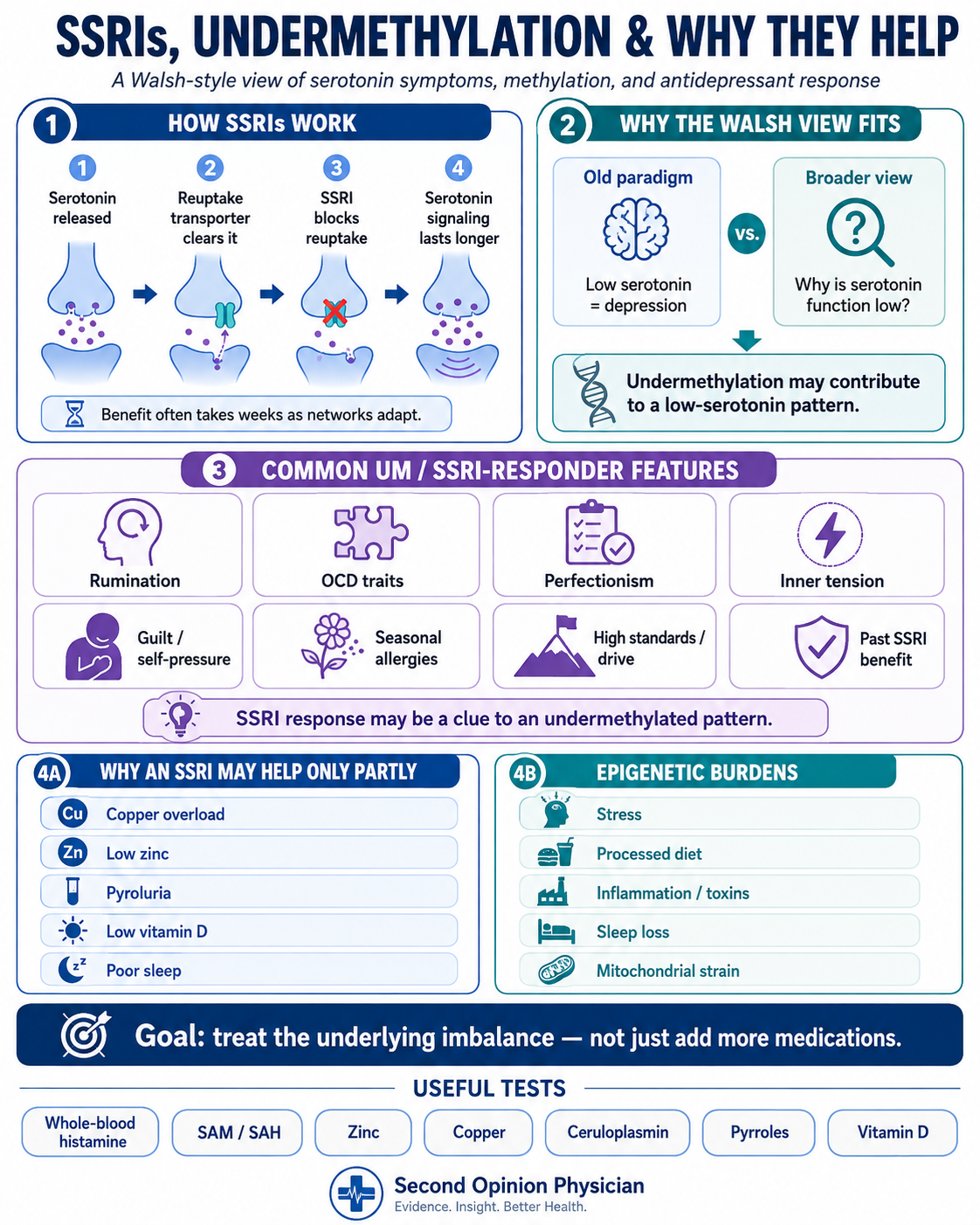
SSRIs are explained as medications that increase serotonin by blocking reuptake, but that simple explanation does not fully tell patients why these drugs help some people dramatically, help others only temporarily, and make some worse. Many of the patients who respond best to SSRIs appear to share a recognizable biochemical and symptom pattern that overlaps strongly with the Walsh concept of undermethylation: depression with rumination, obsessive thinking, perfectionism, high internal tension, guilt, strong self-pressure, seasonal allergies, and other signs suggesting relatively low functional serotonin activity. In these patients, SSRIs may improve symptoms because they prolong serotonin signaling, but the deeper issue may be the undermethylated terrain that contributed to the low-serotonin state in the first place.
This is why the Walsh approach can be so useful for current or past SSRI responders. Instead of treating “depression” or “anxiety” as one uniform ICD diagnosis, it asks whether the person’s broader pattern points to undermethylation and whether incomplete response, anxiety, insomnia or the need for multiple medications is actually being driven by additional factors such as copper overload, low zinc, pyroluria, low vitamin D, poor sleep, oxidative stress, toxic burden or epigenetic pressures that burden methylation. The treatment goal is not to chase each symptom with another drug. It is to improve the underlying imbalance—primarily undermethylation—while correcting the additional biochemical and lifestyle factors that keep the patient stuck in the same pattern that led to SSRI therapy in the first place.
Many of the patients who benefit from SSRIs share a recognizable Walsh-type pattern: obsessive thinking, rumination, perfectionism, high internal tension, high standards, seasonal allergies, a strong stress response and signs that point toward undermethylation. The treatment goal is not to chase every symptom with a new medication. It is to improve the underlying imbalance—primarily undermethylation—while also checking whether anxiety, insomnia, panic or poor response is being amplified by copper overload, pyroluria, low zinc, low vitamin D, poor sleep or other epigenetic burdens.
What Is an SSRI?
SSRI stands for selective serotonin reuptake inhibitor. These medications do not directly “pour serotonin into the brain.” They primarily block the serotonin transporter, reducing reuptake and allowing serotonin to remain available in the synapse longer.
SSRIs are widely used for depression, anxiety, OCD, panic, PTSD and other conditions. That broad use can create the impression that the diagnosis alone predicts response. In reality, many patients taking SSRIs share a deeper biochemical pattern—especially symptoms consistent with undermethylation and low functional serotonin activity.
The Older Serotonin Theory Versus the Current Understanding
Older paradigm
“Depression means low serotonin”
The older public explanation was simple: depressed patients were said to have too little serotonin, and antidepressants were said to fix the deficit. Earlier antidepressants such as tricyclics and MAOIs were often understood in that same broad framework because they raised or prolonged monoamine signaling.
Current view
SSRIs regulate signaling—not just “levels”
Modern psychiatry recognizes that SSRI benefit involves transporter blockade, receptor adaptation, network-level changes, neuroplasticity, stress-circuit regulation, sleep, inflammation and more than one neurotransmitter. The delayed benefit shows that the story is broader than simple chemical replacement.
The Walsh view overlaps this newer understanding in a practical way. Many SSRI responders do appear to have a biologic state consistent with relatively low functional serotonin activity. The Walsh framework asks why that state developed in the first place: high histamine, undermethylation, nutrient depletion, oxidative stress, toxic burden, poor sleep and epigenetic strain can all contribute.
How Do SSRIs Work?
A Simplified View of SSRI Action
Serotonin is released into the synapse
The transporter normally clears much of it
The SSRI inhibits serotonin reuptake
Serotonin signaling lasts longer
Receptors and networks gradually adapt
The immediate drug effect happens quickly, but meaningful benefit may take weeks. That time gap suggests that successful treatment depends on more than transporter blockade alone. Sleep, stress hormones, methylation, nutrient availability, receptor sensitivity and brain-network adaptation all matter.
How the Walsh View Can Fit the SSRI Model
Undermethylation and high histamine suggest low functional serotonin activity
The patient becomes more vulnerable to depression, OCD, rumination and inner tension
An SSRI may temporarily improve symptoms by prolonging serotonin signaling
Longer-term success often improves when the undermethylated terrain is corrected
Which Patients Often Fit SSRIs Best?
Not every patient with depression or anxiety is a true SSRI fit. In practice, the clearest SSRI responders often show a cluster of symptoms that overlap strongly with the Walsh undermethylation pattern.
Low-serotonin symptom pattern
Persistent rumination, obsessive thoughts, low mood, inner tension, self-pressure, guilt, strong conscience and a “stuck” style of thinking often point toward serotonin-related benefit.
Past benefit from SSRIs
If a patient has already improved with sertraline, fluoxetine, escitalopram, fluvoxamine or another SSRI, that history may itself be a clue that the dominant imbalance overlaps the undermethylated pattern.
Walsh characteristics in the history
Perfectionism, competitiveness, family history of high achievement or depression, seasonal allergies, low pain tolerance, OCD traits or ritualistic behavior may all strengthen the undermethylation hypothesis.
Why This Matters Clinically
If undermethylation is the real driver, an SSRI may help because it increases serotonin signaling. But the deeper treatment opportunity is not only reuptake inhibition—it is targeted therapy for the undermethylated state. Many patients therefore improve further, relapse less often or tolerate medication better when zinc, vitamin B6, vitamin D, methylation balance, protein intake, sleep and related factors are addressed at the same time.
ICD Diagnoses Versus Walsh Symptom Patterns
ICD diagnoses such as major depression, generalized anxiety disorder, OCD or panic disorder are necessary for communication and prescribing, but they do not explain why one patient benefits from an SSRI and another does not. The Walsh approach adds a layer of pattern recognition that is often more useful for treatment selection.
Diagnosis-centered view
“Depression” or “anxiety”
These labels justify treatment but combine many biologic subtypes into one category. They do not distinguish an undermethylated, high-histamine patient from an overmethylated, chemically sensitive patient or a patient with copper-related high norepinephrine.
Walsh pattern-centered view
“What is the underlying terrain?”
This view asks whether low functional serotonin from undermethylation is dominant, or whether anxiety is being amplified by copper overload, pyroluria, vitamin D deficiency, sleep loss or toxic burden. That extra layer often clarifies why the SSRI helps, helps only partly, or causes side effects.
Common Walsh Signs and Symptoms of Undermethylation
These features are not required in every case, but a broad cluster strongly supports the undermethylation hypothesis—especially in a patient who has responded to SSRIs or seems likely to respond.
Depression with rumination
OCD or obsessive traits
Perfectionism
Strong internal tension
Seasonal allergies
Competitiveness / high drive
Guilt and self-criticism
Strong family history
Low pain tolerance
Low serotonin-type anxiety
Past SSRI benefit
High whole-blood histamine tendency
In this framework, the SSRI response is not the final explanation—it is a clue. It suggests that the patient likely shares a low-serotonin or undermethylated pattern that may also be addressed through Walsh testing and targeted nutrient therapy.
Why Do SSRIs Help Some Patients but Not Others?
True undermethylation fit
When low functional serotonin activity is central, an SSRI may be a good symptomatic fit and the patient may share many Walsh undermethylation traits.
Overmethylation or low histamine
Patients who are already overactivated, chemically sensitive or low in histamine may worsen with added serotonergic stimulation.
Copper overload anxiety
Anxiety driven by high norepinephrine and low zinc can resemble “serotonin anxiety,” yet the patient may actually need copper-zinc evaluation.
Pyroluria and low B6 / zinc
Even when an SSRI is directionally correct, low B6 and zinc may limit serotonin and GABA synthesis and keep the response incomplete.
Low vitamin D, poor sleep or inflammation
These factors can reduce resilience and make a correct SSRI appear weaker or less durable over time.
Epigenetic burden
Toxin exposure, mitochondrial strain, poor diet, sleep loss, substance use and stress can increase methylation demand and recreate the low-serotonin state that led to SSRI prescribing in the first place.
Can SSRIs Make Anxiety Worse?
Yes. SSRIs are commonly used for anxiety, but some patients become more restless, agitated, panicky or unable to sleep during early treatment or after dose escalation.
Early activation Increased nervous energy may occur before adaptation develops.
Overmethylation An already activated serotonin/dopamine pattern may worsen when serotonergic tone rises further.
Copper overload If anxiety is largely norepinephrine-driven, the patient may need copper, zinc and pyroluria assessment rather than immediate polypharmacy.
Bipolar activation Reduced need for sleep, racing thoughts or unusual energy suggests hypomania or mania rather than simple SSRI anxiety.
Why Do SSRIs Sometimes Help Temporarily and Then Stop Working?
Many patients describe a clear early benefit that later fades. This does not always mean that the SSRI mechanism was wrong. Often the patient still fits the undermethylated pattern, but the terrain around serotonin signaling has shifted.
Persistent undermethylation
The SSRI improved symptoms, but the underlying methylation imbalance remained untreated.
Rising copper or falling zinc
Anxiety, agitation or insomnia may return because copper-related norepinephrine activity increases.
Pyroluria depletion
Zinc and B6 needs may keep growing under stress and limit serotonin, dopamine and GABA balance.
Low vitamin D or poor sleep
Brain resilience falls even if serotonin reuptake remains inhibited.
Toxic burden / elevated SAH
Methylation bottlenecks and oxidative stress may block progress despite medication.
Hormones, stress and lifestyle
Major life stress, processed foods, alcohol, cannabis and irregular meals can re-create the low-serotonin state.
When the underlying pattern is not recognized, one medication is often added to offset the side effects or incomplete benefit of another. A patient begins with an SSRI, then an anxiolytic is added for activation, then a stimulant is added for fatigue or poor focus, and the overall picture becomes harder to interpret.
In many of these cases, the better question is not “Which additional drug should be added next?” but “Is this primarily undermethylation, and is the anxiety being amplified by copper overload, low zinc, pyroluria or low vitamin D?”
A More Rational Sequence
Confirm safety and major diagnosis
Review past SSRI response and Walsh traits
Test methylation, histamine, zinc, copper, pyrroles and vitamin D
Correct the undermethylated terrain and related imbalances
Reassess whether anxiety or focus problems still require more medication
Use the fewest medications needed
Epigenetic Factors Can Push Patients Toward the Low-Serotonin State That Led to SSRI Therapy
Many patients are not “born needing an SSRI” in a simple, fixed way. The need for reuptake therapy can emerge when cumulative epigenetic stress increases methylation demand or reduces the body’s ability to maintain serotonin balance.
Sleep loss and circadian disruption
Poor sleep weakens mood regulation, raises stress hormones and often worsens depression, anxiety and obsessive thinking.
Poor diet and processed foods
Low protein, high sugar, skipped meals and ultra-processed foods can weaken methylation, mineral status and energy balance.
Inflammation and toxic burden
Mold, chemicals, infections, gut dysfunction and chronic inflammation increase oxidative demand and may interfere with methylation.
High creatine and repair demand
The body’s methyl groups are spent on many processes besides neurotransmitters. Increased demand can leave less reserve for mood stability.
Mitochondrial strain
Low cellular energy can contribute to fatigue, poor resilience, brain fog and an incomplete response to otherwise reasonable treatment.
Stress, alcohol and recreational drugs
These may worsen sleep, nutrient depletion and methylation burden, further destabilizing the serotonin system.
Why the Walsh Approach Is So Useful for Many Past or Current SSRI Responders
The Walsh approach does not treat “depression” as one uniform category. It identifies a biochemical pattern that often explains why SSRIs help: undermethylation, high histamine, low functional serotonin activity and a characteristic symptom profile. This is often more useful than simply recording that a patient meets criteria for depression, anxiety or OCD.
What SSRIs do
Improve serotonin signaling
They prolong serotonin action in the synapse, which may reduce low-serotonin symptoms such as rumination, OCD, depression and tension.
What Walsh treatment adds
Improve the imbalance that created the low-serotonin pattern
Undermethylation therapy, zinc, vitamin B6 when indicated, antioxidant support, vitamin D correction, sleep repair, diet change and management of copper or pyroluria may strengthen the same system more fundamentally.
The Practical Interpretation
If a patient has done well on an SSRI, it is reasonable to ask whether the deeper pattern is undermethylation. If the patient also has anxiety, panic, insomnia, agitation, poor focus or only partial response, the next step is often not automatic poly-drug prescribing. It is evaluation for copper overload, low zinc, pyroluria, low vitamin D, sleep loss and epigenetic burdens that may be maintaining the problem.
Laboratory Testing That Often Clarifies SSRI Response
Targeted Nutrient Therapy for the SSRI-Type Patient
The treatment goal is not to treat every symptom in isolation. It is to improve the underlying imbalance—primarily undermethylation—while correcting the other common factors that keep SSRI-type symptoms active.
Undermethylation support
When testing and history fit the pattern, treatment may focus on methylation support and the broader Walsh undermethylation approach.
Zinc and vitamin B6
These may be especially important when pyroluria or copper imbalance is present and when serotonin, dopamine and GABA synthesis appear stressed.
Vitamin D
Low vitamin D can reduce resilience and may contribute to poor antidepressant response, fatigue and seasonal worsening.
Protein, diet and meal structure
Balanced protein intake, reduced processed foods and consistent meals support neurotransmitter production and metabolic stability.
Sleep repair
Insomnia treatment is essential because ongoing poor sleep can recreate the same emotional state that originally led to SSRI use.
Toxic-burden and oxidative-stress reduction
Reducing inflammatory and oxidative load may lower methylation pressure and improve response stability over time.
Which Medications Are SSRIs?
Brand
Generic
Often chosen for
Practical note
Prozac
Fluoxetine
Depression, OCD, lower energy states
Often more activating
Lexapro
Escitalopram
Depression, generalized anxiety
Often well tolerated, but emotional blunting can occur
Zoloft
Sertraline
Depression, anxiety, PTSD, OCD
GI side effects may be more noticeable early
Paxil
Paroxetine
Anxiety states, depression
Often more sedating; discontinuation can be difficult
Frequently Asked Questions About SSRIs and Undermethylation
Do SSRIs prove that a person is low in serotonin?
No. They show that increasing serotonin signaling may help. The Walsh interpretation asks why that helped and whether the deeper pattern is undermethylation with low functional serotonin activity.
Why do so many SSRI responders also fit the Walsh undermethylation pattern?
Because the symptom clusters overlap strongly: rumination, OCD traits, perfectionism, guilt, internal tension, depression and a tendency toward high histamine or seasonal allergies are common in both descriptions.
Can a patient need an SSRI and still need Walsh treatment?
Yes. In many cases the medication helps symptomatically while Walsh and nutrient therapy address the underlying biochemical terrain that made the patient vulnerable in the first place.
Why would an SSRI patient need copper or pyroluria testing?
Because anxiety, panic, irritability, insomnia or partial response may reflect more than low serotonin. Copper-driven norepinephrine excess, low zinc and pyroluria can change the picture substantially.
Does poor sleep affect SSRI response?
Absolutely. Ongoing insomnia can worsen the same symptoms that led to SSRI use and can make a reasonable medication seem less effective.
Can epigenetic factors create the need for SSRI therapy?
They can contribute. Sleep loss, poor diet, inflammation, toxic burden, emotional stress and mitochondrial strain may increase methylation demand and help push a vulnerable patient into a lower-serotonin state.
Should partial SSRI response automatically lead to more medications?
Not necessarily. A more rational next step is often evaluation for undermethylation, copper overload, pyroluria, low vitamin D and other functional barriers before defaulting to additional drugs.
What tests are most useful for the likely undermethylated SSRI responder?
Whole-blood histamine, a plasma methylation panel, zinc, copper, ceruloplasmin, urinary pyrroles, vitamin D, CBC and CMP are often among the most useful starting points.
Can Walsh therapy help patients who used to do well on SSRIs but no longer do?
Often that is one of the most useful situations for Walsh testing because it may show that the original low-serotonin pattern remains, while copper imbalance, pyroluria, low vitamin D, toxic burden or sleep disruption have grown more important over time.
Use the SSRI Response as a Clue—Then Treat the Underlying Pattern
When a patient clearly benefits from SSRIs, the next question is often whether the deeper pattern is undermethylation and which epigenetic or nutrient burdens are keeping the problem active. The goal is not reflexive polypharmacy. It is the strongest, simplest and most biologically matched treatment plan possible.