
Salivary Cortisol Test ×4 | Diurnal

$158.00
Measures salivary cortisol at four points throughout the day—morning, noon, evening, and night—to evaluate the diurnal cortisol rhythm and HPA-axis function. Useful for investigating fatigue, anxiety, insomnia, afternoon crashes, chronic stress, circadian disruption, and symptoms that overlap with thyroid, metabolic, and hormone problems.
Description
Measure Cortisol Across the Day — Not Just at One Moment
Cortisol should change substantially from morning to night. A single cortisol measurement cannot show whether that normal daily rhythm is intact.
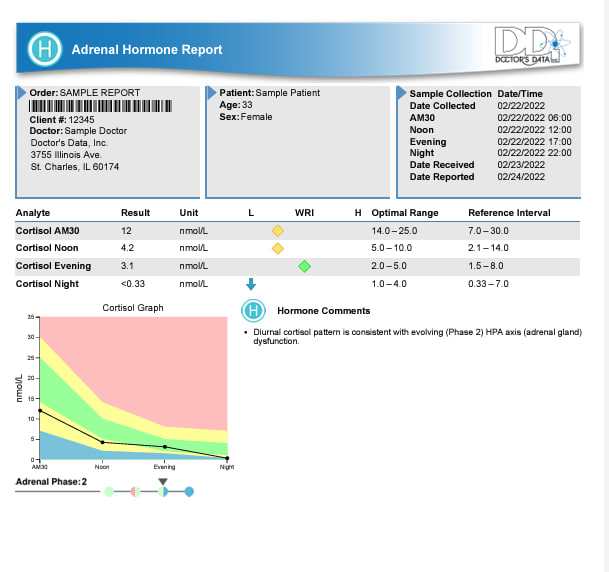
The Doctors Data Salivary Cortisol Test measures cortisol at four different times during the day—morning, noon, evening, and night.
This allows us to evaluate the shape and timing of your cortisol curve and compare it with symptoms such as morning anxiety, daytime fatigue, afternoon crashes, poor stress tolerance, nighttime hyperarousal, and insomnia.
Why Test Cortisol Four Times?
Cortisol is regulated by the hypothalamic-pituitary-adrenal, or HPA, axis and follows a strong circadian rhythm.
In a typical pattern, cortisol rises around awakening, remains higher during the first part of the day, and then gradually declines toward nighttime.
What Cortisol Does
Cortisol is often called a “stress hormone,” but its role is much broader.
Normal cortisol physiology contributes to:
Energy Availability
Cortisol helps maintain glucose availability between meals and during physical or psychological stress.
Wakefulness
The morning cortisol rise helps the brain and body transition from sleep into daytime activity.
Blood Pressure
Cortisol helps maintain normal vascular tone and blood-pressure regulation.
Inflammation
Cortisol is an important regulator of immune and inflammatory activity.
Stress Response
Cortisol helps mobilize energy and coordinate the body's response to illness, fasting, exercise, and psychological stress.
Circadian Rhythm
Cortisol works with the sleep-wake system to help distinguish biological daytime from nighttime.
Common Cortisol Patterns
Waking Anxious or Overactivated
A high morning pattern may accompany waking with a racing mind, internal tension, palpitations, or feeling immediately “on edge.”
Difficulty Getting Started
A low morning pattern may accompany severe morning fatigue, slow activation, low stamina, or difficulty functioning until later in the day.
Tired but Wired
Cortisol that remains elevated late in the day may accompany insomnia, racing thoughts, nighttime anxiety, or a late “second wind.”
Afternoon Energy Crash
Some people experience poor concentration, low stamina, or increased dependence on caffeine or sugar as the day progresses.
Reduced Day–Night Variation
Chronic illness, disrupted sleep, altered circadian timing, inflammation, and prolonged stress can be associated with a flatter cortisol rhythm.
The Clock May Be the Problem
Cortisol may not simply be “high” or “low.” It can be relatively normal in amount but released at the wrong time of day.
Cortisol and Anxiety
The stress response can strongly influence both the physical and mental experience of anxiety.
Cortisol works together with adrenaline, norepinephrine, and the sympathetic nervous system to prepare the body to respond to perceived threats.
Possible Hyperarousal Symptoms
- Morning anxiety
- Racing thoughts
- Internal trembling
- Palpitations
- Panic tendency
- Difficulty relaxing
Nighttime Stress Pattern
- Second wind at night
- Difficulty becoming sleepy
- Nighttime rumination
- Frequent awakening
- Feeling physically tired but mentally alert
A four-point cortisol curve can help determine whether the timing of anxiety corresponds with abnormal cortisol timing.
Cortisol and Fatigue
Fatigue does not automatically mean cortisol is low.
Both excessive stress-system activation and reduced or flattened daytime cortisol rhythms can accompany fatigue.
Too Much Activation Can Be Exhausting
Persistent stress activation can impair sleep, increase metabolic demand, and produce significant daytime fatigue even when cortisol is not low.
Low Daytime Activation
Some chronic illness and circadian patterns are associated with reduced morning activation or flattened daytime cortisol, which may accompany low stamina and poor stress tolerance.
Cortisol and Sleep
One of the most useful applications of diurnal cortisol testing is evaluating sleep-related timing.
Cortisol and melatonin normally follow roughly opposite rhythms:
- Cortisol rises toward morning.
- Melatonin rises toward night.
- Nighttime cortisol should normally remain relatively low.
When cortisol remains elevated too late in the day, symptoms may include:
- Difficulty falling asleep
- A late-night second wind
- Racing thoughts at bedtime
- Frequent nighttime waking
- Difficulty returning to sleep
- Feeling exhausted but unable to relax
Cortisol and Thyroid Function
The HPA axis and thyroid axis are separate endocrine systems, but they interact.
During major physiologic stress, illness, inflammation, fasting, or calorie restriction, thyroid-hormone metabolism can change.
Stress & Energy Availability
Cortisol helps regulate the stress response, glucose availability, blood pressure, and circadian timing.
Metabolic Rate
Thyroid hormones influence temperature regulation, metabolic rate, cardiovascular function, brain activity, and muscle metabolism.
Similar Symptoms
Fatigue, brain fog, poor exercise tolerance, weight changes, sleep disturbance, and anxiety can occur with abnormalities in either system.
Significant physiologic stress can also influence conversion of T4 into active T3 and inactive metabolites such as reverse T3.
Cortisol, Cholesterol and Sex Hormones
Cortisol belongs to the steroid-hormone family.
Like DHEA, estrogen, testosterone, and progesterone, cortisol is ultimately synthesized from cholesterol.
This does not mean stress simply “steals” hormones from estrogen or testosterone production. Steroid-hormone regulation is more complex.
However, cortisol symptoms frequently overlap with sex-hormone symptoms, particularly during perimenopause, menopause, and age-related androgen changes.
Women
Anxiety, insomnia, hot flashes, fatigue, poor stress tolerance, and mood changes may involve overlapping cortisol, estrogen, progesterone, thyroid, and sleep-related factors.
Men
Fatigue, low libido, poor exercise tolerance, mood changes, and sleep disturbance may require considering cortisol together with testosterone, estradiol, thyroid function, and metabolic health.
Cortisol, Blood Sugar and Energy Crashes
Cortisol helps maintain adequate glucose availability between meals and during stress.
For this reason, cortisol symptoms can overlap with problems involving glucose regulation and insulin resistance.
Possible Symptoms
- Feeling shaky when meals are delayed
- Afternoon fatigue
- Strong sugar or caffeine cravings
- Irritability when hungry
- Waking during the night
Look Beyond Cortisol
Fasting glucose, insulin, HbA1c, meal timing, sleep, diet, and metabolic health may need to be evaluated when these symptoms are prominent.
Who May Benefit From a Four-Point Cortisol Test?
Fatigue
- Morning exhaustion
- Afternoon crashes
- Low stamina
- Poor stress tolerance
Anxiety
- Morning anxiety
- Racing thoughts
- Hyperarousal
- Panic-like symptoms
Insomnia
- Difficulty falling asleep
- Second wind at night
- Frequent waking
- Tired-but-wired pattern
Chronic Stress
- Persistent stress load
- Burnout-like symptoms
- Poor resilience
- Irregular sleep schedule
Thyroid-Like Symptoms
- Persistent fatigue
- Brain fog
- Low T3 pattern
- Elevated reverse T3
Hormonal Symptoms
- Perimenopause
- Menopause
- Low libido
- Hormone-related sleep changes
What This Test Measures
| Analyte | Why It Matters |
|---|---|
| Morning Cortisol | Evaluates early-day cortisol output and the body's transition from sleep to wakefulness. |
| Noon Cortisol | Shows whether cortisol is declining appropriately after the morning peak. |
| Evening Cortisol | Helps identify abnormal late-day activation or an unusually rapid daytime decline. |
| Night Cortisol | Helps determine whether cortisol is appropriately low when the body should be preparing for sleep. |
Four-Point Saliva Testing vs a Single Blood Cortisol
| Single Blood Cortisol | Salivary Cortisol ×4 | |
|---|---|---|
| Number of measurements | One point in time | Four points across the day |
| Shows daily rhythm? | No | Yes |
| Useful for formal adrenal insufficiency evaluation? | Yes, as part of conventional endocrine testing | Not by itself |
| Useful for circadian timing? | Limited | Yes |
| Home collection | No | Yes |
“Adrenal Fatigue” vs HPA-Axis Dysregulation
The term “adrenal fatigue” is commonly used to describe fatigue, poor stress tolerance, sleep disruption, and low energy after prolonged stress.
However, the adrenal glands generally do not become physically exhausted from ordinary chronic stress.
A more useful framework is altered HPA-axis signaling or an abnormal cortisol rhythm.
Four-point cortisol testing helps evaluate that rhythm without assuming the cause.
Frequently Asked Questions
Why measure cortisol four times instead of once?
Cortisol changes substantially throughout the day. Four measurements allow us to evaluate the daily curve rather than one isolated value.
What should a normal cortisol curve look like?
Cortisol normally rises around awakening, is relatively highest during the morning, and gradually declines toward lower levels at night.
Can cortisol cause anxiety?
Cortisol is one component of the body's stress response and can contribute to physical hyperarousal. Anxiety is multifactorial, but an abnormal cortisol pattern can sometimes correspond with morning anxiety, nighttime hyperarousal, or stress-related symptoms.
Can cortisol cause fatigue?
Fatigue can occur with several cortisol patterns. Prolonged hyperarousal can interfere with sleep and recovery, while flattened or reduced daytime cortisol patterns can accompany chronic illness or circadian disruption.
Can high nighttime cortisol interfere with sleep?
Yes. Cortisol should normally be relatively low at night. A higher-than-expected evening or nighttime value may accompany difficulty relaxing, racing thoughts, or insomnia.
Can cortisol affect thyroid hormone?
Significant stress, illness, inflammation, and calorie restriction can alter thyroid-hormone metabolism, including T4-to-T3 conversion. Cortisol testing does not replace a thyroid panel when thyroid dysfunction is suspected.
What is the relationship between cholesterol and cortisol?
Cortisol is a steroid hormone ultimately synthesized from cholesterol. Cholesterol also serves as the biochemical precursor for DHEA, estrogen, progesterone, and testosterone.
Is this an adrenal fatigue test?
It is more accurately described as a diurnal cortisol or HPA-axis rhythm test. It can identify abnormal cortisol timing but does not prove that the adrenal glands are “fatigued.”