
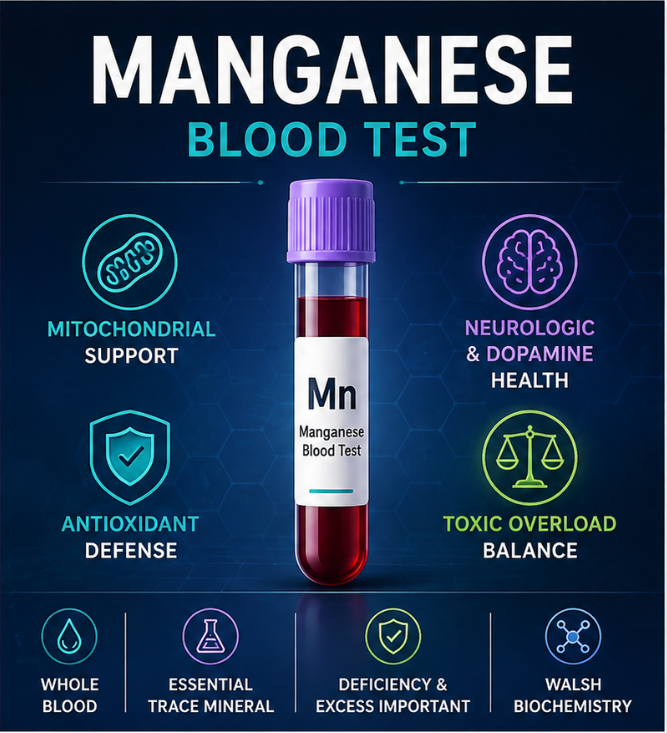
Manganese Blood Test


$149.00
Manganese, Whole Blood –measures manganese status to help evaluate deficiency or excess. Manganese supports mitochondrial MnSOD antioxidant defense, metabolism and neurologic function and may be relevant to Walsh overmethylation and toxic-overload patterns. Because excess manganese can be neurotoxic, balance is important.
Description
What Does a Manganese Blood Test Measure?
This test measures manganese in whole blood to help evaluate manganese status and possible excessive exposure. Manganese is an essential trace mineral involved in mitochondrial antioxidant defense, metabolism, connective tissue and nervous-system function.
Manganese is particularly important because both too little and too much can be undesirable.
Why Test Manganese Levels?
Mitochondrial Function
Manganese is the mineral cofactor for mitochondrial manganese superoxide dismutase (MnSOD/SOD2), an important defense against oxidative stress generated during cellular energy production.
Walsh Biochemistry
Manganese may be considered within the broader nutrient pattern associated with Walsh overmethylation and neurotransmitter regulation.
Toxic Overload
Excessive manganese can accumulate in the nervous system. Testing can therefore be useful when excessive exposure or an abnormal trace-mineral burden is suspected.
Manganese, MnSOD and Mitochondrial Antioxidant Defense
One of the most important functions of manganese occurs inside the mitochondria. Manganese superoxide dismutase (MnSOD or SOD2) uses manganese as a cofactor to help neutralize superoxide produced during normal mitochondrial energy metabolism.
This makes manganese relevant when evaluating oxidative stress, mitochondrial dysfunction or broader nutrient patterns affecting cellular energy production.
Manganese, Overmethylation and the Walsh Approach
Overmethylation
Within the Walsh Approach, manganese may be included among nutrients considered for certain individuals with an overmethylation biochemical pattern.
Manganese interacts with catecholamine biology, including dopamine pathways. Its effects are complex, however, and should not be described simply as “increasing dopamine.”
Toxic Overload
Manganese also illustrates why trace minerals require balance. Excess manganese can become neurotoxic and may affect dopamine signaling and structures within the basal ganglia.
Manganese status may therefore be relevant when evaluating a broader toxic-overload or abnormal mineral pattern.
Manganese, Gut Health and Glyphosate
Gastrointestinal health can influence trace-mineral availability. Manganese is also important to microorganisms within the intestinal ecosystem, creating an interesting relationship between manganese, diet and the gut microbiome.
Glyphosate has been studied for potential effects on intestinal bacteria and microbial metabolism. Because glyphosate can also interact with metal ions, researchers have proposed that chronic exposure could potentially influence manganese availability through a combination of microbiome disruption and mineral-binding effects.
When manganese is unexpectedly low, diet, gastrointestinal function, absorption, intestinal losses and the broader trace-mineral pattern may therefore deserve consideration.
Can You Take Too Much Manganese?
Yes. This is an important distinction between manganese and many commonly supplemented nutrients. Chronic excessive manganese exposure can be neurotoxic.
Excess manganese can accumulate in brain regions involved in movement and motor control. Significant chronic exposure can produce manganism, a neurologic disorder that may include:
- Movement abnormalities
- Muscle rigidity
- Gait changes
- Dystonia
- Tremor or Parkinson-like features
- Behavioral or cognitive changes
Because manganese influences neurologic and dopaminergic function at both physiologic and toxic levels, more manganese is not necessarily better. Significant or prolonged supplementation should have a clear rationale.
Who May Consider a Manganese Blood Test?
Possible Deficiency
Low dietary intake, gastrointestinal dysfunction, malabsorption or unusual trace-mineral findings may prompt evaluation.
Possible Excess
Occupational exposure, environmental exposure or substantial manganese supplementation may justify testing.
Functional Assessment
Manganese may be considered with mitochondrial oxidative stress, toxic-overload patterns or a broader Walsh biochemical assessment.
Labcorp Manganese, Whole Blood – Test #724195
This test measures manganese in whole blood. Whole-blood testing can help assess manganese status when excessive exposure, supplementation or an abnormal trace-mineral pattern is suspected.
Methodology: Inductively Coupled Plasma-Mass Spectrometry (ICP-MS)
Frequently Asked Questions About Manganese Blood Testing
What does a manganese blood test show?
The test measures manganese in whole blood and can help evaluate manganese status or possible excessive exposure.
Why is manganese important for mitochondria?
Manganese is the required mineral cofactor for mitochondrial manganese superoxide dismutase (MnSOD/SOD2), an antioxidant enzyme that helps protect mitochondria against superoxide generated during energy production.
Is manganese used for overmethylation?
Manganese may be considered as one component of the Walsh nutritional approach for certain overmethylation patterns. It should be interpreted in the context of symptoms, laboratory findings and the complete biochemical pattern rather than used as a stand-alone treatment for overmethylation.
Does manganese increase dopamine?
Manganese interacts with dopamine metabolism and signaling, but its effects are complex and dose dependent. It is not accurate to describe manganese simply as a dopamine-increasing nutrient. Excess manganese can disrupt normal dopaminergic function.
Can too much manganese cause movement disorders?
Yes. Significant chronic manganese excess can cause manganism, which can include dystonia, rigidity, gait abnormalities and Parkinson-like movement problems.
Is manganese toxicity the same as tardive dyskinesia?
No. Tardive dyskinesia is generally associated with dopamine-receptor- blocking medications. Manganese toxicity can cause a different neurologic syndrome involving the basal ganglia, including dystonia and Parkinson-like symptoms.
Can glyphosate affect manganese levels?
Glyphosate can affect microorganisms and interact with metal ions, and researchers have proposed that these effects could influence manganese availability. However, clinically significant manganese deficiency caused by ordinary dietary glyphosate exposure has not been established in humans.
Should I test manganese before taking a manganese supplement?
Testing can be particularly useful when significant or prolonged supplementation is being considered because manganese is essential in small amounts but can become neurotoxic with excessive exposure.