
SECOND OPINION SERIES
Walsh Approach Undermethylation
Whole Blood Histamine, and the Plasma Methylation Test
For many years, whole blood histamine has been relied upon in the Walsh Approach as an important marker for undermethylation. In the Walsh model, elevated whole blood histamine has often been used as a clue that methylation activity may be low, especially in patients with depression, anxiety, obsessive tendencies, seasonal allergies, high achievement traits, and other symptoms commonly associated with undermethylation.
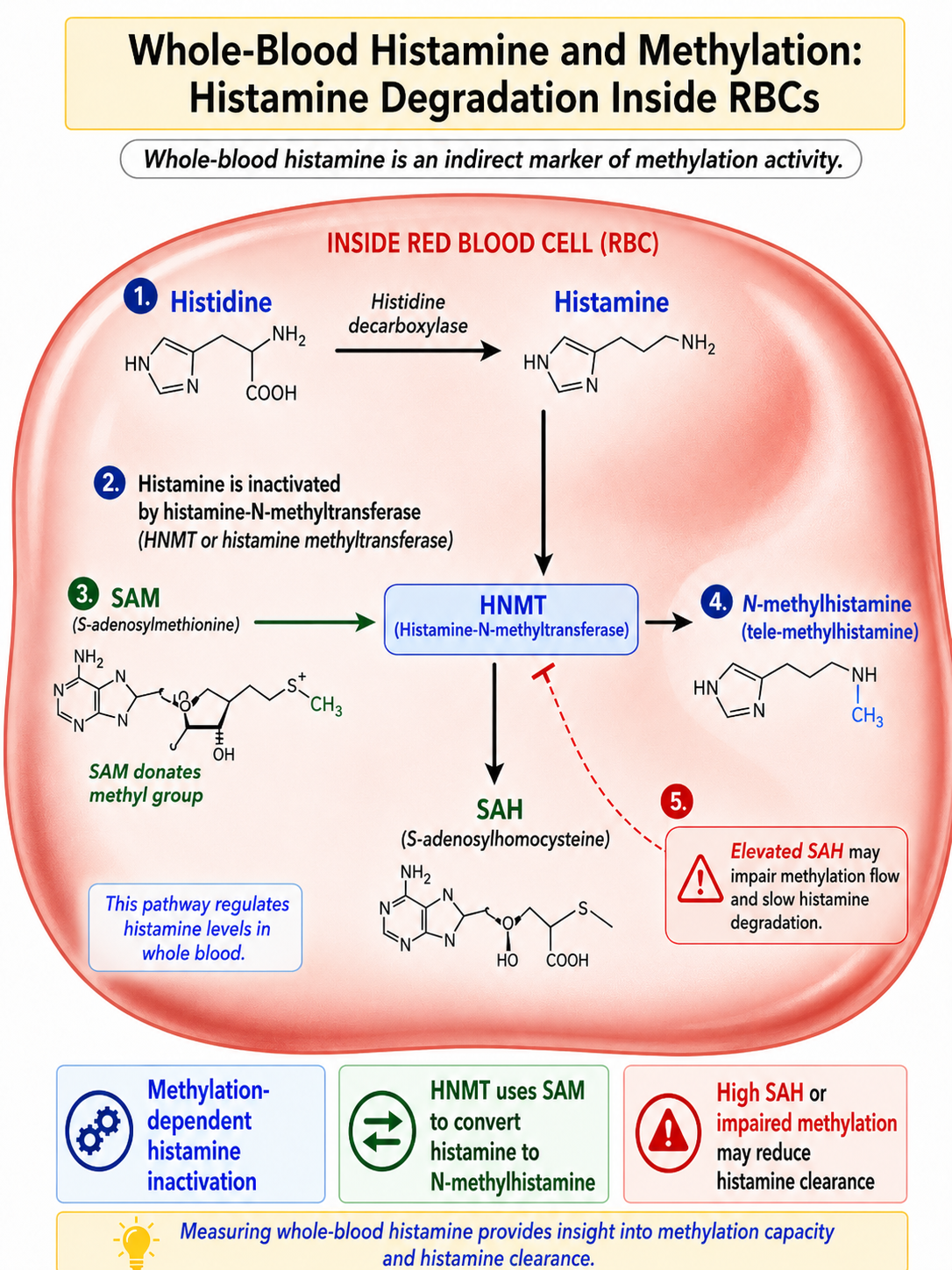
In full respect to Dr. William Walsh, this was an important clinical observation. The use of whole blood histamine in the Walsh Approach helped clinicians identify patterns that conventional psychiatric and medical evaluations often missed. It gave doctors a practical way to think about nutrient therapy, methylation, copper/zinc imbalance, pyroluria, and biochemical individuality.
At the same time, clinical models evolve. A plasma methylation test can provide a more direct test of methylation activity than whole blood histamine alone. This does not mean whole blood histamine is useless. It means whole blood histamine is best understood as a useful Walsh Approach undermethylation marker, while plasma methylation testing may provide a more accurate look at methylation flow, SAM, SAH, and downstream methylation impairment.
Walsh Approach Undermethylation and Whole Blood Histamine
The connection between Walsh Approach undermethylation and whole blood histamine is biochemically reasonable. One of the ways histamine is broken down is through the enzyme histamine N-methyltransferase, often abbreviated HNMT. This enzyme uses SAM as a methyl donor to convert histamine into methylhistamine. In simplified terms, if methylation activity is low, histamine may remain higher.
This is why whole blood histamine Walsh interpretation became an important part of the Walsh Approach. Elevated whole blood histamine often fits the classic undermethylation picture and can be highly predictive when it matches the symptom pattern.
The important distinction is that whole blood histamine is not the same as a complete test of methylation. It is an indirect marker. It can support the diagnosis of Walsh Approach undermethylation, but it does not fully measure methylation activity.
Why Whole Blood Histamine Is Not a Complete Test of Methylation
Whole blood histamine is several steps removed from the methylation cycle. It can be influenced by immune activity, allergy status, inflammation, histamine production, basophil and mast-cell activity, medications, diet, timing, sample handling, and differences between blood, tissue, gut, airway, and brain histamine metabolism.
This means a person may have symptoms that look like Walsh Approach undermethylation but still have a normal or low-normal whole blood histamine result. It also means a person may have histamine-type symptoms such as flushing, congestion, alcohol reactions, food reactions, rashes, itching, or chemical sensitivity without showing a high whole blood histamine level.
In these cases, the whole blood histamine result may not be wrong. It may simply be incomplete. A more direct test of methylation, such as a plasma methylation test, may help clarify whether methylation is actually flowing well or whether there is methylation impairment that whole blood histamine did not capture.
Why the Plasma Methylation Test May Be More Accurate
A plasma methylation test can evaluate methylation pathway markers more directly than whole blood histamine. Depending on the panel, this may include SAM, SAH, SAM/SAH ratio, methionine, homocysteine, adenosine, and related methylation markers.
This is important because methylation depends not only on whether the body has enough methyl donors, but also on whether methylation reactions are moving efficiently. A person may have low SAM, elevated SAH, a low SAM/SAH ratio, abnormal methionine, abnormal homocysteine, or elevated adenosine even when whole blood histamine is not elevated.
That is why the plasma methylation test may be a more accurate test of methylation activity than relying only on whole blood histamine. Whole blood histamine can remain a useful Walsh Approach undermethylation marker, but plasma methylation testing gives deeper information about methylation flow and possible downstream blockage.
Walsh Approach Undermethylation Versus Methylation Impairment
One important evolution is the distinction between classic Walsh Approach undermethylation and broader methylation impairment.
Classic undermethylation may include a strong undermethylation symptom pattern along with elevated whole blood histamine. This is the traditional whole blood histamine Walsh pattern that has been useful for many patients.
However, some patients appear to have methylation stress or impaired methylation throughput even when whole blood histamine is normal or low-normal. In these cases, the issue may not be classic high-histamine undermethylation. It may be a different methylation problem that is better identified by a plasma methylation test.
This distinction matters because treatment may differ. A person with classic Walsh Approach undermethylation may respond well to appropriate methylation support. A person with elevated SAH, low SAM/SAH ratio, toxic burden, inflammation, digestive dysfunction, or poor methylation flow may need a different sequence of support.
When Methionine or SAMe May Not Work as Expected
Some patients previously treated as undermethylated may have used methionine, SAMe, or other methylation-supportive nutrients based on symptoms and whole blood histamine interpretation. In many cases, this can be appropriate.
However, if SAH is elevated or the SAM/SAH ratio is low, simply adding methionine or SAMe may be less effective. SAH can act like a methylation brake. If methylation is backed up downstream, adding methyl donors may not solve the underlying problem and may sometimes be poorly tolerated.
This is another reason a plasma methylation test may be a better test of methylation function in patients who have undermethylation symptoms but an unclear or unreliable whole blood histamine result.
High SAH, Low SAM/SAH Ratio, and Methylation Flow
When SAH is elevated or the SAM/SAH ratio is low, the clinical question changes. Instead of asking only whether the patient needs methyl donors, we also need to ask why methylation is backed up.
Possible contributors include inflammation, toxic burden, oxidative stress, digestive dysfunction, dysbiosis, impaired liver or kidney clearance, poor nutrient absorption, medication effects, poor sleep, dehydration, alcohol, diet, and lifestyle factors that influence acid-base balance or pH-related physiology.
These issues may create methylation impairment even when whole blood histamine is not elevated. This is why Walsh Approach undermethylation assessment may be improved by adding a plasma methylation test when the clinical picture and whole blood histamine do not match.
Toxic Burden, Gut Function, and the Test of Methylation
Methylation does not occur in isolation. It is influenced by the larger terrain of the body. Toxic burden, mold exposure, chronic inflammation, poor digestion, constipation, dysbiosis, poor diet, dehydration, high stress, poor sleep, medication burden, and impaired liver or kidney clearance may all affect methylation activity.
In these cases, the most useful test of methylation may not be whole blood histamine alone. A plasma methylation test may show whether the methylation cycle is functioning efficiently or whether methylation is impaired by downstream blockage, elevated SAH, low SAM, or poor SAM/SAH ratio.
This does not discard the Walsh Approach. It refines the Walsh Approach undermethylation model by adding more biochemical context.
A More Complete Walsh Approach Undermethylation Framework
A more evolved clinical framework may include several categories:
- Classic Walsh Approach undermethylation: undermethylation symptoms plus elevated whole blood histamine.
- Suspected Walsh Approach undermethylation: undermethylation symptoms with incomplete, normal, or conflicting whole blood histamine results.
- Methylation impairment: abnormal plasma methylation test markers such as low SAM, high SAH, low SAM/SAH ratio, abnormal methionine, abnormal homocysteine, or elevated adenosine.
- Toxic burden/undermethylation overlap: undermethylation-type symptoms with inflammation, digestive burden, mold or chemical exposure, detoxification difficulty, high SAH, poor supplement tolerance, or histamine-type reactions.
This approach keeps whole blood histamine in the model, while also recognizing that the plasma methylation test may provide a more accurate test of methylation activity in complex or unclear cases.
Honoring the Walsh Approach While Improving Testing
Dr. Walsh’s work helped many clinicians and patients understand that depression, anxiety, OCD tendencies, behavioral symptoms, and mood instability may have biochemical patterns that deserve individualized nutrient therapy rather than generic supplementation.
That remains an important contribution. Whole blood histamine has been a useful and often predictive marker in the Walsh Approach, especially when it fits the classic undermethylation picture.
At the same time, the use of whole blood histamine as a methylation marker should continue to evolve. Some patients with undermethylation symptoms may have normal or low-normal histamine. Some patients treated with methionine or SAMe may not respond if SAH is elevated or if methylation is blocked by toxic burden, inflammation, gut dysfunction, medication effects, kidney or liver clearance issues, diet, hydration, sleep, or lifestyle factors.
The next step is not to abandon the Walsh Approach. The next step is to use it with more precision.
Whole blood histamine remains a useful Walsh Approach undermethylation clue. The plasma methylation test may provide a more accurate test of methylation activity. The best assessment comes from interpreting symptoms, history, tolerance, labs, and treatment response together.
That is how the Walsh Approach can continue to evolve while honoring the original insight.