
Genetics vs Epigenetics: Why Your Genes Don’t Tell the Whole Story
Genetics shows the DNA you inherited. Epigenetics helps explain how that genetic potential is regulated and expressed. One of the most important genetic testing limitations is that inherited risk does not always reveal what is happening in the body now. Nutrition, methylation, stress, toxins, inflammation, mitochondrial function and hormones can all influence gene expression and current biochemistry.
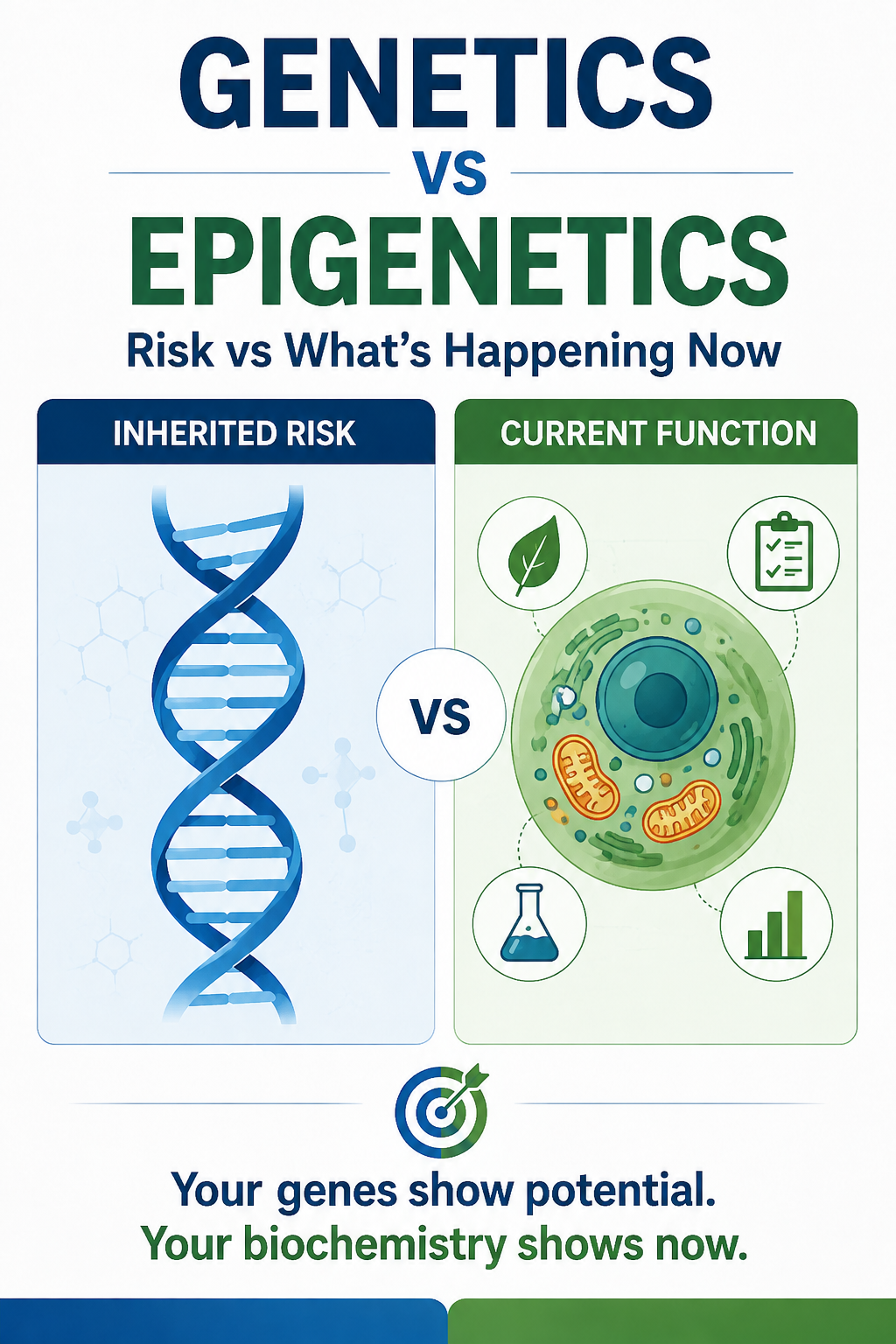

Genetics shows the DNA you inherited. Epigenetics helps explain how that genetic potential is regulated and expressed. Nutrition, methylation, stress, toxins, inflammation, mitochondrial function and other environmental influences can affect gene activity without changing the underlying DNA sequence.
Genetics vs Epigenetics: What Is the Difference?
The simplest way to understand genetics vs epigenetics is to separate the DNA sequence itself from the biological processes that influence how that DNA is used.
Main question:
What biological traits, variants and inherited vulnerabilities did you receive?
- Reflects the DNA sequence you inherit
- Usually remains stable throughout life
- Can identify disease-causing mutations
- Can identify inherited disease susceptibility
- Can provide pharmacogenomic information
- Can predict altered enzyme function
- Does not necessarily show whether a predicted pathway is abnormal today
Main question:
How is genetic potential being regulated and expressed?
- Influences gene activity without changing the DNA sequence
- Can change over time
- Is influenced by nutrition and metabolic state
- Is affected by methylation and cellular energy
- Can be influenced by stress, inflammation and hormones
- Can respond to environmental exposures
- Helps explain why the same genes can produce different biological outcomes
Genetics provides the blueprint. Epigenetics helps determine how that blueprint is read.
Genes vs Environment: Why DNA Does Not Determine Everything
The familiar idea of genes vs environment is really an interaction rather than a competition. Your genes influence susceptibility, while environment and biochemistry influence how that susceptibility is expressed.
Two people can carry similar genetic variants yet develop very different symptoms, laboratory abnormalities and health outcomes.
Important influences on gene expression and environment include:
Vitamins, Minerals & Amino Acids
Nutrients provide substrates and cofactors required for enzyme activity, antioxidant defense, mitochondrial energy production and methylation.
SAM, SAH & Methyl Donors
Methylation is one mechanism involved in regulation of gene activity. SAM availability and SAH accumulation also influence many other methyltransferase reactions throughout the body.
Cellular Energy
ATP availability affects cellular repair, metabolism and energy-dependent biochemical pathways.
Cellular Signaling & Damage
Reactive oxygen species can affect DNA, proteins, membranes and intracellular signaling.
Toxins & Exposures
Metals and other environmental exposures can increase oxidative, mitochondrial and detoxification stress.
Inflammation, Hormones & Stress
Inflammatory signaling, hormones, stress physiology and aging can all alter the biological environment surrounding gene expression.
What Is Epigenetics?
Epigenetics refers to regulatory processes that influence gene activity without changing the underlying DNA sequence.
DNA methylation is one important epigenetic mechanism. Other mechanisms include histone modification, chromatin organization and regulatory RNA activity.
This is why inherited genetics vs gene expression should not be treated as the same thing. Carrying a genetic variant does not automatically tell us how strongly that pathway is being expressed or whether it is currently producing a clinically important biochemical abnormality.
Genetic Testing Limitations: Risk Is Not the Same as Current Function
Genetic testing can be extremely valuable. But one of the most important genetic testing limitations is that a DNA result often identifies susceptibility rather than current physiology.
A common SNP may suggest that an enzyme could function differently, but the genetic result alone may not answer:
- Is the predicted pathway actually impaired now?
- Is the gene variant being expressed in a clinically important way?
- Has another metabolic pathway compensated?
- Are symptoms actually related to the variant?
- Is the predicted biochemical abnormality measurable?
- Has nutrition or environment changed the phenotype?
- Would treatment directed only at the SNP improve the problem?
Genetic testing may tell you where vulnerability exists. Current biochemical testing can show whether that vulnerability is being expressed.
When Genetic Testing Can Be Diagnostic
The limitations of genetic testing should not be confused with saying that genetic testing is unimportant. In the right setting, it can be highly informative or diagnostic.
Pathogenic Mutations
Certain variants can confirm or strongly support the diagnosis of an inherited genetic disorder.
Hereditary Susceptibility
Genetic testing may identify substantially increased inherited risk for certain cancers, cardiovascular diseases, neurologic disorders and other conditions.
Pharmacogenomics
Some genetic variants influence medication metabolism, effectiveness and adverse-effect risk.
The distinction becomes particularly important when common SNP reports are used to explain complex conditions such as depression, anxiety, fatigue, cognitive decline, inflammation, mitochondrial dysfunction or impaired methylation.
Epigenetic Testing vs Functional Biochemical Testing
Epigenetic testing and functional biochemical testing are related concepts, but they are not interchangeable.
True epigenetic testing may examine regulatory features such as DNA methylation patterns. By contrast, tests such as SAM, SAH, CoQ10, lactate, pyruvate, acylcarnitines, magnesium, cystatin C, amino acids, 8-OHdG and lipid peroxides measure current biochemical or physiologic function.
Those functional tests do not directly measure the epigenome. They can, however, help characterize the metabolic environment in which gene expression is occurring.
Genetics describes inherited potential. Epigenetics describes regulation of gene expression. Functional biochemical testing helps show the current physiology associated with that expression.
Genetic Testing vs Functional Testing: Two Different Questions
Once the difference between genetics and epigenetics is clear, functional testing becomes easier to understand.
Genetic testing asks what biological vulnerabilities you inherited. Functional testing asks what is actually happening in the body now.
| Type of Information | What It Can Tell You |
|---|---|
| Genetic testing | Inherited variants, mutations, susceptibility and pharmacogenomic information |
| Epigenetic testing | Selected regulatory changes affecting gene activity, depending on the test used |
| Functional biochemical testing | Current metabolites, nutrients, oxidative stress, mitochondrial function, mineral status, methylation-related metabolites and other physiology |
MTHFR Testing Limitations: A Classic Genetics vs Epigenetics Example
MTHFR is one of the clearest examples of why genetics vs epigenetics matters clinically.
An MTHFR genetic variant can indicate inherited potential for altered folate metabolism. It does not directly measure methylation status, DNA methylation or current methylation capacity.
An MTHFR variant does not automatically mean you are undermethylated, and it does not automatically mean you need methylfolate.
These are important MTHFR testing limitations. A genotype predicts potential; it does not provide a direct measurement of the methylation cycle.
The more useful biochemical questions may include:
- What is your SAM?
- What is your SAH?
- What is the SAM:SAH relationship?
- What is your methionine?
- What is your homocysteine?
- Is folate actually deficient?
- Is vitamin B12 adequate?
- Is mitochondrial ATP production adequate?
- Are there biochemical factors increasing methylation demand?
Two people can carry the same MTHFR variant and have very different biochemical findings.
Same genotype. Different gene expression. Different biochemical phenotype. Potentially different treatment needs.
Methylation Testing: Measuring Function Instead of Predicting It
Methylation testing can provide current biochemical information that cannot be determined from an MTHFR SNP alone.
Important methylation-related markers include:
- SAM — a principal biological methyl donor
- SAH — an inhibitor of methyltransferase reactions
- SAM:SAH relationship — useful for assessing methylation potential
- Methionine — precursor for SAM synthesis
- Homocysteine — central to methylation and transsulfuration metabolism
These measurements address a fundamentally different question from genetic testing:
What is the methylation-related biochemistry doing now?
This distinction is particularly important when an MTHFR result is being used to make assumptions about current methylation status.
View Methylation Testing