Antidepressants
An SSRI may fit a low-functional-serotonin undermethylation pattern but create activation or poor tolerance in another biochemical pattern.

The Walsh Protocol, also known as the Walsh Approach, is a biochemical framework for understanding why patients with depression, anxiety, ADHD, OCD or insomnia can respond differently to the same medication or supplement. It combines symptoms, treatment response and targeted blood tests to identify patterns involving methylation, copper and zinc, histamine, pyroluria, oxidative stress and toxic burden.
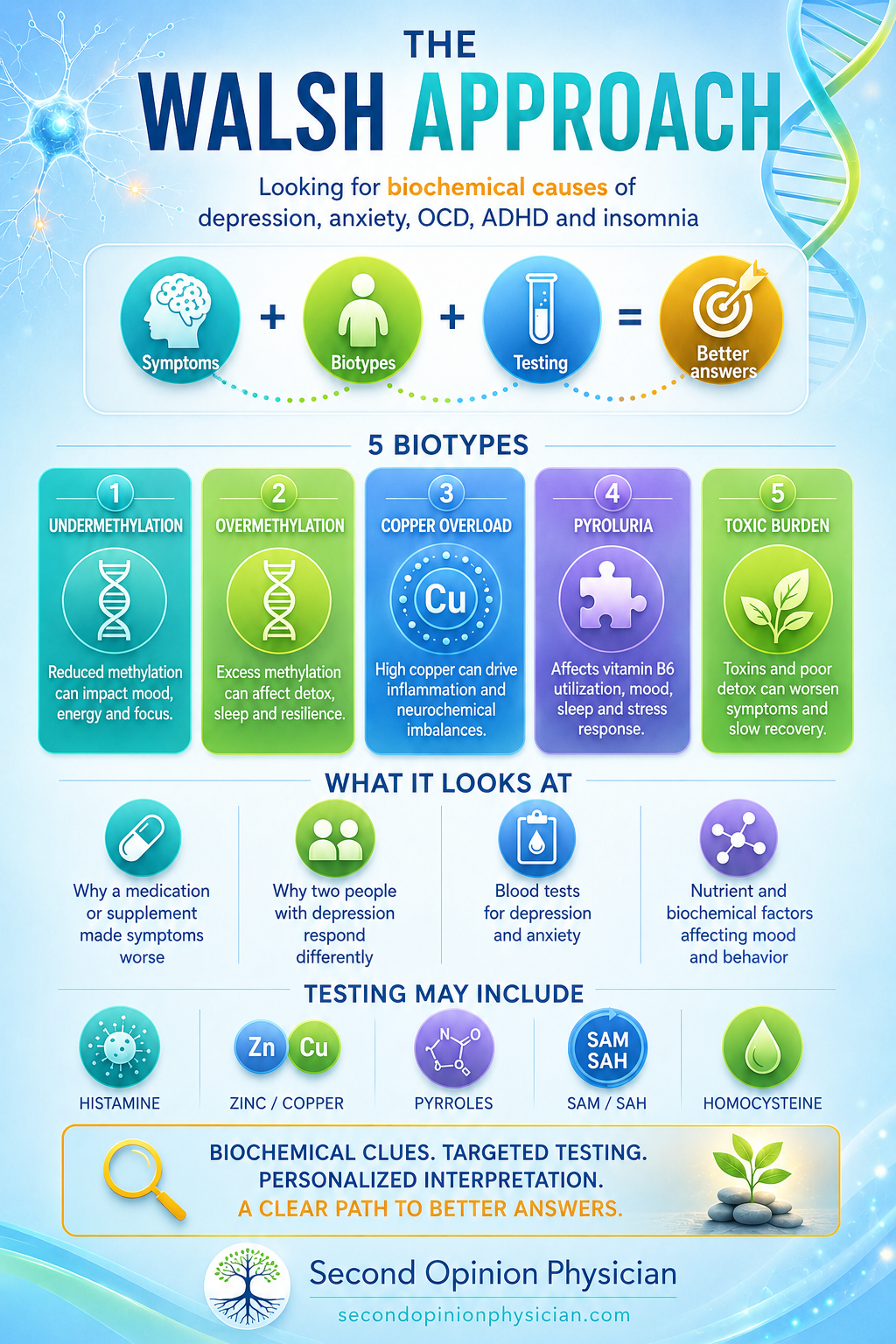
The Walsh Approach, sometimes called the Walsh Protocol or Walsh method, is a biochemical model for understanding why patients with the same psychiatric diagnosis may have very different symptoms, medication responses and nutrient needs.
Rather than treating depression, anxiety, ADHD, OCD or insomnia as one uniform disorder, the Walsh Approach looks for recurring patterns involving methylation, copper and zinc, histamine, pyroluria, oxidative stress, toxic burden and nutrient-dependent neurotransmitter regulation.
The objective is not to replace a diagnosis. It is to explain why a treatment helped, failed or caused side effects—and to use that information to guide testing and a more individualized treatment plan.
A medication or supplement can push the right pathway in one patient and the wrong pathway in another. The diagnosis may be the same, but the underlying biochemical pattern may be different.
This helps explain why an antidepressant may relieve rumination and depression in one patient but cause agitation, insomnia or emotional flattening in another. The same is true for stimulants, folate, methyl donors, zinc, vitamin B6, niacin and detoxification programs.
An SSRI may fit a low-functional-serotonin undermethylation pattern but create activation or poor tolerance in another biochemical pattern.
Folic acid, folinic acid or methylfolate may help selected patients but worsen anxiety or depression in folate-sensitive undermethylation.
These may improve attention in one patient but intensify anxiety, insomnia or copper-related norepinephrine activity in another.
“Depression” describes a cluster of symptoms. It does not identify the biochemical pattern producing those symptoms. Two patients can meet the same diagnostic criteria while having very different neurotransmitter activity, mineral balance, histamine levels, stress tolerance and medication response.
Perfectionism, rumination, seasonal allergies, internal tension, high achievement and previous benefit from an SSRI may fit classic Walsh undermethylation.
Chemical sensitivity, nervous energy, emotional reactivity and antidepressant activation may fit overmethylation, copper imbalance or another pattern.
The Walsh Approach uses these differences as clues. Medication response, supplement tolerance, physical traits, family history and laboratory findings can all help refine the interpretation.
These conditions are rarely caused by one nutrient or one pathway. However, recurring biochemical patterns can contribute to symptom intensity, treatment response, medication sensitivity and relapse risk.
May involve undermethylation, overmethylation, copper overload, pyroluria, inflammation, toxic burden or impaired methylation.
May involve copper overload, low zinc, pyroluria, cortisol imbalance, histamine, glutamate sensitivity or mitochondrial stress.
May overlap with zinc deficiency, pyroluria, undermethylation, high histamine, stimulant sensitivity or glutamate dysregulation.
May reflect copper-related norepinephrine activity, histamine, cortisol imbalance, glutamate sensitivity or poor methylation clearance.
No single laboratory test diagnoses depression or anxiety. The Walsh Approach uses selected markers as part of a broader assessment that includes symptoms, history and treatment response.
| Test | What it may reveal | Why it matters |
|---|---|---|
| Whole-blood histamine | High- or low-histamine pattern | Helps distinguish classic undermethylation from lower-histamine patterns |
| Serum copper, plasma zinc and ceruloplasmin | Copper-zinc imbalance and possible free copper | Relevant to anxiety, panic, insomnia, irritability and postpartum mood symptoms |
| Urinary pyrroles | Possible zinc and B6 demand | May help explain stress intolerance, social anxiety and unstable treatment response |
| SAM, SAH and methylation panel | Low methyl-donor capacity or methylation inhibition | Distinguishes low SAM from elevated SAH and impaired methylation clearance |
| Homocysteine and methionine | Methionine-cycle function | Provides context for methylation, remethylation and transsulfuration |
| Vitamin D, CBC and CMP | Common nutritional and metabolic contributors | Identifies anemia, liver, kidney and vitamin-related barriers to improvement |
The Walsh biotypes are recurring biochemical patterns—not psychiatric diagnoses. Each pattern can produce overlapping mood or behavior symptoms while requiring a different treatment strategy.
Often associated with perfectionism, rumination, seasonal allergies, inner tension, high achievement and possible past benefit from SSRIs.
Read the undermethylation guideMay include chemical sensitivity, nervous energy, low histamine, emotional reactivity and unusual medication or methyl-donor responses.
Read the overmethylation guideMay contribute to anxiety, panic, insomnia, irritability, estrogen-related symptoms and postpartum mood changes.
Read the copper overload guideMay involve increased zinc and B6 demand, social anxiety, stress intolerance, mood instability and poor recovery.
Read the pyroluria guideMay interfere with methylation, mitochondrial function, antioxidant reserve and tolerance of otherwise reasonable protocols.
Read the toxic burden guideSee how similar depressive symptoms can arise from different biochemical mechanisms and treatment needs.
Compare the five biotypesMay help a low-functional-serotonin pattern while causing activation, flattening or poor tolerance in another biotype.
May support selected patients but worsen anxiety or depression in folate-sensitive undermethylation through the Walsh SERT mechanism.
May improve attention but worsen anxiety or insomnia when copper, cortisol or sleep disruption is driving symptoms.
May improve copper balance and stress tolerance when deficient but can create copper deficiency if used aggressively without monitoring.
The Walsh biotype describes the recurring biochemical pattern. Epigenetic factors help explain why that pattern may worsen, emerge later in life or become resistant to treatment.
Sleep loss, chronic stress, poor diet, inflammation, toxic exposure, alcohol or drug use, mitochondrial strain and increased methylation demand can alter gene expression and reduce biochemical reserve. A previously manageable vulnerability may then become depression, anxiety, OCD, insomnia or behavioral instability.
Increase inflammatory and hormonal pressure while reducing repair and recovery.
Increase antioxidant demand and can inhibit methylation or mitochondrial function.
Poor protein intake, processed foods, creatine demand and mineral depletion can reduce biochemical reserve.
Treatment resistance does not always mean that nothing can help. It may mean that the dominant biochemical pattern has not been identified, several patterns overlap, or an epigenetic driver continues to block recovery.
A more complete Walsh-style evaluation may review medication response, folate tolerance, copper-zinc balance, histamine, pyroluria, SAM, SAH, sleep, gut function, toxic burden and inflammation. The purpose is to explain partial response, side effects or relapse and identify the next practical step.
WalshDoc organizes the information needed for a Walsh-style assessment before the clinical review begins. It combines symptom patterns, physical traits, family history, medication response, environmental exposures and available labs into a structured report.
The Biotype Questionnaire organizes mood, behavior, sleep, allergy and treatment-response clues.
The report shows which Walsh biotypes and contributing factors are most strongly supported.
Targeted labs confirm, refine or challenge the questionnaire findings.
A consultation connects symptoms, labs, medication history and treatment direction.
The simplest first step is the Biotype Questionnaire. It helps determine whether a Walsh biotype pattern is strongly supported and whether laboratory testing or a consultation is the logical next step.
The Walsh Approach is a biochemical pattern-recognition model that combines symptoms, treatment response and targeted laboratory testing to identify recurring patterns behind mood, behavior, attention, sleep and cognitive symptoms.
The terms are often used interchangeably. The Walsh Approach refers to the overall assessment model, while Walsh Protocol may also refer to the resulting nutrient and laboratory-guided treatment strategy.
The major patterns commonly discussed are undermethylation, overmethylation, copper overload and pyroluria, with toxic burden and oxidative stress often assessed as important contributing patterns.
Common tests include whole-blood histamine, serum copper, plasma zinc, ceruloplasmin, urinary pyrroles, homocysteine, SAM, SAH, vitamin D, CBC and CMP.
A supplement may push the wrong biochemical pathway. Folate, methyl donors, activating nutrients, high-dose zinc or detoxification strategies may help one pattern while aggravating another.
It may help explain why standard treatment produced only partial benefit, side effects or relapse by identifying methylation, copper-zinc, histamine, pyroluria, toxic burden or epigenetic factors that were not previously assessed.
The Biotype Questionnaire is the simplest starting point. Laboratory testing and consultation can then be selected according to the pattern and available prior results.