
How to Improve Mitochondrial Function: A Practical Treatment Strategy for Cellular Energy
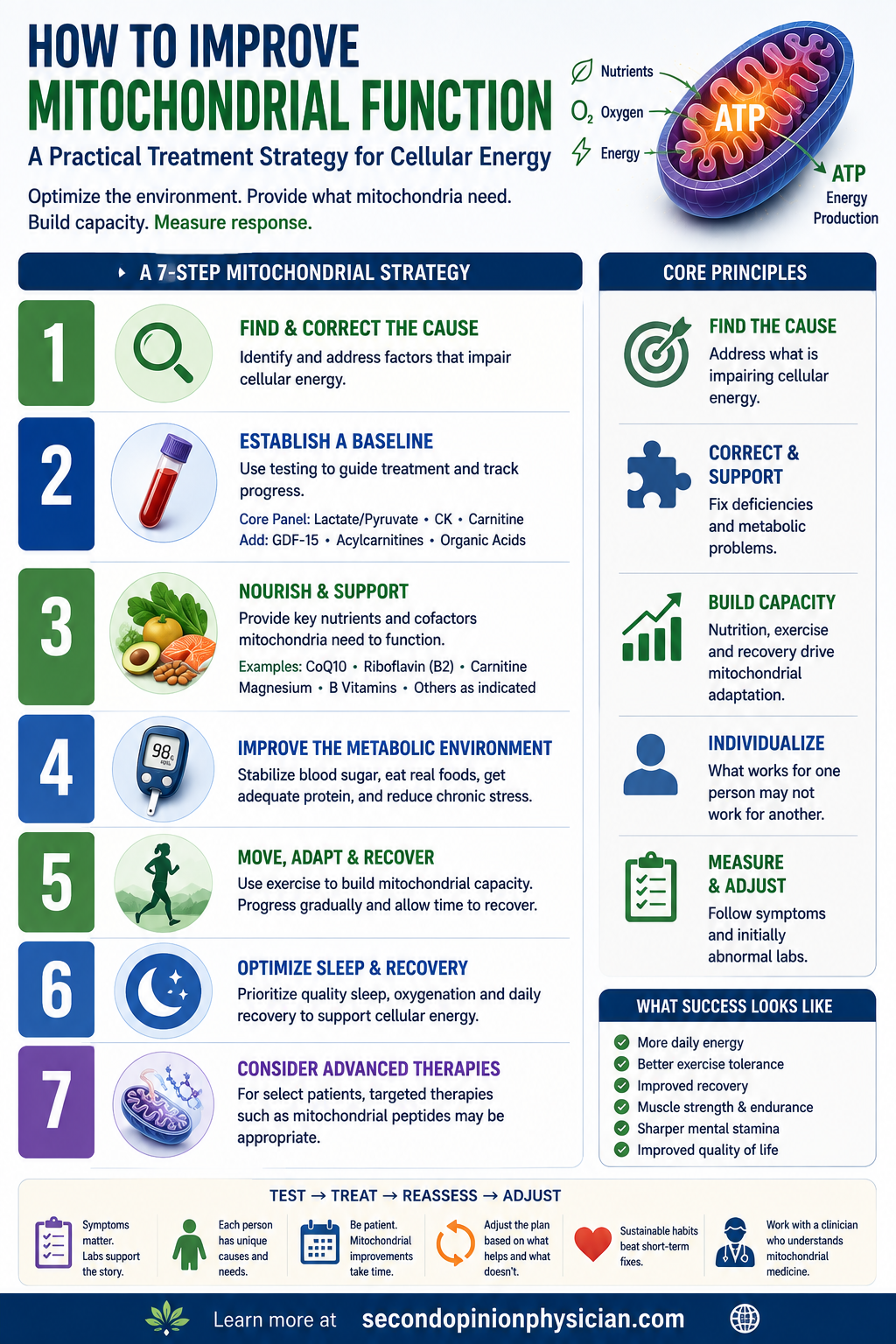
Mitochondrial dysfunction can contribute to fatigue, exercise intolerance, muscle weakness, poor recovery, cognitive fatigue and other symptoms involving tissues with high energy requirements. But there is no single “mitochondrial treatment.” The most useful approach is to determine why cellular energy production is impaired, correct reversible contributors, provide the nutrients and metabolic environment mitochondria require, gradually rebuild capacity, and reserve more specialized therapies for patients who need them.
The goal is not simply to take more “mitochondrial supplements.” It is to create a treatment strategy that can be adjusted according to symptoms, laboratory findings, underlying causes and measurable response.
Mitochondria respond continuously to the biochemical environment in which they operate. Nutrient availability, oxygen delivery, metabolic health, sleep, physical activity, medications, inflammation, toxic exposures and underlying disease can all influence cellular energy production.
But mitochondrial dysfunction can also intersect with methylation, oxidative stress, mineral balance and epigenetic regulation. For some patients, impaired cellular energy is not an isolated problem. It may be one part of a broader biochemical pattern.
That is why an effective mitochondrial strategy usually involves several layers of treatment rather than a single supplement, peptide or intervention.
1. Identify what is impairing cellular energy
2. Determine whether methylation or another biochemical driver is involved
3. Establish a useful laboratory baseline
4. Correct deficiencies and reversible metabolic problems
5. Support mitochondrial energy production and recovery
6. Build mitochondrial capacity gradually
7. Consider advanced therapies selectively
8. Reassess symptoms, function and initially abnormal biomarkers
Mitochondrial Dysfunction Is Not One Disease—or One Treatment
Two people can experience similar fatigue, weakness, cognitive difficulty or exercise intolerance for very different biochemical reasons.
One may have impaired glucose metabolism. Another may have a nutrient deficiency. Another may have medication-related mitochondrial stress, chronic inflammation, toxic burden or impaired oxygen delivery. Another may have a primary mitochondrial disorder.
And in some patients, mitochondrial dysfunction may overlap with impaired methylation and epigenetic regulation.
The first treatment question therefore should not be:
A better question is:
Step 1: Identify the Drivers of Mitochondrial Stress
Before attempting to stimulate mitochondria, look for factors that may be interfering with normal cellular-energy production.
Deficiencies or inadequate intake of nutrients required for energy metabolism can limit mitochondrial function.
Insulin resistance, abnormal glucose handling and poor metabolic flexibility can alter mitochondrial fuel utilization.
Chronic inflammatory signaling can increase oxidative stress, alter energy demand and interfere with normal cellular function.
Environmental exposures, alcohol and selected medications may contribute to oxidative and mitochondrial stress in susceptible patients.
Thyroid dysfunction, anemia, cardiopulmonary disease and other medical conditions can substantially affect cellular energy and oxygen delivery.
Poor sleep, sleep apnea, excessive training and inadequate recovery can perpetuate fatigue and impaired energy metabolism.
Where Do Methylation and Epigenetics Fit?
Methylation and mitochondrial energy metabolism are closely interconnected cellular systems. Methylation reactions depend upon adequate metabolic resources, while mitochondrial dysfunction and oxidative stress can alter the biochemical environment in which methylation occurs.
This relationship becomes particularly important when mitochondrial symptoms coexist with features of undermethylation or another Walsh biochemical pattern.
Mitochondrial Distress Can Be Part of a Larger Undermethylation Pattern
Our expanded Five Epigenetic Biotypes of Undermethylation model asks a question beyond whether undermethylation is present:
Mitochondrial distress is one potential contributor. Other biochemical patterns may involve methyl-group demand, oxidative stress, inflammatory signaling, nutrient/mineral imbalance, toxic burden and impaired metabolic clearance.
This does not mean that mitochondrial dysfunction automatically indicates undermethylation, or that every undermethylated patient has mitochondrial disease. Rather, it means that the two systems can intersect and may deserve evaluation together when the clinical pattern suggests both.
Step 2: Establish a Useful Cellular Energy Baseline
Laboratory testing does not diagnose every form of mitochondrial dysfunction. Selected tests can, however, identify abnormalities that change treatment, provide a baseline for reassessment or indicate when deeper investigation is appropriate.
Provides information about oxidative energy metabolism and cellular redox relationships.
Looks for evidence of muscle-cell injury or involvement.
Can identify abnormal carnitine status—a potentially correctable contributor to fatty-acid metabolism.
Which Testing Path Makes Sense?
Not every patient needs every test. The important distinction is what question we are trying to answer.
Is Cellular-Energy Metabolism Abnormal?
Consider when fatigue, muscle symptoms, exercise intolerance, poor recovery or other findings raise concern about mitochondrial metabolism.
Core testing:
Lactate/Pyruvate • CK • Free + Total Carnitine
Deeper testing when indicated:
Acylcarnitines • GDF-15 • Organic Acids • specialty metabolic/genetic evaluation
Is a Broader Biochemical Pattern Contributing?
Consider when cellular-energy symptoms overlap with mood, cognition, behavioral symptoms, stress intolerance, suspected undermethylation, copper/zinc imbalance or another Walsh biotype pattern.
Walsh assessment may include:
Whole-Blood Histamine • Copper • Ceruloplasmin • Zinc • Homocysteine • Vitamin D and related markers.
Functional methylation testing may include:
SAM • SAH • Methionine • Homocysteine and related methylation metabolites.
Step 3: Correct Deficiencies and Support Energy Metabolism
Mitochondrial energy production depends upon numerous vitamins, minerals and metabolic cofactors. Deficiency can impair energy metabolism, but this does not mean every patient needs every ingredient in a large “mitochondrial cocktail.”
Correct identified deficiencies first. Additional mitochondrial support can then be individualized according to symptoms, diet, medications, laboratory findings and the broader biochemical pattern.
Coenzyme Q10
Participates in electron transport and mitochondrial ATP production. It may be particularly relevant when deficiency, mitochondrial disease or medication-related depletion is suspected.
Riboflavin — B2
Contributes to flavoproteins involved throughout mitochondrial energy metabolism and has particular relevance in selected mitochondrial and metabolic disorders.
Carnitine
Transports long-chain fatty acids toward mitochondrial oxidation. Replacement has the clearest rationale when deficiency is documented.
Thiamine — B1
Thiamine-dependent enzymes connect carbohydrate metabolism with mitochondrial energy pathways. Deficiency should be recognized and corrected.
Magnesium
ATP is biologically utilized largely in magnesium-associated form, making adequate magnesium important for normal cellular-energy physiology.
Antioxidant / Redox Support
NAC, alpha-lipoic acid and other interventions may support antioxidant and redox systems when appropriate.
Creatine: The Bridge Between Cellular Energy and Methylation
Creatine has a somewhat different role from vitamins and mitochondrial cofactors. The creatine/phosphocreatine system helps cells rapidly regenerate ATP during periods of high energy demand, particularly in muscle and brain.
But creatine is also important to this larger treatment model because endogenous creatine synthesis consumes methyl-group capacity.
Producing creatine requires methyl groups from S-adenosylmethionine (SAM) and generates S-adenosylhomocysteine (SAH). Supplemental creatine reduces the body's need to synthesize as much creatine internally.
CELLULAR ENERGY → ATP BUFFERING → CREATINE DEMAND → METHYLATION DEMAND
Step 4: Improve the Metabolic Environment
Mitochondria constantly respond to nutrient supply, fuel availability and energy demand. Improving metabolic health can therefore be a mitochondrial intervention in its own right.
Address insulin resistance, excessive glucose exposure and other metabolic abnormalities when present.
Protein supports muscle maintenance, enzymes and recovery while helping preserve metabolically active tissue.
A nutrient-dense diet provides vitamins, minerals and substrates required for normal energy metabolism.
Healthy mitochondria must adapt to changing fuel availability rather than functioning in a state of persistent metabolic overload.
Where Does Toxic Burden Fit?
Toxic burden is best viewed as a potential upstream or intermediary driver rather than as another name for mitochondrial dysfunction.
Environmental exposures and impaired clearance can increase oxidative stress, alter enzyme activity and place additional demands on cellular defense and detoxification systems. In susceptible patients, this may contribute to both mitochondrial stress and disturbances in methylation-related metabolism.
↓
OXIDATIVE + METABOLIC STRESS
↓
MITOCHONDRIAL STRESS ↔ METHYLATION STRESS
↓
CELLULAR DYSFUNCTION
The clinical goal is not to assume that every patient is “toxic.” Exposure history, symptoms, biochemical findings and appropriate testing should determine whether this pathway deserves greater attention.
Step 5: Use Exercise to Build Mitochondrial Capacity
For many people, appropriately dosed physical activity is one of the strongest physiological signals for mitochondrial adaptation. Exercise can stimulate mitochondrial biogenesis and improve oxidative capacity.
But exercise needs to match the patient's current capacity.
Supports oxidative capacity and mitochondrial adaptation when tolerated.
Maintains muscle mass and metabolic capacity while increasing functional reserve.
Training should be balanced against symptoms and recovery rather than repeatedly exceeding available energy capacity.
Step 6: Sleep, Oxygenation & Recovery
Mitochondrial treatment is incomplete if a patient is chronically sleep deprived, hypoxic at night or unable to recover from normal physiological stress.
Sleep quality, sleep apnea, pulmonary or cardiovascular disease, anemia and other conditions affecting oxygen delivery can all influence cellular energy and exercise tolerance.
Recovery is not separate from mitochondrial treatment. It is part of the environment that determines whether mitochondria can adapt and rebuild capacity.
Step 7: Where Do Peptides and Advanced Mitochondrial Therapies Fit?
Interest has grown rapidly in therapies intended to influence mitochondrial membranes, signaling, biogenesis and cellular stress responses.
These approaches are fundamentally different from simply supplying vitamins or metabolic substrates. They attempt to influence how mitochondria function, communicate, respond to stress or maintain membrane integrity.
SS-31 / Elamipretide
A mitochondria-targeted peptide developed to interact with cardiolipin and mitochondrial membranes. It represents a different strategy from simply supplying metabolic cofactors.
Learn About SS-31 →Mitochondrial Peptides
Peptide-based strategies are being investigated for effects on metabolic regulation, cellular stress responses, mitochondrial signaling and energy homeostasis.
Explore Mitochondrial Peptides →Step 8: Test → Treat → Reassess
Treatment should produce a measurable benefit. That does not mean every laboratory marker must normalize or that every test needs to be repeated.
Instead, establish the abnormalities that matter at baseline, treat the underlying pattern, and then reassess symptoms, function and the markers that were actually abnormal.
SYMPTOMS + HISTORY
IDENTIFY THE BIOCHEMICAL PATTERN
FOCUSED TESTING
TARGET CORRECTABLE DRIVERS
MITOCHONDRIAL + METABOLIC SUPPORT
SYMPTOMS + FUNCTION + ABNORMAL LABS
ADJUST THE PLAN
Useful Measures of Progress
When Should Mitochondrial Testing Go Deeper?
Persistent symptoms, significant abnormalities or a presentation suggesting a more substantial metabolic or mitochondrial disorder may justify additional investigation.
GDF-15
Provides an additional biomarker associated with mitochondrial and cellular stress.
GDF-15 Testing →Acylcarnitines
Evaluates patterns involving fatty-acid oxidation and mitochondrial fuel metabolism.
Acylcarnitines Profile →Organic Acids
Provides a broader view of metabolic intermediates involving cellular-energy production and related pathways.
Organic Acids →When Should Mitochondrial and Methylation Testing Be Considered Together?
A combined approach can make sense when fatigue, exercise intolerance or cognitive symptoms occur alongside a clinical pattern suggesting undermethylation, mineral imbalance or another Walsh biotype.
The purpose is not simply to order more tests. It is to distinguish two different questions:
MITOCHONDRIAL TESTING:
Is there evidence of abnormal cellular-energy metabolism, muscle involvement, carnitine deficiency or another metabolic pattern?
WALSH + METHYLATION TESTING:
Is there a broader biochemical pattern involving methylation, zinc/copper balance or another potential epigenetic driver that may influence treatment?
Biotype + Undermethylation Assessment
The combined questionnaire evaluates traditional Walsh biotype characteristics together with a more detailed assessment of undermethylation and potential epigenetic drivers.
It can help determine whether the next step should emphasize mitochondrial testing, Walsh biochemistry, functional methylation testing—or a combination.
Biotype + Undermethylation QuestionnaireWhat if Primary Mitochondrial Disease Is Suspected?
Primary inherited mitochondrial disease is different from the broader acquired mitochondrial dysfunction discussed throughout much of this site.
Early onset, progressive neurological disease, cardiomyopathy, significant myopathy, hearing or vision abnormalities, unexplained multisystem disease or a suggestive family history may warrant specialist metabolic and genetic evaluation rather than simply expanding nutritional or functional treatment.
Frequently Asked Questions About Improving Mitochondrial Function
Can mitochondrial function be improved?
In many acquired conditions, contributors to impaired cellular energy can be modified. Correcting deficiencies, improving metabolic health, treating underlying illness, improving sleep and appropriately increasing physical activity can all influence mitochondrial function. Primary genetic mitochondrial diseases require a different approach.
What is the best treatment for mitochondrial dysfunction?
There is no single best treatment because mitochondrial dysfunction can arise from many different causes. Treatment should focus on identifying reversible drivers, correcting deficiencies, improving the metabolic environment and adding targeted mitochondrial support when appropriate.
What is the best supplement for mitochondria?
No single supplement is best for everyone. CoQ10, creatine, carnitine, B vitamins, magnesium and antioxidant support affect different pathways. The most appropriate intervention depends upon the underlying biochemical problem.
What does methylation have to do with mitochondrial function?
Methylation and mitochondrial metabolism are interconnected. Cellular energy, oxidative stress, nutrient availability and methyl-group demand can influence one another. Creatine metabolism provides one particularly clear connection because endogenous creatine synthesis consumes SAM-derived methyl groups.
Can mitochondrial dysfunction contribute to undermethylation?
Mitochondrial dysfunction does not automatically mean a person is undermethylated. However, mitochondrial distress, oxidative stress and metabolic dysfunction may interact with methylation pathways. In our expanded model, mitochondrial distress is therefore considered one potential epigenetic driver or perpetuating factor in selected patients with undermethylation.
Does creatine improve mitochondrial energy?
Creatine helps buffer cellular ATP availability through the phosphocreatine system. It is particularly relevant to tissues with rapidly changing energy requirements such as muscle and brain and also reduces the methylation demand associated with endogenous creatine synthesis.
Does exercise improve mitochondria?
Appropriately dosed exercise can stimulate mitochondrial adaptation and biogenesis. Exercise should be individualized when significant exercise intolerance, post-exertional worsening or metabolic disease is present.
Should mitochondrial blood tests be repeated?
Retesting is most useful when a meaningful abnormality was present initially and repeating it can determine whether treatment changed that abnormality. Normal markers generally do not need to be repeatedly measured as a nonspecific mitochondrial wellness score.
Are mitochondrial peptides necessary?
No. Peptides and other advanced therapies represent one possible layer of treatment. Correctable deficiencies, metabolic problems, sleep, exercise tolerance and underlying medical conditions should not be overlooked in favor of experimental therapies.
Treat the Pattern, Not Just the Mitochondria
A focused mitochondrial strategy combines symptoms and history with appropriate cellular-energy testing, correction of reversible problems and targeted treatment. When the clinical pattern also suggests undermethylation or another Walsh biotype, methylation and epigenetic drivers deserve consideration as part of the same biochemical picture.