
Mitochondrial Supplements: Nutrients That Support ATP & Cellular Energy
Mitochondria require vitamins, minerals, antioxidants, electron carriers and metabolic substrates to convert food into usable cellular energy. That makes nutritional support an important part of mitochondrial medicine—but “mitochondrial support” is not one supplement and more supplements are not necessarily better. CoQ10, creatine, carnitine, B vitamins, magnesium and antioxidants each affect cellular energy in different ways, and the best choices depend on the patient's symptoms, diet, laboratory findings and underlying cause of mitochondrial stress.

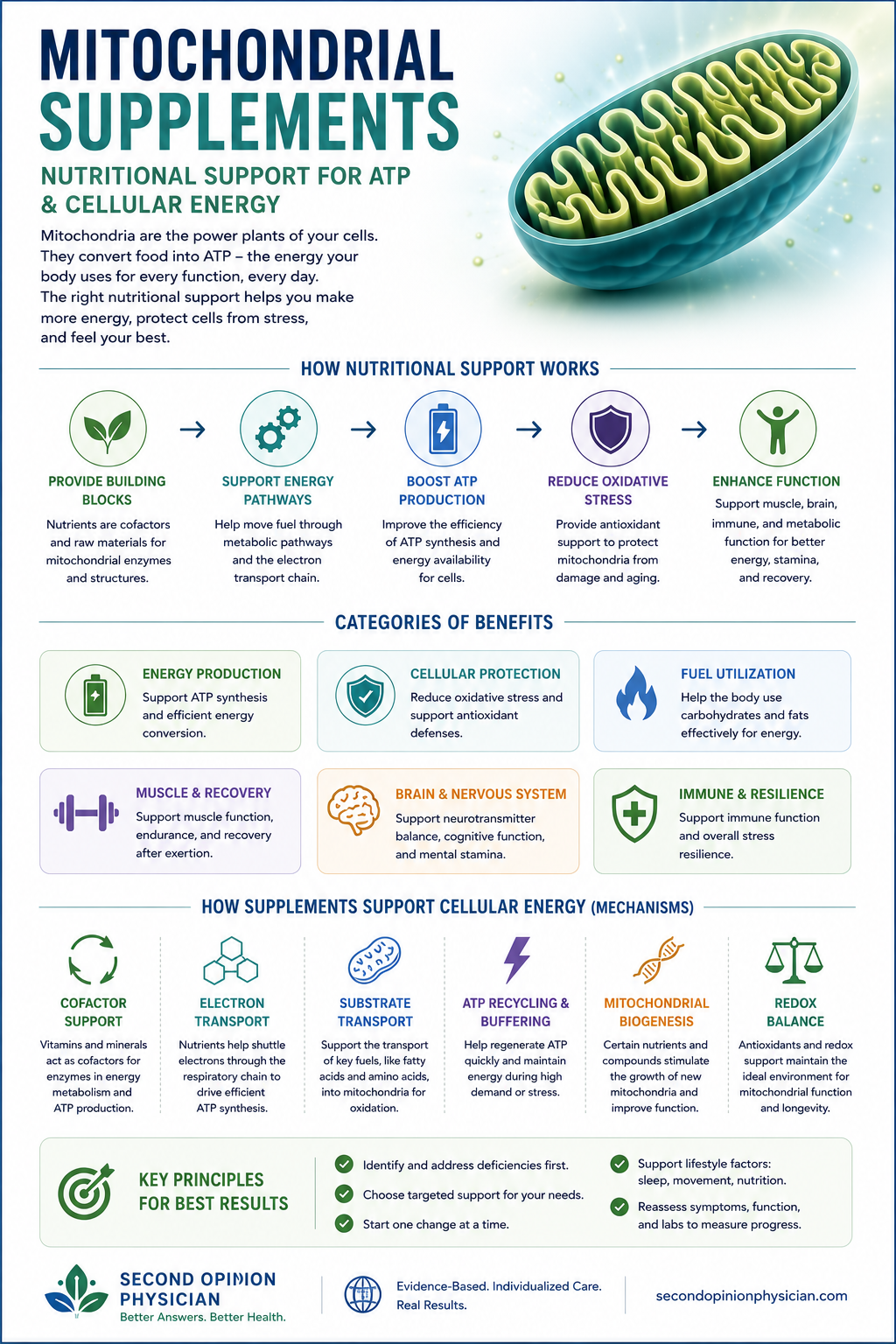
Mitochondria require a network of nutrients rather than one “energy vitamin.” Some participate directly in the electron transport chain, some help enzymes process fuel, some transport fatty acids, some buffer ATP availability, and others help protect cells from oxidative stress.
The practical goal is therefore to determine which part of cellular energy metabolism needs support rather than automatically taking every supplement marketed for mitochondria.
There is another layer that is often overlooked. Mitochondrial nutrients interact with methylation, oxidative stress, mineral balance and epigenetic regulation. In patients with undermethylation or another recognizable biochemical pattern, the best nutrient strategy may depend upon more than mitochondrial function alone.
CoQ10 → electron transport & ATP production
Creatine → rapid ATP buffering + reduced methyl demand
Carnitine → fatty-acid transport
B1 + B2 → metabolic enzyme cofactors
Magnesium → ATP utilization & enzyme function
ALA + NAC → antioxidant / redox support
Is There a “Mitochondrial Cocktail”?
The term mitochondrial cocktail is commonly used for combinations of vitamins, cofactors and antioxidants intended to support mitochondrial function. Typical formulas may contain CoQ10, B vitamins, carnitine, alpha-lipoic acid, creatine and antioxidants.
There is biochemical rationale for many of these nutrients, but clinical evidence varies substantially. Even mitochondrial specialists use different combinations, and there is no single cocktail proven to be best for every mitochondrial disorder.
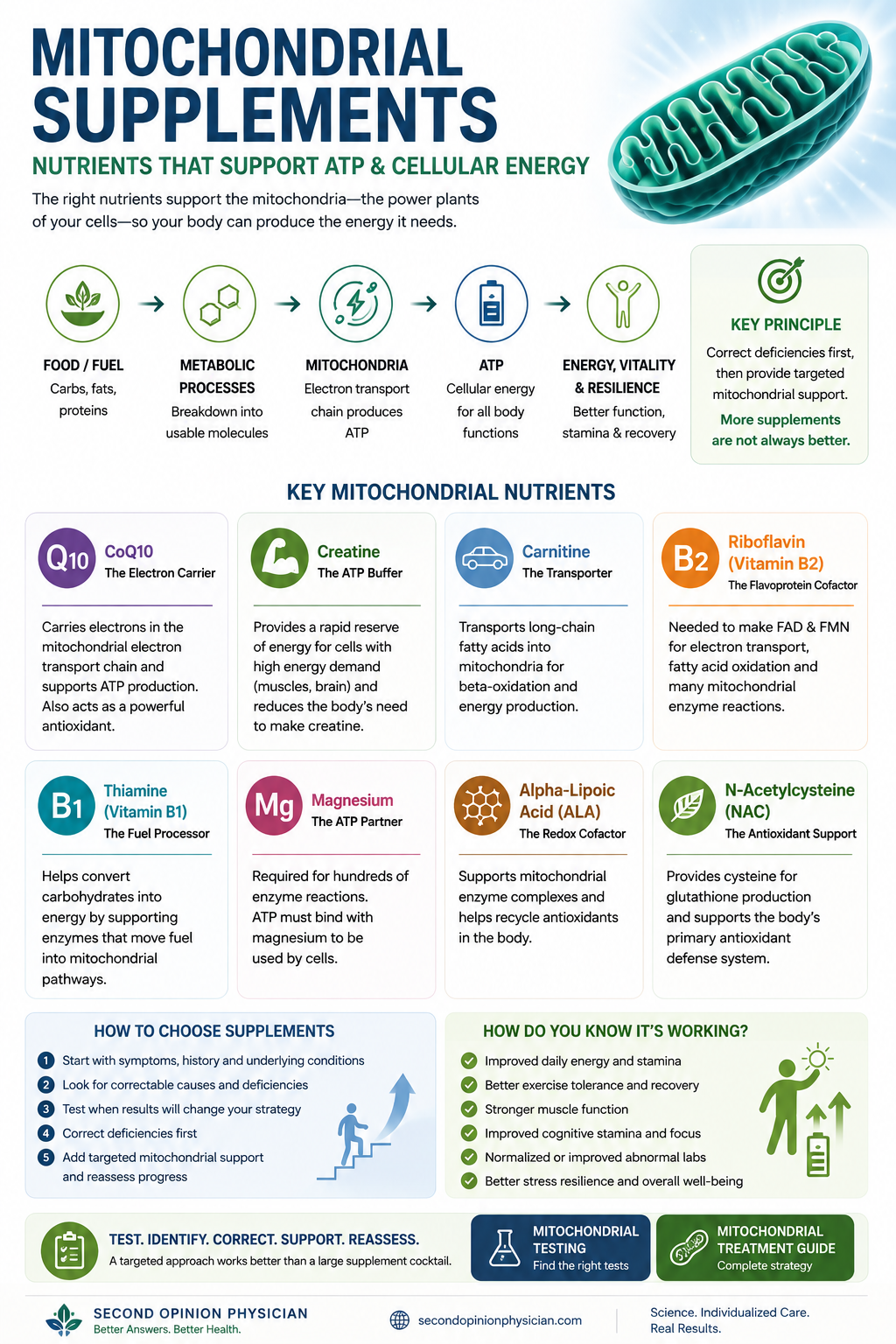
CoQ10: Supporting the Mitochondrial Electron Transport Chain
Coenzyme Q10 is one of the most directly mitochondrial nutrients. It carries electrons within the inner mitochondrial membrane as part of oxidative phosphorylation—the process responsible for producing much of the cell's ATP.
CoQ10 also has antioxidant activity. Primary CoQ10 deficiency is a special situation in which replacement may directly address an underlying biochemical defect. Outside of specific deficiencies and mitochondrial disorders, expected benefit is less predictable.
Established mitochondrial disease, documented CoQ10 deficiency, selected mitochondrial myopathies, or circumstances in which CoQ10 depletion is clinically suspected.
Ubiquinol is the reduced form of CoQ10 and generally has greater bioavailability, although formulation and dose also affect absorption.
Creatine: ATP Support With an Important Methylation Connection
Creatine works differently from CoQ10. Instead of functioning primarily inside the respiratory chain, the creatine-phosphocreatine system acts as a rapidly available energy reserve.
This is particularly important in tissues with rapidly changing energy requirements, including skeletal muscle and brain.
Creatine also has an important relationship with methylation. Producing creatine inside the body consumes methyl groups from S-adenosylmethionine (SAM) and generates S-adenosylhomocysteine (SAH). Supplemental creatine reduces the need for endogenous creatine synthesis and can therefore reduce this methylation demand.
Carnitine: Getting Fatty Acids Into the Mitochondrial Energy Pathway
Carnitine plays an essential role in transporting long-chain fatty acids into mitochondria where they can undergo beta-oxidation and contribute to energy production.
Rather than routinely adding carnitine to every mitochondrial regimen, there is a particularly strong rationale for replacement when free or total carnitine is actually low.
Vitamin B1 & B2: Cofactors for Energy Metabolism
Several B vitamins participate in mitochondrial metabolism, but thiamine (B1) and riboflavin (B2) have particularly direct relationships with cellular-energy pathways.
Thiamine
Thiamine-dependent enzymes help move carbohydrate-derived fuel into mitochondrial energy metabolism.
Think: glucose → pyruvate → mitochondrial energy.
Riboflavin
Riboflavin supplies precursors for FAD and FMN, which participate in electron transport, fatty-acid oxidation and numerous mitochondrial enzyme reactions.
Think: fuel processing + electron transport.
Magnesium: ATP Is a Magnesium-Dependent Energy Currency
Magnesium participates in hundreds of enzymatic reactions, including many involved in energy metabolism. Inside cells, ATP commonly functions as a magnesium-ATP complex.
Inadequate magnesium can therefore affect muscle function, neurological function and cellular-energy metabolism even though magnesium is not itself a mitochondrial “fuel.”
Alpha-Lipoic Acid & NAC: Redox and Antioxidant Support
Energy production inevitably generates reactive oxygen species. Mitochondria therefore depend upon antioxidant and redox systems to maintain cellular balance.
Alpha-Lipoic Acid
ALA functions in mitochondrial enzyme complexes and also participates in cellular antioxidant/redox systems. It has long been included in mitochondrial nutrient protocols.
N-Acetylcysteine
NAC provides cysteine used in glutathione synthesis and can support cellular antioxidant defenses. Its role is primarily redox support rather than directly generating ATP.
Why Methylation and Epigenetics Matter When Choosing Mitochondrial Nutrients
Mitochondrial metabolism does not operate independently from methylation. Cellular-energy production, oxidative stress, antioxidant defense, amino-acid metabolism and methylation continually influence one another.
This becomes particularly relevant in undermethylation. The traditional Walsh Approach identifies characteristic biochemical and clinical patterns associated with undermethylation and other biotypes. Our expanded model goes a step further by asking why methylation function may be impaired in a particular patient.
The Nutrient Strategy Should Fit the Biochemical Pattern
Which mitochondrial pathways or cofactors may need support?
Is methyl-group availability, demand or utilization contributing to the pattern?
Is redox stress increasing cellular demand or impairing mitochondrial function?
Are zinc, copper, histamine or other characteristic biochemical patterns present?
Mitochondrial Distress as an Epigenetic Driver
In our Five Epigenetic Biotypes of Undermethylation model, mitochondrial distress is one of several biochemical patterns that may contribute to impaired methylation and epigenetic regulation.
This does not mean that everyone with mitochondrial dysfunction is undermethylated—or that mitochondrial dysfunction explains every case of undermethylation. It means that the two systems can intersect and that treating one without considering the other may sometimes miss an important part of the biochemical picture.
What About B12, Folate, Iron, Zinc & Vitamin D?
These nutrients are important—but that does not automatically make them universal “mitochondrial supplements.” Their greatest value is often in identifying and correcting deficiency or another biochemical abnormality that can independently cause fatigue, weakness or impaired metabolism.
Required for oxygen transport and iron-containing proteins within the respiratory chain. Both deficiency and excess matter.
Deficiency can produce fatigue, neurological symptoms and metabolic abnormalities that may resemble or compound mitochondrial symptoms.
Supports numerous enzymes, antioxidant defenses and cellular signaling pathways. Zinc status is also important in Walsh biochemistry and should be interpreted together with copper and ceruloplasmin when appropriate.
Deficiency can contribute to weakness and poor musculoskeletal function and should be corrected when present.
Folate participates in one-carbon metabolism but is not simply an energy supplement. Its use should take the patient's methylation pattern, neurological condition and other clinical factors into account rather than automatically including high-dose folate in every mitochondrial formula.
This is one reason identifying an undermethylation or other Walsh biotype pattern can be important before assuming that a standard nutrient cocktail is appropriate for every patient.
Which Mitochondrial Supplements Do I Actually Need?
A practical way to approach mitochondrial supplementation is to separate measurable deficiencies from broader metabolic support—and then consider whether methylation, mineral imbalance or another biochemical pattern changes the treatment strategy.
START WITH SYMPTOMS + HISTORY
IDENTIFY THE BIOCHEMICAL PATTERN
TEST WHEN RESULTS CAN CHANGE TREATMENT
CORRECT DOCUMENTED DEFICIENCIES
ADD TARGETED MITOCHONDRIAL + METABOLIC SUPPORT
REASSESS ENERGY • FUNCTION • LABS
Can Laboratory Testing Help Choose Mitochondrial Nutrients?
Sometimes. No blood test can identify a perfect mitochondrial supplement combination, but laboratory testing can identify abnormalities that directly change the treatment strategy.
Low free or total carnitine creates a clearer rationale for replacement and provides a marker that can be followed.
Magnesium, iron, B12, vitamin D, zinc and other abnormalities can be identified and corrected when clinically appropriate.
Lactate/pyruvate, acylcarnitines and other metabolic testing can sometimes identify patterns that justify more targeted investigation.
Mitochondrial Testing vs. Methylation & Biotype Testing
These evaluations answer different questions. Mitochondrial testing examines cellular-energy metabolism. Walsh and functional methylation testing can help determine whether methylation, mineral balance or another biochemical pattern may be contributing to the patient's symptoms and treatment response.
What Is Happening to Energy Metabolism?
Useful when fatigue, exercise intolerance, muscle symptoms, poor recovery or other findings raise concern about cellular-energy metabolism.
May include:
Lactate/Pyruvate • CK • Free + Total Carnitine • Acylcarnitines • GDF-15 and expanded testing when indicated.
Why Might the Biochemical Pattern Be Present?
Useful when mitochondrial symptoms overlap with mood, cognition, stress intolerance, suspected undermethylation, copper/zinc imbalance or other Walsh biotype features.
May include:
Whole-Blood Histamine • Homocysteine • Copper • Ceruloplasmin • Zinc • Vitamin D • SAM • SAH • Methionine and related methylation markers.
Start With the Biotype + Undermethylation Assessment
Symptoms cannot diagnose mitochondrial dysfunction or a methylation disorder, but they can help identify which biochemical patterns deserve closer investigation.
The combined assessment evaluates traditional Walsh biotype features together with a more detailed assessment of undermethylation and its potential epigenetic drivers. This can help determine whether testing should emphasize cellular energy, Walsh biochemistry, functional methylation—or a combination.
Biotype + Undermethylation QuestionnaireQuick Guide to Mitochondrial Nutrients
| Nutrient | Primary Role | Testing Useful? |
|---|---|---|
| CoQ10 | Electron transport / ATP | Sometimes |
| Creatine | ATP buffering / reduced methyl demand | Usually clinical |
| Carnitine | Fatty-acid transport | Yes |
| Riboflavin B2 | Flavoproteins / ETC / β-oxidation | Context dependent |
| Thiamine B1 | Carbohydrate → mitochondrial metabolism | Sometimes |
| Magnesium | ATP / enzyme function | Often useful |
| ALA | Redox + enzyme cofactor | Usually clinical |
| NAC | Glutathione / redox support | Usually clinical |
| Zinc | Enzymes / antioxidant defense / biochemical balance | Yes — with copper |
How Do You Know if Mitochondrial Supplements Are Helping?
The most useful endpoint is not the number of capsules taken. It is improvement in function.
When a measurable deficiency or metabolic abnormality was present before treatment, repeating that marker can sometimes provide objective evidence that the underlying biochemical problem has improved.
The same principle applies when methylation or Walsh abnormalities are identified. Treatment should not simply accumulate indefinitely. Symptoms, tolerance and meaningful biochemical abnormalities should be reassessed so the program can evolve with the patient.
What if Nutritional Mitochondrial Support Is Not Enough?
Nutrients are only one layer of mitochondrial treatment. Sleep, metabolic health, physical conditioning, oxygen delivery, medications, inflammation, methylation and underlying disease may be equally or more important.
For selected patients, there is also growing interest in more advanced mitochondrial therapies—including compounds designed to influence mitochondrial membranes, signaling, stress responses and cellular repair.
The Treatment Progression
Identify the pattern → correct deficiencies → support energy metabolism → address methylation / metabolic drivers → build mitochondrial capacity → consider advanced therapies when appropriate
Frequently Asked Questions About Mitochondrial Supplements
What are the best supplements for mitochondrial function?
There is no single best combination. CoQ10, creatine, riboflavin, thiamine, carnitine, magnesium and antioxidant support affect different aspects of energy metabolism. The most appropriate choices depend upon the underlying problem and individual biochemical context.
What supplement helps ATP production?
CoQ10 participates directly in mitochondrial electron transport and ATP generation, while creatine helps rapidly regenerate ATP through the phosphocreatine system. Magnesium is also required for normal ATP-dependent cellular reactions.
Should everyone with fatigue take CoQ10?
No. Fatigue has many possible causes. CoQ10 has a clear biochemical role in mitochondrial energy production, but that does not mean every patient with fatigue has a CoQ10 problem or will respond to supplementation.
Should carnitine be tested before supplementation?
Testing free and total carnitine can be particularly useful because documented deficiency provides a clearer reason for replacement and an objective marker for follow-up.
Is creatine a mitochondrial supplement?
Creatine does not primarily stimulate the respiratory chain. Instead, phosphocreatine acts as a rapid cellular-energy buffer that helps regenerate ATP. Creatine also has a methylation connection because endogenous creatine synthesis consumes SAM-derived methyl groups.
What does undermethylation have to do with mitochondrial supplements?
Methylation, cellular-energy metabolism and oxidative stress interact. Creatine synthesis is one direct connection because it consumes methyl groups. In selected patients, an undermethylation or other biochemical pattern may therefore influence which nutrients are appropriate and what additional testing deserves consideration.
Should folate automatically be included in a mitochondrial supplement program?
No. Folate participates in one-carbon metabolism but should not simply be treated as a universal mitochondrial nutrient. The patient's methylation pattern and broader clinical context should be considered.
Do I need a mitochondrial cocktail?
Not necessarily. Large combinations can make it difficult to determine which intervention is helping or causing side effects. A more targeted strategy begins with deficiencies and the nutrients most relevant to the individual metabolic and biochemical pattern.
How long do mitochondrial supplements take to work?
There is no universal timeline. Response depends upon the underlying cause, severity of dysfunction, nutrient status and treatment. Functional measures such as energy, stamina and recovery are often more useful than expecting an immediate subjective effect.
Support the Pathway That Actually Needs Support
Mitochondrial nutrients work at different points in cellular-energy metabolism. The better strategy is to identify correctable deficiencies, determine whether mitochondrial, methylation or Walsh biotype abnormalities are contributing, and then target treatment to the biochemical pattern rather than simply adding more supplements.