
Mitochondrial Peptides & Advanced Therapies: SS-31, MOTS-c, NAD+ and Beyond
Mitochondrial treatment is moving beyond vitamins and antioxidants. Newer approaches attempt to influence the mitochondrial membrane, metabolic signaling, cellular redox balance and the adaptive processes that determine how mitochondria respond to stress.
SS-31/elamipretide, MOTS-c and NAD+ are often discussed together, but they represent very different therapeutic concepts. Understanding those differences is essential before deciding where an advanced mitochondrial therapy may—or may not—fit.
Most mitochondrial treatment should begin with a simpler question: what is interfering with cellular energy production? Nutrient deficiency, metabolic dysfunction, poor sleep, inflammation, medication effects, impaired oxygen delivery and underlying disease may all create mitochondrial stress.
Advanced therapies become more meaningful after those factors have been considered. The goal is not to find the strongest mitochondrial treatment. It is to determine which part of mitochondrial biology may actually need support.
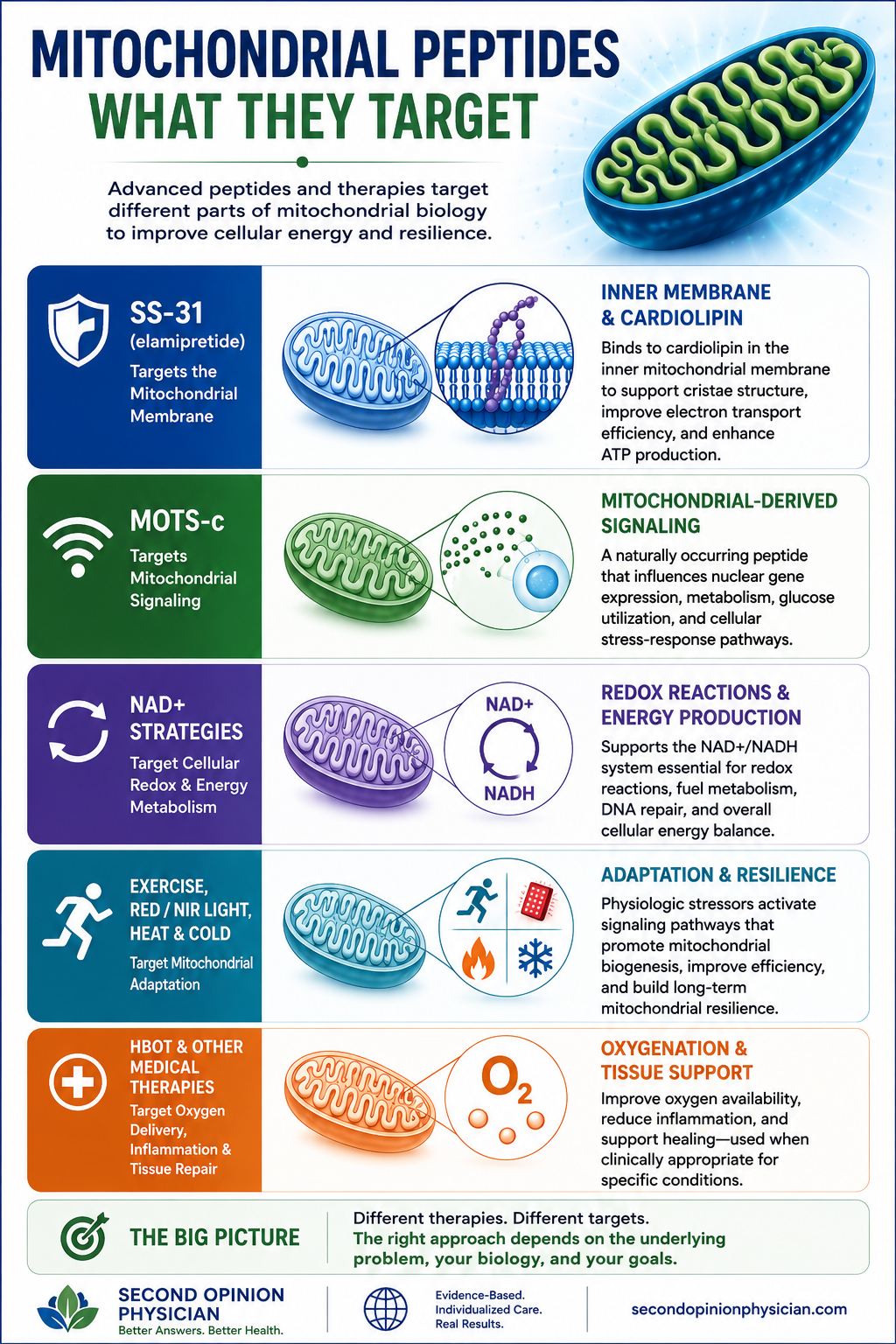
SS-31 / Elamipretide → inner mitochondrial membrane & cardiolipin
MOTS-c → mitochondrial-derived metabolic signaling
NAD+ strategies → cellular redox & metabolic reactions
Exercise / Light / Heat → adaptive mitochondrial signaling & resilience
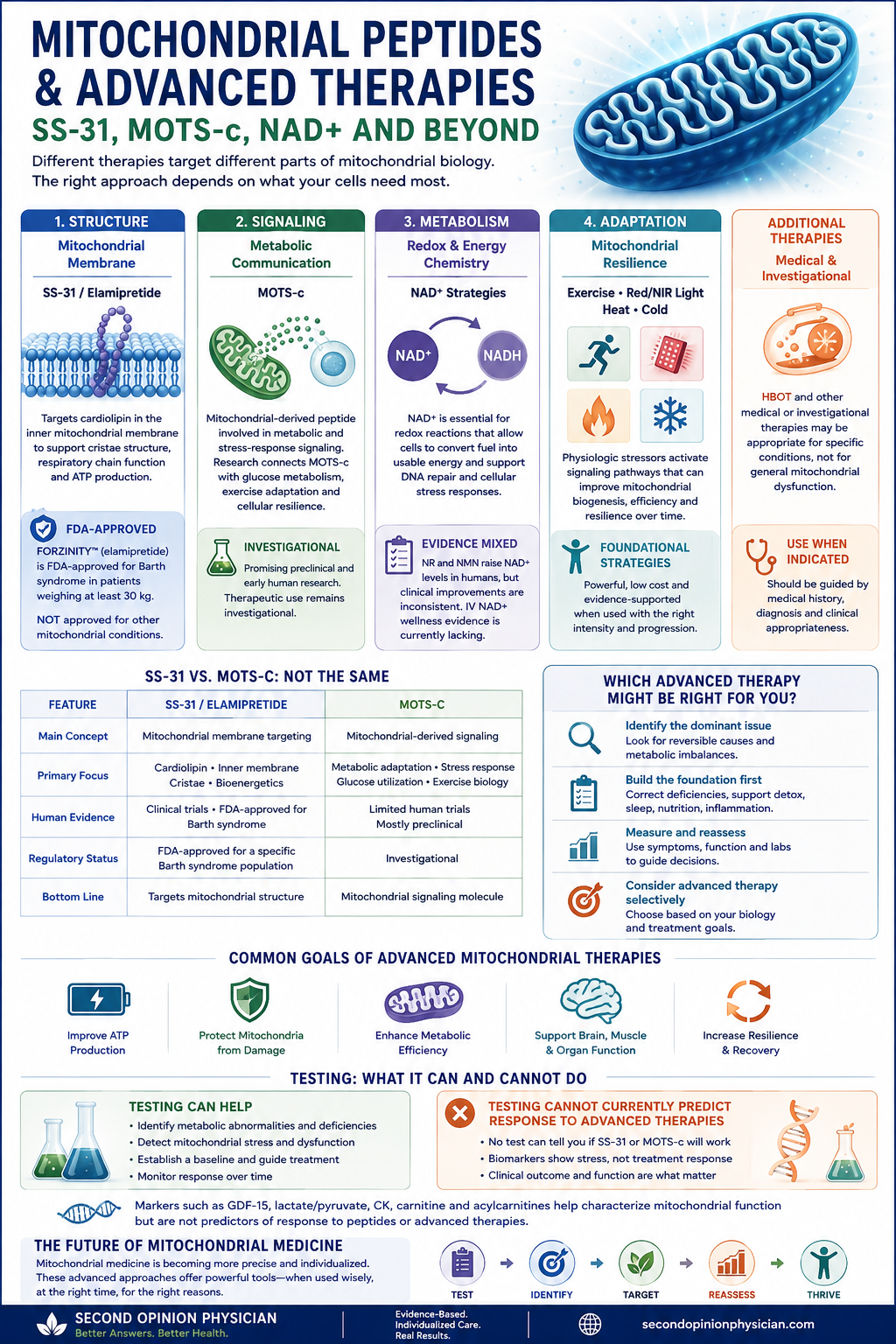
Four Different Ways to Target Mitochondrial Function
The easiest way to understand advanced mitochondrial treatment is to separate the interventions according to what they are attempting to influence.
Mitochondrial Membrane
SS-31 / elamipretide targets the cardiolipin-rich inner mitochondrial membrane and mitochondrial cristae environment.
Metabolic Communication
MOTS-c is a mitochondrial-derived peptide involved in metabolic and cellular stress signaling.
Redox & Energy Chemistry
NAD+/NADH participates in the redox reactions that allow cells to process fuel and generate energy.
Mitochondrial Resilience
Exercise, photobiomodulation and other physiologic stimuli may influence mitochondrial signaling, adaptation and capacity.
Advanced mitochondrial therapies target different parts of cellular energy biology. SS-31 focuses on the mitochondrial membrane, while other approaches influence signaling, redox metabolism, oxygen delivery and mitochondrial adaptation.
SS-31 / Elamipretide: Targeting the Mitochondrial Membrane
SS-31—also known as elamipretide—is fundamentally different from a mitochondrial vitamin or metabolic substrate. It is a mitochondria-targeting tetrapeptide that localizes to the inner mitochondrial membrane and interacts with cardiolipin.
Cardiolipin is an unusual phospholipid concentrated within the inner mitochondrial membrane. It helps organize mitochondrial cristae and supports proteins involved in electron transport and oxidative phosphorylation.
Current research suggests that the SS-31–cardiolipin interaction can influence mitochondrial membrane organization, respiratory-chain protein assembly, bioenergetics and oxidative stress. This membrane-targeting mechanism is one reason SS-31 has attracted interest across muscle, cardiovascular, renal and ocular mitochondrial research.
Elamipretide is FDA-approved as Forzinity for Barth syndrome in patients weighing at least 30 kg. That approval should not be interpreted as FDA approval for generalized fatigue, aging, acquired mitochondrial dysfunction or other mitochondrial disorders. Broader applications remain separate clinical and research questions.
Why Is Barth Syndrome Important to the SS-31 Story?
Barth syndrome is especially relevant because it involves abnormal cardiolipin remodeling. The disease therefore provides a particularly direct connection between cardiolipin biology, mitochondrial membrane dysfunction and elamipretide's proposed target.
In 2025, the FDA granted accelerated approval to Forzinity based on improvement in knee extensor muscle strength considered reasonably likely to predict clinical benefit. Confirmatory study requirements remain part of that accelerated-approval pathway.
MOTS-c: Mitochondria as a Signaling Organ
MOTS-c represents an entirely different mitochondrial concept.
Rather than being a molecule designed primarily to stabilize the mitochondrial membrane, MOTS-c is a mitochondrial-derived peptide encoded within mitochondrial DNA. Research suggests that it participates in metabolic signaling and cellular adaptation to stress.
Under cellular stress, MOTS-c has been reported to influence nuclear gene expression. Experimental research has connected the peptide with glucose metabolism, insulin sensitivity, skeletal-muscle metabolism and exercise adaptation.
Human research also shows that endogenous mitochondrial-derived peptides respond to exercise. However, much of the therapeutic excitement surrounding administering MOTS-c itself still comes from preclinical research rather than established clinical treatment trials.
SS-31 vs. MOTS-c: They Are Not Interchangeable
| Feature | SS-31 / Elamipretide | MOTS-c |
|---|---|---|
| Main Concept | Mitochondrial membrane targeting | Mitochondrial-derived signaling |
| Major Focus | Cardiolipin / cristae / bioenergetics | Metabolic adaptation / stress signaling |
| Human Evidence | Clinical trials + approved Barth indication | Limited therapeutic human evidence |
| Regulatory Status | FDA-approved for a specific Barth syndrome population | Investigational |
NAD+: Supporting Cellular Redox and Energy Metabolism
NAD+ is not a mitochondrial peptide. It is an essential cellular coenzyme involved in oxidation-reduction reactions throughout metabolism.
The NAD+/NADH system helps transfer electrons during the processing of carbohydrates, fats and other fuels. NAD+ also serves as a substrate for enzymes involved in cellular signaling, DNA repair and stress responses.
This has created considerable interest in NAD+-raising strategies, particularly nicotinamide riboside (NR), nicotinamide mononucleotide (NMN) and intravenous NAD+.
Human trials show that oral NR and NMN can increase NAD-related metabolites, demonstrating biochemical target engagement. But improvements in energy, metabolic function, physical performance and other clinical outcomes have been inconsistent.
Red & Near-Infrared Light: Photobiomodulation
Photobiomodulation uses specific wavelengths of red or near-infrared light to influence cellular signaling. One proposed mitochondrial target is cytochrome c oxidase, a component of the respiratory chain.
Research suggests photobiomodulation can influence mitochondrial bioenergetics, reactive oxygen species signaling, nitric oxide pathways and downstream inflammatory responses.
Clinical evidence is considerably broader for some pain, tissue-repair and rehabilitation applications than it is for treating a generalized diagnosis of “mitochondrial dysfunction.” Wavelength, dose, tissue penetration and treatment protocol matter.
Exercise May Be the Most Important Mitochondrial Signal
Exercise is not merely a way of burning calories. It creates a controlled energetic challenge that can stimulate mitochondrial adaptation.
Depending upon intensity and training status, exercise can influence mitochondrial biogenesis, oxidative capacity, insulin sensitivity, vascular function and skeletal-muscle metabolism.
Interestingly, human studies have also demonstrated that exercise changes endogenous mitochondrial-derived peptide signaling, including MOTS-c-related responses.
Heat, Cold and Mitochondrial Adaptation
Heat and cold exposure are sometimes described as mitochondrial therapies because they impose controlled physiologic stress.
Heat exposure can activate heat-shock and cellular stress-response pathways. Cold exposure can influence sympathetic signaling, thermogenesis and brown adipose tissue metabolism.
These are better viewed as adaptive physiologic stimuli than as direct treatments for a specific mitochondrial defect.
What About Hyperbaric Oxygen Therapy?
Hyperbaric oxygen therapy increases dissolved oxygen exposure and has established medical indications unrelated to generalized mitochondrial dysfunction.
There is research interest in its effects on oxidative signaling, vascular biology, tissue repair and mitochondrial adaptation. However, the fact that mitochondria use oxygen does not mean that more oxygen automatically improves mitochondrial function.
HBOT should therefore remain a condition-specific medical intervention, not a universal mitochondrial treatment.
Can Mitochondrial Testing Tell Us Which Advanced Therapy Will Work?
Not yet.
This is one of the most important distinctions in the entire mitochondrial evaluation.
Identify metabolic abnormalities, detect deficiencies, characterize mitochondrial stress, establish baseline biomarkers and determine whether further investigation is warranted.
Reliably predict that a patient will respond to SS-31, MOTS-c, NAD+, photobiomodulation or another advanced mitochondrial intervention.
Markers such as GDF-15, lactate/pyruvate, CK, free and total carnitine, acylcarnitines and organic acids can contribute different information about mitochondrial and metabolic function.
An abnormal result may strengthen the evidence that cellular-energy metabolism deserves attention. It does not automatically select a peptide.
Who Should Consider Advanced Mitochondrial Therapy?
The threshold should be higher than simply having fatigue or wanting more energy.
1. Define the symptoms and functional limitation
2. Look for common reversible causes
3. Test when the result can change management
4. Correct deficiencies and metabolic abnormalities
5. Establish foundational mitochondrial support
6. Measure response and remaining impairment
7. Consider advanced therapy selectively
Advanced Therapy Should Still Have a Measurement Strategy
Whether the intervention is nutritional, physiologic or investigational, treatment becomes much more useful when there is a defined baseline.
When a laboratory abnormality was present initially, repeating that marker may provide useful objective information. But the most meaningful endpoint remains whether the patient's function actually improves.
The Future of Mitochondrial Medicine Is More Targeted
The emerging mitochondrial field is moving away from the idea that mitochondrial dysfunction should simply be treated with a larger supplement cocktail.
SS-31 illustrates the possibility of targeting mitochondrial structure. MOTS-c illustrates mitochondria acting as signaling organelles. NAD+ strategies target cellular redox metabolism. Exercise and photobiomodulation attempt to influence adaptive mitochondrial biology.
These approaches may eventually allow mitochondrial therapy to become increasingly individualized—but the evidence is not equally mature for each intervention.
The goal is to identify the dominant problem, correct what can be corrected, support mitochondrial recovery and then determine whether a more targeted intervention is justified.
Frequently Asked Questions About Mitochondrial Peptides
What is SS-31?
SS-31, or elamipretide, is a mitochondria-targeting tetrapeptide that interacts with cardiolipin in the inner mitochondrial membrane. Elamipretide is FDA-approved under the brand Forzinity for a specific population with Barth syndrome.
Is SS-31 FDA approved?
Yes, but for a very specific indication. Forzinity received accelerated FDA approval in 2025 for Barth syndrome in patients weighing at least 30 kg. This does not constitute approval for generalized mitochondrial dysfunction, fatigue or anti-aging treatment.
What is MOTS-c?
MOTS-c is a mitochondrial-derived peptide encoded within mitochondrial DNA and involved in metabolic and stress-response signaling. Therapeutic administration remains investigational.
Is MOTS-c the same as SS-31?
No. SS-31 primarily targets the inner mitochondrial membrane and cardiolipin environment. MOTS-c is a naturally occurring mitochondrial-derived signaling peptide associated with metabolic adaptation.
Does NAD+ improve mitochondrial function?
NAD+ is essential to cellular metabolism, and NR and NMN can raise NAD-related metabolites in humans. However, clinical improvements from NAD+-raising interventions have been inconsistent, and evidence for IV NAD+ wellness therapy remains limited.
Can GDF-15 tell me whether SS-31 will work?
No. GDF-15 can be useful in the evaluation of mitochondrial disease and metabolic stress, but it is not a validated test for predicting response to SS-31.
Should mitochondrial peptides come before supplements?
Usually the more useful sequence is to identify reversible causes and deficiencies first, establish foundational treatment, measure remaining dysfunction and then consider advanced therapies when the clinical situation supports them.
Test. Identify. Target. Reassess.
Advanced mitochondrial therapy makes the most sense when it is part of a larger strategy—not an isolated peptide or infusion. Start by defining the cellular-energy problem, address reversible causes, establish a measurable baseline and then determine whether targeted advanced therapy belongs in the plan.