
Autism Signs & Symptoms: Looking Beyond Behavior to Biochemistry
Autism signs and symptoms can appear in communication, social interaction, sensory processing, behavior, sleep, attention, gastrointestinal function and development—but the same outward symptom does not necessarily have the same biological explanation in every child.
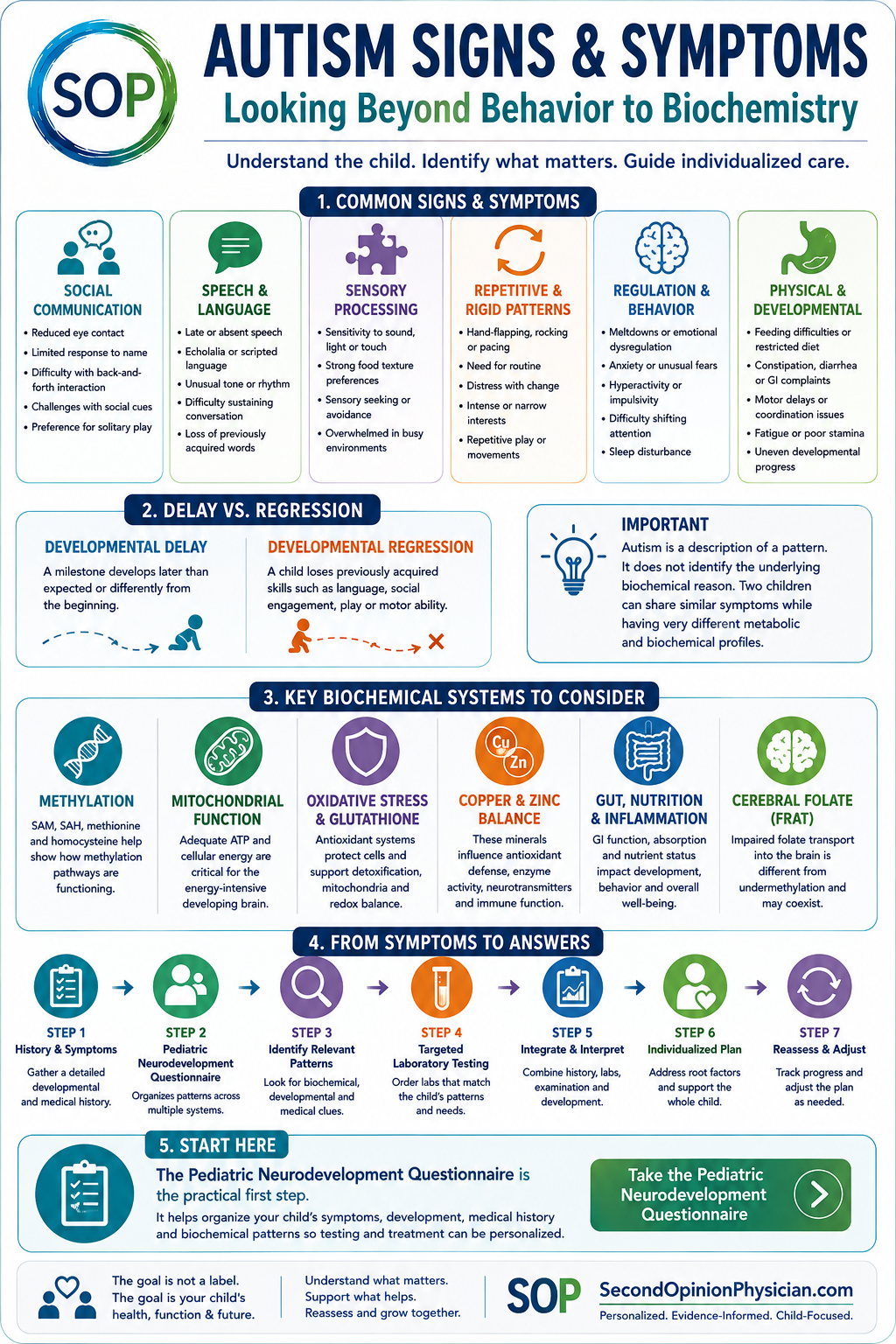
A child with language delay, sensory sensitivity, repetitive behavior or emotional dysregulation may also have very different patterns involving methylation, mitochondrial energy, oxidative stress and glutathione, copper-zinc balance, nutrition, gastrointestinal function or cerebral folate. The goal is not to explain autism with a single biochemical theory. It is to look beyond the diagnostic label, understand the individual child, and identify measurable factors that may help guide testing, treatment and developmental support.
Autism signs and symptoms can appear in communication, social interaction, sensory processing, behavior, sleep, attention, gastrointestinal function and development—but the same outward symptom does not necessarily have the same biological explanation in every child. A child with language delay, sensory sensitivity, repetitive behavior or emotional dysregulation may also have very different patterns involving methylation, mitochondrial energy, oxidative stress and glutathione, copper-zinc balance, nutrition, gastrointestinal function or cerebral folate. The goal is not to explain autism with a single biochemical theory. It is to look beyond the diagnostic label, understand the individual child, and identify measurable factors that may help guide testing, treatment and developmental support.
Autism describes a pattern. It does not tell us everything about the child.
An autism diagnosis can be important for developmental services, education and therapy. But children who share the same diagnosis may have very different medical histories, nutritional status, biochemical patterns and developmental trajectories.
What Are the Signs and Symptoms of Autism?
Autism can look very different from one child to another. The pattern and combination of traits matter more than any single symptom.
Parents are often the first to notice that something about development is different.
Sometimes it is delayed language. Sometimes a child seems unusually sensitive to sound or touch. Some children develop intense interests or repetitive behaviors. Others have difficulty with transitions, sleep, feeding, emotional regulation or social communication.
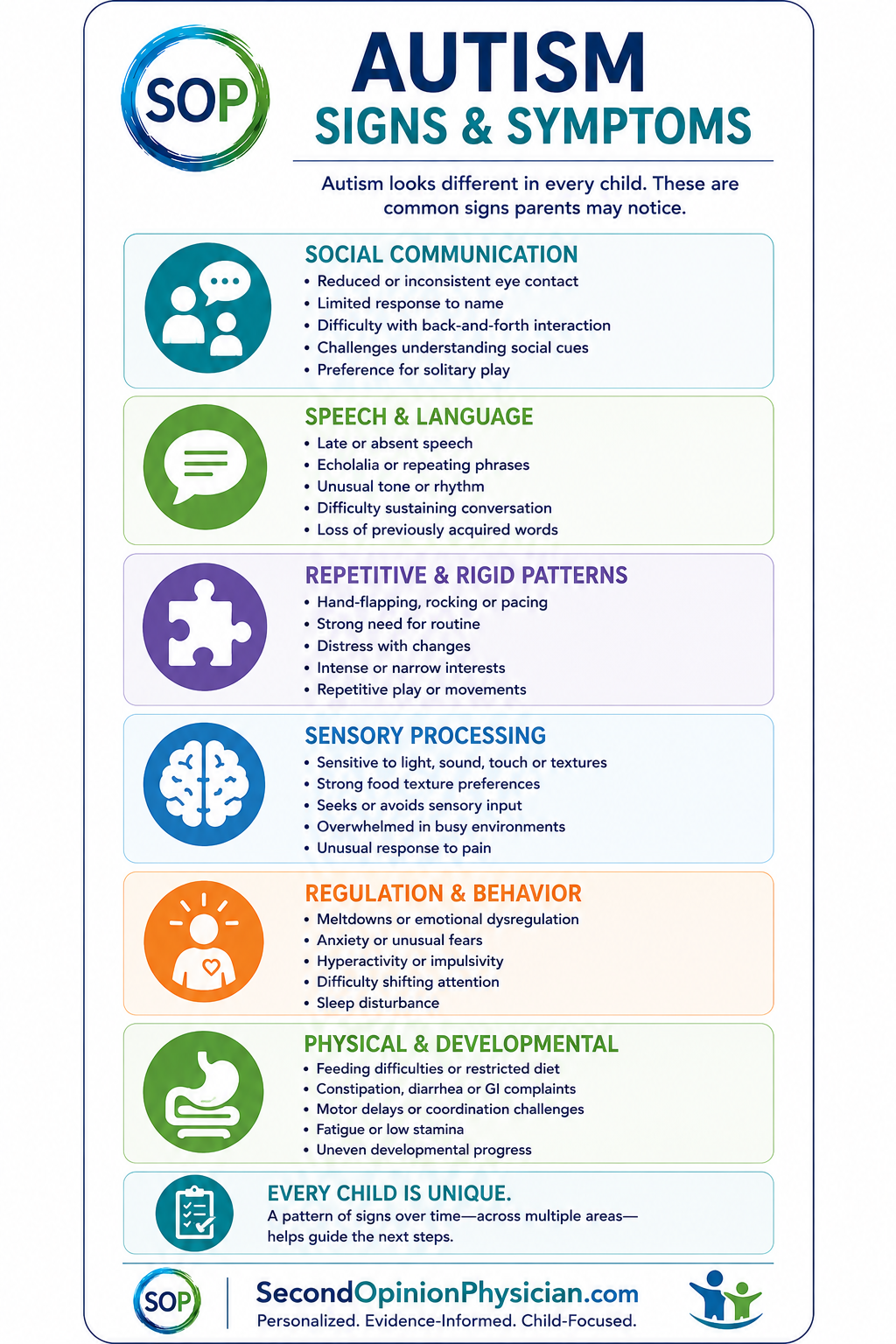
Social Communication
- Reduced or inconsistent eye contact
- Limited response to name
- Difficulty with back-and-forth interaction
- Reduced use of gestures
- Difficulty reading facial or social cues
Speech & Language
- Delayed spoken language
- Echolalia or repeated phrases
- Unusual speech rhythm or tone
- Difficulty sustaining conversation
- Loss of previously acquired words
Sensory Processing
- Sensitivity to sound, light or touch
- Strong food texture preferences
- Unusual response to pain
- Sensory seeking or avoidance
- Becoming overwhelmed in busy environments
Repetitive & Rigid Patterns
- Hand flapping, rocking or pacing
- Strong need for routine
- Distress with unexpected change
- Intense or narrow interests
- Repetitive play or movements
Regulation & Behavior
- Meltdowns or emotional dysregulation
- Anxiety or unusual fears
- Hyperactivity or impulsivity
- Difficulty shifting attention
- Sleep disturbance
Physical & Developmental
- Feeding difficulties or restricted diet
- Constipation, diarrhea or GI complaints
- Motor delays or coordination problems
- Fatigue or poor stamina
- Uneven developmental progress
A symptom is a clue—not a biochemical diagnosis.
Sensory sensitivity does not prove copper overload. Repetitive behavior does not prove undermethylation. Language delay does not prove mitochondrial dysfunction or oxidative stress. These patterns can help guide questions, but laboratory and clinical evaluation are needed to determine whether a biochemical abnormality is actually present.
Developmental Delay Is Not the Same as Developmental Regression
One of the most important questions in a child's history is whether a skill developed late—or developed normally and was subsequently lost.
Developmental Delay
A developmental milestone such as speech, motor development or social communication is acquired later than expected or develops differently from the beginning.
Developmental Regression
A child loses previously acquired language, social engagement, play, motor ability or another developmental skill. Regression deserves careful medical and developmental evaluation.
The distinction can substantially change the questions that should be asked.
If regression occurred, document the child's developmental baseline, what changed, the timing, preceding illness or physiologic stress, medications or exposures, sleep changes, gastrointestinal symptoms, seizures or unusual neurologic events, and whether recovery was complete, partial or absent.
Why Investigate Biochemistry in Autism?
The brain depends upon energy production, antioxidant defenses, methylation, minerals, nutrients, gastrointestinal health and many interconnected metabolic systems.
Autism is heterogeneous. There is no single laboratory profile shared by every autistic child.
That is precisely why an individualized biochemical assessment can be useful.
Rather than assuming that one pathway explains autism, we can ask whether the individual child has measurable abnormalities that may be clinically relevant.
Methylation
SAM, SAH, methionine and homocysteine help show how effectively methylation pathways are functioning.
Mitochondria
Cellular energy production is particularly important to the energy-intensive developing brain.
Oxidative Stress
Glutathione and other antioxidant systems help protect cells, mitochondria and membranes from oxidative damage.
Copper & Zinc
These minerals influence antioxidant defense, neurotransmitter metabolism, immune function and numerous enzymes.
Gut & Nutrition
Restricted diets, malabsorption and gastrointestinal disease can contribute to nutritional and metabolic problems.
Cerebral Folate
Folate transport into the brain represents a separate pathway that may deserve evaluation in selected children.
Undermethylation, SAM and SAH
Methylation is one part of the broader biochemical picture and should be measured rather than inferred from symptoms or an MTHFR result alone.
Methylation participates in gene regulation, neurotransmitter metabolism, phospholipid production, creatine synthesis and numerous cellular processes.
The plasma methylation panel provides a more direct biochemical view by measuring methionine, SAM, SAH and homocysteine.
SAM is the principal methyl donor. After a methyl group is transferred, SAH is formed. Because SAH can inhibit methyltransferases when it accumulates, methylation efficiency depends upon more than simply providing methyl donors.
SAM
The primary methyl donor used throughout numerous cellular pathways.
SAH
An important product of methylation that can inhibit methyltransferase activity when elevated.
SAM : SAH
Provides information about the relationship between methyl donor availability and methylation inhibition.
Whole-blood histamine can provide additional information within the Walsh framework, but the plasma methylation panel helps distinguish different reasons methylation may be impaired.
The Five Epigenetic Biotypes
If methylation is impaired, the next question is why. Different biochemical pressures can produce very different methylation patterns.
Our Five Epigenetic Biotypes framework expands the traditional undermethylation concept by examining potential drivers of impaired methylation rather than treating every low-methylation pattern as the same condition.
Mitochondrial Distress
Methylation and cellular repair depend upon adequate energy production.
Creatine Demand
Endogenous creatine synthesis represents a substantial use of methyl groups and can increase methylation demand.
Toxic Burden
Selected environmental exposures may increase oxidative and metabolic stress.
Increased Methylation Demand
Cellular repair and other biochemical processes can increase demand on the methylation system.
Impaired SAH Clearance
Accumulated SAH can inhibit methyltransferases even when methyl donors are available.
Mitochondria, Oxidative Stress and Glutathione
Energy production and antioxidant protection are closely connected, particularly in the developing nervous system.
Mitochondria produce ATP—the energy required for cellular function. The brain has particularly high energy requirements.
Mitochondrial energy production also generates reactive oxygen species. Healthy cells depend upon antioxidant systems—including glutathione, superoxide dismutase and catalase—to maintain redox balance.
When oxidative demand exceeds antioxidant capacity, mitochondrial function may suffer. Mitochondrial dysfunction can then increase oxidative stress further, creating a potentially self-reinforcing metabolic problem.
The transsulfuration pathway connects methylation with glutathione production, creating another important intersection between methylation, oxidative stress and cellular resilience.
Copper, Zinc and Neurochemical Regulation
Copper and zinc are essential nutrients. The issue is not whether copper is “bad,” but whether mineral balance and copper binding are appropriate for the individual child.
Copper participates in catecholamine metabolism, mitochondrial enzymes and oxidation-reduction reactions. Zinc supports hundreds of enzymes, antioxidant defenses, immune regulation and other metabolic processes.
For that reason, copper should be interpreted together with ceruloplasmin and plasma zinc rather than from a serum copper value alone.
A child with sensory sensitivity, anxiety or emotional dysregulation should not automatically be labeled copper overloaded. Those symptoms can have many causes.
But when the history suggests the possibility, copper-zinc status is measurable.
Restricted Diets, GI Symptoms and Nutrient Status
Gastrointestinal and nutritional problems deserve attention when they are part of the child's clinical picture.
Some autistic children have extremely restricted diets. Others experience constipation, diarrhea, reflux, abdominal discomfort, feeding difficulty or suspected malabsorption.
These issues can influence nutrient status, sleep, behavior and overall well-being regardless of whether they are directly related to autism.
- Review diet variety and protein intake
- Identify significant feeding restrictions
- Evaluate persistent constipation or diarrhea
- Consider malabsorption when clinically indicated
- Look for measurable nutrient deficiencies
- Investigate persistent gastrointestinal symptoms rather than assuming they are simply behavioral
Low Brain Folate Is Not the Same as Undermethylation
This distinction is especially important because folate biology and methylation are frequently discussed as though they were the same thing.
They are not.
Folate receptor alpha autoantibodies may interfere with folate transport into the central nervous system. This represents a different problem from an undermethylation pattern identified through whole-blood histamine or plasma SAM and SAH.
The two patterns can potentially coexist, which is why cerebral folate should be evaluated on its own merits when the child's history and clinical picture support doing so.
Not Everything Is a Walsh Biotype
A biochemical framework should broaden clinical thinking—not narrow every symptom into one favored explanation.
Depending upon the child's history, other areas may deserve investigation.
Neurological
Seizures, unusual movements, regression or other neurologic findings may require pediatric neurological evaluation.
Genetic / Metabolic
Certain developmental presentations warrant genetic or metabolic evaluation independent of the Walsh framework.
Dysautonomia
Autonomic dysfunction may affect heart rate, temperature regulation, GI function, fatigue and stress tolerance.
Sleep
Persistent sleep disruption can substantially affect learning, behavior, regulation and family function.
Start With the Pediatric Neurodevelopment Questionnaire
You do not need to determine whether your child's primary issue is methylation, mitochondria, oxidative stress, copper, zinc, gut function or another pathway before beginning.
The Pediatric Neurodevelopment Questionnaire brings the history together and looks for patterns across multiple developmental and biochemical domains.
The questionnaire does not diagnose autism or establish a biochemical cause. Its purpose is to organize a complicated clinical picture, identify patterns that deserve closer attention and help guide the next stage of evaluation.
Testing Should Follow the Child's Pattern
The objective is not to order every possible laboratory test. It is to use the history to decide which questions deserve answers.
Common Testing Pathways
Walsh Comprehensive Biotype Panel
Whole-blood histamine, copper, ceruloplasmin, plasma zinc, pyrroles and other foundational markers help identify traditional Walsh biochemical patterns.
Plasma Methylation Panel
Methionine, SAM, SAH and homocysteine provide a more detailed view of methylation function and possible bottlenecks.
Oxidative / Mitochondrial Evaluation
Selected testing may be appropriate when the child's history suggests oxidative stress, impaired energy production or reduced metabolic reserve.
Additional Targeted Testing
GI, nutritional, cerebral folate, neurologic, genetic or metabolic testing can be added when the clinical pattern supports it.
Measure first. Individualize second.
Two children with similar autism symptoms may have very different laboratory findings. Testing allows treatment priorities to follow the child's biology rather than assumptions based on the diagnosis alone.
Treat the Child, Not the Biotype Label
Biochemical patterns are useful only when they help us make better decisions for the individual child.
A laboratory finding should not become another label.
If zinc is deficient, the question is how best to correct it and follow the response. If copper regulation is abnormal, address the measured imbalance. If SAM is low or SAH elevated, determine which methylation pattern is present rather than reflexively giving methylfolate. If oxidative stress is significant, investigate the contributors while supporting antioxidant defenses appropriately.
At the same time, developmental therapies remain important.
Speech therapy, occupational therapy, educational support and other appropriate interventions can continue while medical and biochemical problems are investigated.
Not Sure Which Testing Your Child Needs?
You do not need to choose among methylation, copper, oxidative stress, mitochondrial, gut or cerebral folate testing on your own.
Start with the Pediatric Neurodevelopment Questionnaire. It is designed to organize your child's symptoms, developmental history and relevant biochemical patterns so the next step can be more individualized.
Frequently Asked Questions About Autism Signs & Symptoms
What are the early signs of autism?
Early signs can include delayed or unusual language development, reduced response to name, differences in eye contact or social interaction, repetitive behaviors, intense interests, sensory sensitivity and difficulty adapting to change. No single behavior establishes an autism diagnosis.
What is the difference between developmental delay and regression?
Developmental delay means a skill develops later than expected or differently from the beginning. Developmental regression means a child loses a skill that had already been acquired, such as words, social engagement, play or motor ability. Regression deserves careful medical and developmental evaluation.
Can autism symptoms tell you which biochemical problem a child has?
No. Symptoms can suggest questions worth investigating, but sensory sensitivity, repetitive behavior, anxiety, language delay or other traits cannot by themselves diagnose undermethylation, copper overload, oxidative stress or mitochondrial dysfunction.
What is undermethylation in autism?
Undermethylation is a biochemical pattern considered within the Walsh Approach. Whole-blood histamine has traditionally been used as a screening marker, while plasma methionine, SAM, SAH and homocysteine provide additional information about methylation function.
Why measure SAM and SAH?
SAM is a major methyl donor used in many cellular reactions. SAH is formed after methyl donation and can inhibit methyltransferases when it accumulates. Measuring both provides information that cannot be obtained from an MTHFR result alone.
What do mitochondria have to do with autism?
Mitochondria produce cellular energy, and the developing brain has very high energy requirements. Mitochondrial abnormalities are not present in every autistic child, but mitochondrial function may deserve closer evaluation when the history suggests impaired energy production, unusual fatigue, metabolic stress or developmental regression.
Why evaluate oxidative stress and glutathione?
Glutathione and other antioxidant systems help maintain cellular redox balance. Oxidative stress is closely connected with mitochondrial function and transsulfuration, which also links it to methylation biology. Testing may be useful when the clinical pattern supports it.
Can copper and zinc affect behavior?
Copper and zinc participate in neurotransmitter metabolism, antioxidant defense, immune function and numerous enzyme systems. When a copper-zinc imbalance is suspected, plasma zinc, serum copper and ceruloplasmin can be measured rather than assuming the imbalance from behavior alone.
Is cerebral folate deficiency the same as undermethylation?
No. Impaired folate transport into the central nervous system and undermethylation describe different biochemical issues. They may coexist, but one should not be used as proof of the other.
Does every autistic child need all of these laboratory tests?
No. Testing should be selected according to the child's developmental history, symptoms, diet, medical history and patterns identified during assessment. The goal is targeted testing rather than ordering every available panel.
Where should parents begin?
The Pediatric Neurodevelopment Questionnaire provides a practical starting point. It organizes autism symptoms, developmental history, regression, methylation, oxidative stress, mitochondrial and energy-related patterns, copper-zinc and Walsh biotype indicators, gastrointestinal and nutritional factors, and other relevant clinical information. Those patterns can then help guide the next stage of evaluation.
Thanks for sharing