
SECOND OPINION SERIES
Creatine is usually discussed as a muscle and exercise supplement, but its relationship to methylation may be even more important for patients with depression, anxiety, brain fog, fatigue or undermethylation. The body can obtain creatine from meat and fish or manufacture it from amino acids. That internal production uses SAM and generates SAH through the GAMT reaction, making creatine synthesis one of the body’s largest ongoing methylation expenses. When demand rises because of muscle growth, intensive exercise, poor sleep, cognitive stress, recovery from illness, low dietary creatine or mitochondrial strain, more methylation capacity may be directed toward maintaining the creatine pool.
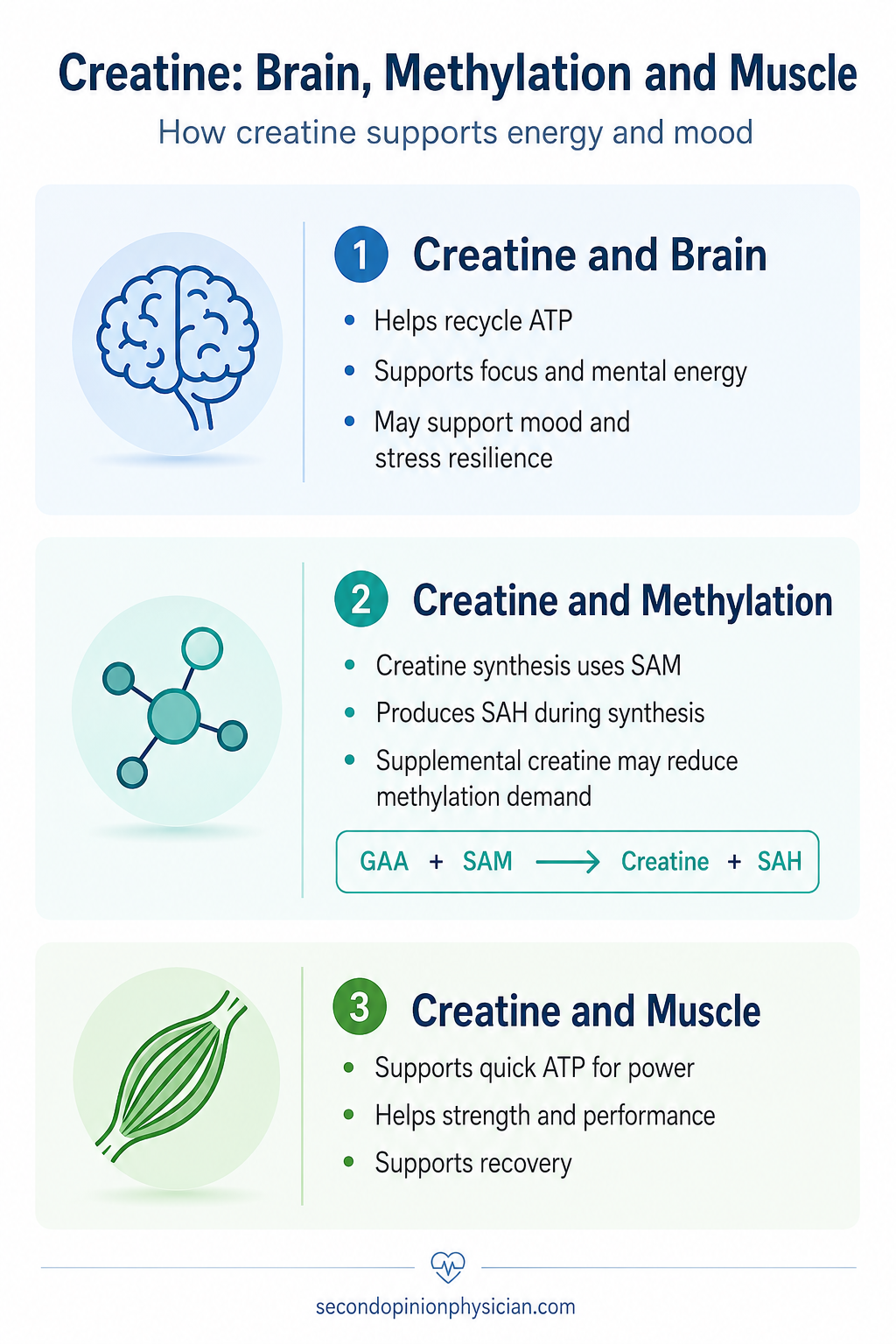
Supplemental creatine may reduce the amount the body must manufacture while directly supporting phosphocreatine and rapid ATP recycling in the brain and muscles. This creates a practical link between creatine and methylation, creatine and mood, creatine and anxiety, creatine and depression, creatine and brain function, and creatine and energy. The broader treatment goal is not simply to raise energy. It is to determine whether high creatine demand, low SAM, elevated SAH, undermethylation, toxic burden, poor sleep or another epigenetic pressure is reducing the reserve needed for mood regulation, cellular repair and recovery.

Creatine is one of the most important links between energy metabolism and methylation. The body can obtain creatine from meat and fish or manufacture it from amino acids. Endogenous production requires SAM and generates SAH through the GAMT reaction. When brain, muscle or recovery demand rises, maintaining the creatine pool can become a major methylation expense.
Supplemental creatine does not “add methyl groups.” Its value is that it can reduce the body’s need to manufacture creatine, potentially conserving methylation capacity while directly supporting the phosphocreatine system that rapidly recycles ATP in the brain and muscles.
Creatine and Methylation: Why Making Creatine Uses So Much SAM
Creatine synthesis occurs in two major steps. First, AGAT combines arginine and glycine to form guanidinoacetate. Then GAMT transfers a methyl group from SAM to guanidinoacetate, producing creatine and SAH.
Creatine production is frequently described as one of the body’s largest uses of labile methyl groups. Common estimates place it near 40%–50% of SAM-derived methyl transfers, although the exact proportion varies with diet, body size, growth, activity and physiology.
Why Supplemental Creatine Can Conserve Methylation Activity
When preformed creatine is supplied, the body downregulates part of its own creatine production. That reduces guanidinoacetate methylation demand and can spare SAM that would otherwise be used by GAMT. The mechanism is clear; the degree to which blood SAM, SAH or homocysteine changes varies among studies and patients.
Why Creatine Demand Can Affect Methylation, Mood and Recovery
The creatine pool is not static. Creatine and phosphocreatine are continually used, converted and replenished. Greater muscle mass, intensive exercise, growth, injury recovery, low dietary creatine, cognitive stress and poor sleep may increase the importance of both creatine supply and methylation reserve.
Muscle demand
Resistance training, sprinting, repeated contraction and larger muscle mass increase phosphocreatine turnover and the amount of creatine the body must maintain.
Brain demand
Neurons use ATP continuously for membrane potentials, ion transport, neurotransmitter release, receptor recycling and cellular repair.
Recovery demand
Illness, inflammation, injury, poor sleep and mitochondrial strain can increase energy and repair needs while reducing metabolic reserve.
Creatine and the Brain: ATP, Memory, Focus and Brain Fog
The brain is only a small percentage of body weight but has a very high and continuous energy requirement. The creatine–phosphocreatine system helps buffer sudden changes in ATP demand, allowing brain cells to maintain electrical signaling and recover from metabolic stress.
Brain energy reserve
Phosphocreatine can rapidly donate phosphate to ADP, helping restore ATP when neuronal demand rises.
Memory and information processing
Meta-analyses suggest possible benefits for memory and processing speed, although results are not uniform across every population or cognitive test.
Brain fog under stress
Benefits may be more noticeable during sleep deprivation, aging, vegetarian diets or other conditions in which brain energy availability is challenged.
Creatine is not a stimulant. It does not force neurons to fire faster. It strengthens the cellular energy buffer that allows the brain to meet demand more efficiently.
Creatine and Energy: Why It Helps Muscles and the Brain Without Acting Like Caffeine
Creatine supports energy by recycling ATP rather than by stimulating adrenaline or directly increasing norepinephrine. This distinction matters for patients who feel tired but are also anxious, overstimulated or unable to tolerate caffeine and stimulant medication.
Muscle energy
Creatine increases phosphocreatine availability, supporting strength, power, training volume and recovery during repeated high-energy effort.
Brain energy
Creatine supports ATP buffering for attention, executive function, neurotransmission, stress recovery and cellular repair.
Fatigue still requires evaluation. Creatine may improve energy reserve, but anemia, thyroid dysfunction, sleep apnea, low protein intake, vitamin D deficiency, insulin resistance, chronic infection and mitochondrial dysfunction should not be overlooked.
Creatine and Mood: How Cellular Energy Can Influence Emotional Resilience
Mood regulation is energy intensive. The brain must maintain ion gradients, synthesize and recycle neurotransmitters, regulate stress circuits and repair oxidative damage. When brain bioenergetics are impaired, symptoms may include low motivation, cognitive fatigue, emotional exhaustion, poor stress tolerance and depression.
Low motivation
Inadequate cellular energy can make initiation, concentration and sustained effort more difficult even when the patient wants to function.
Mood under sleep deprivation
Creatine has shown benefits for selected cognitive and mood measures when sleep loss places exceptional demand on the prefrontal cortex.
Stress resilience
A stronger phosphocreatine reserve may help the brain tolerate periods of higher metabolic demand without relying on a stimulant response.
Creatine and Depression: What the Research Suggests
Creatine has been studied as an adjunctive treatment for depression because mitochondrial and brain-energy abnormalities may contribute to symptoms in some patients. Several studies—particularly in women receiving antidepressant therapy—have reported earlier or greater improvement with creatine augmentation.
However, the evidence remains developing. Trials are relatively small, populations differ, and recent reviews conclude that average benefit may be modest and uncertain. Creatine should therefore be viewed as a potentially useful metabolic adjunct, not a universal standalone treatment for depression.
Who May Be the Strongest Mood Candidate?
The clinical case is strongest when depression overlaps with fatigue, poor concentration, low dietary creatine, vegetarian or vegan diet, sleep deprivation, high exercise demand, low SAM, elevated SAH, mitochondrial strain or incomplete response to otherwise appropriate treatment.
Creatine and Anxiety: Can Creatine Help—or Make Anxiety Worse?
Creatine is not an anxiolytic in the same way as a sedative or serotonin medication. Its potential value is indirect: improving cellular energy may reduce cognitive fatigue, poor stress recovery and the “tired but wired” state that occurs when the brain relies heavily on stress hormones to maintain function.
Why it may help
Better ATP buffering may support prefrontal control, exercise tolerance, sleep-loss resilience and recovery from prolonged mental stress.
Why some patients feel worse
A minority report activation, restlessness, digestive discomfort or disturbed sleep. Symptoms may reflect dose, timing, concurrent caffeine, dehydration, bipolar susceptibility or an unrelated biochemical driver.
Persistent anxiety deserves biochemical evaluation. Copper overload, pyroluria, low zinc, cortisol imbalance, overmethylation, thyroid disease, histamine intolerance, toxic burden and glutamate/NMDA receptor hyperactivity may be more important than creatine itself.
Creatine and Undermethylation: Removing a Major Methylation Expense
Within the Walsh framework, undermethylation may be associated with obsessive thinking, perfectionism, high internal tension, seasonal allergies, depression, low functional serotonin activity and elevated whole-blood histamine. The methylation pathway must support neurotransmitter regulation, histamine metabolism, detoxification, repair and many other functions at the same time.
Creatine can be important because the body’s own creatine production competes for SAM. Providing creatine directly may reduce this demand and leave more methylation capacity available for other processes.
Low SAM
Reducing endogenous creatine synthesis may conserve SAM rather than requiring the body to spend it through GAMT.
Elevated SAH
Less guanidinoacetate methylation means less SAH is generated through that reaction, although circulating SAH also depends on clearance, adenosine and homocysteine metabolism.
High histamine pattern
Conserving methylation capacity may support the larger treatment plan for a patient whose symptoms and whole-blood histamine fit undermethylation.
Related reading: What Causes Undermethylation? and Five Epigenetic Biotypes of Undermethylation.
Creatine as an Epigenetic Influence on Methylation and Mood
Epigenetics describes how diet, sleep, activity, toxins, inflammation and other environmental pressures influence gene expression and metabolic demand. Creatine is relevant because its synthesis directly consumes methyl groups, while creatine itself supports energy-dependent cellular repair and brain function.
Exercise and muscle growth
Exercise is beneficial, but high training volume increases ATP turnover, muscle repair and creatine-pool demand.
Sleep loss and cognitive strain
Sleep deprivation increases prefrontal energy demand and can reveal limited brain bioenergetic reserve.
Inflammation and toxic burden
Oxidative stress, glutathione demand, mitochondrial strain and impaired SAH clearance can compound the methylation burden.
Creatine, SAM and SAH: What Changes—and What Does Not
The biochemical mechanism is straightforward: endogenous creatine synthesis consumes SAM and produces SAH. Supplemental creatine lowers guanidinoacetate, showing that the body reduces its own synthetic activity.
That does not guarantee that every patient’s blood SAM will rise or SAH will fall. SAH is also controlled by the reversible SAH hydrolase reaction and by the clearance of homocysteine and especially adenosine. Kidney function, zinc-dependent adenosine metabolism, mitochondrial energy, inflammation, diet and toxic burden may therefore remain decisive.
Creatine reduces one source of methylation demand; it does not correct every cause of elevated SAH. A patient with persistently high SAH may also need evaluation of adenosine clearance, zinc status, kidney and liver function, toxic burden, gut health, oxidative stress and acid-base or mineral factors.
Who May Have Higher Creatine or Methylation Demand?
Vegetarians and vegans
Plant foods provide little preformed creatine, increasing reliance on endogenous synthesis.
Athletes and active adults
High-intensity training and repeated muscular effort increase phosphocreatine turnover.
People with greater muscle mass
A larger creatine pool must be maintained across more muscle tissue.
Adults over 50
Aging can reduce muscle mass, mitochondrial efficiency and metabolic reserve.
Sleep-deprived or cognitively stressed patients
Brain benefits may become more noticeable when energy reserve is challenged.
Patients with mood disorders
Depression with fatigue, brain fog or incomplete antidepressant response may justify assessment of brain-energy and methylation factors.
Patients with low SAM or elevated SAH
Reducing creatine synthesis demand may be more relevant when methylation reserve is already limited.
Recovery from illness or injury
Rehabilitation can increase the need for muscle preservation, repair and cellular energy.
Mitochondrial or toxic burden
Energy dysfunction and oxidative stress may increase both brain symptoms and methylation pressure.
How to Test Whether Creatine Demand Is Affecting Methylation or Mood
No single laboratory marker measures “creatine demand.” The best assessment combines diet, activity, symptoms, treatment history and biochemical testing.
| Clinical question | Useful information or test | Why it matters |
|---|---|---|
| Is methylation reserve limited? | SAM, SAH, SAM/SAH ratio, methionine and homocysteine | Distinguishes donor shortage from product inhibition and impaired clearance. |
| Does the patient fit undermethylation? | Whole-blood histamine, symptoms, family pattern and medication response | Places creatine within the broader Walsh treatment plan. |
| Is creatine intake or demand unusually high? | Diet, vegetarian status, muscle mass, training volume, sleep and recovery | Shows whether endogenous synthesis is likely carrying more of the burden. |
| Are other factors limiting energy? | CBC, CMP, thyroid, vitamin D, zinc, copper, glucose, insulin and inflammatory clues | Identifies anemia, thyroid disease, mineral imbalance, metabolic dysfunction and other fatigue causes. |
| Is SAH clearance impaired? | Kidney/liver function, zinc, homocysteine, adenosine context, toxic burden and gut health | Creatine cannot correct persistent SAH if the downstream clearance problem remains. |
Creatine Dosage for Energy, Brain and Methylation Support
| Goal | Common amount | Practical note |
|---|---|---|
| General maintenance | 3–5 grams daily | Common long-term range for muscle and metabolic support. |
| Higher body mass, intensive training or low dietary creatine | 5–10 grams daily | May be divided for gastrointestinal tolerance. |
| Optional loading phase | About 20 grams daily for 5–7 days | Usually divided into four doses, then reduced to maintenance. |
| Selected neurological or research protocols | 10–20 grams daily | Higher doses have been studied but should be individualized. |
Creatine monohydrate is the best-studied form. Kidney disease, pregnancy, complex illness or medications affecting renal function require individualized medical review. Creatinine may rise because creatine breaks down to creatinine; kidney interpretation should consider the full clinical context.
Frequently Asked Questions About Creatine, Mood and Methylation
Is creatine good for methylation?
Creatine may reduce methylation demand by decreasing the amount the body must manufacture. This can conserve SAM use through the GAMT pathway, although blood SAM and SAH responses vary.
Can creatine improve mood?
Creatine may support mood by improving brain-energy buffering. Research is most encouraging in selected patients with depression, fatigue, sleep loss or incomplete antidepressant response, but it is not a universal mood treatment.
Can creatine help depression?
Several small trials and reviews suggest possible adjunctive benefit, particularly in women receiving antidepressant therapy. The overall evidence remains developing and uncertain.
Can creatine help anxiety?
Creatine may indirectly improve stress resilience and cognitive energy, but direct evidence for anxiety treatment is limited. Persistent anxiety should be evaluated for copper overload, pyroluria, cortisol, thyroid, histamine, toxic burden and glutamate-related factors.
Does creatine give energy like caffeine?
No. Creatine supports ATP recycling rather than stimulating adrenaline or norepinephrine. It strengthens energy reserve without functioning as a conventional stimulant.
Does creatine help the brain?
Creatine supports the phosphocreatine energy buffer in the brain. Research suggests possible benefits for memory and information processing, particularly when energy demand is high or baseline creatine is lower.
Can creatine reduce SAH?
Creatine reduces the need for the GAMT reaction that generates SAH, but circulating SAH also depends on downstream clearance. Creatine therefore reduces one source of SAH production without guaranteeing that a high SAH blood level will normalize.
Does exercise cause undermethylation?
Exercise does not automatically cause undermethylation. Intensive training can increase creatine turnover, ATP demand and repair needs, potentially exposing an existing methylation bottleneck when diet and recovery are inadequate.
Is creatine useful after age 50?
Creatine may be particularly relevant after 50 because muscle mass, recovery and brain-energy reserve can decline with age. Benefits are strongest when paired with appropriate exercise and nutrition.
What tests help determine whether creatine is relevant?
A plasma methylation panel, whole-blood histamine, zinc, copper, vitamin D, CBC, CMP, thyroid testing and a detailed diet, sleep and activity history may help identify the larger pattern.
Creatine Is a Brain-Energy and Methylation Strategy—not Only a Muscle Supplement
Creatine can reduce a major methylation expense while supporting rapid ATP recycling in the brain and muscles. Its greatest clinical value may be in patients whose mood, anxiety, fatigue, diet, exercise, sleep, low SAM, elevated SAH or epigenetic stress suggest that energy and methylation demands are competing for limited reserve.