
Developmental Regression After Vaccination: The Individual Child, Susceptibility & Recovery
For some families, vaccination is a routine decision. For others, it raises difficult questions about whether their child may be unusually vulnerable to fever, inflammation or other physiologic stress. And if you have already watched your child lose words, eye contact, sleep stability, social engagement or other abilities after a vaccination or significant reaction, these questions are no longer theoretical.
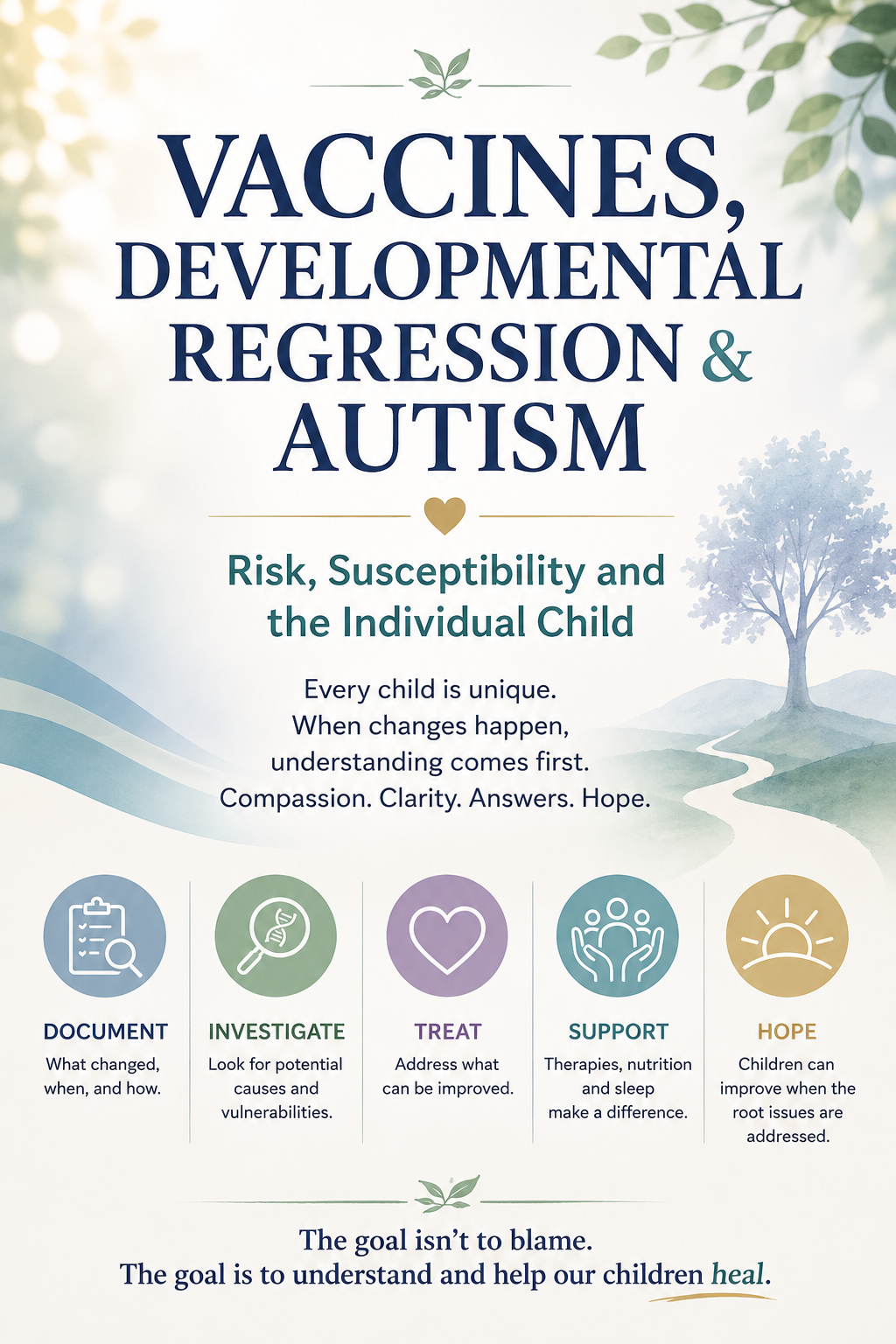
This page looks at what may deserve attention before vaccination, how mitochondrial function, oxidative stress, methylation, nutrition, copper-zinc balance and other individual factors may influence resilience, and what can be investigated and treated when a child experiences developmental regression. The goal is awareness before the decision, thoughtful prevention where possible, and an individualized path forward when something has already gone wrong.
For some families, vaccination is a routine decision. For others, it raises difficult questions about whether their child may be unusually vulnerable to fever, inflammation or other physiologic stress. And if you have already watched your child lose words, eye contact, sleep stability, social engagement or other abilities after a vaccination or significant reaction, these questions are no longer theoretical. This page looks at what may deserve attention before vaccination, how mitochondrial function, oxidative stress, methylation, nutrition, copper-zinc balance and other individual factors may influence resilience, and what can be investigated and treated when a child experiences developmental regression.
Start with the individual child.
Children differ in medical history, previous reactions, development, genetics, nutrition, immune function and metabolic resilience. Those differences deserve consideration before an intervention—and serious investigation when something has already gone wrong.
Could Your Child Be More Vulnerable?
Before asking what is true for children in general, consider what may be important about your child.
The most useful vaccine conversation may not begin with an argument about whether vaccines are universally “safe” or “dangerous.” Those words are too broad to describe every child, every vaccine and every clinical circumstance.
A better place to begin is with the child.
How has your child responded to previous vaccines? How does your child respond to fever and illness? Is development progressing normally? Are there seizures, unexplained weakness, unusual fatigue, severe feeding problems, significant gastrointestinal symptoms or another medical issue that has not been explained?
None of these findings automatically means that vaccination will cause an adverse outcome. They mean that the child's medical history deserves attention rather than allowing the calendar alone to determine the decision.
You Know When Something Has Changed
You know the words your child used. You know how your child played, slept, interacted, made eye contact and responded to you.
When you report that something changed, that observation belongs in the medical history.
Sometimes the change is temporary. Sometimes another explanation is identified. Sometimes the relationship to a preceding event remains uncertain.
But when a child loses previously acquired abilities, the appropriate response is not dismissal.
It is investigation.
Developmental regression deserves attention.
Loss of language, social engagement, eye contact, motor abilities, continence, feeding skills or other previously acquired functions deserves a careful developmental and medical evaluation.
An autism diagnosis may describe the child's developmental and behavioral presentation. It does not necessarily tell us why a change occurred.
Anecdotal Does Not Mean Irrelevant
An individual observation cannot by itself establish causation. But that does not make the observation meaningless.
Clinical medicine begins with observation: what happened, when it happened, what came before it and what followed.
When families describe a sequence involving previously acquired developmental abilities, a significant physiologic event, an acute reaction and subsequent developmental change, that history deserves careful documentation and investigation.
Timing is a reason to investigate—not a final diagnosis.
Something occurring after vaccination does not automatically establish that vaccination caused it. But uncertainty about causation should never become a reason to ignore genuine developmental regression.
Build the Timeline
1. Before
What words, behaviors, social interactions and developmental abilities were clearly present?
2. The Event
Which vaccine or vaccines were given? Was there fever, seizure, prolonged illness or another unusual reaction?
3. The Change
What happened afterward? Which previously acquired abilities weakened or disappeared?
4. Recovery
Did your child return to baseline, partially recover, fluctuate or continue to lose function?
Why Might One Child Respond Differently?
Children are biologically different.
They do not have identical mitochondrial reserve, antioxidant capacity, nutritional status, genetics, immune regulation, gastrointestinal health or metabolic function.
A physiologic stressor that is readily tolerated by one child may be more difficult for another child with an underlying disorder or reduced metabolic reserve.
We cannot currently identify every susceptible child in advance. But individual susceptibility exists throughout medicine, and the child's history may sometimes suggest that additional evaluation is appropriate.
Before Vaccination: Look at the Child, Not Just the Calendar
Preparation begins with the child's health, history and previous responses—not with a one-size-fits-all supplement protocol.
For many healthy children, the vaccination decision may be straightforward. For a child with an unusual history, it may deserve a more detailed discussion.
Before vaccination, consider whether anything about your child's current condition or previous history deserves additional attention.
- Previous significant vaccine reaction
- Current fever or significant acute illness
- History of seizures or unusual neurologic events
- Known mitochondrial or metabolic disease
- Known immune disorder
- Unexplained developmental changes already occurring
- Significant feeding difficulty or restricted diet
- Major nutritional deficiency
- Persistent diarrhea, vomiting or other significant GI illness
- Unusual weakness, fatigue or poor recovery from ordinary illnesses
The appointment should not become more important than the child.
A minor cold is different from significant illness, neurologic instability or unexplained developmental change. When something is not routine, discuss whether additional evaluation or temporary deferral is appropriate.
Can Vulnerability Be Measured Beforehand?
Not completely.
There is no validated laboratory panel that can reliably predict which otherwise healthy child will experience a serious vaccine reaction.
But that does not mean measurable health abnormalities should be ignored.
When the history suggests mitochondrial disease, nutritional deficiency, metabolic dysfunction, significant gastrointestinal disease or another medical problem, investigating that problem may be appropriate on its own merits.
Mitochondrial Reserve: Does the Child Have Enough Energy Capacity?
Mitochondria produce most of the ATP required by our cells. The developing brain has particularly high energy requirements.
Fever, infection, inflammation and other physiologic stresses can increase metabolic demand.
Children with established mitochondrial disease can deteriorate during illness, fever, fasting and other metabolic stressors. Mitochondrial function therefore belongs in the differential diagnosis when a child has unusual neurologic deterioration, poor recovery from illness or developmental regression.
Oxidative Stress, Glutathione and Methylation
Energy production and immune activation generate reactive oxygen species. Healthy cells rely on antioxidant systems—including glutathione, superoxide dismutase and catalase—to maintain redox balance.
Oxidative stress and altered glutathione metabolism have been studied in autism and other neurodevelopmental conditions. They do not establish the cause of autism or prove vaccine injury, but they are relevant to the broader question of how effectively an individual child handles metabolic and inflammatory stress.
Oxidative Stress
Greater cellular stress increases demand for antioxidant protection.
Glutathione
Transsulfuration connects sulfur metabolism and methylation with antioxidant defense.
Methylation
SAM and SAH help show whether methylation capacity is keeping pace with biochemical demand.
Methylation, SAM, SAH and Epigenetic Resilience
Methylation participates in gene regulation, neurotransmitter metabolism, membrane biology, creatine synthesis and numerous cellular processes.
Methylation also depends on cellular energy and intersects with transsulfuration and antioxidant defense.
Rather than assuming every child with autism has the same methylation abnormality, methylation can be examined biochemically.
Plasma methionine, SAM, SAH and homocysteine provide a more direct view of methylation chemistry than an MTHFR variant alone.
The relationship between SAM and SAH is particularly important because SAH can inhibit methyltransferase reactions even when other markers appear relatively normal.
Don't stop at “MTHFR.”
The more clinically useful question is whether methylation is actually impaired—and, if it is, why?
The Five Epigenetic Biotypes: What May Be Driving Undermethylation?
Our Five Epigenetic Biotypes framework moves beyond simply labeling a child “undermethylated.”
The next question is what may be contributing to impaired methylation in that particular child.
Mitochondrial Distress
Insufficient cellular energy may interfere with energy-dependent biochemical processes.
Creatine Demand
Endogenous creatine synthesis represents one of the body's major methyl-group demands.
Toxic Burden
Environmental exposures may add oxidative and metabolic stress in susceptible individuals.
Increased Methylation Demand
Repair and other biochemical processes may consume methyl capacity.
Impaired SAH Clearance
Accumulation of SAH can inhibit methyltransferase activity and reduce effective methylation.
Copper, Zinc and Antioxidant Defense
Copper and zinc participate in neurotransmitter chemistry, antioxidant defense, immune regulation and cellular metabolism.
Some children with autism demonstrate meaningful copper-zinc abnormalities, but these should be measured rather than presumed from the diagnosis.
The Walsh Comprehensive Biotype Assessment examines plasma zinc, serum copper, ceruloplasmin and related markers to determine whether a clinically relevant imbalance is actually present.
Copper
Copper participates in catecholamine metabolism and multiple oxidation-reduction reactions.
Zinc
Zinc supports antioxidant enzymes, immune regulation and many metabolic pathways.
Balance
Serum copper, ceruloplasmin and plasma zinc help determine whether a meaningful imbalance exists.
Gut Health, Nutrition and Sleep
A child with chronic diarrhea, malabsorption, severe food restriction, persistent vomiting or another significant gastrointestinal disorder may not have optimal nutritional status.
A child who is profoundly sleep-deprived is also not functioning at baseline.
These problems matter because they affect the child's health and resilience. They should not be ignored simply because the immediate discussion is about vaccination.
Optimize what can be identified and corrected.
Adequate protein, hydration, sleep and essential nutrients support normal immune, antioxidant and metabolic function. Documented deficiencies deserve correction, and significant GI disease deserves evaluation.
That is good pediatric care regardless of the eventual vaccination decision.
What About Antioxidants Before Vaccination?
Parents frequently ask about glutathione, NAC, zinc, selenium, vitamins and other antioxidant support.
There is biological reason to be interested in antioxidant reserve because immune activation and fever can increase oxidative demand.
However, no specific supplement protocol has been established as a reliable way to prevent vaccine-associated neurologic injury or autism.
The important distinction is between correcting an identified deficiency or supporting general health and promising that a supplement can eliminate risk.
Informed Choice Means Being Able to Ask Difficult Questions
You should be able to ask which vaccine is being proposed, what illness it is intended to prevent, what benefits are expected, what adverse reactions are recognized, whether your child's medical history changes the decision and whether an active medical problem deserves attention first.
Choosing vaccination deserves respect.
Wanting more information deserves respect.
And if your child has already experienced a serious reaction, that history deserves particularly careful consideration before another exposure.
If Something Has Already Happened
When your child has lost abilities or failed to return to baseline, the priority changes from assessing possible vulnerability to finding out what can be identified and treated now.
You Do Not Need to Be Convinced That You Saw a Change
You remember what your child was like before.
Perhaps words disappeared. Perhaps eye contact changed. Perhaps sleep became chaotic. Perhaps there was a seizure, fever or prolonged illness followed by a child who simply did not return to baseline.
You may never be able to establish one event as the complete explanation for everything that followed.
But you do not need to solve the causation question before beginning the medical investigation.
There are two different questions.
What caused this?
And:
What abnormalities are present in my child now, and what can potentially be treated?
The first question matters. But uncertainty about the first should not prevent us from pursuing the second.
First: Preserve the Story
Chronology matters. Write down what happened while the details can still be reconstructed.
- What developmental abilities were present beforehand?
- Which vaccine or vaccines were administered?
- What was the date and approximate time?
- What was the manufacturer and lot number, if available?
- How soon did the first unusual symptom appear?
- Was there fever? How high and for how long?
- Was there a seizure or abnormal movement?
- Was your child unusually sleepy, difficult to awaken or inconsolable?
- Did eating or bowel function change?
- Did sleep change?
- Did language change?
- Did eye contact or social engagement change?
- Did previously acquired abilities disappear?
- Did your child completely return to the previous baseline?
Preserve objective information when you have it.
Home videos, photographs, developmental records, medical records and contemporaneous messages can help reconstruct what your child could do before and what changed afterward.
Report a Significant Adverse Event
A significant event occurring after vaccination can be reported to the appropriate vaccine adverse-event surveillance system.
Reporting does not require you to prove beforehand that the vaccine caused the event.
The report documents what happened. Determining causation is a separate question.
Do Not Allow “Autism” to End the Medical Investigation
Autism describes a pattern of development, communication and behavior. It does not tell us everything about the underlying biology of an individual child.
A child with autism can also have seizures, gastrointestinal disease, nutritional deficiencies, cerebral folate problems, genetic disorders, mitochondrial disease, sleep disorders or other medical conditions.
Developmental therapy remains important, but the medical investigation does not need to stop because an autism diagnosis has been assigned.
What Might Be Investigated?
There is no single “vaccine injury test.” Testing should follow the child's symptoms, history and clinical pattern.
| Clinical Question | Possible Evaluation |
|---|---|
| Seizures or neurologic change? | Pediatric neurologic evaluation, EEG, imaging or other testing when clinically indicated. |
| Genetic or metabolic disorder? | Genetic and metabolic evaluation based on developmental history, physical findings and phenotype. |
| Mitochondrial dysfunction? | Depending on the clinical picture, evaluation may include lactate/pyruvate, CK, carnitine and acylcarnitines, organic acids, GDF-15 and specialist assessment. |
| Oxidative stress? | Selected oxidative and redox markers may include 8-OHdG and glutathione assessment when clinically useful. |
| Walsh biochemical pattern? | Whole-blood histamine, plasma zinc, serum copper, ceruloplasmin, pyrroles, vitamin D and related Comprehensive Biotype markers. |
| Methylation dysfunction? | Methionine, SAM, SAH, SAM:SAH relationship and homocysteine. |
| Cerebral folate concerns? | Folate receptor antibody testing may be considered when the history and clinical pattern support it. |
| GI or nutritional problems? | Evaluation directed toward significant gastrointestinal symptoms, restricted diet, malabsorption and suspected nutritional deficiencies. |
Recovery Is Not One Protocol
When you are searching desperately for help, you will encounter programs promising to “detox vaccines” or reverse autism with one supplement, one diet or one treatment.
There is no universal vaccine detox, and developmental regression does not have one biochemical cause.
That does not mean there is nothing to do.
It means treatment should follow the child.
Development
Speech, occupational, educational and other developmental therapies remain important while medical causes are investigated.
Mitochondria
When mitochondrial abnormalities are identified, support can be directed toward the specific metabolic findings.
Nutrition & GI
Correct deficiencies, inadequate intake, malabsorption and clinically important gastrointestinal problems.
Methylation
Distinguish low SAM, elevated SAH and other methylation patterns rather than treating an MTHFR result alone.
Copper & Zinc
Identify and appropriately address laboratory-confirmed mineral imbalances.
Oxidative Stress
When meaningful redox abnormalities are demonstrated, support can be individualized to the findings.
Look for What Can Be Changed
One of the hardest realities for families is that medicine may not always be able to reconstruct every biological event that occurred months or years earlier.
But there is an enormous difference between saying:
and
“There is nothing left to investigate.”
Those are not the same conclusion.
Your child may have abnormalities today that can be identified today. Those findings may include nutritional deficiencies, seizures, gastrointestinal disease, mitochondrial abnormalities, oxidative stress, methylation dysfunction, copper-zinc imbalance or another medical problem.
The purpose of testing is not to manufacture an explanation for the past.
It is to find what may be relevant to your child's health now.
Keep both questions alive.
You may still want to know why this happened. That question matters.
At the same time, keep asking: What can we identify, support and treat now?
Awareness. Prevention. Treatment.
The goal is neither fear nor false reassurance. It is individualized attention before a consequential decision and persistent investigation when a child has experienced developmental regression.
Awareness
Know your child's history. Pay attention to previous reactions, developmental changes and unusual responses to illness or physiologic stress.
Prevention
Address significant illness and identifiable medical problems, ask questions and make an informed decision based on the individual child.
Treatment & Recovery
When something has already happened, document it, investigate broadly, identify abnormalities and treat what can reasonably be treated.
After an unexpected reaction: document what happened and seek appropriate care.
After developmental regression: investigate broadly, support development and look for what can be treated.
Start With Your Child
The Pediatric Neurodevelopment and Biotype Assessment is designed to organize developmental history and identify patterns that may justify additional investigation, including methylation, copper-zinc balance, mitochondrial function, oxidative stress, nutritional factors and related biochemical pathways.
It is not a test that predicts vaccine injury and it does not replace pediatric, neurologic or emergency evaluation when those are needed. Its purpose is to help determine whether potentially important biochemical patterns deserve a closer look.
Frequently Asked Questions
What should I do if I believe my child changed after vaccination?
Start by documenting exactly what happened. Record the vaccination date, vaccines administered, symptoms, fever, seizures, sleep and feeding changes, and the developmental abilities that changed or disappeared. Significant developmental or neurologic changes deserve appropriate medical evaluation regardless of whether their ultimate cause is known.
Does developmental regression after vaccination prove vaccine injury?
Timing alone cannot establish causation. But that does not make the regression unimportant. A meaningful developmental change deserves documentation and investigation whether or not the initiating event can ultimately be established.
Should vaccination proceed when my child is sick?
The severity and type of illness matter. Mild illness is different from significant systemic illness, neurologic instability or unexplained developmental change. Discuss the child's current condition and whether deferral is medically appropriate with the treating clinician.
Can testing tell me whether my child is vulnerable to vaccine injury?
There is currently no validated laboratory test that reliably predicts which otherwise healthy child will experience a serious vaccine reaction. Testing can nevertheless identify genuine medical abnormalities when the history suggests mitochondrial disease, nutritional deficiency, methylation dysfunction, mineral imbalance or another condition that deserves evaluation.
Should my child take antioxidants before vaccination?
No antioxidant or supplement protocol has been established as a reliable method of preventing vaccine-associated neurologic injury. Adequate nutrition and correction of documented deficiencies remain important components of general pediatric health.
What is the connection between mitochondria and developmental regression?
The brain requires large amounts of cellular energy. Children with recognized mitochondrial disorders may deteriorate during fever, infection or other metabolic stress. Mitochondrial disease is therefore one consideration in the differential diagnosis of unexplained developmental regression, particularly when other metabolic symptoms are present.
Why look at methylation?
Methylation participates in neurotransmitter regulation, cellular repair, membrane function, creatine synthesis and gene regulation. When methylation dysfunction is suspected, measuring SAM, SAH, methionine and homocysteine provides information that cannot be obtained from an MTHFR genotype alone.
What do copper and zinc have to do with autism?
Copper and zinc participate in neurotransmitter chemistry, antioxidant defense and immune function. Some children demonstrate clinically important abnormalities in these minerals, but they should be measured rather than assumed from an autism diagnosis.
Is there a single treatment for suspected vaccine injury?
No. Reported adverse events and developmental regression can involve many different mechanisms and causes. Treatment should be directed toward the child's actual clinical findings—neurologic, developmental, nutritional, gastrointestinal, mitochondrial, metabolic or otherwise.
Is there a vaccine detox?
There is no universal evidence-based “vaccine detox.” A child who has regressed deserves an individualized evaluation: determine what is abnormal, identify what can reasonably be treated and support developmental recovery.
Should an autism diagnosis end the medical investigation?
No. Autism describes developmental and behavioral characteristics. Children with autism can also have seizures, gastrointestinal disease, nutritional deficiencies, sleep disorders, genetic conditions, mitochondrial disease and other medical problems that warrant appropriate evaluation and treatment.
How should I approach the vaccination decision for my child?
Ask questions. Understand which vaccine is being considered, the disease it is intended to prevent, expected benefits, recognized risks, your child's previous reactions and relevant medical history. If there is a significant unresolved medical concern, discuss it before making the decision.
The goal is informed, individualized medical decision-making rather than fear or pressure.