
Copper, Oxidative Stress & Autism: Zinc, Mitochondria and the Epigenetic Connection
Copper overload in autism is best evaluated as a biochemical pattern rather than from serum copper alone. Copper, zinc and ceruloplasmin help regulate neurotransmitter chemistry and antioxidant defenses, while copper is also required by mitochondrial cytochrome c oxidase for cellular energy production. Zinc and copper participate in cytosolic SOD1 antioxidant activity, while manganese supports mitochondrial SOD2.
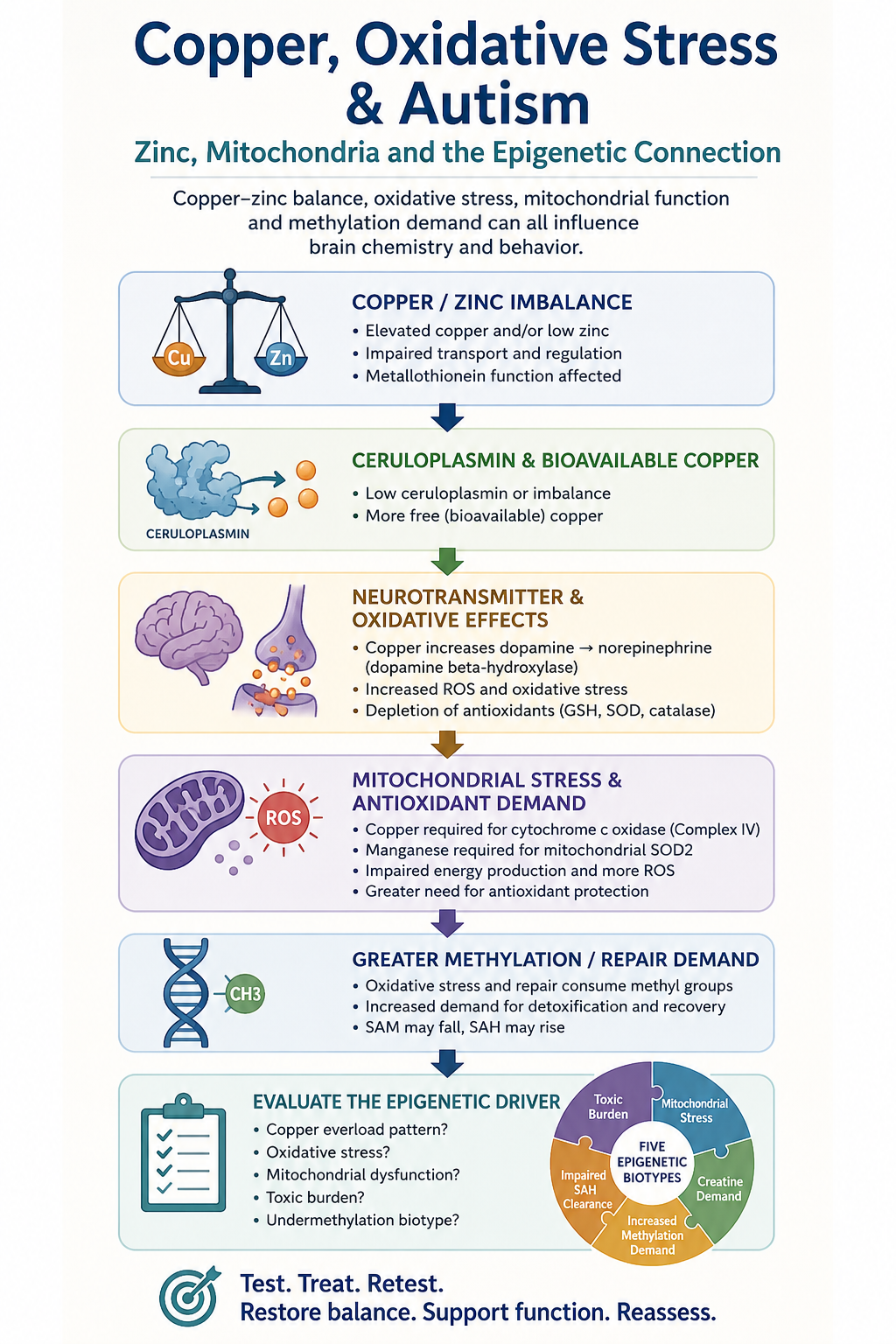

When copper–zinc balance, oxidative stress, mitochondrial function or toxic-metal exposure becomes abnormal, these systems may interact with methylation demand and the broader Five Epigenetic Biotypes of Undermethylation. A comprehensive assessment can therefore look beyond copper alone to determine whether copper overload, oxidative stress, mitochondrial dysfunction, toxic burden or undermethylation represents the more important biochemical pattern.
Copper overload is one of the major biochemical patterns described in the Walsh Approach. But the clinically important issue is not simply whether serum copper is above a laboratory reference range.
Copper should be interpreted together with ceruloplasmin, calculated non-ceruloplasmin-bound copper, zinc, symptoms and the broader biochemical pattern. When oxidative stress or mitochondrial dysfunction is also suspected, additional testing can help determine whether copper imbalance is one part of a larger metabolic problem.
What Does “Copper Overload” Mean?
Copper is an essential nutrient. It participates in mitochondrial energy production, connective-tissue metabolism, iron handling, antioxidant enzymes and catecholamine metabolism.
The objective is therefore not to eliminate copper. The clinical question is whether copper is being appropriately transported and regulated relative to ceruloplasmin and zinc.
Serum Copper
Shows circulating copper but should not be interpreted alone.
Ceruloplasmin
The major copper-carrying protein and an important part of interpreting copper status.
Plasma Zinc
Provides essential context because zinc and copper regulation interact through several biochemical systems.
Non-Ceruloplasmin-Bound Copper
A calculated estimate can add context when serum copper and ceruloplasmin appear disproportionate.
Symptoms That May Raise the Question of Copper Overload
Symptoms cannot diagnose copper overload or distinguish it from autism, anxiety, ADHD, sleep disorders or other biochemical patterns. They can, however, help determine whether copper and zinc testing is reasonable.
Behavioral & Emotional Clues
- Anxiety or excessive internal tension
- Irritability or emotional volatility
- Agitation or hyperarousal
- Sensory sensitivity
- Difficulty settling or calming
- Sleep disturbance
- Stress intolerance
Biochemical Context
- Low or marginal zinc
- Disproportionate copper and ceruloplasmin
- History suggesting oxidative stress
- Evidence of pyroluria or increased zinc requirements
- Overlapping undermethylation pattern
- Possible toxic or environmental exposures
Autism symptoms are not copper-overload symptoms
Social-communication differences, repetitive behavior, sensory differences and developmental concerns establish the clinical autism picture. Copper testing asks a separate question: is a potentially relevant biochemical pattern present within that individual?
Copper and Neurotransmitter Chemistry
Copper is a cofactor for dopamine beta-hydroxylase, the enzyme that converts dopamine to norepinephrine.
This does not mean that an elevated serum copper result automatically produces excessive norepinephrine. It does explain why copper metabolism is relevant to catecholamine biology and why the Walsh copper-overload pattern has traditionally been considered in patients with anxiety, hyperarousal and emotional instability.
Copper, Manganese and Mitochondrial Antioxidant Defense
Copper and manganese both matter to mitochondrial biology, but they perform different jobs.
Copper → Complex IV
Cytochrome c oxidase, or Complex IV of the mitochondrial respiratory chain, contains essential copper centers. Adequate copper is therefore required for normal oxidative phosphorylation and ATP production.
Copper + Zinc → SOD1
Copper and zinc are cofactors for Cu/Zn superoxide dismutase, an important antioxidant enzyme that helps convert superoxide into less reactive molecules.
Manganese → SOD2
Manganese supports mitochondrial superoxide dismutase, SOD2, one of the major defenses against superoxide generated within mitochondria.
This is why mineral status should not be reduced to a simple “high copper versus low copper” model. Copper must be available for essential enzymes while simultaneously being appropriately transported and controlled.
Where Oxidative Stress Fits
When antioxidant defenses are inadequate relative to oxidant production, reactive oxygen species can damage lipids, proteins and DNA. Mitochondria can both contribute to this oxidative burden and become targets of it.
Should 8-OHdG Be Tested?
Yes—when the clinical question is oxidative damage.
Urinary 8-hydroxy-2'-deoxyguanosine (8-OHdG) is a marker of oxidative DNA damage. It can help determine whether oxidative injury is occurring rather than merely assuming it from symptoms or copper findings.
I would use it selectively as an oxidative-stress marker rather than as a copper-overload marker. An elevated result tells us that oxidative DNA damage is increased; it does not establish copper as the cause.
Toxic Metals: When Environmental Exposure Enters the Picture
Lead, mercury, arsenic, cadmium and other environmental metals can add another source of oxidative and mitochondrial stress. Exposure history therefore matters when evaluating a child with an unusual oxidative, mineral or developmental pattern.
Hair testing can provide exposure clues—but requires caution
Hair mineral or toxic-metal testing may provide historical or environmental clues, particularly when interpreted alongside exposure history. It should not by itself be used to diagnose systemic metal toxicity.
Hair can be contaminated externally, collection and laboratory methods vary, and reference ranges are not equally validated for every metal. When a clinically important exposure is suspected, the finding should generally be confirmed using the appropriate blood or urine test for that specific metal and exposure window.
This distinction is especially important in autism because finding a metal in hair does not establish that the metal caused autism—or that chelation is indicated.
Copper Overload and the Five Epigenetic Biotypes
Copper overload and undermethylation are not the same biochemical pattern. A patient may demonstrate one, the other, or features of both.
When they overlap, the Five Epigenetic Biotypes framework can help ask a second question: what is maintaining the undermethylation?
Toxic Burden
Environmental exposures may increase oxidative, detoxification and metabolic demand.
Mitochondrial Stress
Impaired cellular energy can affect ATP-dependent SAM production and increase oxidative vulnerability.
Creatine Demand
Endogenous creatine synthesis represents a substantial physiological use of SAM-derived methyl groups.
Increased Methylation Demand
Inflammation, oxidative damage and cellular repair may increase methyl-group utilization.
Impaired SAH Clearance
Elevated SAH can inhibit methyltransferase reactions even when methyl donors remain available.
A Practical Testing Strategy
Rather than ordering every possible marker, testing can proceed in layers according to the biochemical question.
| Clinical Question | Testing | What It Adds |
|---|---|---|
| Is copper overload present? | Serum copper, ceruloplasmin, plasma zinc and calculated non-ceruloplasmin-bound copper | Defines the copper–zinc pattern rather than relying on serum copper alone |
| What is the broader Walsh biotype? | Whole-blood histamine, copper, ceruloplasmin, plasma zinc, urinary pyrroles and associated comprehensive markers | Evaluates copper overload alongside undermethylation, overmethylation and pyroluria |
| Is oxidative damage present? | Urinary 8-OHdG; GSH/GSSG and other oxidative-stress markers when appropriate | Provides objective evidence of oxidative burden |
| Is mitochondrial stress involved? | Lactate/pyruvate, carnitine, CK, GDF-15, organic acids or deeper testing when indicated | Evaluates cellular-energy metabolism and possible mitochondrial involvement |
| Is undermethylation being driven metabolically? | SAM, SAH, SAM:SAH ratio, methionine and homocysteine | Distinguishes low methyl-donor capacity from methylation inhibition and other pathway bottlenecks |
| Is toxic-metal exposure plausible? | Exposure history; selected hair screen if used cautiously; confirmatory blood or urine testing appropriate to the suspected metal | Separates an exposure clue from clinically meaningful internal exposure |
Why Start With the Comprehensive Walsh Biotype Panel?
A copper result by itself cannot tell us whether the dominant pattern is copper overload, undermethylation, pyroluria, oxidative stress or a combination.
The Comprehensive Walsh Biotype Panel provides the better starting framework because copper, ceruloplasmin and zinc can be interpreted alongside whole-blood histamine, pyrroles and the other markers used to characterize the broader biochemical phenotype.
When the history or initial results suggest additional mitochondrial, oxidative, toxic-metal or methylation involvement, those pathways can then be tested selectively rather than assuming that every autistic child needs every test.
Treatment Should Follow the Pattern
Treatment should address the abnormalities actually demonstrated rather than treating autism itself as evidence of copper toxicity.
Copper–Zinc Balance
Correct documented mineral imbalance gradually and follow copper, ceruloplasmin and zinc rather than treating a single value.
Antioxidant Defense
Support glutathione and antioxidant systems when oxidative stress, nutrient status or testing indicates increased demand.
Mitochondrial Function
Address cellular-energy abnormalities when symptoms and objective testing indicate mitochondrial involvement.
Methylation
Distinguish low SAM, elevated SAH and increased methylation demand before deciding how methylation should be supported.
Test → Treat → Retest
Start With the Biochemical Pattern—Not the Diagnosis
Autism does not establish copper overload, oxidative stress, mitochondrial dysfunction or undermethylation. The purpose of biochemical assessment is to determine which of these patterns are actually present in the individual patient.
Copper, Oxidative Stress & Autism FAQs
What are symptoms of copper overload in an autistic child?
Possible clues can include anxiety, irritability, hyperarousal, sensory sensitivity, emotional volatility and sleep difficulty. These symptoms are nonspecific, however, and cannot diagnose copper overload. Copper, ceruloplasmin and zinc testing can help determine whether a copper-related biochemical pattern is actually present.
What tests are used to evaluate copper overload?
Serum copper should be interpreted together with ceruloplasmin and plasma zinc. Calculated non-ceruloplasmin-bound copper can provide additional context. A broader Walsh assessment may also include whole-blood histamine, urinary pyrroles and other biochemical markers to determine whether copper overload overlaps with another biotype.
What does copper do in mitochondria?
Copper is an essential component of cytochrome c oxidase, also called Complex IV of the mitochondrial respiratory chain. This makes copper important to oxidative phosphorylation and normal cellular ATP production.
Where does manganese fit into mitochondrial function?
Manganese serves a different role from copper. It is the required cofactor for mitochondrial superoxide dismutase, SOD2, which helps protect mitochondria from superoxide generated during cellular energy production.
Should 8-OHdG be tested when copper overload is suspected?
8-OHdG can be useful when oxidative damage is part of the clinical question. Urinary 8-OHdG reflects oxidative DNA damage, but an elevated result does not establish copper as the cause. It is therefore better used as an oxidative-stress marker than as a primary copper-overload test.
Can hair testing diagnose toxic-metal toxicity?
Hair testing may provide clues about possible environmental exposure, but it should not by itself diagnose systemic metal toxicity. External contamination, laboratory methodology and reference-range limitations can affect results. Clinically important suspected exposures may require confirmation with appropriate blood or urine testing for the specific metal.
Is copper overload the same as undermethylation?
No. Copper overload and undermethylation are distinct biochemical patterns within the Walsh framework, although they can occur together. When undermethylation is suspected, SAM, SAH, methionine, homocysteine and other methylation markers can provide additional information about the underlying pathway.
How can copper overload connect with oxidative stress?
Copper is essential to normal physiology, but abnormal copper distribution or regulation may occur alongside altered antioxidant defenses. Zinc, copper-dependent SOD1, manganese-dependent SOD2, glutathione systems and mitochondrial function all contribute to the larger redox picture. Testing can help determine whether measurable oxidative stress accompanies the copper pattern.
Why use the Comprehensive Walsh Biotype Panel instead of testing copper alone?
A copper result alone cannot determine whether the dominant biochemical pattern is copper overload, undermethylation, overmethylation, pyroluria or an overlapping pattern. The Comprehensive Walsh Biotype Panel places copper, ceruloplasmin and zinc into a broader biochemical context using the principal markers associated with the Walsh Approach.
How do the Five Epigenetic Biotypes relate to copper overload?
Copper overload is not itself one of the Five Epigenetic Biotypes of Undermethylation. However, a patient can have both copper overload and undermethylation. When they coexist, evaluating mitochondrial stress, toxic burden, creatine demand, increased methylation demand and impaired SAH clearance can help identify factors that may be perpetuating the undermethylation pattern.