
Vaccine Injury & Developmental Regression: What to Investigate and How to Support Recovery
If your child changed after a vaccination or significant reaction, you may remember the dividing line clearly—how your child talked, played, slept, made eye contact, interacted, and responded to you before, and what was different afterward. You may still be searching for an explanation, but you do not have to resolve every question about causation before asking what can be investigated now.
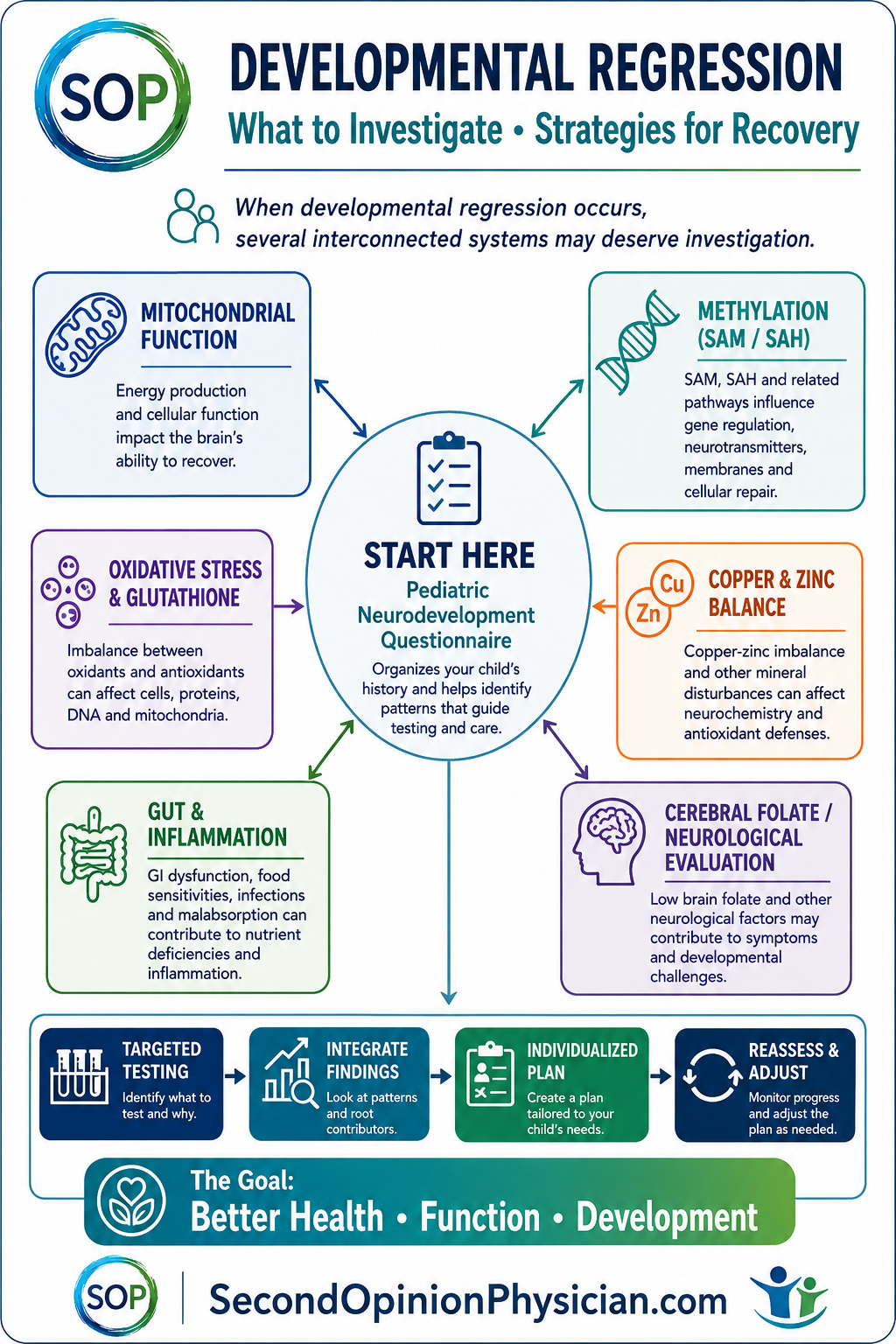
Developmental regression deserves a broad, individualized evaluation for potentially important neurologic, metabolic and biochemical factors—including mitochondrial dysfunction, oxidative stress, methylation abnormalities, copper-zinc imbalance, nutritional and gastrointestinal problems, and cerebral folate abnormalities when indicated. Our Pediatric Neurodevelopment Questionnaire provides a practical place to begin, bringing these interconnected patterns together to help identify what deserves closer investigation and which testing may be most useful for your child.
If your child changed after a vaccination or significant reaction, you may remember the dividing line clearly: how your child communicated, played, slept and interacted before—and what was different afterward. You may also have spent months or years trying to understand what happened and what can still be done. You do not have to resolve every question about causation before looking carefully at your child's health today. Developmental regression deserves a broad investigation for neurologic, metabolic and potentially treatable abnormalities, including mitochondrial dysfunction, oxidative stress, impaired glutathione defenses, methylation abnormalities, copper-zinc imbalance, nutritional deficiencies, gastrointestinal problems and cerebral folate abnormalities when indicated. The objective is not to force every child into one explanation. It is to identify what may be interfering with your child's function and recovery now.
If you know your child changed, begin with the child—not the debate.
You may still want answers about why it happened. That question matters. But there is another question that can be pursued right now: What is happening in your child's body today, and is there anything we can identify and treat?
You Know Your Child's Before and After
Developmental regression is a clinical event. The first step is to preserve the story accurately and take the change seriously.
You know the words your child used.
You know how your child played, slept, ate, responded to your voice, looked at you and interacted with other people.
If those things changed, they are part of the medical history.
Perhaps the change followed fever or prolonged illness. Perhaps there was unusual lethargy, inconsolable crying, a seizure, disturbed sleep, new gastrointestinal symptoms or another significant reaction. Perhaps the change was immediate, or perhaps it became apparent over the days or weeks that followed.
Whatever the chronology, loss of previously acquired abilities deserves careful evaluation.
Preserve what you can.
Medical records, vaccination records, home videos, photographs, developmental reports and contemporaneous messages may help reconstruct your child's baseline and the sequence of events.
Causation and Investigation Are Different Questions
A temporal association does not, by itself, establish the biological cause of developmental regression.
But uncertainty about causation should not prevent investigation.
Question 1
What caused this?
This may remain difficult to establish, particularly long after the
event.
Question 2
What is abnormal now?
This can often be investigated with current history, examination and
appropriate testing.
Developmental Regression Is Not an Explanation
An autism diagnosis can describe a child's developmental pattern. It does not necessarily explain why previously acquired abilities were lost.
A diagnosis can be useful. It may open access to speech therapy, occupational therapy, educational services and other developmental support.
But it should not automatically end the medical investigation.
A child with autism can also have seizures, sleep disorders, gastrointestinal disease, nutritional deficiencies, cerebral folate abnormalities, mitochondrial disease, genetic or metabolic disorders, mineral imbalances and other medical problems.
“Autism” and “nothing medical to investigate” are not the same thing.
Developmental therapies and medical investigation can proceed at the same time. Supporting communication and development does not require us to stop asking whether potentially treatable medical abnormalities are also present.
Why Recovery May Be a Systems Problem
The developing brain requires enormous amounts of energy. It also depends upon antioxidant protection, adequate nutrients, healthy membranes, neurotransmitter regulation and numerous methylation-dependent processes.
These systems are interconnected.
The Pediatric Neurodevelopment Questionnaire
You do not need to determine which biochemical pathway may be involved before beginning the assessment.
The Pediatric Neurodevelopment Questionnaire is designed to organize your child's developmental and clinical history while looking for patterns across several interconnected areas that may deserve closer attention.
The purpose is not to diagnose vaccine injury from a questionnaire. It is to organize a complicated history and help identify which patterns may justify more focused laboratory or clinical evaluation.
What May Be Interfering With Recovery?
Testing should follow the child's history and patterns rather than ordering every available test for every child.
Mitochondria: Does the Brain Have Enough Energy Reserve?
Mitochondria generate most cellular ATP. The developing brain is one of the body's most energy-dependent organs.
Fever, inflammation, infection and other physiologic stresses can increase energy requirements.
Children with established mitochondrial disorders can deteriorate during fever, illness, fasting and other metabolic stress. For that reason, mitochondrial dysfunction belongs in the broader differential diagnosis when regression is accompanied by unusual fatigue, weakness, poor exercise tolerance, neurologic deterioration, seizures or poor recovery from illness.
Energy
Can mitochondrial ATP production meet the child's cellular and neurologic requirements?
Stress
Fever, inflammation and illness can substantially increase metabolic demand.
Recovery
Reduced metabolic reserve may become most apparent when the body is challenged.
Oxidative Stress and Glutathione
Mitochondrial energy production naturally generates reactive oxygen species. Immune activation and inflammation can increase that burden.
Cells depend upon glutathione and other antioxidant systems to keep oxidation and reduction in balance.
When oxidative demand exceeds antioxidant capacity, proteins, membranes, DNA and mitochondrial function may be placed under greater stress.
Oxidative Demand
Inflammation and cellular metabolism can increase reactive oxygen species.
Glutathione
Antioxidant defenses help buffer cellular oxidative stress.
Mitochondria
Redox balance and mitochondrial function influence one another.
Markers such as 8-OHdG may sometimes be used to assess oxidative DNA damage. Glutathione or related redox testing may also be useful in selected cases.
These are markers of oxidative biology—not tests that establish that a vaccine caused a child's regression.
Methylation: SAM, SAH and the Capacity to Recover
Methylation participates in neurotransmitter regulation, phospholipid metabolism, gene regulation, creatine synthesis and many cellular repair processes.
It is also closely connected to mitochondrial energy and transsulfuration.
This is why we prefer to look beyond MTHFR alone.
The plasma methylation panel measures methionine, SAM, SAH and homocysteine, providing a biochemical view of methylation rather than assuming methylation status from genetics.
SAM
The major methyl donor used in many methyltransferase reactions.
SAH
Accumulation of SAH can inhibit methyltransferase activity and reduce effective methylation.
SAM : SAH
The relationship between methyl donor availability and methylation inhibition can provide important clinical information.
The Five Epigenetic Biotypes: Ask Why Methylation Is Impaired
Finding impaired methylation is only the beginning.
Our Five Epigenetic Biotypes framework asks what may be contributing to that impairment.
Mitochondrial Distress
Reduced cellular energy may impair energy-dependent methylation and repair processes.
Creatine Demand
Endogenous creatine production represents a major use of methyl groups.
Toxic Burden
Selected environmental exposures may contribute to oxidative and metabolic stress.
Increased Methylation Demand
Repair and other biochemical requirements may increase demand on the methylation system.
Impaired SAH Clearance
Excess SAH may inhibit methyltransferases even when methyl donors are available.
Copper, Zinc and Neurochemical Balance
Copper and zinc participate in neurotransmitter metabolism, antioxidant defense, immune function and numerous enzyme systems.
Some children demonstrate clinically meaningful copper-zinc imbalances, but these should be measured rather than assumed because a child has autism or developmental regression.
The Walsh Comprehensive Biotype Panel helps examine this chemistry using plasma zinc, serum copper, ceruloplasmin, whole-blood histamine, pyrroles and related markers.
Copper
Copper participates in catecholamine metabolism and multiple oxidation-reduction reactions.
Zinc
Zinc supports antioxidant defenses, immune regulation and numerous metabolic enzymes.
Measure the Pattern
Copper, ceruloplasmin and plasma zinc help determine whether a clinically relevant imbalance is actually present.
Gut, Nutrition and Inflammatory Burden
Significant gastrointestinal problems can affect far more than bowel function.
Chronic diarrhea, malabsorption, restricted diets, feeding difficulty and intestinal disease may contribute to deficiencies or other metabolic problems.
The goal is not to assume that every child needs an elaborate “gut protocol.” It is to recognize clinically meaningful GI and nutritional problems and investigate them appropriately.
Treat what is actually present.
If a child is deficient, correct the deficiency. If malabsorption is present, investigate why. If significant GI disease is present, address it. Treatment becomes more useful when it follows findings rather than assumptions.
Cerebral Folate: A Different Pathway That Can Coexist
Low brain folate and folate receptor autoantibodies represent a different biochemical issue from undermethylation.
That distinction matters.
A child can have evidence suggesting cerebral folate dysfunction while also demonstrating a separate methylation or Walsh biotype pattern. One finding should not automatically be used to infer the other.
When the developmental history and clinical presentation support it, folate receptor antibody testing may therefore be considered as a separate part of the investigation.
Let the Child's Pattern Guide the Investigation
The objective is not to order every test. It is to identify the domains most likely to matter for this child and investigate them intelligently.
From Questionnaire to Laboratory Testing
| Pattern / Question | Possible Evaluation |
|---|---|
| Developmental or neurologic regression | Pediatric and neurologic evaluation as indicated; EEG, imaging, genetic or metabolic evaluation when clinically appropriate. |
| Walsh biotype pattern | Whole-blood histamine, plasma zinc, serum copper, ceruloplasmin, pyrroles, vitamin D and related Comprehensive Biotype markers. |
| Methylation dysfunction | Methionine, SAM, SAH, SAM:SAH relationship, homocysteine and related methylation markers. |
| Mitochondrial / metabolic pattern | Testing may include lactate/pyruvate, CK, carnitine, acylcarnitines, organic acids, GDF-15 or specialist-directed testing depending upon the phenotype. |
| Oxidative stress pattern | Selected oxidative/redox assessment may include 8-OHdG, glutathione or related markers when clinically useful. |
| Copper-zinc imbalance | Plasma zinc, serum copper and ceruloplasmin interpreted together. |
| GI / nutritional pattern | Testing directed by symptoms, restricted diet, malabsorption, nutritional status and gastrointestinal history. |
| Cerebral folate pattern | Folate receptor antibody testing when clinically indicated. |
There is no single “vaccine injury panel.”
A broad history can point toward very different problems in different children. The value of testing is not in attaching a label to the original event. It is in finding abnormalities that may be clinically important now.
Follow the Abnormality, Not a Universal Protocol
Recovery should not be reduced to one supplement, one diet or one “detox.” The treatment priorities should come from the child's actual findings.
There Is No Single Vaccine Detox
When you are searching for help, it is understandable to want one treatment that explains and reverses everything.
Developmental regression is rarely that simple.
A child may have several overlapping problems, and the most important one may not be the same in every child.
Neurologic
Identify and appropriately manage seizures or other neurologic abnormalities when present.
Mitochondrial
When mitochondrial dysfunction is identified, treatment can be directed toward the specific metabolic pattern.
Oxidative Stress
Address contributing factors and support antioxidant defenses when meaningful redox abnormalities are present.
Methylation
Distinguish low SAM, elevated SAH and other patterns before choosing methylation support.
Nutrition & GI
Correct deficiencies, malabsorption and clinically important gastrointestinal problems.
Development
Speech, occupational, educational and other developmental therapies continue while medical issues are investigated and treated.
Identify → Correct → Reassess
Treatment becomes more rational when each intervention has a reason.
What Does Recovery Mean?
Recovery does not have to be defined as an all-or-nothing outcome.
For one child, progress may first appear as better sleep. For another, improved bowel function, fewer episodes of dysregulation, greater stamina, improved attention, more language, better learning readiness or renewed social engagement may be meaningful changes.
Developmental progress should be observed alongside laboratory improvement rather than assuming that changing a laboratory number automatically means the child is better.
Follow the child, not just the laboratory report.
Laboratory testing helps identify possible treatment targets. The meaningful outcome is whether the child's health, function, comfort and development improve.
What If This Happened Years Ago?
You may no longer be able to reconstruct every biological event that occurred at the time of the original regression.
That does not necessarily mean the current investigation has no value.
A nutritional deficiency can be measured now. Copper and zinc can be measured now. SAM and SAH can be measured now. Significant GI disease, seizures, sleep problems and other abnormalities can be investigated now.
The objective is not to manufacture certainty about the past.
It is to determine whether something important is being missed in the present.
You Don't Have to Know Where to Start
A complicated developmental history can involve many overlapping systems. You do not need to decide whether the primary issue is methylation, oxidative stress, mitochondria, copper, zinc, gut function or another pathway before beginning.
The Pediatric Neurodevelopment Questionnaire is the starting point. It brings the developmental history together with patterns involving methylation, oxidative stress and other neurodevelopmental and biochemical factors so that the next step can be more individualized.
From there, laboratory testing can be selected according to the child's pattern rather than simply ordering everything.
Frequently Asked Questions
My child changed after vaccination. Where do I start?
Begin by preserving the chronology: your child's developmental baseline, the vaccination, any acute reaction and the changes that followed. Significant developmental or neurologic regression also deserves appropriate pediatric or neurologic evaluation. The Pediatric Neurodevelopment Questionnaire can then help organize the broader developmental and biochemical history and identify areas that may deserve additional investigation.
Do I have to prove the vaccine caused the regression before investigating?
No. Establishing causation and investigating the child's current health are different questions. Even when the original trigger remains uncertain, current neurologic, metabolic, nutritional or biochemical abnormalities may still be identifiable.
What does the Pediatric Neurodevelopment Questionnaire evaluate?
It organizes developmental and clinical history while looking for patterns involving neurodevelopment, methylation, oxidative stress, mitochondrial and energy-related concerns, copper-zinc and Walsh biotype patterns, gastrointestinal and nutritional factors, and other potential contributors. It is an assessment tool rather than a diagnostic test for vaccine injury.
Is there a laboratory test for vaccine injury?
There is no single laboratory panel that establishes vaccine injury. Testing is more useful when it is directed toward abnormalities suggested by the child's history, such as mitochondrial dysfunction, oxidative stress, methylation abnormalities, nutritional deficiencies or mineral imbalance.
Why test SAM and SAH?
SAM is a major methyl donor, while SAH can inhibit methyltransferase reactions when it accumulates. Measuring SAM, SAH, methionine and homocysteine provides a biochemical assessment of methylation that cannot be obtained from an MTHFR result alone.
Why evaluate oxidative stress?
Oxidative stress reflects an imbalance between oxidative burden and antioxidant defenses. It is closely connected with mitochondrial function and glutathione metabolism. Selected markers such as 8-OHdG or glutathione-related testing may be useful when the clinical pattern supports their use.
What are the Five Epigenetic Biotypes?
The framework examines several possible contributors to impaired methylation rather than treating undermethylation as a single biochemical problem. These include mitochondrial distress, creatine demand, toxic burden, increased methylation demand and impaired SAH clearance.
Is low brain folate the same as undermethylation?
No. Cerebral folate dysfunction and undermethylation describe different biochemical issues. They may coexist in the same child, which is why the findings should be evaluated separately rather than assuming that one proves the other.
Is there a vaccine detox protocol?
There is no universal evidence-based vaccine detox protocol. A more individualized approach is to identify clinically meaningful abnormalities and address those findings rather than assuming every child needs the same treatment.
Can a child still be evaluated if the regression happened years ago?
Yes. It may become more difficult to establish precisely what happened during the original event, but current nutritional, metabolic, gastrointestinal, neurologic, methylation or mineral abnormalities can still be investigated when clinically appropriate.
Should developmental therapies continue during this evaluation?
Yes. Medical investigation and developmental support are complementary. Speech, occupational, educational and other appropriate therapies do not need to stop while potentially treatable medical abnormalities are being investigated.
What is the goal of treatment?
The goal is to identify abnormalities that may be relevant to the individual child, prioritize what appears most important, address those findings and then follow the child's actual function and development. Laboratory improvement is useful, but the meaningful outcome is how the child is doing.