
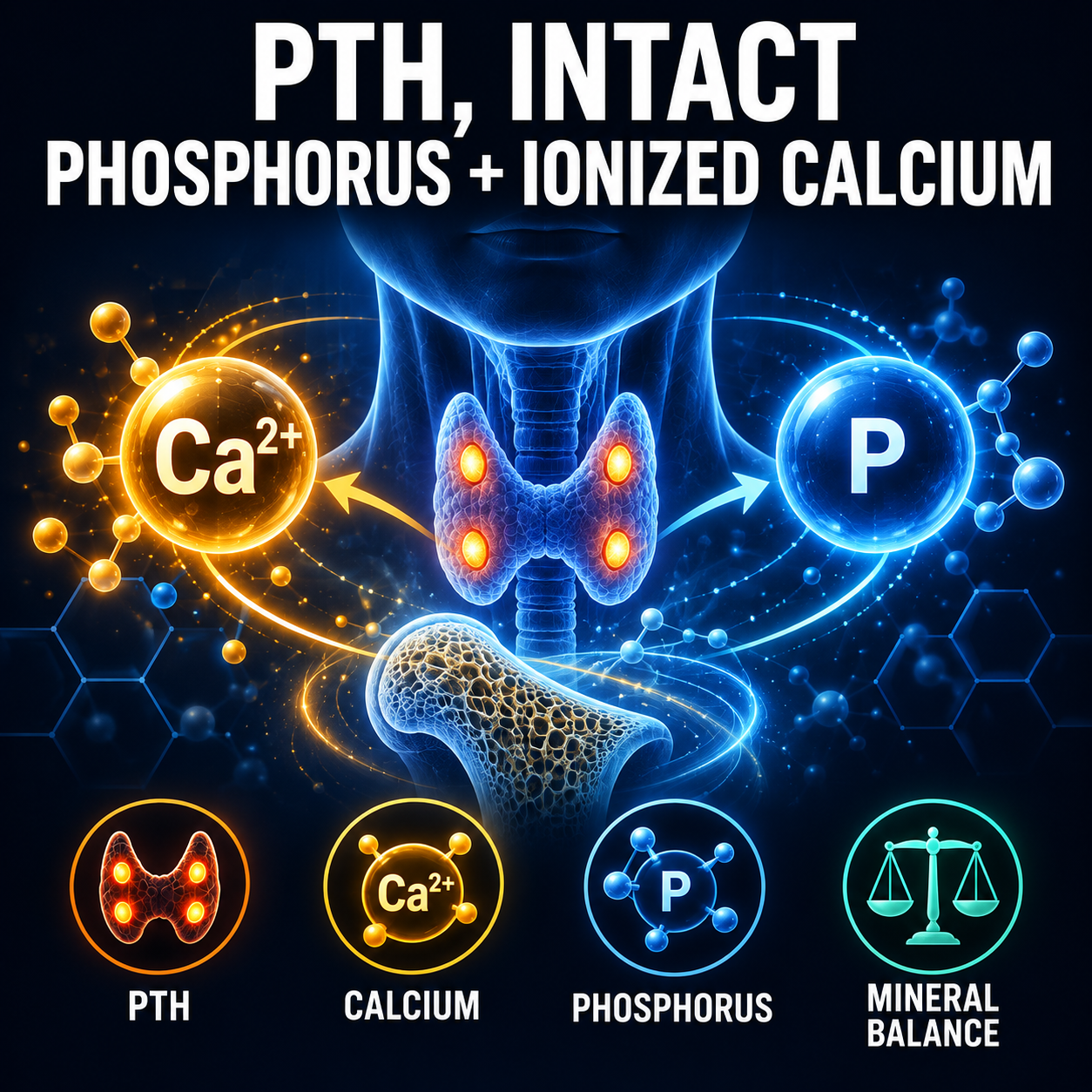
Calcium | Parathyroid Regulation Panel

$195.00
The Calcium / Parathyroid Regulation Panel evaluates three closely related markers that help clarify parathyroid function, calcium regulation, vitamin D response, kidney mineral handling, and bone metabolism.
Tests included:
-
PTH, Intact — Labcorp 015610 | CPT 83970
-
Calcium, Ionized — Labcorp 004804 | CPT 82330
-
Phosphorus — Labcorp 001024 | CPT 84100
This panel is especially useful when evaluating high or low calcium, elevated PTH, persistent vitamin D deficiency, osteopenia or osteoporosis, kidney disease, kidney stones, abnormal phosphorus, or neuromuscular symptoms such as cramping, twitching, tingling, or weakness.
Testing these markers together provides more useful information than total calcium alone and can help distinguish primary parathyroid disorders from secondary causes such as vitamin D deficiency, impaired calcium absorption, or renal dysfunction.
Description
Calcium / Parathyroid Regulation Panel
The Calcium / Parathyroid Regulation Panel is designed to evaluate how calcium is actually being regulated rather than relying on total calcium alone.
By testing intact parathyroid hormone (PTH), ionized calcium and phosphorus together, this panel can help clarify whether an abnormal calcium pattern is related to parathyroid activity, vitamin D deficiency, kidney function, impaired calcium absorption, abnormal phosphorus handling or another disturbance in mineral metabolism.
When Should PTH, Ionized Calcium & Phosphorus Be Tested?
This is not necessarily a routine screening panel for everyone. It is most useful when there is a reason to investigate calcium regulation, parathyroid function, vitamin D response, bone metabolism or renal mineral handling.
Abnormal Calcium
- High serum calcium
- Low serum calcium
- Repeated borderline calcium
- Calcium results inconsistent with symptoms
Persistent Vitamin D Problems
- Vitamin D remains low despite supplementation
- High vitamin D requirement
- Possible poor calcium absorption
- Concern for secondary hyperparathyroidism
Previously Elevated PTH
- High PTH with normal calcium
- High PTH with high calcium
- Possible hyperparathyroidism
- Possible secondary parathyroid stimulation
Bone Loss
- Osteopenia
- Osteoporosis
- Unexpected fractures
- Progressive bone loss despite treatment
Kidney & Stone Evaluation
- Chronic kidney disease
- Abnormal renal mineral handling
- Kidney stones
- Abnormal phosphorus
Neuromuscular Symptoms
- Muscle cramping
- Twitching
- Tingling or numbness
- Unexplained weakness
Tests Included
| Test | Labcorp Code | CPT | Primary Purpose |
|---|---|---|---|
| PTH, Intact | 015610 | 83970 | Evaluates parathyroid signaling and helps distinguish primary parathyroid disorders from secondary stimulation due to vitamin D deficiency, impaired calcium absorption or kidney disease. |
| Calcium, Ionized | 004804 | 82330 | Measures the biologically active, unbound fraction of calcium available to nerves, muscles, the heart and cellular signaling systems. |
| Phosphorus | 001024 | 84100 | Evaluates phosphorus balance and provides additional information about PTH activity, vitamin D physiology, kidney handling and bone metabolism. |
Why These Three Tests Are Evaluated Together
Calcium regulation depends on a coordinated system involving the parathyroid glands, vitamin D, kidneys, gastrointestinal absorption and bone.
↓
Calcium & Phosphorus Absorption
PTH
↓
Kidney Regulation + Vitamin D Activation + Bone Signaling
Ionized Calcium + Phosphorus
↓
Neuromuscular Function + Bone + Cellular Metabolism
Testing these markers together provides much more useful information than measuring total calcium by itself.
PTH, Intact: The Main Hormonal Regulator of Calcium
Parathyroid Hormone, Intact
Parathyroid hormone is the principal hormone responsible for maintaining blood calcium within a narrow physiologic range.
When circulating calcium falls, PTH normally rises. It then acts through several mechanisms:
- Increases calcium conservation by the kidneys
- Stimulates activation of vitamin D in the kidneys
- Supports increased intestinal calcium absorption indirectly through activated vitamin D
- Promotes renal phosphorus excretion
- Influences calcium release from bone when necessary to maintain circulating calcium
Because of these coordinated actions, PTH is one of the most useful tests for determining why calcium metabolism is abnormal.
Ionized Calcium: The Biologically Active Calcium
Calcium, Ionized
Routine chemistry panels usually measure total calcium. However, a substantial portion of circulating calcium is bound to albumin and other molecules.
Ionized calcium measures the free, physiologically active fraction of calcium.
This is the calcium directly involved in:
- Nerve conduction
- Skeletal muscle contraction
- Heart muscle function
- Cellular signaling
- Hormone secretion
- Blood coagulation
Ionized calcium is especially useful when total calcium is borderline, albumin is abnormal, acid-base balance is altered, kidney disease is present or parathyroid dysfunction is suspected.
Phosphorus: An Important Clue to PTH Activity
Phosphorus
Phosphorus works closely with calcium, PTH, vitamin D and the kidneys. It is also an essential component of bone and cellular energy metabolism.
PTH normally causes the kidneys to excrete more phosphorus while conserving calcium. For this reason, phosphorus can provide an additional clue about the direction and effect of parathyroid signaling.
Abnormal phosphorus may occur with:
- Vitamin D deficiency
- Parathyroid disorders
- Kidney dysfunction
- Malabsorption
- Malnutrition
- Abnormal bone metabolism
Common PTH / Calcium Patterns
High PTH + High Calcium
This pattern raises concern for primary hyperparathyroidism, in which PTH remains elevated or inappropriately normal despite an elevated calcium concentration.
High PTH + Normal or Low Calcium
This often reflects secondary hyperparathyroid stimulation caused by vitamin D deficiency, inadequate calcium intake or absorption, or chronic kidney disease.
Low PTH + High Calcium
This suggests that the elevated calcium is occurring independently of the parathyroid glands and shifts the evaluation toward non-PTH causes of hypercalcemia.
Low or Inappropriately Normal PTH + Low Calcium
This can indicate impaired PTH production or response and may occur with hypoparathyroidism, severe magnesium deficiency or other disorders affecting calcium regulation.
Why High PTH With Normal Calcium Matters
A normal calcium level does not necessarily mean calcium metabolism is normal.
The body strongly defends circulating calcium because it is essential for heart, nerve and muscle function. If calcium absorption falls, PTH can rise to compensate and maintain serum calcium within the normal range.
This is why elevated PTH with normal calcium should prompt evaluation of vitamin D, kidney function, calcium intake and absorption before assuming a primary parathyroid disorder.
Vitamin D Deficiency & Secondary Hyperparathyroidism
Vitamin D is necessary for efficient intestinal calcium absorption. When vitamin D falls, calcium absorption can decrease.
The parathyroid glands may respond by increasing PTH in order to preserve circulating calcium.
A Common Pattern
Low Vitamin D → reduced calcium absorption → increased PTH → serum calcium maintained
This compensatory response may occur before total calcium becomes frankly abnormal.
Kidney Function & PTH
The kidneys play a central role in calcium and phosphorus regulation. They also convert vitamin D into its active hormonal form.
As kidney function declines:
- Phosphorus clearance may decrease
- Activated vitamin D may decline
- Calcium absorption may fall
- PTH may rise
- Bone and mineral metabolism may become progressively abnormal
For this reason, kidney function should be considered whenever PTH is elevated, particularly when calcium is normal or low.
Calcium Regulation & Bone Loss
Bone is the body's major reservoir of calcium and phosphorus. When calcium availability is inadequate, PTH can increase bone turnover in an effort to maintain blood calcium.
This panel can therefore be useful when evaluating:
- Osteopenia
- Osteoporosis
- Unexpected fractures
- Progressive decline in bone density
- Persistent vitamin D deficiency
- Elevated PTH
- Abnormal calcium
Calcium Regulation & Neuromuscular Symptoms
Ionized calcium has an immediate role in nerve conduction and muscle contraction. Abnormal calcium physiology can therefore produce prominent neuromuscular symptoms.
Possible manifestations include:
- Muscle cramping
- Muscle twitching
- Tingling or numbness
- Weakness
- Abnormal muscle excitability
- Fatigue
- Cardiac rhythm abnormalities with more significant disturbances
Magnesium should often be evaluated at the same time because magnesium is required for normal PTH secretion and also affects neuromuscular function.
When Total Calcium May Not Be Enough
Total serum calcium is useful for routine screening, but it can be influenced by albumin and other binding factors.
Ionized calcium can provide a clearer assessment when:
- Albumin is low or abnormal
- Total calcium is borderline
- Symptoms do not fit the total calcium result
- Kidney disease is present
- Acid-base abnormalities are suspected
- Parathyroid disease is being evaluated
Can This Panel Help Determine Whether Calcium Supplementation Is Appropriate?
Yes. Calcium supplementation makes more sense when the underlying calcium-regulation pattern is understood.
Low calcium associated with vitamin D deficiency or poor intestinal absorption represents a very different problem from elevated calcium associated with elevated PTH.
The panel helps clarify whether the issue is primarily related to:
- Calcium availability
- Vitamin D status
- Parathyroid signaling
- Kidney function
- Mineral absorption
- Bone turnover
Related Testing
Depending on the clinical picture, the following tests may provide additional information.
| Test | Why It May Be Useful |
|---|---|
| 25-OH Vitamin D | Particularly important when PTH is elevated with normal or low calcium and for evaluating secondary hyperparathyroid stimulation. |
| Magnesium | Magnesium affects PTH secretion, vitamin D metabolism and neuromuscular function. |
| Comprehensive Metabolic Panel | Provides total calcium, albumin, creatinine, electrolytes and other metabolic markers. |
| Creatinine / eGFR | Evaluates whether impaired kidney function may be contributing to abnormal phosphorus, vitamin D or PTH regulation. |
| Cystatin C | Provides an additional assessment of renal filtration when creatinine-based estimates may be incomplete. |
| Alkaline Phosphatase | May provide additional information about bone turnover when interpreted with other laboratory findings. |
| 24-Hour Urine Calcium | Can help evaluate calcium excretion, kidney stone risk and selected causes of hypercalcemia. |
| 1,25-Dihydroxy Vitamin D | May be useful in selected kidney, granulomatous or unusual calcium disorders. |
Specimen Handling Matters
PTH is sensitive to specimen type, processing and storage conditions. Ionized calcium is affected by collection and specimen handling because changes in specimen pH can alter the measured ionized calcium concentration.
These tests should therefore be collected according to the specific Labcorp specimen instructions rather than treated as routine CMP add-ons.
Frequently Asked Questions
When should PTH, ionized calcium and phosphorus be tested?
This panel is most useful when calcium is high, low or borderline; PTH is elevated; vitamin D remains low despite supplementation; bone density is declining; kidney disease or kidney stones are present; phosphorus is abnormal; or symptoms suggest disturbed calcium metabolism.
Why test PTH if calcium is normal?
PTH may rise to compensate for vitamin D deficiency, reduced calcium absorption or kidney dysfunction while maintaining serum calcium within the normal range.
What does high PTH with high calcium suggest?
This pattern raises concern for primary hyperparathyroidism because PTH remains elevated or inappropriately normal despite an elevated calcium concentration.
What does high PTH with normal calcium suggest?
Vitamin D deficiency, poor calcium intake or absorption, and kidney disease are common causes of secondary PTH elevation and should generally be evaluated before considering normocalcemic primary hyperparathyroidism.
Why measure ionized calcium instead of total calcium?
Ionized calcium directly measures the biologically active calcium fraction. Total calcium can be influenced by albumin and other binding factors.
Why is phosphorus included?
PTH directly affects renal phosphorus handling. Phosphorus therefore provides another clue regarding parathyroid activity, kidney function and vitamin D physiology.
Can vitamin D deficiency raise PTH?
Yes. Reduced vitamin D can decrease calcium absorption, causing PTH to rise in an effort to preserve circulating calcium.
Can kidney disease raise PTH?
Yes. Kidney disease can impair phosphorus clearance and vitamin D activation, both of which can contribute to secondary hyperparathyroidism.
Can abnormal calcium cause muscle symptoms?
Yes. Ionized calcium is directly involved in nerve conduction and muscle contraction. Abnormalities can contribute to cramping, twitching, tingling, weakness and other neuromuscular symptoms.
Clarify Why Calcium Regulation Is Abnormal
PTH, ionized calcium and phosphorus provide a focused evaluation of the system controlling calcium balance. Together, they can help distinguish parathyroid disease from vitamin D deficiency, impaired calcium absorption, kidney-related mineral dysregulation and other causes of abnormal calcium metabolism.