



Walsh Biotype Assessment | No Labs Required

$199.00
A symptom-based WalshDoc assessment for patients who have completed the Biotype Questionnaire and want a practical supplement plan without ordering labs first. This review focuses on likely copper overload, undermethylation, overmethylation, and related mood, anxiety, sleep, attention, and stress-tolerance patterns.
Description
The WalshDoc Biotype Questionnaire Assessment provides an online, symptom-based Walsh assessment for patients who want physician review and an individualized nutrient plan but cannot obtain laboratory testing, have limited access to specialized labs, or prefer to begin without labs.
The assessment combines your WalshDoc questionnaire scores with your reported clinical history, symptoms, medication and supplement history, and prior treatment response. These findings are reviewed by David Epstein, D.O. and incorporated into a written Biotype assessment with individualized nutrient and supplement recommendations.
Can I Have a Walsh Protocol Assessment Without Lab Testing?
Yes. Laboratory testing provides valuable objective information, but it is not always readily available. Some patients live in countries where specialized Walsh testing is difficult to obtain. Others may have difficulty finding a laboratory that performs whole blood histamine, pyrrole testing, or other specialized testing, while some patients simply want to begin with symptom assessment before deciding whether laboratory testing is necessary.
Instead of laboratory interpretation, the assessment relies on the patient's structured questionnaire, clinical history, reported symptoms, physical and behavioral patterns, family history, medication response, supplement response, and other relevant clinical information.
Who Is the Online Walsh Biotype Assessment Best For?
International Patients
Patients outside the United States who do not have convenient access to the specialized laboratory tests commonly used in the Walsh Approach.
Limited Lab Access
Patients who cannot obtain specialty testing locally, have difficulty arranging blood collection, or otherwise cannot complete the recommended laboratory panel.
Patients Wanting to Start With Symptoms
Patients who prefer to begin with questionnaire-based Biotype assessment before deciding whether laboratory testing is worthwhile.
Patients Seeking a Practical Starting Plan
Patients whose symptom pattern strongly suggests a Walsh Biotype and who want physician-reviewed nutrient recommendations without beginning with laboratory testing.
What Does the WalshDoc Biotype Questionnaire Evaluate?
The WalshDoc Biotype Questionnaire organizes symptoms and clinical traits associated with the major Walsh biochemical patterns.
Undermethylation
Evaluates symptom patterns, personality traits, family history, physical findings, and treatment-response characteristics commonly associated with undermethylation.
Overmethylation
Looks for findings more characteristic of the overmethylation pattern and helps distinguish it from undermethylation.
Copper Overload
Evaluates symptoms and historical features that may suggest copper/zinc imbalance, including relevant mood, anxiety, hormonal, and treatment-response patterns.
Pyroluria
Organizes findings associated with stress intolerance, zinc and B6-related symptoms, cognitive patterns, and other features traditionally associated with pyroluria.
The questionnaire scores indicate how strongly the reported findings support each Biotype pattern. They are not laboratory results and do not establish a biochemical diagnosis.
Can I Take the Walsh Biotype Questionnaire Before Ordering?
Yes. In fact, this is one of the advantages of this service.
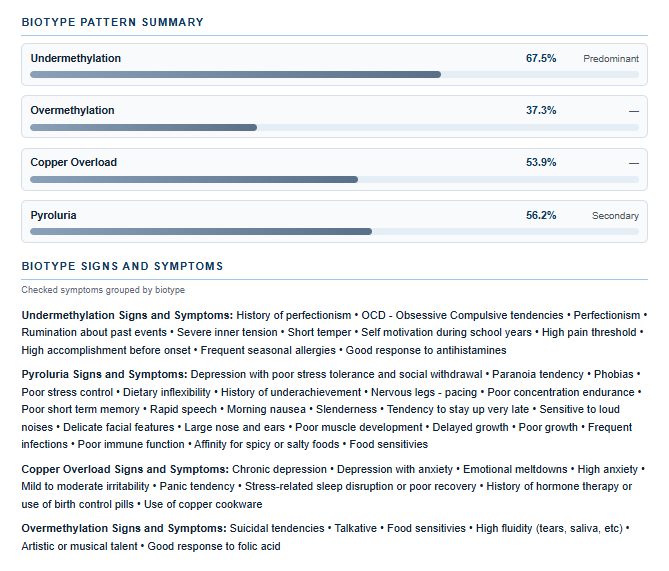
You may complete the WalshDoc Biotype Questionnaire first and receive a preliminary symptom-based Biotype screening score. This allows you to see whether your reported symptoms resemble undermethylation, overmethylation, copper overload, or pyroluria patterns before deciding whether you want physician review and a supplement plan.
Complete the questionnaire first to receive your symptom-based Walsh Biotype screening results. You may then return to this consultation if you want the findings reviewed in greater clinical context with individualized recommendations.
Take the WalshDoc Biotype QuestionnaireWhat Is Added When I Order the Physician-Reviewed Assessment?
The free questionnaire score is a screening tool. Ordering this consultation adds a more complete review of the patient information and converts the questionnaire findings into a clinically useful written assessment.
Your Walsh Biotype support scores and the symptoms contributing to each pattern are reviewed.
Relevant history, prior diagnoses, medication and supplement use, treatment response, family history, and other reported clinical information are considered.
The questionnaire patterns are interpreted in the context of the clinical history rather than relying on the numerical scores alone.
Nutrient and supplement recommendations are developed according to the overall symptom pattern and clinical assessment.
The Biotype scores, supporting symptoms, physician review, and recommendations are organized into a written report.
Can Symptoms Suggest Copper Overload Without Blood Testing?
Certain symptom and historical patterns can provide substantial support for a possible copper overload or copper/zinc imbalance pattern. The WalshDoc questionnaire evaluates those features and compares them with the patient's broader clinical history.
A symptom-based copper overload assessment can be useful when laboratory testing is unavailable, but it does not measure copper, zinc, ceruloplasmin, or calculated free copper.
When testing becomes available, copper, zinc, and ceruloplasmin can provide objective information that may confirm, challenge, or refine the symptom-based assessment.
Can Pyroluria Be Assessed From Symptoms?
The questionnaire evaluates a characteristic cluster of symptoms and traits associated with the pyroluria pattern, including stress intolerance and zinc/B6-related findings.
This can provide a useful pyroluria symptom assessment when urinary pyrrole testing is unavailable or impractical. However, questionnaire findings are not equivalent to a urinary pyrrole test.
Can Undermethylation Be Identified Without a Methylation Test?
Symptoms and clinical history can strongly resemble a traditional Walsh undermethylation pattern, and the questionnaire is designed to identify those characteristics.
However, methylation is more complex than symptoms alone can determine. Whole blood histamine, homocysteine, and direct methylation markers such as SAM and SAH can add important biochemical information when testing is available.
For patients who want a deeper symptom-based evaluation of factors that may contribute to impaired methylation, the WalshDoc Biotype + Methylation Assessment may be more appropriate.
What Does the Written WalshDoc Biotype Report Include?
Biotype Scores
Questionnaire support scores for the major Walsh Biotype patterns.
Supporting Symptoms
The reported findings that contributed to the questionnaire scores are organized by Biotype.
Clinical History
Relevant patient-reported history is considered alongside the questionnaire rather than treating the score as a stand-alone result.
Physician Assessment
The most clinically relevant patterns are reviewed and interpreted in the context of the patient's reported history.
Supplement Recommendations
Individualized nutrient and supplement recommendations are provided based on the symptom-supported biochemical pattern.
Are Any Laboratory Results Reviewed in This Assessment?
No. This is specifically a questionnaire and clinical-history based assessment without laboratory interpretation.
If you already have appropriate laboratory results or want to order biochemical testing, the Walsh Protocol Biotype Assessment is the better choice.
What if I Want to Add Walsh Labs Later?
You may begin with this symptom-based assessment and add laboratory testing later.
The Comprehensive Biotype Panel evaluates objective markers relevant to the Walsh Approach, including copper, zinc, ceruloplasmin, whole blood histamine, homocysteine, vitamin D, CBC, and metabolic findings.
What if I Want a More Detailed Methylation Assessment Without Labs?
The basic Biotype Questionnaire focuses on the core Walsh patterns. Patients who want a broader symptom-based evaluation of why methylation may be impaired can use the expanded Biotype + Methylation questionnaire.
That assessment adds questionnaire support for:
Mitochondrial / Energy Stress
Symptoms that may suggest impaired cellular energy production or increased metabolic stress.
Creatine / Neuromuscular Demand
Findings that may indicate increased creatine demand and increased use of methyl groups.
Methylation Demand
Factors that may increase methyl-group requirements or contribute to ongoing undermethylation symptoms.
Acidic / Gut / Hypoxia Burden
Gastrointestinal, acid-base, fermentation, and oxygen-related factors that may interfere with normal metabolic function.
Toxic Burden
Reported environmental and exposure-related factors that may contribute additional biochemical stress.
Complete the expanded questionnaire if you want symptom screening for both the traditional Walsh Biotypes and the five Epigenetic Biotype patterns.
Take the Biotype + Methylation Questionnaire View the Expanded AssessmentWhat if I Want Biotype and Methylation Laboratory Testing?
Patients who can obtain laboratory testing and want the most detailed biochemical assessment can combine the Biotype questionnaire with laboratory testing of both the traditional Walsh markers and methylation chemistry.
Why Might an International Patient Choose This Assessment?
Many biochemical tests used in the Walsh Approach are not uniformly available in every country or region. Laboratory methods, ordering requirements, shipping restrictions, and access to specialty testing may differ considerably.
The questionnaire-based assessment provides a practical way to begin with the information that is available: symptoms, clinical history, treatment response, and recognizable Walsh Biotype patterns.
If appropriate testing becomes available later, those laboratory findings can then be used to reassess or refine the original symptom-based strategy.
What Are the Limitations of a Symptom-Based Biotype Assessment?
- laboratory testing;
- laboratory interpretation;
- measurement of copper, zinc, ceruloplasmin, or free copper;
- whole blood histamine testing;
- urinary pyrrole testing;
- SAM/SAH methylation-panel interpretation;
- a comprehensive multi-system functional medicine assessment;
- emergency or psychiatric crisis care.
Questionnaire findings identify symptom-supported biochemical patterns. Laboratory testing can provide additional objective information when available and may change the interpretation or supplement strategy.
Not Sure Which Walsh Assessment to Choose?
If you are uncertain whether to begin with questionnaire-only assessment, Biotype laboratory testing, or Biotype + Methylation testing, the free pre-consultation can help determine the most appropriate starting point.
Learn More About Walsh Biotypes
Online Walsh Biotype Assessment FAQs
Can I get a Walsh Protocol assessment without laboratory testing?
Yes. This service uses the WalshDoc Biotype Questionnaire and clinical history to provide a symptom-based physician assessment and individualized nutrient recommendations without laboratory interpretation.
Can international patients use this assessment?
The questionnaire-based format can be particularly useful when specialized Walsh laboratory testing is difficult or unavailable locally. Whether a particular medical service can be provided depends on the patient's location and applicable clinical requirements.
Can I take the questionnaire before paying for the assessment?
Yes. You can complete the WalshDoc Biotype Questionnaire first and review your preliminary symptom-based Biotype screening results before deciding whether you want physician review and a supplement plan.
Does the $199 assessment include laboratory review?
No. This product is specifically a questionnaire and clinical-history based assessment. No laboratory results are interpreted as part of this service.
What does the physician review add to the questionnaire score?
The physician reviews the Biotype scores together with the reported clinical history, symptoms, prior diagnoses, medications, supplements, and treatment response and prepares a written assessment with individualized nutrient recommendations.
Can the questionnaire identify copper overload?
It can identify symptom and history patterns that support possible copper overload or copper-zinc imbalance, but it does not measure copper, zinc, ceruloplasmin, or free copper.
Can the questionnaire identify undermethylation?
It can identify symptom patterns consistent with traditional Walsh undermethylation. Laboratory markers such as whole blood histamine, homocysteine, SAM, and SAH can provide additional biochemical information when available.
Can I add laboratory testing later?
Yes. Patients may begin with symptom-based assessment and later use appropriate Biotype or methylation laboratory testing to confirm, challenge, or refine the initial strategy.