

APOE Alzheimer’s Risk Test — APOE2, APOE3 & APOE4 Genotyping


$295.00
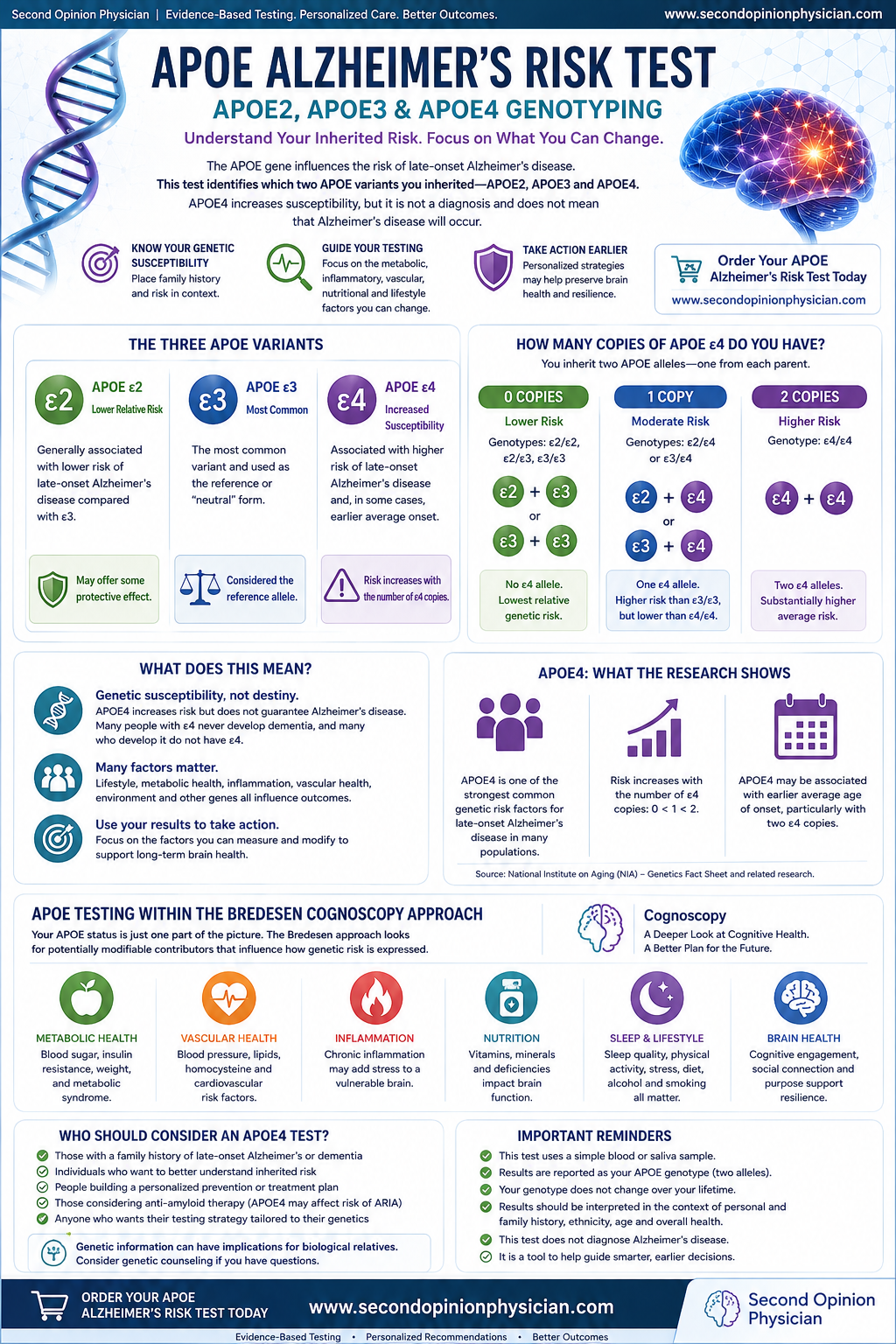
The APOE Alzheimer’s Risk Test identifies your APOE genotype, including the common ε2, ε3 and ε4 variants associated with different levels of late-onset Alzheimer’s susceptibility. APOE4 increases genetic risk but does not diagnose Alzheimer’s or determine that dementia will occur; results are most useful when considered alongside metabolic, vascular, inflammatory, nutritional and lifestyle factors.
Description
What Does an APOE4 Test Tell You?
An APOE genetic test determines which two common APOE alleles you inherited. The result may be ε2/ε2, ε2/ε3, ε2/ε4, ε3/ε3, ε3/ε4 or ε4/ε4. APOE4 increases susceptibility to late-onset Alzheimer’s disease, while APOE2 is generally associated with lower risk relative to APOE3.
The test does not diagnose Alzheimer’s disease and cannot tell with certainty whether dementia will develop. It provides information about inherited susceptibility that can be considered alongside age, family history, ancestry, health conditions and potentially modifiable risk factors.
What Do APOE2, APOE3 and APOE4 Mean?
APOE2 is relatively uncommon and is generally associated with a lower risk of late-onset Alzheimer’s disease compared with APOE3, although it does not provide complete protection.
APOE3 is the most common allele and is generally treated as the reference or neutral form when discussing Alzheimer’s genetic risk.
APOE4 is associated with increased risk of late-onset Alzheimer’s disease and, in certain populations, an earlier average age of onset. One copy raises susceptibility; two copies generally confer greater risk.
What Does One APOE4 Copy Mean?
People with one ε4 allele—such as APOE3/4 or APOE2/4—have greater susceptibility to late-onset Alzheimer’s disease than comparable people without ε4.
However, risk varies considerably among individuals and populations. Genetics, ancestry, age, vascular health, metabolic health and environmental factors all influence the meaning of an APOE result. APOE4 therefore should not be treated as a predetermined outcome.
What Does APOE4/4 Mean?
An APOE4/4 result means that an individual inherited an ε4 allele from each biological parent.
APOE4 homozygotes have substantially greater average Alzheimer’s risk than people with APOE3/3 or a single ε4 allele. Research summarized by the National Institute on Aging has estimated that APOE4 homozygotes may have approximately a 60% probability of developing Alzheimer’s dementia by age 85, although estimates vary by population and study.
APOE4/4 still does not mean 100% risk.
Some people with two APOE4 alleles do not develop Alzheimer’s dementia. Conversely, many people who develop Alzheimer’s disease do not have two APOE4 copies. Genetic susceptibility is one part of a much larger biological picture.
Why Does APOE4 Affect Alzheimer’s Risk?
The APOE gene provides instructions for apolipoprotein E, a protein involved in transporting cholesterol and other lipids. APOE has important functions in both systemic lipid metabolism and the brain.
Research suggests that APOE4 may influence several processes relevant to neurodegeneration, including:
- Lipid and cholesterol handling
- Amyloid accumulation and clearance
- Tau-related pathology
- Neuroinflammation and immune signaling
- Blood-brain-barrier function
- Neuronal repair and resilience
Recent NIH-supported research continues to show that abnormal lipid handling and immune responses may be important parts of the APOE4-associated disease pathway.
Why Knowing APOE4 Status Can Change the Cognitive Health Conversation
The practical value of APOE testing is not simply learning that risk is higher or lower. It can help determine how aggressively potentially modifiable contributors deserve attention.
For an APOE4 carrier, it may be particularly useful to evaluate:
Metabolic Health
Glucose, HbA1c, insulin resistance, obesity and other metabolic abnormalities that affect vascular and inflammatory health.
Lipids & Vascular Risk
Cholesterol, triglycerides, blood pressure, homocysteine and cardiovascular disease deserve careful interpretation because ApoE itself participates in lipid transport.
Inflammation
Chronic inflammatory and immune activity may add biological stress to an already susceptible neurological environment.
Nutritional Status
Vitamin and mineral deficiencies can contribute to neurological symptoms and should be identified rather than assumed.
Sleep & Lifestyle
Sleep quality, sleep apnea, activity, smoking, alcohol exposure, diet and cardiovascular fitness remain modifiable factors regardless of genotype.
Methylation & Biochemistry
Whole-blood histamine, homocysteine and direct SAM/SAH testing can provide information about biochemical function that a genetic APOE result cannot show.
APOE Genetics vs. Functional Testing
APOE testing answers an important question: What inherited susceptibility did I receive?
It does not answer another equally important question: What is happening in my body now?
That requires assessment of current metabolic, inflammatory, nutritional and biochemical function.
APOE Test
Inherited once and does not change. Identifies APOE2, APOE3 and APOE4 alleles.
Blood Testing
Glucose, insulin, lipids, inflammation, hormones, nutrients, homocysteine, zinc, copper and other biomarkers can change substantially with health and treatment.
Methylation Testing
SAM, SAH and related metabolites assess biochemical function rather than inherited susceptibility.
APOE Testing Within the Bredesen Cognoscopy Framework
APOE testing is particularly relevant to the Bredesen model because the Cognoscopy concept looks beyond a single diagnosis and evaluates the environment in which genetic susceptibility operates.
Someone with APOE4 may therefore have greater reason to identify modifiable contributors such as insulin resistance, inflammation, vascular disease, nutrient deficiencies, poor sleep, hormonal dysfunction and environmental burden.
The result can then be combined with targeted laboratory testing rather than being interpreted as destiny.
APOE4 and New Alzheimer’s Treatments
APOE status has acquired another clinical role with the use of anti-amyloid therapies. APOE4—particularly APOE4/4—is associated with a greater risk of amyloid-related imaging abnormalities (ARIA) during treatment with certain anti-amyloid antibodies.
For this reason, APOE genotyping may be considered or requested before some anti-amyloid treatments so that treatment risk can be discussed more accurately.
Who Should Consider an APOE4 Test?
APOE genetic testing may be worth considering for individuals who:
- Have a strong family history of late-onset Alzheimer’s disease
- Want to better understand inherited cognitive-health risk
- Are building a personalized dementia-prevention or cognitive-health strategy
- Have subjective cognitive changes and want genetic risk interpreted alongside functional testing
- Are considering certain anti-amyloid Alzheimer’s therapies
- Want to determine whether APOE susceptibility should influence the intensity of metabolic, vascular and lifestyle risk management
Because genetic information has implications beyond the individual—including potential information about biological relatives—some people may benefit from genetic counseling before or after testing.
Use APOE Status to Ask Better Questions
An APOE4 result should not end the conversation with “you are at risk.” It should begin a more useful investigation into the factors that can actually be measured and potentially changed.
Combining APOE genetic susceptibility with metabolic, inflammatory, nutritional, vascular and biochemical testing creates a more complete picture of cognitive-health risk than genetics alone.
APOE4 and Alzheimer’s Genetic Testing FAQs
What is the APOE4 gene?
APOE4 is one common form of the APOE gene. It is associated with increased susceptibility to late-onset Alzheimer’s disease in many populations but does not itself mean that someone has or will develop Alzheimer’s disease.
What does APOE3/4 mean?
APOE3/4 means you inherited one ε3 allele and one ε4 allele. This is generally associated with higher Alzheimer’s susceptibility than APOE3/3, although individual risk depends on many additional factors.
What does APOE4/4 mean?
APOE4/4 means both inherited APOE alleles are ε4. This genotype is associated with substantially higher average risk of late-onset Alzheimer’s disease and earlier average onset in some populations, but it still does not guarantee dementia.
Does APOE4 mean I will get Alzheimer’s?
No. APOE4 increases susceptibility but is not deterministic. Many APOE4 carriers never develop Alzheimer’s disease, while people without APOE4 can develop it.
What is APOE2?
APOE2 is generally associated with lower late-onset Alzheimer’s risk compared with the common APOE3 allele, although it does not eliminate risk.
Can an APOE test diagnose Alzheimer’s disease?
No. APOE genotyping assesses genetic susceptibility. It cannot diagnose Alzheimer’s disease or establish whether current memory symptoms are caused by Alzheimer’s pathology.
Does my APOE genotype ever change?
No. Your inherited APOE genotype remains the same throughout life, so genetic APOE testing generally only needs to be performed once.
What should I do if I have APOE4?
The result can be used to place modifiable factors into context. A broader cognitive-health assessment may evaluate metabolic health, insulin resistance, lipids, inflammation, vascular health, sleep, nutrition and other relevant biochemical factors.
Why might APOE testing matter before anti-amyloid treatment?
APOE4 carriers, particularly APOE4 homozygotes, have an increased risk of amyloid-related imaging abnormalities with some anti-amyloid therapies. APOE status can therefore be relevant to treatment-risk discussions.