
Developmental Regression in Children: What Should Be Evaluated?
Developmental regression in children means the loss of skills that were previously acquired—such as words, eye contact, social engagement, play skills, motor abilities, feeding skills or self-care. Regression deserves medical evaluation because there is no single cause. Neurologic and genetic disorders, seizures, illness, medications, nutritional or metabolic abnormalities and other medical conditions may need to be considered first. When appropriate, a broader biochemical assessment can then investigate potentially modifiable contributors including mitochondrial dysfunction, oxidative stress, copper-zinc imbalance, methylation and folate pathways, immune or inflammatory activation, gut dysfunction and environmental exposures.
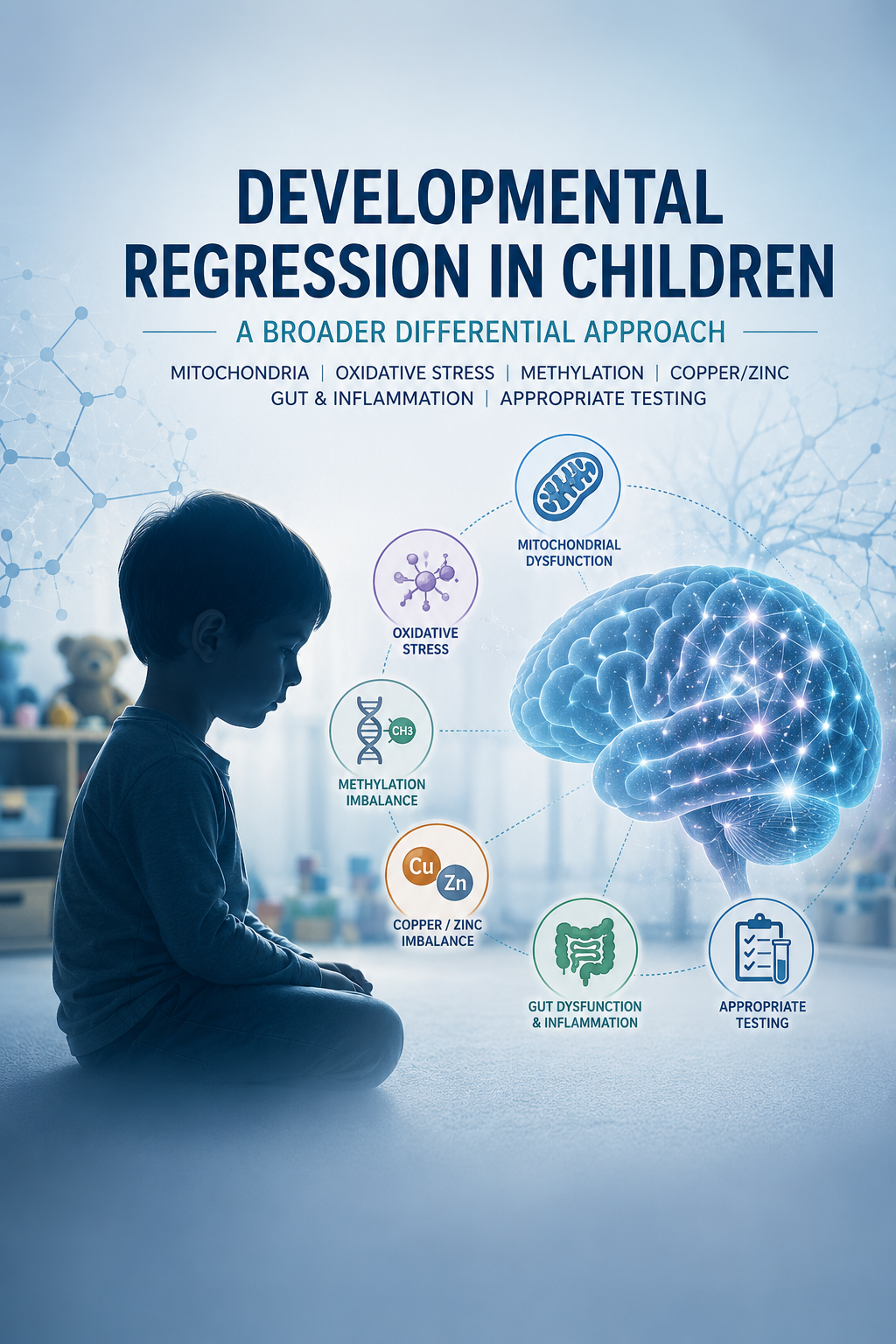
A child who has never developed a skill has a developmental delay. A child who had a skill and then lost it has developmental regression. That distinction matters.
Regression may involve language, social interaction, motor function, feeding, sleep, toileting or other previously established abilities. The first objective is to document what changed, when it changed and whether the pattern suggests a condition requiring prompt conventional medical evaluation.
What Does Developmental Regression Look Like?
Regression can be dramatic, but it can also be gradual enough that the pattern is recognized only when parents compare the child with earlier months or review old videos.
Speech & Communication
Loss of words, phrases, gestures, pointing, receptive language or previously reliable communication.
Social Engagement
Reduced eye contact, less shared attention, loss of interactive play or withdrawal from previously enjoyed social interaction.
Motor Skills
Loss of coordination, gait changes, reduced endurance, weakness or loss of previously established gross- or fine-motor abilities.
Adaptive Skills
Loss of feeding, toileting, dressing, play or other age-appropriate self-care abilities.
Regression Is a Symptom—Not a Diagnosis
Medical causes should be considered before assuming a biochemical explanation.
New or progressive loss of skills may require evaluation for neurologic, genetic, metabolic, infectious, medication-related or other medical causes.
Rapid regression, seizures, abnormal movements, weakness, loss of walking, altered consciousness, severe headaches, repeated vomiting, significant weight loss or other acute neurologic changes deserve prompt medical evaluation.
A functional or biochemical assessment should complement—not replace— appropriate pediatric, neurologic, developmental or genetic evaluation.
What Should Be Evaluated When a Child Regresses?
There is no single “regression test.” The evaluation should be guided by the child's age, developmental history, timing, symptoms, physical findings and events surrounding the change.
Neurologic
Seizures, epileptiform activity, abnormal movements, weakness, coordination changes and other neurologic findings may require pediatric neurology evaluation.
Genetic
Chromosomal, single-gene and other genetic conditions may present with developmental delay or regression and should be considered when the history supports testing.
Metabolic
Hypoglycemia, metabolic disease, nutrient deficiencies and other systemic abnormalities may affect development and neurologic function.
Illness & Medication
The timing of infections, fever, medications, supplements, anesthesia, dietary changes or other exposures may provide important clinical clues.
After the Medical Differential: Look for Modifiable Biochemical Contributors
Once urgent and appropriate conventional medical causes are being addressed, biochemical evaluation can ask a different question: are there measurable metabolic stresses that may be contributing to the child's current function or ability to recover?
1. Mitochondrial Dysfunction and Cellular Energy
The developing brain has substantial energy requirements. Mitochondria produce the ATP needed for neuronal signaling, membrane function, cellular repair and many metabolic reactions.
Mitochondrial involvement becomes more relevant when regression occurs alongside features such as:
- Low stamina or unusual fatigue
- Loss of endurance
- Low muscle tone
- Heat intolerance
- Exercise intolerance
- Worsening after fasting or missed meals
- Prolonged loss of function after illness
- Slow recovery after physiologic stress
2. Oxidative Stress and Antioxidant Reserve
Oxidative stress occurs when reactive oxygen species exceed the body's ability to neutralize and repair their effects. Mitochondria can both generate oxidative stress and become damaged by it.
Glutathione, superoxide dismutase and other antioxidant systems help protect neuronal and mitochondrial function. When clinically indicated, markers such as 8-OHdG, GSH/GSSG and related oxidative-stress measures can help determine whether oxidative injury is actually present.
3. Copper, Zinc and Mineral Balance
Copper and zinc participate in neurotransmitter metabolism, antioxidant defense and many enzymatic processes. The Walsh Approach places particular emphasis on evaluating copper, ceruloplasmin and plasma zinc together rather than interpreting serum copper in isolation.
Copper-zinc abnormalities do not explain developmental regression by themselves. They may, however, identify a potentially modifiable biochemical pattern—particularly when behavioral activation, anxiety, sensory sensitivity, sleep disruption, pyroluria or oxidative stress are also present.
4. Methylation, SAM/SAH and the Epigenetic Connection
Methylation supports neurotransmitter metabolism, membrane function, creatine synthesis, gene regulation and many other cellular processes. It also depends on adequate cellular energy because ATP is required to convert methionine into SAM.
When undermethylation is suspected, direct measurement of SAM, SAH, methionine and homocysteine can provide more information than an MTHFR genotype alone.
The Five Epigenetic Biotypes
When an undermethylation pattern is identified, the next question is what may be driving or perpetuating it. The Five Epigenetic Biotypes framework considers:
- Toxic burden
- Mitochondrial stress
- Creatine demand
- Increased methylation demand
- Impaired SAH clearance
These are potential biochemical contributors to undermethylation—not alternative diagnoses for developmental regression.
5. Folate Receptor Antibodies and Cerebral Folate
Folate receptor alpha autoantibodies can interfere with folate transport across the blood-brain barrier. This is a different biochemical issue from undermethylation, although the two can coexist.
When developmental history and symptoms raise this question, FRAT/FRAA testing may help determine whether impaired folate transport deserves specific consideration.
6. Immune and Inflammatory Patterns
Regression sometimes occurs in temporal association with infection, fever or other immune stress. Timing alone does not establish causation, but it is clinically important information.
A history of recurrent infections, eczema, allergies, asthma, eosinophilia, rashes, hives or marked symptom changes during illness may justify evaluation of immune, inflammatory or nutritional factors.
7. Gut Dysfunction, Feeding and Nutritional Status
Constipation, diarrhea, reflux, restricted eating, food selectivity, bloating and abnormal stool patterns are common enough in children with neurodevelopmental concerns that they deserve direct attention rather than being assumed to be part of autism.
Severe food restriction can also produce nutritional deficiencies, while gastrointestinal dysfunction may affect nutrient intake and overall health.
8. Environmental and Toxic Exposures
Exposure history should be reviewed when regression follows a plausible environmental event or when other findings suggest unusual toxic or oxidative burden.
Lead and other toxic metals can affect neurodevelopment. Testing should be selected according to the suspected exposure. Hair testing may sometimes provide exposure clues, but clinically important findings generally require appropriate confirmatory blood or urine testing.
Which Tests May Be Useful?
The answer depends on the child's history. A broad differential does not mean every child should receive every laboratory test.
| Clinical Pattern | Possible Evaluation | What It Helps Clarify |
|---|---|---|
| Loss of skills / neurologic change | Pediatric, developmental, neurologic and genetic evaluation as indicated | Neurologic, seizure, genetic or other medical causes of regression |
| Low stamina / poor recovery / low tone | Lactate/pyruvate, CK, carnitine, organic acids or deeper mitochondrial testing when indicated | Cellular-energy and metabolic abnormalities |
| Oxidative-stress pattern | 8-OHdG, GSH/GSSG and related markers | Objective evidence of oxidative burden |
| Copper / zinc pattern | Copper, ceruloplasmin, plasma zinc and calculated free/non-ceruloplasmin-bound copper | Copper-zinc balance and Walsh biochemical context |
| Broader Walsh pattern | Comprehensive Walsh biotype testing including whole-blood histamine, copper, ceruloplasmin, zinc and pyrroles | Undermethylation, overmethylation, copper overload, pyroluria and overlapping patterns |
| Methylation concerns | SAM, SAH, methionine, homocysteine and whole-blood histamine | Methyl-donor capacity and methylation inhibition |
| Possible cerebral folate issue | FRAT/FRAA testing when clinically appropriate | Folate receptor autoantibodies and possible impaired CNS folate transport |
| Gut / feeding pattern | Nutritional assessment, organic acids or stool testing when indicated | Nutritional, metabolic and gastrointestinal contributors |
| Possible environmental exposure | Exposure-specific blood or urine testing; selected hair testing interpreted cautiously | Evidence supporting or refuting a suspected toxic exposure |
Start With the History Before Choosing the Labs
Parents often have the most important information: exactly what was lost, when it happened, whether the change was sudden or gradual, and what else was occurring at the time.
The Pediatric Neurodevelopmental Biochemical Assessment organizes those observations across the major support domains already used in our pediatric framework, including regression, oxidative stress, copper-zinc balance, mitochondrial energy, immune burden, gut dysfunction, methylation/folate and autonomic or sensory regulation.
The questionnaire does not diagnose the cause of regression.
Its purpose is to organize the history so that the most relevant medical and biochemical questions can be investigated rather than ordering the same panel for every child.
A Better Framework for Developmental Regression
This approach avoids two opposite errors: assuming that regression is simply “part of autism,” or assuming that one biochemical abnormality must explain every child's regression.
Developmental Regression Often Requires a Team
Depending on the presentation, appropriate care may involve the child's pediatrician, developmental specialist, neurologist, geneticist, speech-language pathologist, occupational therapist and other members of the care team.
Pediatric / Developmental
Growth, development, physical examination and overall medical differential.
Neurology
Seizures, abnormal movements, motor regression and other neurologic concerns.
Genetics
Genetic conditions associated with developmental delay or regression.
Therapy & Education
Speech, occupational, physical, behavioral and educational support should continue while medical causes are investigated.
Developmental Regression Deserves a Broader Look
The goal is not to assign every child the same biochemical explanation. It is to identify the medical issues that must not be missed and then determine whether potentially modifiable metabolic or biochemical patterns deserve investigation.
Developmental Regression in Children FAQs
What is developmental regression?
Developmental regression means losing a skill that had previously been acquired. Examples include loss of words, gestures, eye contact, social interaction, motor abilities, feeding skills or other established functions. This differs from developmental delay, in which the skill has not yet been acquired.
Is developmental regression always caused by autism?
No. Regression can occur in children with autism, but autism is not the only possible explanation. Neurologic, genetic, metabolic and other medical conditions may also cause loss of previously acquired skills.
When does developmental regression require urgent medical evaluation?
Rapid or progressive regression, seizures, abnormal movements, loss of walking, weakness, altered consciousness, severe headaches, repeated vomiting or other acute neurologic changes warrant prompt medical evaluation.
Can mitochondrial dysfunction contribute to developmental regression?
Mitochondrial disorders and other abnormalities of cellular-energy metabolism can affect neurologic function. Mitochondrial evaluation may be particularly relevant when regression occurs with low stamina, exercise intolerance, low tone, heat intolerance or prolonged worsening after illness or metabolic stress.
Should oxidative stress be tested?
Not every child requires oxidative-stress testing. When the history or other laboratory findings suggest increased oxidative burden, markers such as urinary 8-OHdG, GSH/GSSG and related antioxidant measures may provide objective information.
Should copper and zinc be checked in a child with regression?
Copper-zinc testing may be useful when the broader history suggests mineral imbalance, oxidative stress, copper overload or another Walsh biochemical pattern. Copper should be interpreted with ceruloplasmin and plasma zinc rather than as an isolated value.
What is the relationship between regression and undermethylation?
Undermethylation is a biochemical pattern, not a diagnosis of developmental regression. If undermethylation is suspected, whole-blood histamine and direct methylation markers such as SAM, SAH, methionine and homocysteine may help characterize the pattern and possible metabolic drivers.
Are folate receptor antibodies the same as undermethylation?
No. Folate receptor alpha autoantibodies concern folate transport, including transport into the central nervous system, while undermethylation describes a different biochemical problem. The two patterns may coexist and may require different testing and treatment considerations.
Does every child with regression need extensive functional testing?
No. Testing should follow the history, examination and clinical differential. The purpose of the pediatric biochemical assessment is to identify which domains deserve closer investigation rather than ordering every available test for every child.
What should parents document when regression occurs?
Document which skills were lost, when the change began, whether it was sudden or gradual, illnesses or fever around the time of regression, medication or supplement changes, sleep changes, gastrointestinal symptoms, dietary changes, possible exposures and any new neurologic or behavioral symptoms. Earlier videos can also help establish what skills were previously present.
Related Developmental & Biochemical Resources
Five Epigenetic Biotypes
Metabolic drivers that may contribute to persistent undermethylation.
Read More →This page is educational and is not intended to diagnose the cause of developmental regression. Loss of previously acquired skills should be discussed with the child's healthcare provider, particularly when the change is rapid, progressive or associated with neurologic symptoms.