
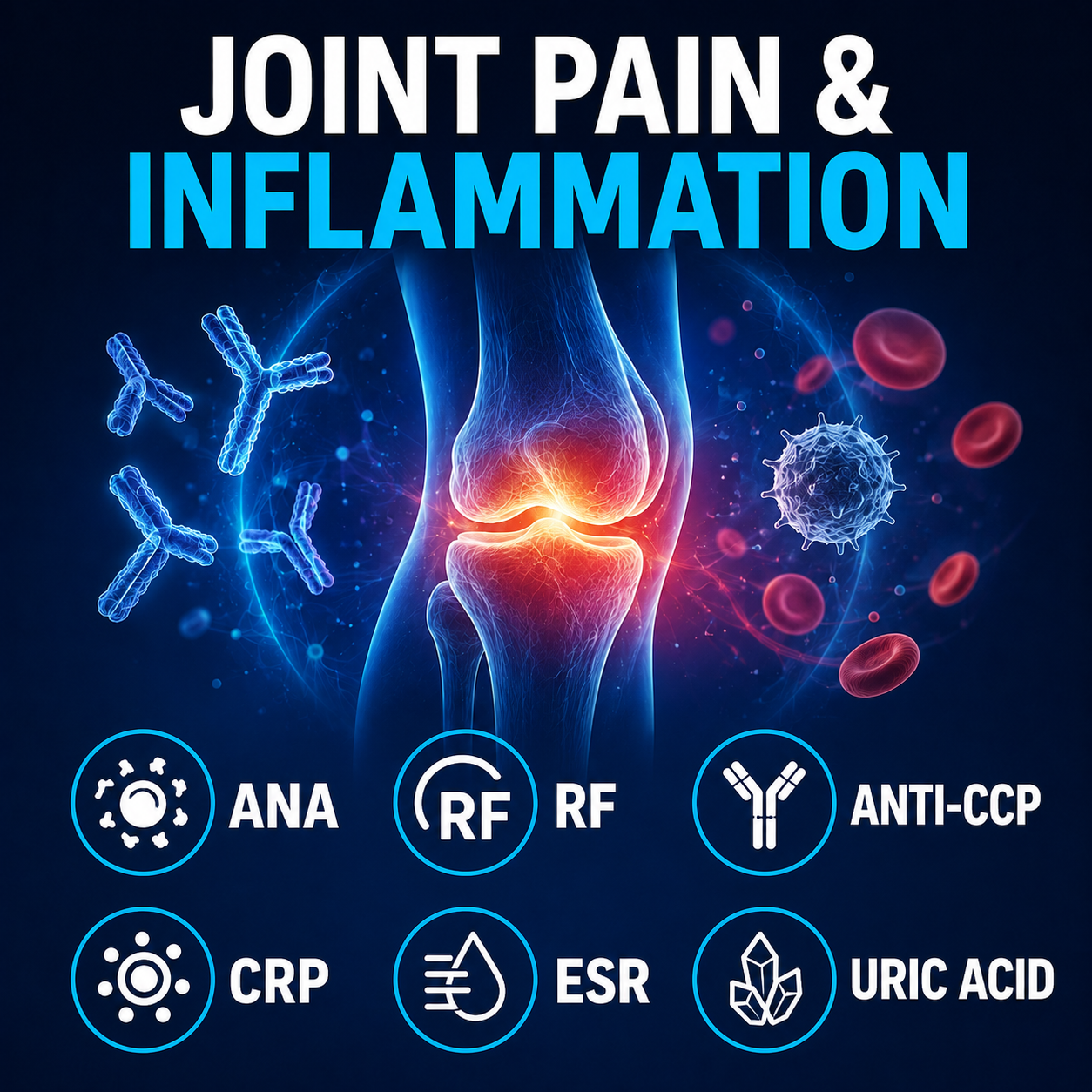
Joint Pain & Inflammation

$199.00
The Joint Pain & Autoimmune Inflammation Panel is a focused Labcorp blood panel designed to evaluate common causes of persistent joint pain, morning stiffness, swelling, fatigue, and unexplained inflammation.
The panel combines ANA by IFA, Rheumatoid Factor, Anti-CCP antibodies, CRP, ESR, and uric acid to screen for rheumatoid arthritis, broader connective-tissue autoimmune activity, systemic inflammation, and gout-related uric acid abnormalities.
It is particularly useful when joint symptoms are persistent, inflammatory rather than purely mechanical, or accompanied by fatigue, swelling, stiffness, rash, dry eyes or mouth, unexplained inflammation, or other systemic symptoms.
Description
The Joint Pain & Autoimmune Inflammation Panel is designed as a practical first-line blood evaluation for persistent joint pain, swelling, morning stiffness, fatigue, and unexplained inflammatory symptoms.
The panel looks for evidence of rheumatoid arthritis, broader connective-tissue autoimmune activity, systemic inflammation, and elevated uric acid associated with gout.
Rather than relying on one inflammatory marker, this panel combines autoimmune antibodies with CRP and ESR so the results can help distinguish between a possible autoimmune arthritis pattern, nonspecific inflammation, and other causes that may require more targeted evaluation.
ANA by IFA
Provides broader screening for connective-tissue autoimmune disease and can identify patterns associated with lupus, Sjögren syndrome, systemic sclerosis, mixed connective-tissue disease, and other autoimmune conditions.
RF + Anti-CCP
Combines two of the most commonly used antibody tests in rheumatoid arthritis evaluation. Anti-CCP is particularly useful because of its greater specificity for RA.
CRP + ESR
Provides two complementary measurements of systemic inflammatory activity and helps determine whether an active inflammatory process may be present.
What Does the Joint Pain & Autoimmune Inflammation Panel Include?
ANA by IFA With Reflex
ANA testing by indirect fluorescent antibody is a widely used first-line screen for systemic connective-tissue autoimmune disorders.
If ANA is positive, the titer and staining pattern can provide additional information that may help guide more focused testing.
Rheumatoid Factor
RF is commonly used when rheumatoid arthritis is suspected. It may also become elevated in other autoimmune, inflammatory, infectious, and age-related conditions, so it should not be interpreted by itself.
Anti-CCP Antibodies
Anti-cyclic citrullinated peptide antibodies are more specific for rheumatoid arthritis than RF and may become positive early in the disease process.
C-Reactive Protein
CRP is an acute-phase protein that rises with inflammation. It can help determine whether systemic inflammatory activity is currently increased.
ESR / Sedimentation Rate
ESR is another broad inflammatory marker. It changes differently from CRP and can provide useful complementary information when inflammatory or autoimmune disease is suspected.
Uric Acid
Elevated uric acid can promote monosodium urate crystal formation and gout. It is especially relevant with episodic severe pain, redness, swelling, or involvement of the great toe, ankle, knee, or other joints.
Why Test ANA for Joint Pain?
Joint pain is not limited to rheumatoid arthritis.
Inflammatory joint symptoms can occur as part of broader connective-tissue autoimmune diseases, including:
- Systemic lupus erythematosus
- Sjögren syndrome
- Mixed connective-tissue disease
- Systemic sclerosis
- Inflammatory myositis and related disorders
ANA becomes particularly useful when joint symptoms occur with:
- Rashes or photosensitivity
- Dry eyes or dry mouth
- Raynaud-type color changes in the fingers
- Mouth ulcers
- Unexplained fever
- Marked fatigue
- Low blood counts
- Kidney abnormalities
- Multisystem symptoms
A positive ANA does not automatically mean autoimmune disease is present. ANA can be positive in otherwise healthy individuals. The titer, staining pattern, symptoms, and additional antibody testing determine whether the result is clinically meaningful.
RF and Anti-CCP for Rheumatoid Arthritis
When rheumatoid arthritis is suspected, RF and Anti-CCP are best interpreted together.
Sensitive but Less Specific
Rheumatoid Factor may be positive in RA but can also occur with other autoimmune diseases, infections, chronic inflammatory states, and sometimes in people without rheumatoid arthritis.
Greater Specificity for RA
Anti-CCP antibodies are more strongly associated with rheumatoid arthritis and can help support diagnosis when symptoms suggest inflammatory arthritis.
Symptoms that raise suspicion for rheumatoid arthritis include:
- Morning stiffness lasting 30–60 minutes or longer
- Swelling of the hands, wrists, or feet
- Symmetrical joint involvement
- Persistent rather than intermittent inflammatory pain
- Reduced grip strength
- Fatigue accompanying joint inflammation
CRP and ESR: Is Active Inflammation Present?
CRP and ESR do not diagnose a specific disease. Their purpose is to determine whether a broader inflammatory process may be active.
More Responsive to Current Change
CRP can rise relatively quickly during active inflammation and may also fall relatively quickly as the inflammatory process improves.
Complementary Inflammatory Marker
ESR changes more slowly and can remain elevated in some chronic inflammatory and autoimmune conditions even when CRP is less impressive.
Using both can provide more context than relying on either test alone.
Why Include Uric Acid in a Joint Pain Panel?
Not every painful or swollen joint is autoimmune.
Gout is one of the most common inflammatory arthritides and occurs when urate crystals trigger intense inflammation within a joint.
Uric acid testing can be especially relevant with:
- Sudden severe joint pain
- Redness and warmth
- Great-toe pain
- Recurrent ankle or knee swelling
- Kidney stones
- High alcohol intake
- Metabolic syndrome
- Diuretic use
- Reduced kidney function
A normal uric acid does not completely exclude gout. Uric acid can occasionally be normal during an acute gout attack. When a joint is acutely hot and swollen, synovial-fluid examination for crystals may provide more definitive information.
What Can This Joint Pain Panel Help Distinguish?
Possible Rheumatoid Arthritis
Positive Anti-CCP and/or RF with compatible inflammatory joint symptoms increases concern for rheumatoid arthritis and supports further rheumatologic evaluation.
Broader Autoimmune Pattern
A positive ANA, especially with systemic symptoms, may lead to more focused testing for lupus, Sjögren syndrome, systemic sclerosis, or another connective-tissue disorder.
Inflammation Without Positive Antibodies
Elevated CRP or ESR with negative RF, Anti-CCP, and ANA may require evaluation for seronegative arthritis, infection, metabolic inflammation, gut-related inflammation, or another inflammatory process.
Negative RF and Anti-CCP Do Not Rule Out Inflammatory Arthritis
A negative rheumatoid factor or Anti-CCP result makes classic seropositive rheumatoid arthritis less likely, but it does not completely exclude autoimmune or inflammatory joint disease.
Possible causes of inflammatory joint symptoms with negative traditional RA antibodies include:
- Seronegative rheumatoid arthritis
- Psoriatic arthritis
- Ankylosing spondylitis / axial spondyloarthritis
- Reactive arthritis
- Lupus-related arthritis
- Inflammatory bowel disease-associated arthritis
- Other connective-tissue disorders
Labcorp notes that approximately 20–25% of established RA patients may be negative for both traditional RF and Anti-CCP markers, with an even greater percentage reported in suspected early RA.
Joint Pain, Gut Health and Secondary Inflammation
If the initial autoimmune evaluation is negative, the next question becomes whether inflammation may be arising from another source.
Depending on symptoms and history, contributors may include:
- Gut dysbiosis
- Inflammatory bowel disease
- Celiac disease
- Chronic or recent infection
- Metabolic syndrome
- Insulin resistance
- Obesity-related inflammation
- Oxidative stress
- Environmental or toxic exposure
- Nutrient deficiencies
This is where broader functional testing can become useful after major rheumatologic causes have first been considered.
Joint Pain, Oxidative Stress and Mitochondrial Function
Persistent inflammation increases production of reactive oxygen species and can increase antioxidant and cellular-repair requirements.
At the same time, mitochondrial dysfunction can contribute to fatigue, poor muscle recovery, and increased oxidative stress.
When the autoimmune screening panel does not fully explain symptoms, additional testing may include:
- 8-OHdG and lipid peroxides
- Vitamin D
- RBC magnesium
- Zinc and copper
- Creatine kinase
- CoQ10
- Organic acids or Metabolomix+
When Should More Specific Autoimmune Testing Be Added?
The first-line panel is intentionally broad. More specialized testing should be guided by symptoms rather than ordered indiscriminately.
Lupus / Sjögren / Connective Tissue
Consider dsDNA, SSA/Ro, SSB/La, RNP, Sm antibodies, complement C3/C4, and other disease-specific antibodies depending on symptoms.
HLA-B27
May be useful with inflammatory back pain, sacroiliac symptoms, psoriasis, recurrent uveitis, or suspected spondyloarthritis.
CK / Aldolase
Useful when true muscle weakness, rather than primarily joint pain, raises concern for inflammatory or metabolic muscle disease.
Who May Benefit From the Joint Pain & Autoimmune Inflammation Panel?
This panel may be useful for patients with:
- Persistent joint pain
- Morning stiffness
- Joint swelling
- Hand or wrist pain
- Knee, ankle, elbow, or foot inflammation
- Fatigue accompanying joint symptoms
- Unexplained elevated inflammatory markers
- Possible rheumatoid arthritis
- Possible connective-tissue autoimmune disease
- Recurrent gout-like attacks
- Multisystem inflammatory symptoms
What Can the Joint Pain & Autoimmune Inflammation Panel Help Answer?
- Is there evidence supporting rheumatoid arthritis?
- Are Anti-CCP or Rheumatoid Factor antibodies present?
- Is ANA positive, suggesting that broader connective-tissue testing may be appropriate?
- Is systemic inflammation present?
- Do CRP and ESR suggest active inflammatory burden?
- Is uric acid elevated enough to increase concern about gout?
- Should rheumatology evaluation or more disease-specific testing be considered?
- If autoimmune markers are negative, should non-autoimmune causes of inflammation be investigated?
Before Your Joint Pain & Autoimmune Blood Test
- This is a blood panel performed through Labcorp.
- Fasting is generally not required solely for these tests.
- Tell your clinician about corticosteroids, biologic medications, immune-suppressing drugs, and anti-inflammatory medications.
- Recent infection, injury, or surgery can affect CRP and ESR.
- Very strenuous exercise may also influence inflammatory markers.
- Uric acid can vary with diet, alcohol intake, kidney function, medications, and recent gout activity.
- Do not stop prescription medications simply for testing unless instructed by your treating clinician.
How the Joint Pain & Autoimmune Inflammation Panel Works
Order the Panel
A Labcorp requisition is provided for the autoimmune, inflammatory, and uric-acid testing included in the panel.
Have Your Blood Drawn
Visit an appropriate Labcorp patient service center for specimen collection.
Identify the Pattern
Results are reviewed for rheumatoid arthritis antibodies, ANA findings, systemic inflammation, and uric acid abnormalities.
Determine Next Testing
The pattern can help determine whether rheumatology evaluation, disease-specific antibody testing, imaging, gout evaluation, or investigation of secondary inflammatory causes is appropriate.
Frequently Asked Questions About the Joint Pain Panel
Does this panel diagnose rheumatoid arthritis?
No single blood panel diagnoses rheumatoid arthritis by itself. RF and Anti-CCP provide important supporting evidence and should be interpreted with the pattern of joint symptoms, physical examination, and sometimes imaging.
Why are both RF and Anti-CCP included?
RF is commonly used but is not very specific for rheumatoid arthritis. Anti-CCP has greater specificity. Using the two together provides more useful information than either test alone.
Why is ANA included?
ANA broadens the evaluation beyond rheumatoid arthritis. Joint pain can occur with lupus, Sjögren syndrome, systemic sclerosis, mixed connective-tissue disease, and other autoimmune disorders.
Can I have rheumatoid arthritis with negative RF and Anti-CCP?
Yes. Seronegative rheumatoid arthritis occurs, particularly in earlier disease. Negative results lower the probability of classic seropositive RA but do not completely exclude inflammatory arthritis.
What is the difference between CRP and ESR?
Both are nonspecific inflammatory markers. CRP generally changes more rapidly with active inflammation, while ESR tends to change more slowly and is influenced by additional factors. The two can provide complementary information.
Does a high uric acid mean I have gout?
No. Elevated uric acid increases the likelihood of urate crystal formation but does not by itself diagnose gout. Some people with high uric acid never develop gout, and uric acid may occasionally be normal during an acute gout attack.
What happens if ANA is positive?
The significance depends on the ANA titer, staining pattern, and symptoms. More specific antibody testing may be appropriate when findings suggest lupus, Sjögren syndrome, systemic sclerosis, or another connective-tissue autoimmune disease.
What if all autoimmune tests are negative but CRP or ESR is high?
The next step is to consider seronegative inflammatory arthritis and non-autoimmune sources such as infection, gastrointestinal inflammation, metabolic inflammation, obesity, or another inflammatory condition. Negative antibody tests do not mean the inflammation is unimportant.
Joint Pain & Inflammation Panel
(Autoimmune Screening Panel)
This panel is designed to evaluate unexplained joint pain, inflammation, and fatigue, helping determine whether symptoms may be related to an autoimmune condition such as rheumatoid arthritis or a secondary inflammatory process.
What This Panel Includes
This panel combines four key tests:
- Anti-CCP Antibodies
A highly specific marker for rheumatoid arthritis. Helps identify autoimmune joint disease, even in early stages. - Rheumatoid Factor (RF)
A general marker of autoimmune activity that may be elevated in rheumatoid arthritis and other inflammatory conditions. - C-Reactive Protein (CRP)
Measures systemic inflammation in the body and helps assess the current level of inflammatory activity. - Erythrocyte Sedimentation Rate (ESR)
Another marker of inflammation that reflects longer-term inflammatory trends.
Why This Panel Is Important
Joint pain and inflammation can arise from many causes, including:
- Autoimmune disease
- Gut-related immune activation
- Chronic infections or inflammatory states
- Nutrient or metabolic imbalances
This panel helps distinguish between autoimmune-driven inflammation and reactive or secondary causes, allowing for more targeted care.
When This Panel Is Recommended
This test may be appropriate if you experience:
- Persistent joint pain (hands, wrists, knees, elbows)
- Morning stiffness or reduced mobility
- Fatigue or low energy
- Elevated inflammatory markers or immune findings
- Symptoms without a clear diagnosis
How Results Are Used
- Positive Anti-CCP and/or RF
Suggests a higher likelihood of autoimmune arthritis and may require further evaluation. - Elevated CRP or ESR
Indicates active inflammation, but does not specify the cause. - Negative autoimmune markers with inflammation present
Suggests a non-autoimmune source, such as gut inflammation, infection, or metabolic imbalance.
Clinical Perspective
Many patients with joint pain do not have true autoimmune disease. In these cases, inflammation is often driven by underlying factors such as gut health, immune activation, or biochemical imbalance. This panel helps clarify the source and guide appropriate next steps.
Summary
The Joint Pain & Inflammation Panel provides a focused evaluation of autoimmune activity and systemic inflammation, helping identify the underlying cause of joint symptoms and supporting a more precise treatment approach.