
Undermethylation Symptoms, Testing & Treatment: Walsh Approach + Epigenetic Drivers
Undermethylation symptoms may include persistent depression, inner tension, rumination, perfectionism, obsessive traits, seasonal allergies, high achievement drive, sleep disturbance, medication sensitivity, and related mood or behavior changes. Second Opinion Physician uses the Walsh Approach as the starting framework, then expands the assessment with direct methylation markers, Dr. Epstein’s five epigenetic drivers of undermethylation, AI-supported weighted questionnaire scoring, laboratory correlation, physician review, and longitudinal trend analysis to guide a more individualized supplement, diet, lifestyle, and treatment plan.
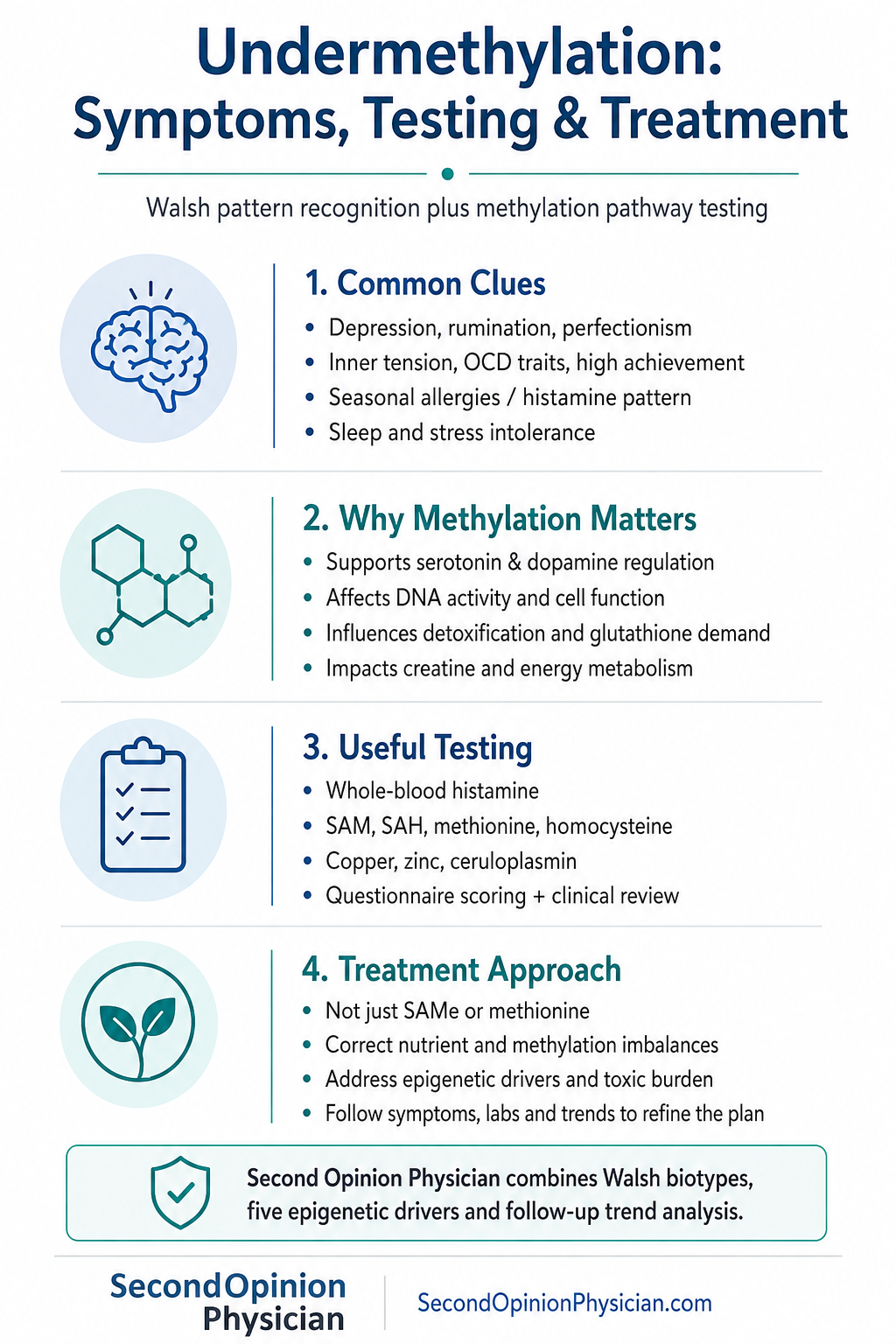
Undermethylation is more than an MTHFR result or a recommendation to take methyl donors. It is a functional pattern that may involve neurotransmitter regulation, DNA methylation, enzyme activity, histamine handling, creatine synthesis, cellular energy, antioxidant defense and detoxification. Second Opinion Physician evaluates the classic Walsh pattern together with the biochemical factors that may be limiting methylation.
Undermethylation Symptoms: Mood, Behavior, Histamine and Treatment Clues
Dr. William Walsh developed the biotype framework by identifying recurring clusters of symptoms, physical traits, family patterns, medication responses and laboratory abnormalities in patients with mood and behavior disorders. In the Walsh model, undermethylation is commonly associated with lower effective serotonin and dopamine activity and a recognizable combination of psychological and physical traits.
Mood and cognition
Persistent depression, inner tension, rumination, obsessive or perfectionistic thinking, rigid standards and chronic dissatisfaction.
Drive and behavior
High achievement, persistence, competitiveness, strong will, high standards, over-responsibility and intense focus in some patients.
Histamine and physical clues
Seasonal allergies, histamine-type symptoms, headaches, sleep disturbance and other physical traits may accompany the pattern.
Medication response
Activation, flattening, poor response or unusual sensitivity to psychiatric medications or folate-heavy protocols can be clinically informative.
Family pattern
Depression, OCD traits, high achievement, addiction patterns, allergies and related behavioral features may cluster in families.
Overlap matters
Copper overload, pyroluria, toxic burden, mitochondrial stress, gut dysfunction, hormones and sleep disorders may mimic or amplify the same symptoms.
Why Methylation Matters for Mood, Behavior, DNA and Detoxification
Methylation is a core cellular process. Methyl groups are used in DNA and histone regulation, neurotransmitter-related signaling, phospholipid metabolism, enzyme reactions, creatine synthesis and many other biochemical functions. The methylation cycle also intersects with homocysteine, transsulfuration and glutathione production.
Neurotransmitter regulation
Within the Walsh model, methylation status is clinically relevant to serotonin and dopamine transporter expression and neurotransmitter reuptake. This helps explain why methylation patterns are considered in depression, OCD, anxiety, irritability and other mood or behavior disorders.
DNA, enzymes, glutathione and toxic burden
Methylation intersects with gene regulation, enzyme function and antioxidant pathways. When inflammation, environmental exposure or oxidative stress increases glutathione demand, more homocysteine may move toward transsulfuration rather than remethylation.
The Five Walsh Biotypes and Where Undermethylation Fits
The Walsh Approach recognizes that patients with the same psychiatric diagnosis may have different biochemical patterns. The five commonly discussed Walsh biotypes are undermethylation, overmethylation, copper overload, pyroluria and toxic overload. Their symptoms overlap, but the biochemical priorities and nutrient strategies can differ substantially.
Undermethylation
Often associated with high-histamine traits, rumination, perfectionism, high achievement and persistent depression.
Overmethylation
Often associated with low histamine, sensory or chemical sensitivity and a different neurotransmitter profile.
Copper Overload
May contribute to anxiety, panic, irritability, insomnia and norepinephrine-related activation.
Pyroluria
Associated in the Walsh model with stress intolerance and increased zinc/B6 requirements.
Toxic Overload
Represents toxic, oxidative or clearance burdens that may interfere with biochemical function and treatment response.
The Methylation Pathway: Where the Major Bottlenecks Can Occur
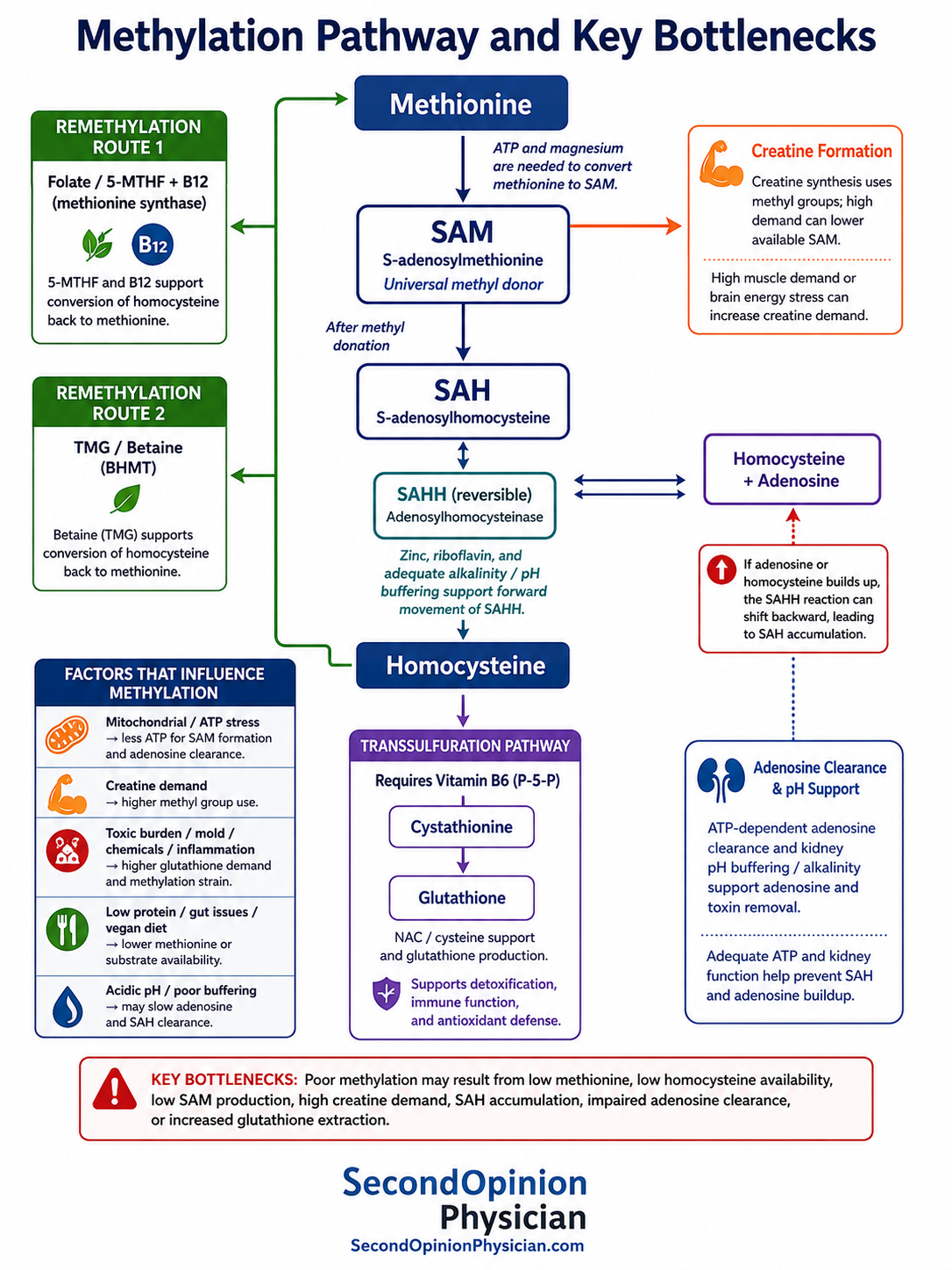
The pathway is best understood as a cycle rather than a single “methylation gene.” Homocysteine can be remethylated to methionine through two principal routes. Methionine then requires cellular energy to form SAM. After SAM donates a methyl group, it becomes SAH. SAH is linked reversibly through SAH hydrolase to homocysteine and adenosine, while homocysteine can either return toward methionine or move into transsulfuration toward cysteine and glutathione.
Remethylation Route 1
Homocysteine → methionine through methionine synthase. Folate in the 5-MTHF pathway supplies the methyl group and vitamin B12 is required for the methionine synthase reaction.
Remethylation Route 2
Homocysteine → methionine through the BHMT pathway using betaine/TMG as a methyl donor. This creates a second route back toward methionine independent of the folate/B12 reaction.
Methionine → SAM
Methionine is converted to SAM through an ATP-dependent reaction. Magnesium participates in ATP-dependent cellular chemistry, while riboflavin supports multiple flavin-dependent reactions elsewhere in one-carbon metabolism.
SAM → SAH
SAM donates methyl groups for cellular reactions and becomes SAH. When SAH accumulates, it can inhibit methyltransferase reactions and reduce effective methylation.
SAH ⇄ Homocysteine + Adenosine
SAH hydrolase is reversible. Efficient forward movement depends on removal or utilization of its products—particularly adenosine and homocysteine—so product accumulation can favor SAH buildup.
Homocysteine → Glutathione
Homocysteine can enter transsulfuration toward cystathionine and cysteine, supporting glutathione production. Vitamin B6/P-5-P is an important cofactor in this pathway, while NAC can provide cysteine substrate support.
Methylation Testing Beyond MTHFR: Histamine, SAM, SAH, Homocysteine and Methionine
MTHFR variants can influence folate metabolism, but they do not directly measure current methylation function. A functional assessment looks at the pathway itself: substrate availability, SAM production, SAH inhibition, homocysteine balance, remethylation, transsulfuration and the biochemical pressures that may be changing demand.
| Marker | What it helps clarify | Why it may change treatment |
|---|---|---|
| Whole-blood histamine | Classic indirect Walsh marker used to support an undermethylation or overmethylation pattern. | Useful as part of a broader biotype screen, especially when combined with copper, zinc, pyrroles and symptoms. |
| Methionine | Substrate available for SAM production. | Low protein intake, poor digestion/absorption or increased metabolic demand may reduce availability. |
| SAM | Primary methyl donor used in many methyltransferase reactions. | Low SAM may reflect substrate limitation, impaired ATP-dependent production or increased utilization. |
| SAH | Product of methylation reactions and an important inhibitor of methyltransferases when elevated. | High SAH may indicate that simply adding more methyl donors is not the first problem to solve. |
| Homocysteine | Branch point between remethylation and transsulfuration. | Low or high values change interpretation of substrate availability, B-vitamin needs and glutathione demand. |
| Adenosine | Product linked to the reversible SAHH reaction. | In the SOP/Walsh interpretation, impaired adenosine handling may contribute to unfavorable SAH dynamics and therefore alter the treatment sequence. |
Undermethylation Treatment Is Not Simply SAMe or Methionine
A low-methylation pattern does not automatically mean that more methionine or SAMe is the correct first step. Treatment depends on where the pathway is limited and which competing demands are most important in the individual patient.
Low methionine substrate
Low-protein intake, vegan or low-animal-protein diets, poor digestion or absorption, and other nutritional limitations may reduce methionine availability.
Homocysteine redirected toward glutathione
When oxidative stress, inflammation or toxic exposure increases glutathione demand, more homocysteine may move toward transsulfuration rather than remethylation back to methionine.
Inadequate ATP for SAM formation
Methionine must be activated to SAM in an ATP-dependent step. Mitochondrial stress and poor cellular energy therefore become relevant to methylation capacity.
High creatine demand
Endogenous creatine synthesis consumes methyl groups. High muscle activity, recovery demand or sustained brain-energy demand may increase the methylation burden.
SAH accumulation
If SAH rises, methyltransferase activity can be inhibited. In that situation the priority may be improving pathway flow and product handling rather than simply increasing methyl donors.
Copper, zinc, pyrroles and cofactors
Mineral imbalance, B6/P-5-P status, B12, folate handling, magnesium, riboflavin and other cofactors can change the appropriate order and intensity of treatment.
Five Epigenetic Drivers of Undermethylation Guide a More Specific Treatment Plan
Second Opinion Physician expands the classic Walsh model by scoring five functional drivers that may create or reinforce impaired methylation. This helps explain why two patients with similar undermethylation symptoms can require a different treatment sequence.
Toxin Exposure
Mold, metals, pesticides, solvents and other exposures can increase oxidative stress, detoxification work and glutathione demand.
Mitochondrial Stress
Reduced ATP can limit energy-dependent SAM production and may impair other energy-requiring clearance processes.
Creatine Demand
Creatine synthesis consumes methyl groups. Greater brain or muscle demand can increase use of available SAM.
Methylation Demand
Inflammation, infection, medications, tissue repair, stress and detoxification can increase methyl-group utilization.
Acidic pH & Impaired Clearance
Within the SOP model, poor buffering, kidney stress and impaired adenosine handling are considered possible contributors to unfavorable SAH dynamics and toxin clearance.
Creatine, ATP, Glutathione and Adenosine: Four Treatment-Relevant Pressure Points
Methyl groups can be diverted toward creatine synthesis
Creatine is important for rapid energy buffering in brain and muscle. Because endogenous creatine synthesis consumes methyl groups, higher demand may reduce methyl capacity available for other functions.
Cellular energy is needed upstream
The conversion of methionine to SAM requires ATP. This is why mitochondrial stress, poor exercise recovery and low cellular energy are included in the epigenetic-driver assessment.
Oxidative stress can pull sulfur toward defense
Homocysteine can move through transsulfuration toward cysteine and glutathione. High oxidative stress, inflammation, mold or chemical exposure may increase demand on this branch.
Product clearance can influence pathway direction
SAH hydrolase is reversible. In the SOP/Walsh interpretation, buildup of adenosine or homocysteine can favor SAH accumulation. Adenosine handling includes ATP-dependent pathways, while hydration, kidney function and acid-base balance are considered clinically when evaluating clearance.
AI-Supported Undermethylation Assessment: Calculated Scores, Correlated Labs and Trend Analysis
WalshDoc uses AI-assisted computation as an analytical layer rather than as the clinician. Weighted questionnaire responses are calculated into pattern scores, clinical history is correlated with signs and symptoms, laboratory findings are compared with the predicted biotype, and each section is reviewed and commented on by the physician.
Primary and supporting Walsh indicators contribute different amounts to the biotype score.
Medication response, diet, family pattern, physical traits and health history modify the working interpretation.
Whole-blood histamine, copper, zinc, ceruloplasmin, pyrroles and methylation markers support, weaken or redirect the working hypothesis.
Questionnaire, labs, epigenetic drivers and contributing factors are reviewed and commented on by the physician.
Supplement, diet and lifestyle plans are followed by repeat symptoms and labs so the protocol can be refined.
Undermethylation Treatment and Follow-Up: Measure the Response, Then Adjust the Plan
The initial supplement plan should be treated as a working therapeutic strategy rather than a permanent prescription. Follow-up compares current symptoms, prior scores, repeat laboratory markers, supplement doses, medication changes, diet and lifestyle factors.
Clinical trend
- Which symptoms improved, resolved, worsened or appeared newly
- Whether the dominant biotype score changed
- Whether mood, sleep, energy, cognition and stress tolerance are moving together
- Whether adverse effects suggest excessive dosage or incorrect sequencing
Laboratory and supplement trend
- Repeat copper, zinc, ceruloplasmin, homocysteine and other core markers
- Repeat SAM, SAH, methionine and related methylation markers when indicated
- Compare supplement dose changes with symptom and laboratory movement
- Adjust treatment priorities when the expected response does not occur
Undermethylation, Detoxification and Chronic Inflammation
Methylation and transsulfuration intersect with antioxidant defense and glutathione production. When chemical exposure, infection, chronic inflammation or oxidative stress increases glutathione demand, the methylation pathway may be affected at several points. This is one reason Second Opinion Physician evaluates toxic burden and inflammatory stress alongside methylation rather than treating them as unrelated problems.
Autism and neurodevelopmental concerns
In patients with autism or developmental concerns, oxidative stress, mitochondrial dysfunction, toxic exposure, nutrient depletion and glutathione demand may coexist with methylation abnormalities. These relationships are assessed individually rather than assuming one universal mechanism.
Chronic inflammation and environmental exposure
Persistent inflammation, medication burden, chemical exposure, impaired sleep and metabolic stress can increase antioxidant and methylation demand. Correcting those pressures may be as important as directly supplying methyl donors.
Start With the Pattern, Confirm the Biochemistry, Then Treat the Limiting Factors
For patients with undermethylation symptoms, the most useful starting point is a structured assessment rather than guessing from MTHFR status or trying SAMe, methionine or methylfolate in isolation. WalshDoc combines weighted symptoms, clinical history, targeted labs, physician interpretation and follow-up trends to build and refine the treatment plan.
Undermethylation Symptoms, Testing and Treatment FAQs
What are common undermethylation symptoms?
In the Walsh framework, common clues include persistent low mood, inner tension, rumination, perfectionism, obsessive traits, high achievement drive, seasonal allergies, histamine-related symptoms, sleep disturbance and characteristic treatment responses. Symptoms alone do not confirm the pattern.
What is the best test for undermethylation?
Whole-blood histamine is commonly used as an indirect Walsh marker, while a broader biotype panel may include copper, zinc, ceruloplasmin, pyrroles and homocysteine. Direct methylation testing with SAM, SAH, methionine and related markers can provide deeper functional information when the clinical picture is complex.
Is undermethylation the same as having an MTHFR variant?
No. MTHFR describes genetic variation affecting folate metabolism. It does not directly measure current SAM production, SAH inhibition, histamine pattern, homocysteine availability, glutathione demand or other functional methylation variables.
Is undermethylation treatment simply SAMe or methionine?
No. Treatment depends on methionine, SAM, SAH, homocysteine, copper, zinc, pyrroles, nutrient status, mitochondrial function, toxic burden, glutathione demand and treatment tolerance. The correct sequence may differ substantially between patients.
How can creatine affect methylation?
The body uses methyl groups to synthesize creatine. Higher creatine demand can therefore increase methyl-group utilization. Supplemental creatine may reduce endogenous synthesis demand in selected patients, but treatment should be individualized.
How does WalshDoc use AI in undermethylation assessment?
AI-assisted computation calculates weighted questionnaire scores, organizes clinical patterns, correlates symptoms with laboratory findings and compares changes over time. Physician review remains responsible for clinical interpretation and treatment planning.
Educational information only. WalshDoc questionnaires and calculated pattern scores do not establish a psychiatric or medical diagnosis. Some pathway interpretations described above reflect the clinical Walsh/SOP framework and should be interpreted alongside conventional biochemistry, laboratory findings and physician judgment. Laboratory and treatment recommendations require individualized physician review. Prescription medications should not be started, stopped or changed without appropriate medical supervision.