
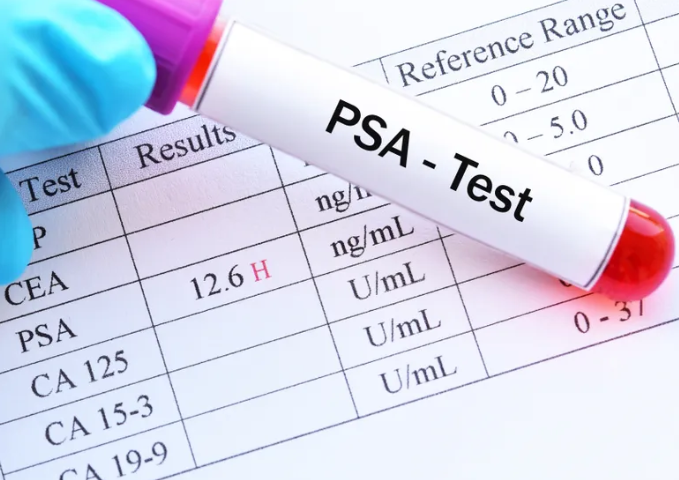
Prostate-Specific Antigen (PSA) Test
The PSA test measures the level of prostate-specific antigen, a protein produced by prostate tissue, in the blood. It is used to assess prostate health and to help evaluate conditions affecting the prostate gland.
What this test evaluates
-
PSA concentration in the blood (ng/mL)
-
Activity and integrity of prostate tissue
Why a PSA test is ordered
-
Screening for prostate cancer risk (age- and risk-dependent)
-
Evaluation of urinary symptoms such as frequency, urgency, weak stream, or nocturia
-
Monitoring known prostate conditions (benign prostatic hyperplasia, prostatitis)
-
Follow-up after prostate cancer treatment or surveillance
How PSA levels are interpreted
-
PSA is not cancer-specific
-
Elevated levels can be seen with:
-
Benign prostatic hyperplasia (BPH)
-
Prostatitis or infection
-
Recent ejaculation
-
Prostate manipulation (exam, catheter, biopsy)
-
Aging
-
-
Persistently rising or significantly elevated PSA may warrant further evaluation
Types of PSA testing
-
Total PSA: standard screening measure
-
Free PSA (percent free PSA): sometimes used when total PSA is borderline to help differentiate benign enlargement from higher-risk patterns
What results may show
-
Low or stable PSA: generally reassuring
-
Mild elevation: often benign, monitored over time
-
Rapid rise or high PSA: may prompt imaging, repeat testing, or urology referral
Specimen requirements
-
Blood draw
-
Avoid ejaculation and vigorous cycling for 24–48 hours before testing if possible
-
Inform the clinician of recent infections, procedures, or medications
Important notes
-
PSA trends over time are often more informative than a single value
-
Interpretation should consider age, prostate size, symptoms, and medical history
After ordering, you will receive a LabCorp requisition with instructions for blood collection at a participating laboratory.
The PSA test is a useful tool for assessing prostate health but is best interpreted in clinical context rather than as a standalone diagnostic.